-
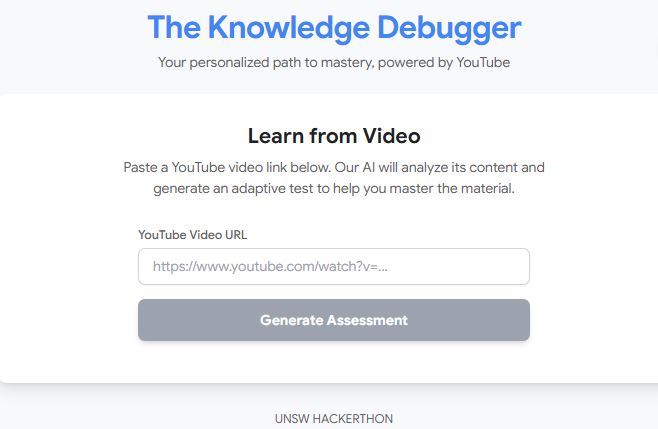
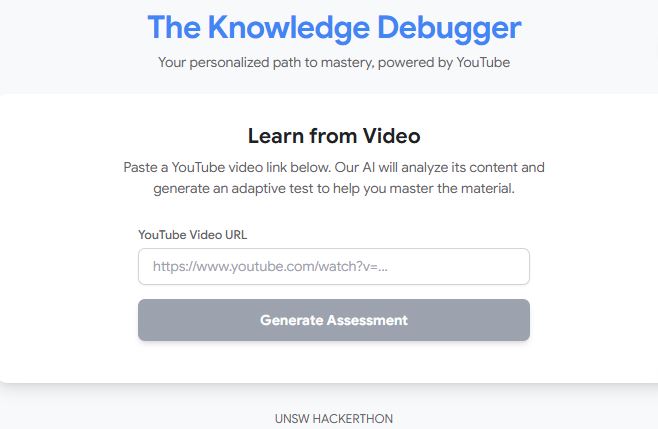
intro
-
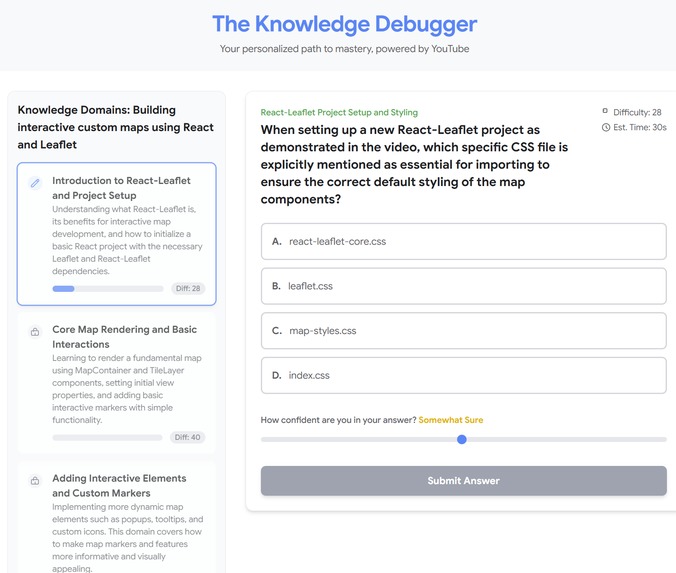
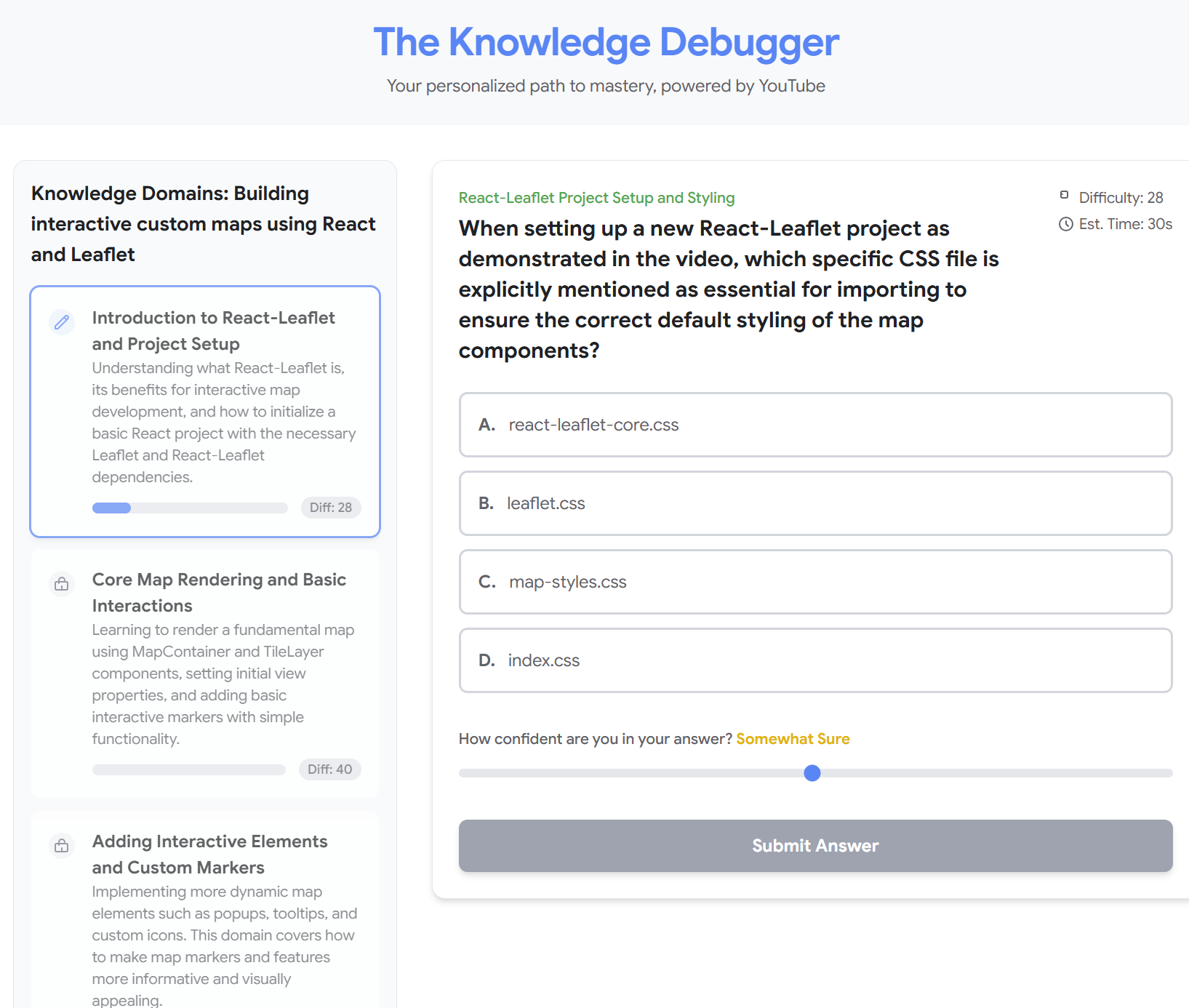
question page
-
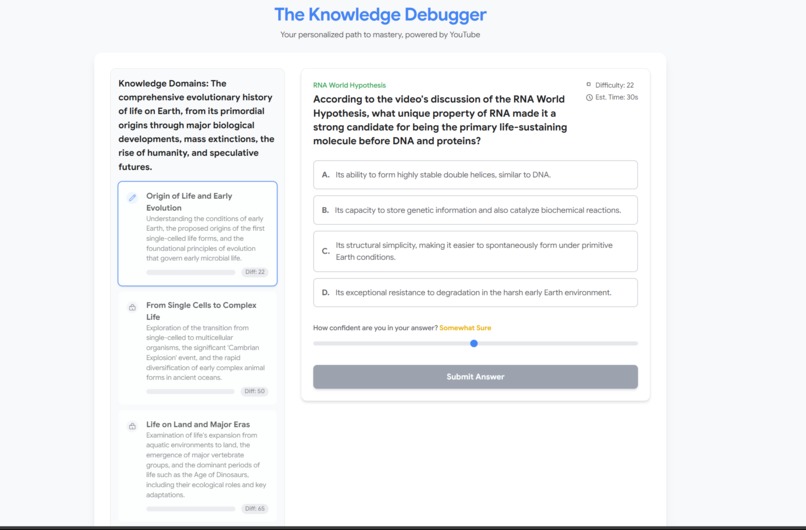
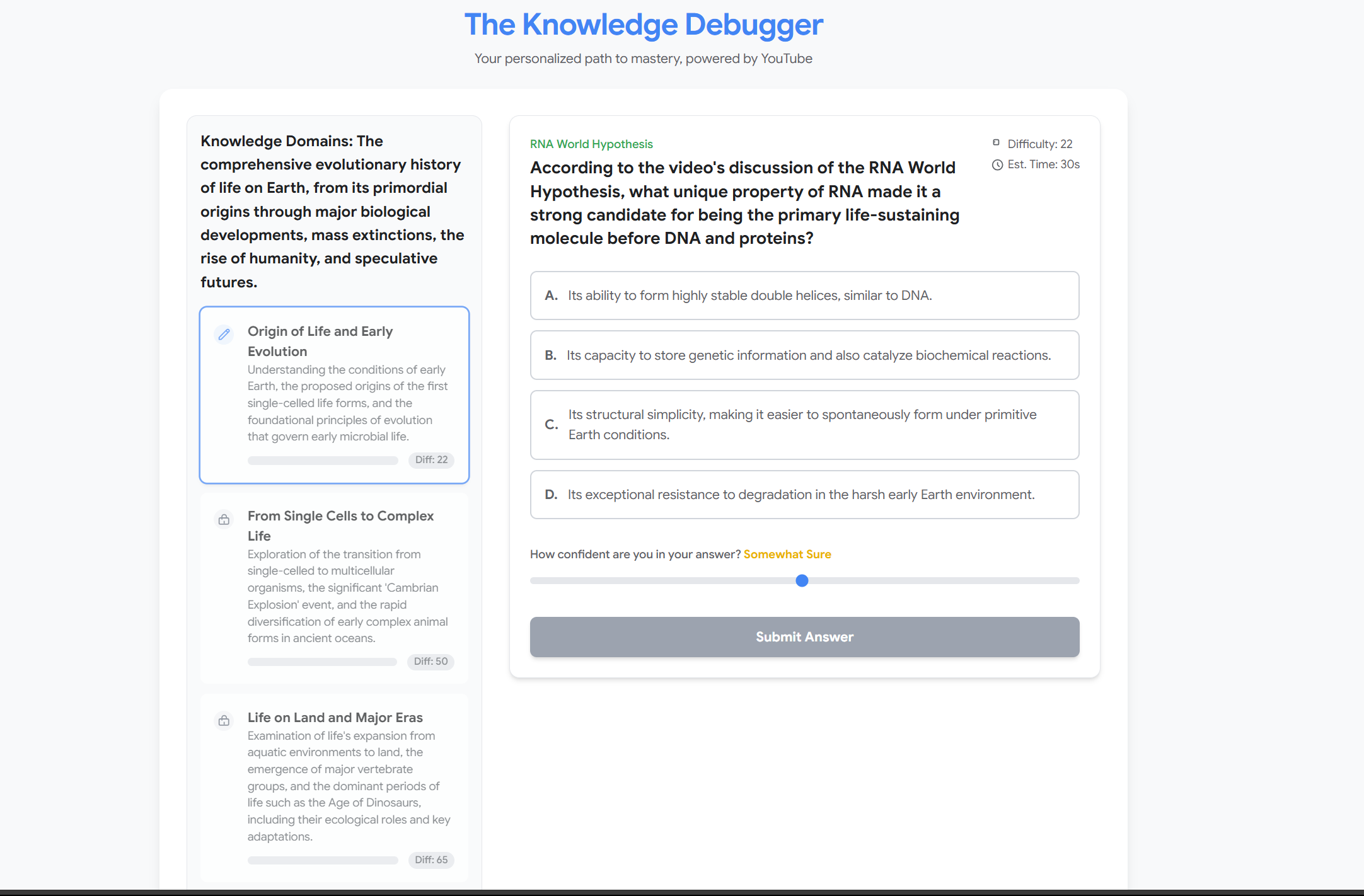
question
-
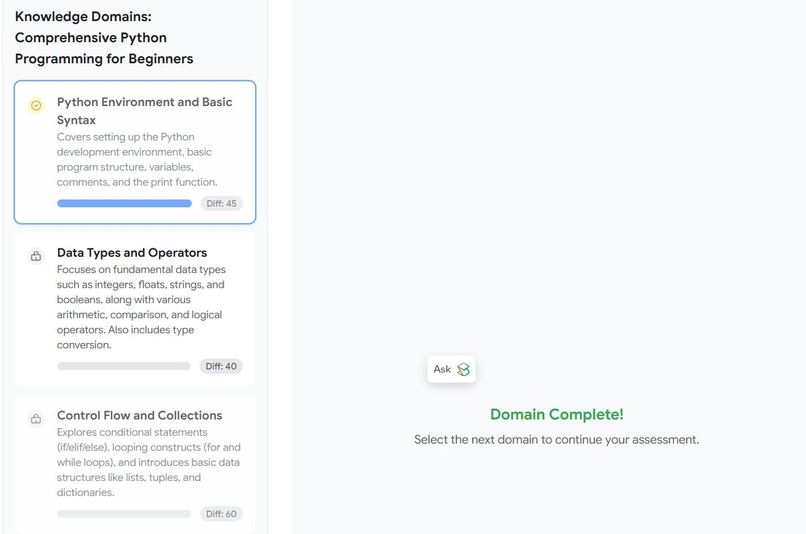
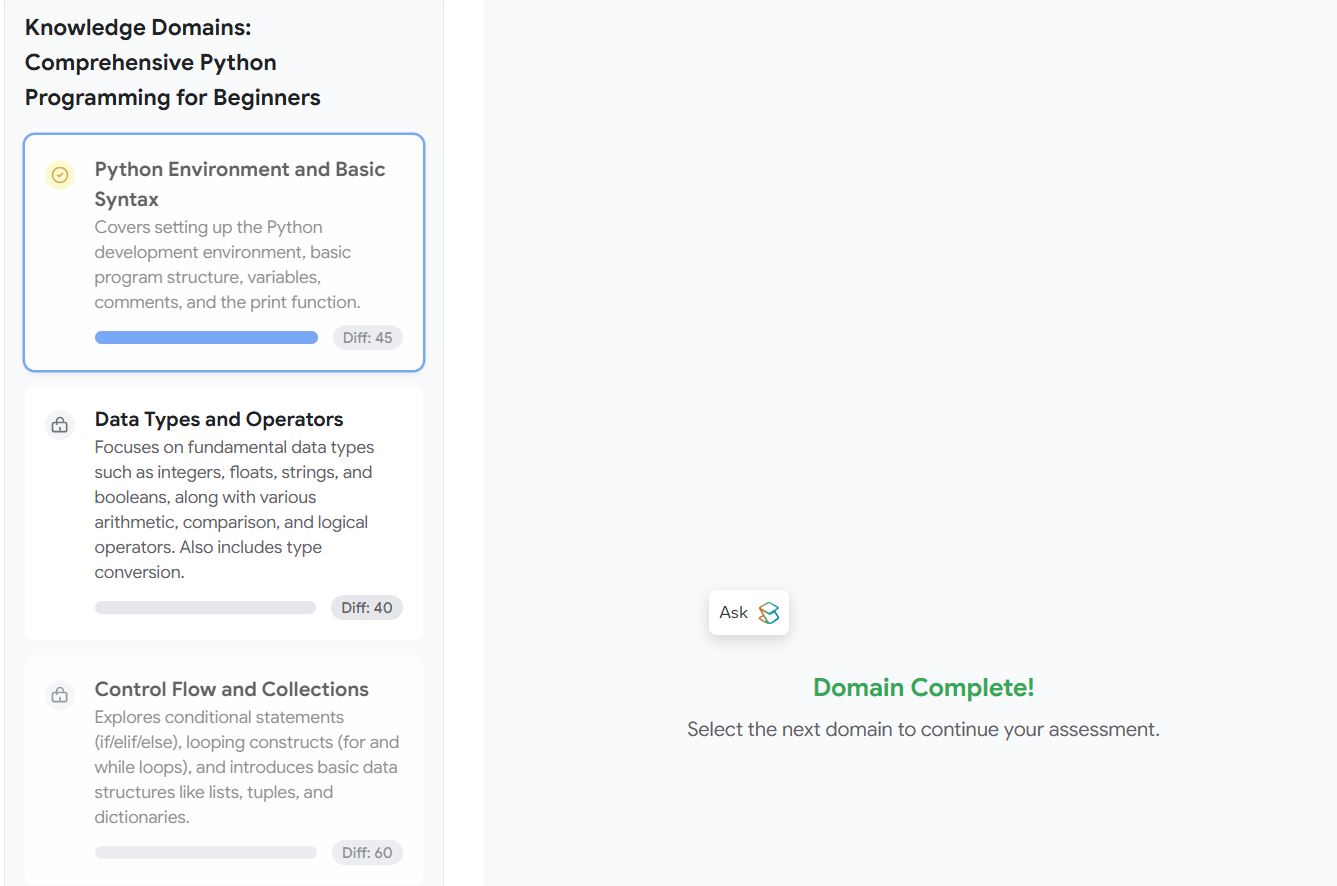
level pass
My Project: The Knowledge Debugger
Inspiration: From Flashcards to "Bug-Finding"
My journey with this project began with a simple observation of tools I use daily, like Anki and Duolingo. These applications are incredibly effective for memorizing vocabulary because they are built on principles of active recall and spaced repetition. They don't just test you; they intelligently adapt to your personal learning curve.
This led to a simple yet powerful question: Why can't we apply this same principle of targeted, adaptive testing not just to vocabulary, but to the mastery of complex problems and concepts?
Traditional tests give you a score, a blunt instrument that tells you what you got wrong, but rarely why. I envisioned a tool that acts less like a test and more like a debugger for your knowledge. An interactive system that could intelligently probe your understanding, pinpoint the specific "bugs" in your mental models, and help you fix them efficiently. The goal was to transform the passive, often frustrating experience of assessment into an engaging, game-like journey of self-discovery.
What I Learned: A Journey into AI and Pedagogy
This project was a deep dive into both technology and the art of learning itself.
Full-Stack Architecture: I learned to orchestrate a complete system, from a dynamic React frontend that prioritizes user experience to a robust Python (FastAPI) backend that handles the heavy lifting. This involved designing a clean RESTful API to ensure seamless communication between the two.
Advanced AI Prompt Engineering: Moving beyond simple API calls, I learned to engineer highly-structured prompts that compel the AI to respond with pure, predictable JSON. This was crucial for dynamically generating questions and analyses without breaking the application.
The Nuance of Adaptive Algorithms: I discovered that a truly adaptive system needs to consider more than just right or wrong answers. I had to model and implement a multi-dimensional algorithm that weighs several factors. The core idea can be simplified by the following relation:
$D_{next} = D_{current} + \Delta_{perf} + \Delta_{conf} + \Delta_{time}$
Where:
- $D_{next}$ is the difficulty of the next question.
- $D_{current}$ is the current difficulty level.
- $\Delta_{perf}$ is the adjustment based on performance (correct/incorrect streaks).
- $\Delta_{conf}$ is the adjustment based on the user's calibrated confidence. A correct answer with low confidence is treated differently than one with high confidence.
- $\Delta_{time}$ is the adjustment based on response time relative to the question's complexity.
The Importance of Pedagogy: I learned that the feeling of learning is as important as the learning itself. The system needed to be encouraging, framing mistakes not as failures but as valuable data points for the "debugger." This influenced everything from the UI design to the tone of the feedback.
How I Built It: Architecting an Intelligent System
The project is built on a modular, dual-flow architecture designed for scalability and clarity.
The Backend (The Brain):
- Built with Python and FastAPI for its speed and automatic API documentation.
- AI Service Module: A dedicated module that handles all communication with the OpenAI API. It contains the master prompts for generating assessment domains, questions, and final summaries.
- Adaptive Engine Module: This is the core of the system. It implements the
ImprovedAdaptiveDifficultyEngineandEnhancedConfidenceEngineclasses from my design. It takes user response data (correctness, time, confidence) and computes the next difficulty level. - API Layer: Exposes clear endpoints like
/assessment/start,/assessment/submit, and/assessment/summaryfor the frontend to consume.
The Frontend (The Experience):
- Developed with React and managed with Redux Toolkit for predictable state management across the application.
- Component-Based UI: The interface is broken down into logical components:
AssessmentSetupfor starting a new test,LevelFlowViewfor navigating between knowledge domains, and theQuestionFlowViewfor the core interactive assessment. - API Service: A dedicated service in the frontend handles all
axiosrequests, centralizing API logic and error handling.
The Workflow:
- A user starts by defining a topic (e.g., "Python Programming").
- The backend AI service generates a set of relevant knowledge domains (e.g., "Basic Syntax," "Data Structures," "OOP").
- The user enters a domain, and the
QuestionFlowbegins. The backend generates the first question at a baseline difficulty. - With each answer, the frontend sends the user's choice and confidence level to the backend.
- The backend's adaptive engine processes this, updates the user's profile for that domain, and generates a new, appropriately-leveled question.
- This loop continues until the user demonstrates mastery or completes the domain, turning a linear test into a dynamic, responsive conversation.
Challenges & Triumphs
Challenge: AI Reliability. The biggest challenge was forcing the AI to be a reliable backend service. Early on, it would occasionally break the JSON format or provide inconsistent output. This required extensive prompt refinement, adding strict output schemas, and implementing retry logic with error parsing on the backend.
Challenge: Algorithm Tuning. The mathematical model for the adaptive algorithm was a balancing act. Making confidence too influential could allow a confident but incorrect user to stagnate. Making performance the only factor would ignore valuable metadata. I spent significant time running simulations and tweaking the weights ($\alpha, \beta, \gamma$) to find a balance that felt both fair and effective.
Challenge: The User Experience. Hiding all this complexity behind a simple, "game-like" interface was difficult. The goal was an effortless flow, where the user is so engaged in the challenge they don't notice the sophisticated calculations happening in the background. This required careful design of loading states, feedback animations, and transitions.
Triumph: The most rewarding moment was testing the system on a topic I was rusty on. After a few questions, it correctly identified a specific misconception I had. It presented me with a question that targeted that "bug" perfectly, and the explanation in the feedback immediately cleared it up. In that moment, the system wasn't just a project; it was the "Knowledge Debugger" I had set out to build.
Built With
- fastapi
- openai
- python
- react
- tailwind
- typescript

Log in or sign up for Devpost to join the conversation.