-
-
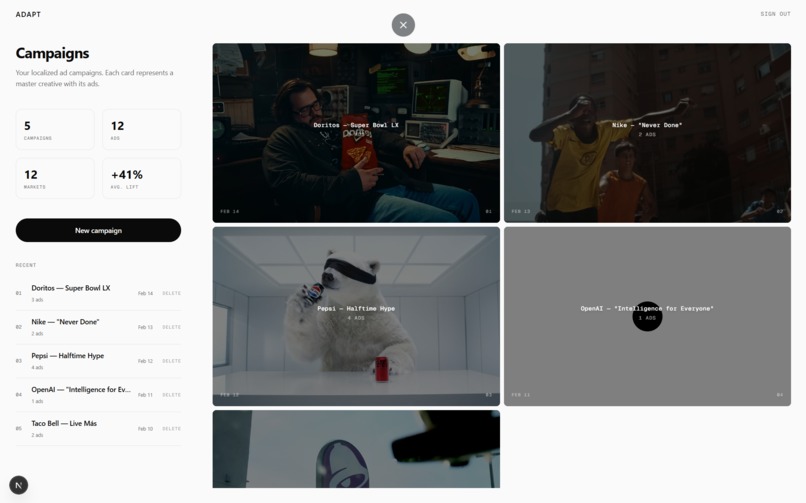
Gallery
-
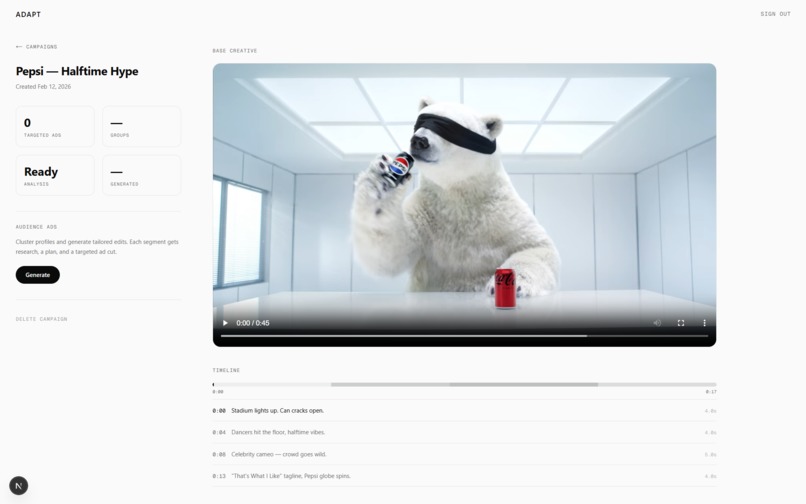
Video Editor
-
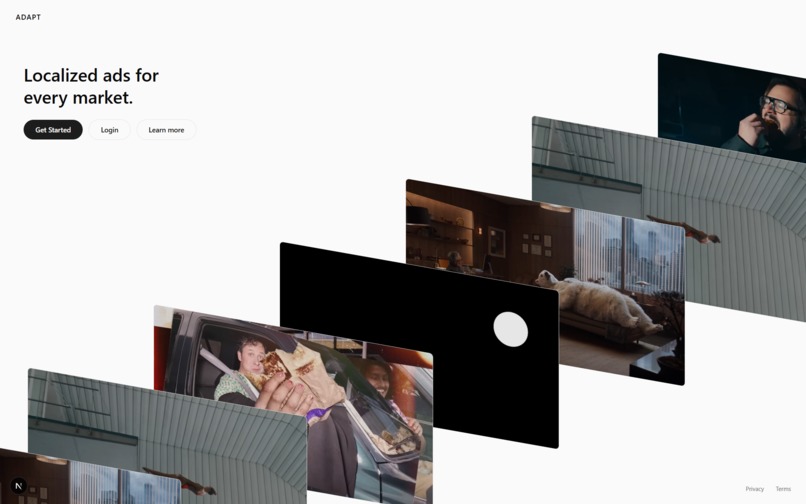
Frontend
Inspiration
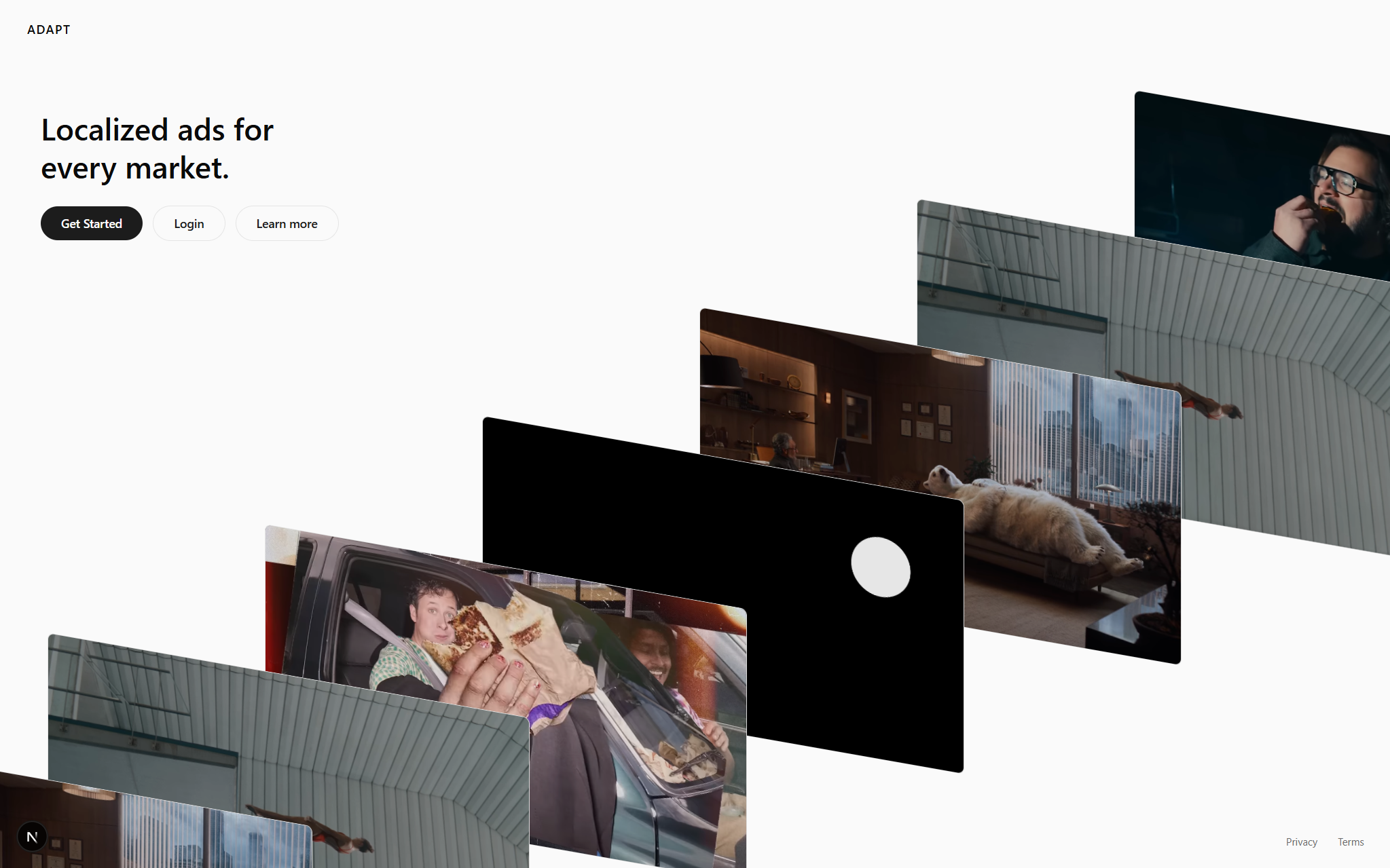
Every brand wants personalized ads, but creating unique creatives for every audience segment is expensive and slow. We watched marketing teams manually re-edit the same video dozens of times, tweaking pacing, color, and captions for different demographics. We thought: what if AI could understand both the video and the audience, and automatically generate targeted variants from a single, manually developed ad?
What it does
ADapt is an AI-powered video ad localization platform. Upload one master video and a CSV of audience profiles, and it:
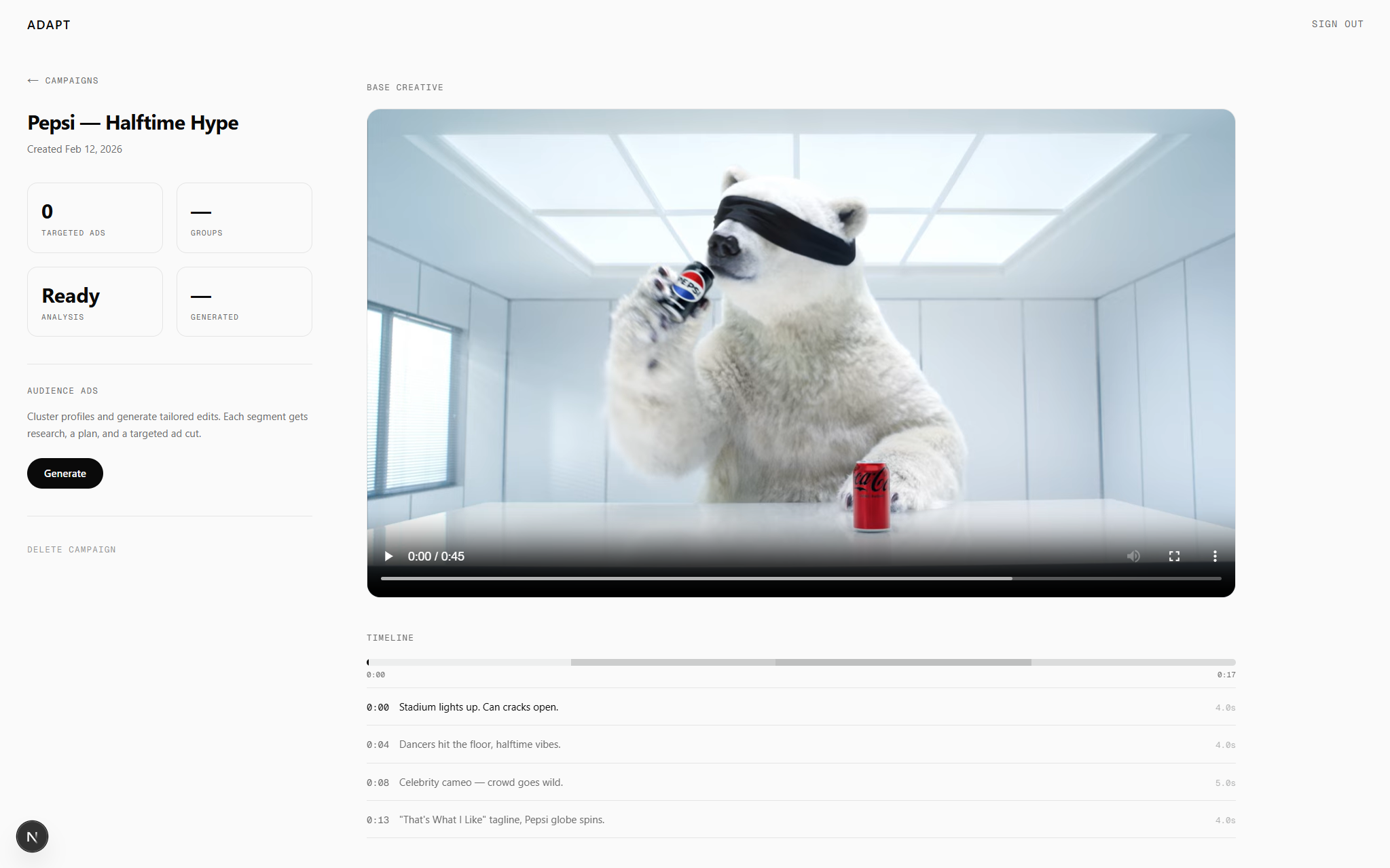
- Analyzes your video by extracting scenes, transcribing audio, and generating per-second action descriptions
- Clusters your audience into meaningful segments using embeddings, visualized on an interactive 3D map
- Researches each segment with real-time market insights via Perplexity Sonar
- Generates targeted variants with segment-specific speed adjustments, color grading, text overlays, vertical reframing, and more, all driven by a constraint-aware AI planner
The result: multiple production-ready ad variants from a single upload, each tailored to a specific audience.
How we built it
- Backend: FastAPI with a multi-agent architecture. An Orchestrator routes requests, a Transform Planner uses GPT with a constraint-checking review loop, a Market Research Agent queries Perplexity Sonar, and a Group Ads Generator coordinates the full pipeline.
- Video Processing: FFmpeg handles speed changes (bounded at ±6%), 7 color grading presets, text overlays with impact-scored phrase placement, film grain, backdrop blur, and vertical reframing.
- Audience Intelligence: Elasticsearch embeddings for clustering with a heuristic fallback, projected into 3D via SVD for interactive visualization.
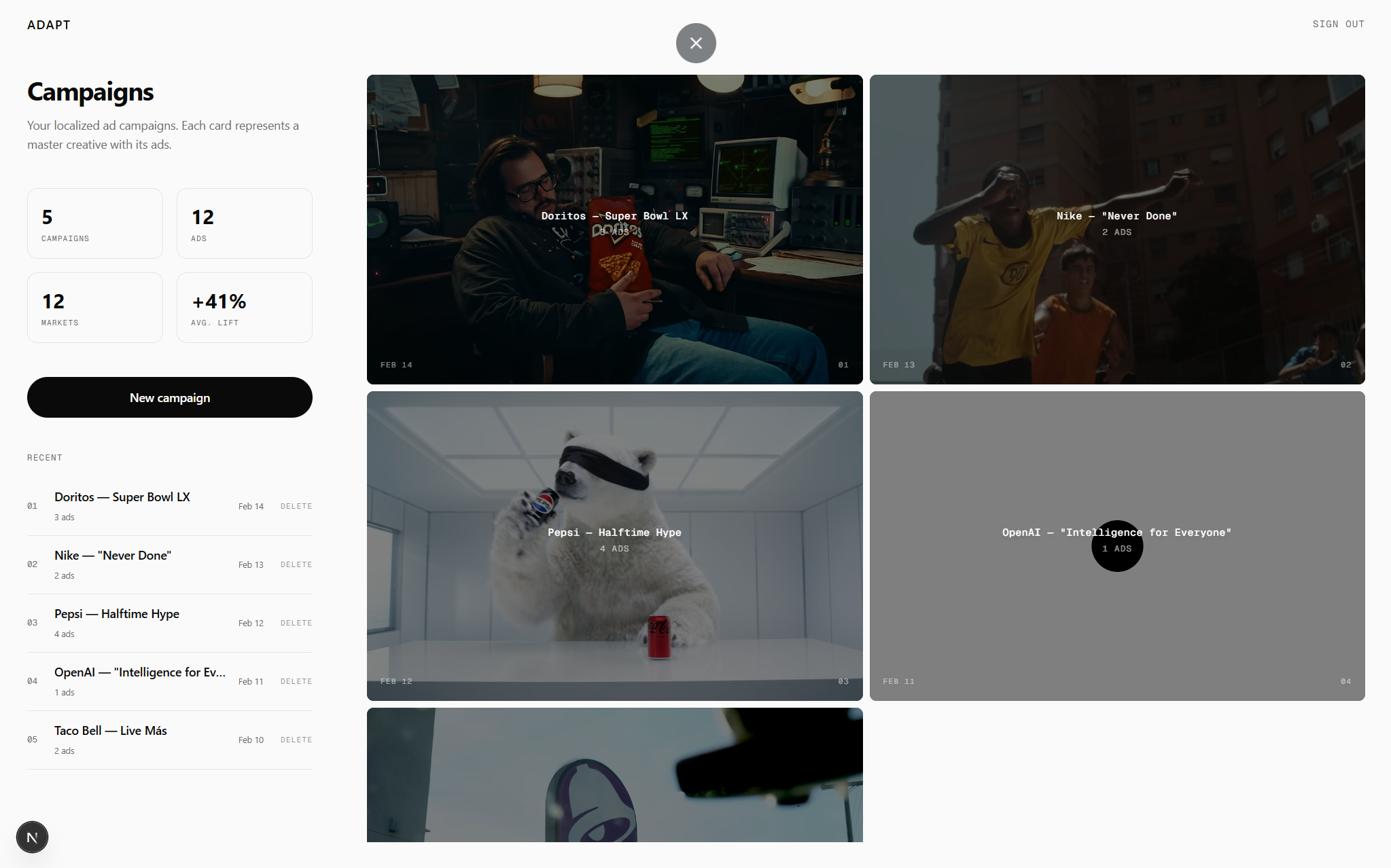
- Frontend: Next.js 16, React 19, Tailwind CSS 4, and TypeScript. Features a campaign dashboard, 3-step upload modal, timeline scrubber, 3D embeddings map, and variant gallery.
- MCP Server: Exposes video editing tools via the Model Context Protocol so external AI agents can use our platform programmatically.
Challenges we ran into
- Getting the LLM to reliably choose the right video transforms. We solved this with a multi-round planner/reviewer loop that enforces explicit constraints over up to 3 revision rounds.
- Deciding where to place text overlays required building an impact scoring algorithm that considers keywords, punctuation, position in the video, and audio vs. visual source.
- Cross-platform font handling with FFmpeg's
drawtextfilter behaves differently across OS, so we built a fallback chain with PIL-based rendering. - Making audience clustering work without Elasticsearch by building a heuristic vectorization fallback from raw profile data.
Accomplishments that we're proud of
- Full end-to-end automation: from a raw video and a CSV to multiple targeted ad variants with zero manual editing.
- A constraint system that produces thoughtful, context-aware edit decisions (moody grades for urban professionals, bright grades for teen audiences).
- An interactive 3D audience visualization that makes segment groupings immediately intuitive.
- MCP integration that makes ADapt composable with any AI agent workflow.
What we learned
- Structured constraint loops beat elaborate prompting for reliable LLM output.
- Small bounded transforms (like ±6% speed) compound into meaningful personalization without jarring artifacts.
- Deterministic randomization (MD5-based stable rolls) is critical for debugging pipelines with many moving parts.
- Robust fallbacks (heuristic clustering, font rendering, hardware acceleration detection) aren't just safety nets, they make the product actually usable across environments.
What's next for ADapt
- Generative transforms: connecting stubbed-out background replacement, object erasure, and text replacement to cloud GPUs.
- A/B testing integration: feeding variant performance data back so ADapt learns which transforms work best per segment.
- Multi-language voice synthesis: re-voicing ads in different languages while preserving tone and cadence.
- Production scale: moving to a production database, adding job queues for parallel processing, and deploying on GPU infrastructure.
Built With
- elasticsearch
- fastapi
- ffmpeg
- graphite
- greylock
- jwt
- model-context-protocol-(mcp)
- next.js
- numpy
- openai-gpt-5
- openai-whisper
- perplexity-sonar-api
- pil
- poke
- python
- react
- runpod
- sqlite
- tailwind-css
- typescript
- visa


Log in or sign up for Devpost to join the conversation.