Inspiration
Most educational systems treat learning as a sequence of questions: answer correctly, move forward; answer incorrectly, try again. We wanted to build something different: an AI learning system that actually adapts to how a learner thinks.
ADAPT was inspired by a simple question: What if an educational AI could identify not just whether an answer is wrong, but what the learner misunderstood, how confident they are, and what challenge would help them learn next?
That led us to build ADAPT: AI that teaches through adaptive challenges, rather than simply generating more content.
What it does
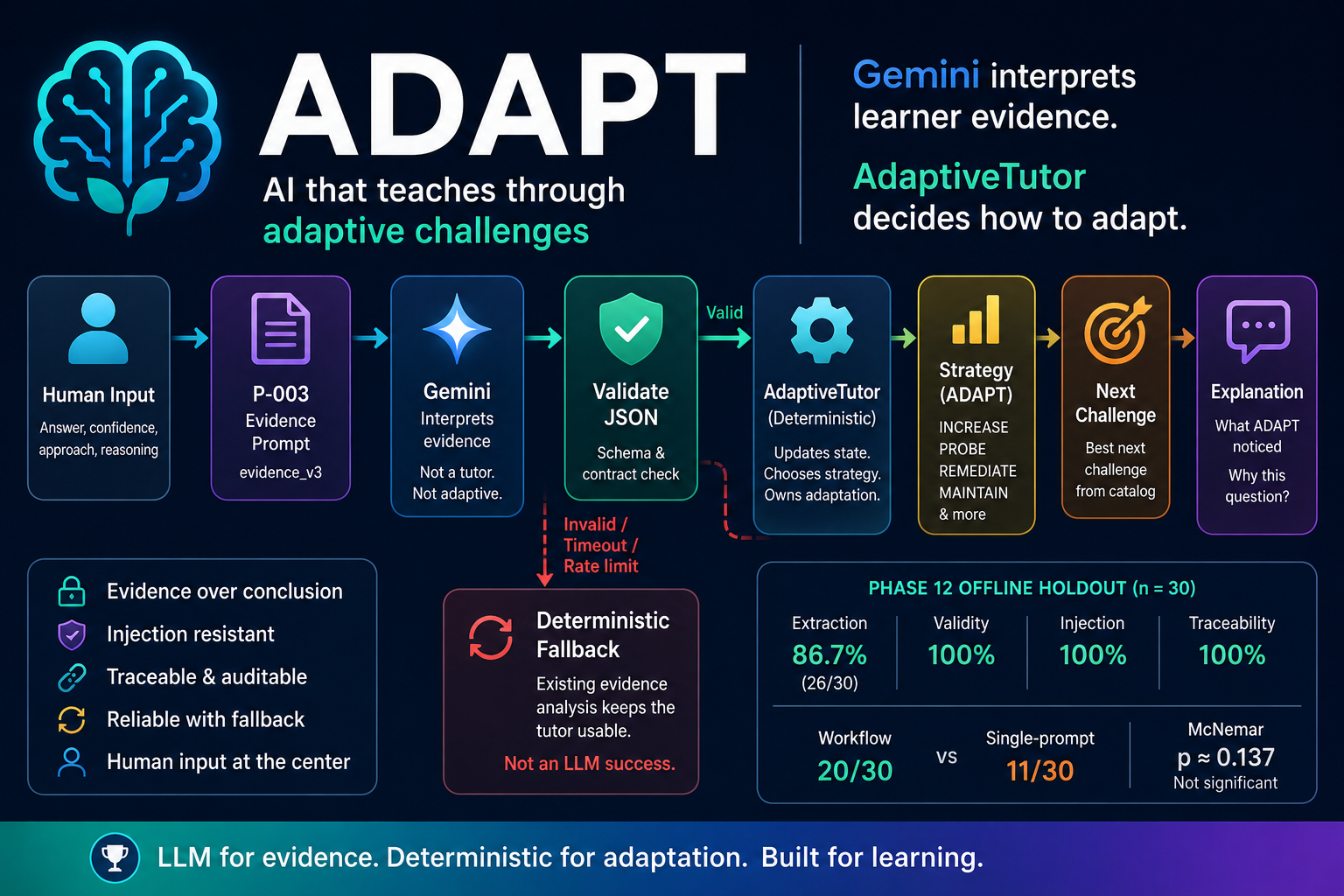
ADAPT continuously observes a learner's responses, reasoning, confidence, and demonstrated understanding. It then uses that evidence to determine what the learner should encounter next.
The core loop is:
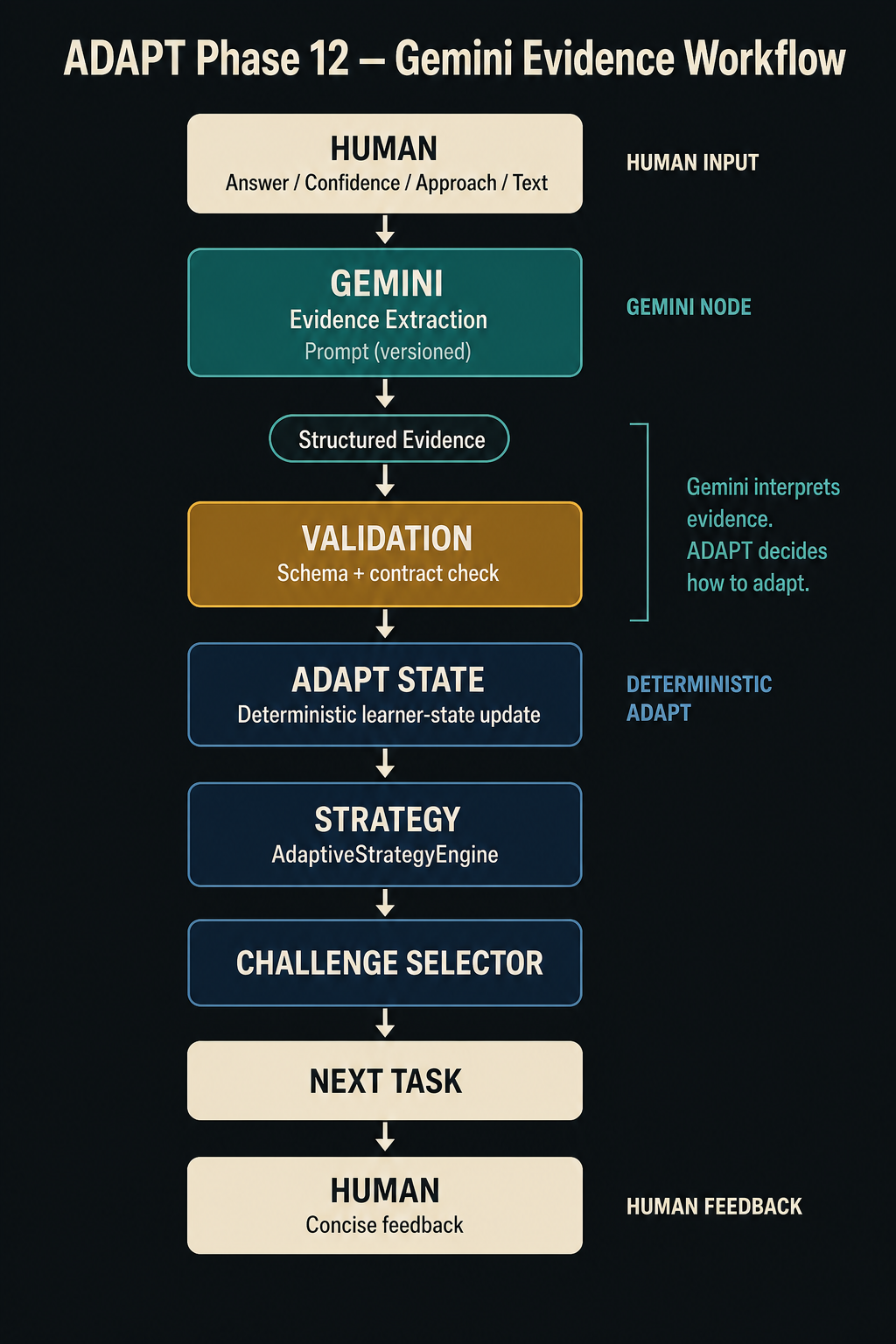
Challenge → Response → Evidence → Learner State → Adaptation → Next Challenge
Instead of only asking whether an answer was correct, ADAPT considers why the learner answered the way they did. It can recognize patterns such as misconceptions, uncertainty, partial understanding, and demonstrated mastery.
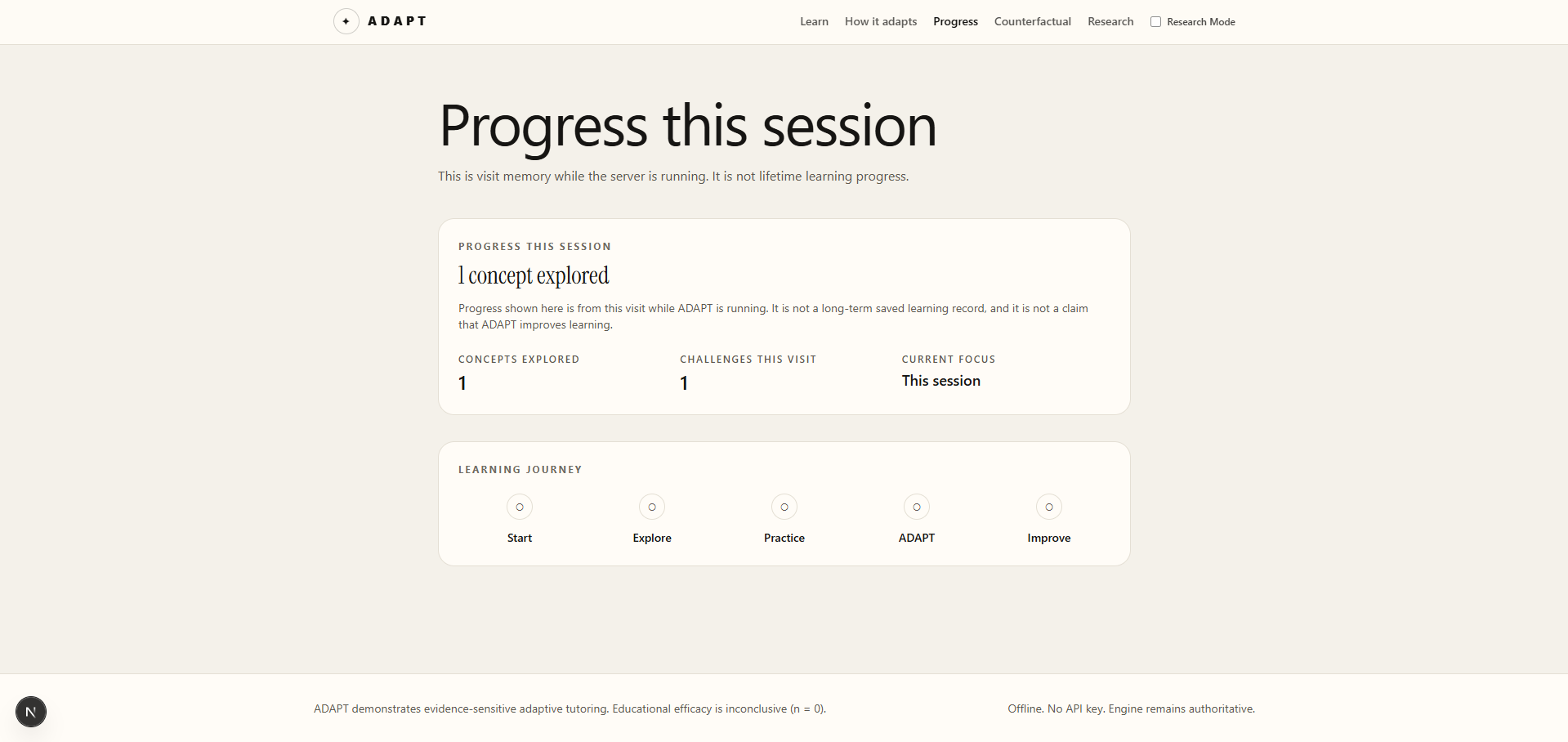
The learner can also see what ADAPT noticed and why a particular question was selected, making the adaptation process transparent rather than a black box.
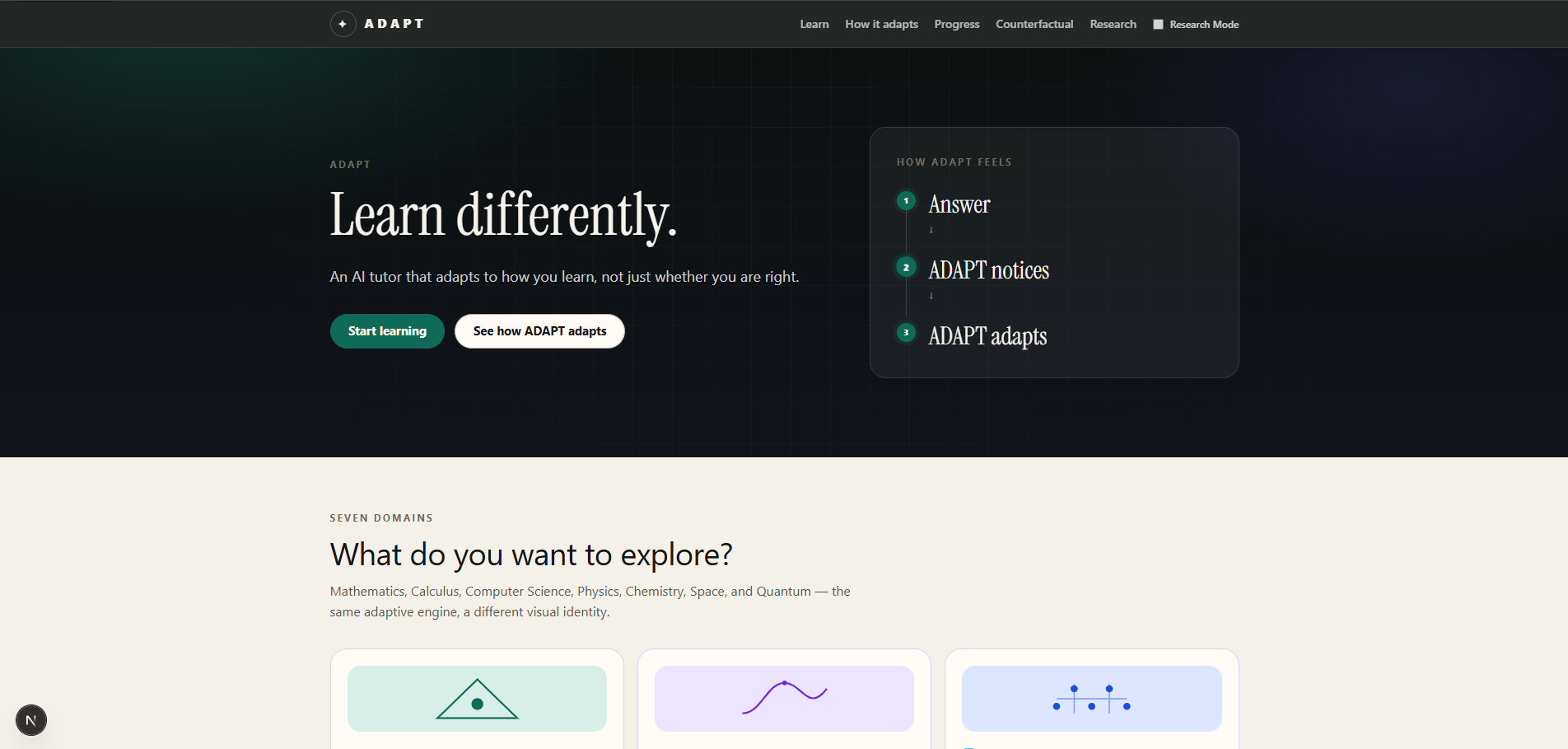
We built the system across multiple domains, including mathematics, calculus, computer science, physics, chemistry, space, and quantum concepts.
How we built it
We started by building a deterministic adaptive-learning engine and establishing a rigorous evaluation framework before building the polished product around it.
The system evolved through multiple phases:
- A deterministic core for evaluating learner evidence and selecting appropriate challenges.
- Benchmark and generalization testing across dozens of scenarios.
- An adaptive strategy layer connecting learner state to challenge selection.
- A complete closed-loop learning engine.
- Counterfactual evaluation to test whether changing learner evidence actually changes the system's decisions.
- Multi-domain content and misconception modeling.
- A polished Next.js learner experience.
- An evaluation and demonstration layer designed to make ADAPT's reasoning visible.
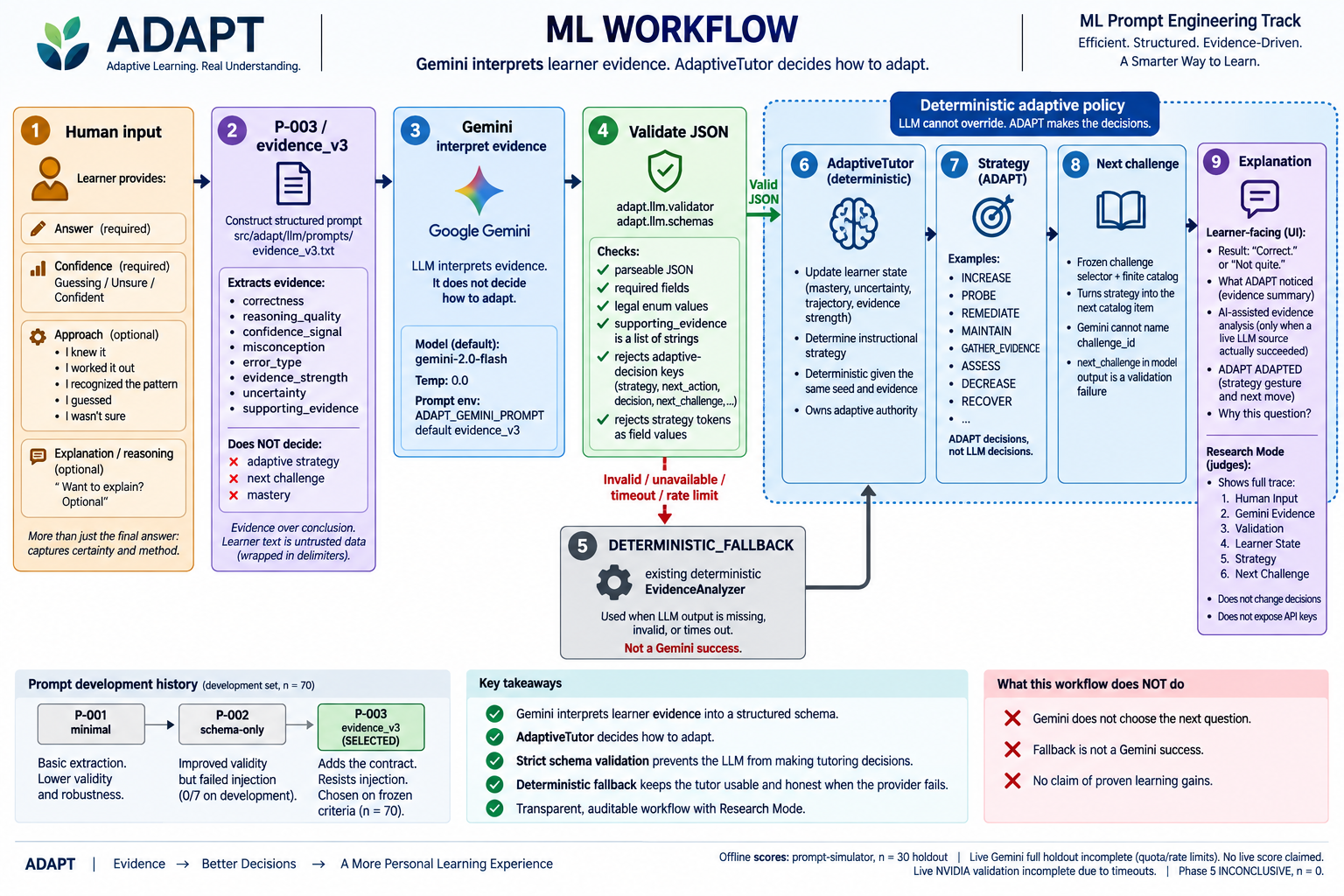
For the hackathon, our focus was particularly on the ML Prompt Engineering aspect: designing the AI workflow so that learner evidence can be transformed into meaningful, reliable adaptations rather than simply generating generic educational responses.
Challenges we ran into
One of our biggest challenges was avoiding the temptation to equate "AI" with simply calling an LLM and generating a question.
We needed ADAPT's behavior to be measurable, reproducible, and explainable. That meant separating the adaptive reasoning from the presentation layer and creating tests that could verify whether the system actually adapted appropriately.
Another challenge was generalization. It was relatively easy to make the system work for examples we designed ourselves. The harder problem was ensuring that the same principles continued to work when we introduced new scenarios, domains, concepts, and learner states.
We also had to balance sophisticated adaptation with a learner experience that remained simple. The complexity should exist inside the system - not overwhelm the student.
Accomplishments that we're proud of
We're proud that ADAPT became more than a prototype UI. We built and evaluated an actual adaptive-learning system with a measurable decision-making pipeline.
Our evaluation work included:
- 51/51 scenarios passing the initial appropriateness benchmark.
- 92.9% performance on the development generalization set.
- 94.4% performance on the holdout generalization set.
- A complete adaptive loop connecting learner evidence to future challenge selection.
- Hundreds of automated tests protecting the core behavior.
- A multi-domain content library spanning 7 domains, 81 concepts, and 248 challenges.
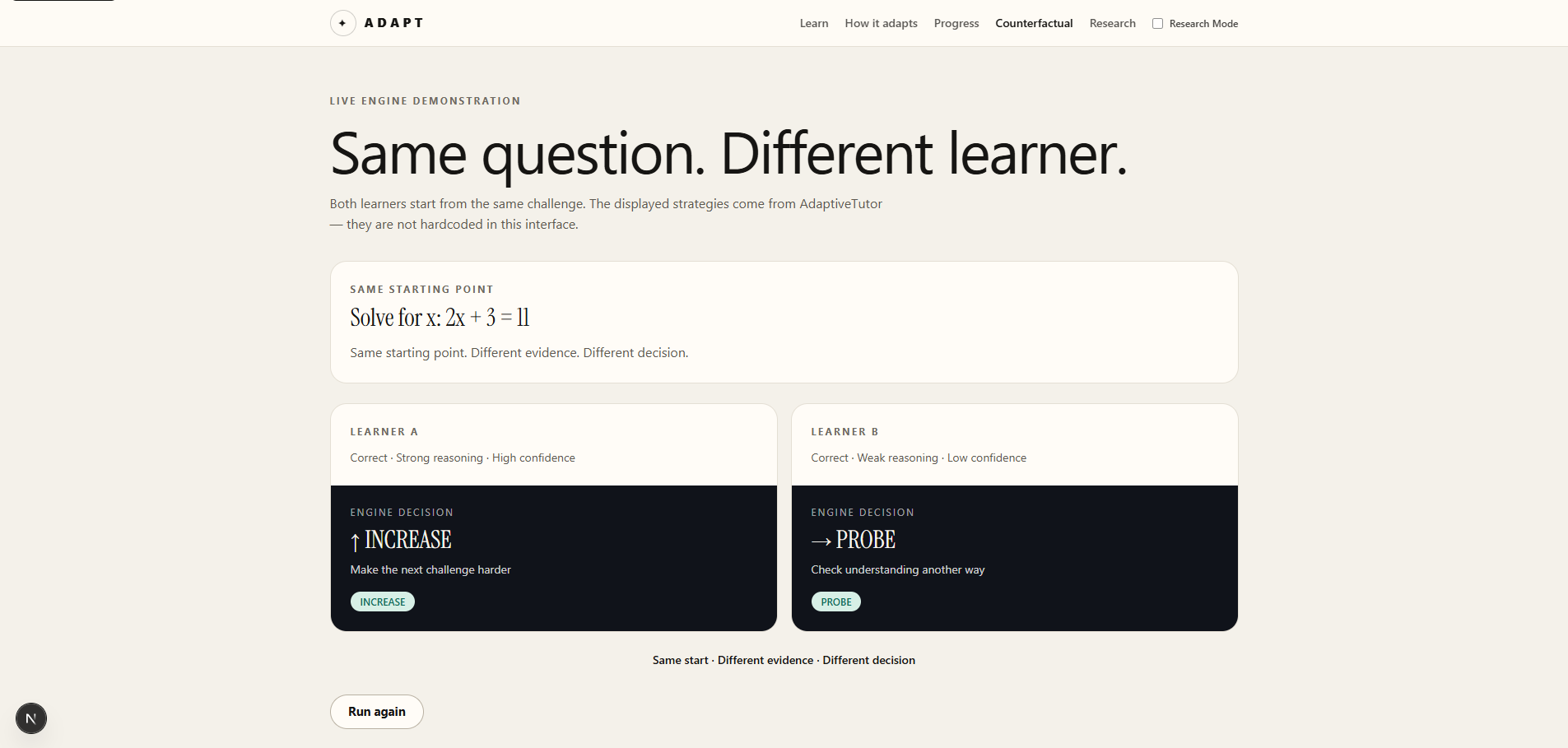
- Counterfactual demonstrations showing how changing learner evidence can change ADAPT's next decision.
Most importantly, we are proud that the learner can actually see the adaptation happen. The system doesn't just say "here's your next question"—it can explain what it noticed and why that question was chosen.
What we learned
We learned that building an effective educational AI is less about generating impressive answers and more about designing a reliable decision-making system around learner evidence.
We also learned the importance of evaluation early in the development process. By defining what "appropriate adaptation" meant before polishing the product, we could test whether the system was genuinely improving its decisions rather than simply appearing intelligent.
Finally, we learned that transparency matters. When learners can understand why a system changed direction, the adaptation feels intentional rather than arbitrary.
What's next for ADAPT
Next, we want to move ADAPT from a hackathon prototype toward a real learning platform.
Our next steps include expanding the learner model, improving the AI-driven reasoning layer, adding more subjects and misconception patterns, and conducting larger-scale human evaluations with real learners.
We also want to explore longer-term learning trajectories: instead of adapting only to the next question, ADAPT could understand a learner's progress over weeks or months and continuously adjust their learning path.
Our ultimate goal is simple:
Build an AI tutor that doesn't just know the answer: it knows what the learner needs next.
Built With
- ai
- machine-learning
- next.js
- prompt-engineering
- python
- react
- typescript
- ux/ui

Log in or sign up for Devpost to join the conversation.