-
-
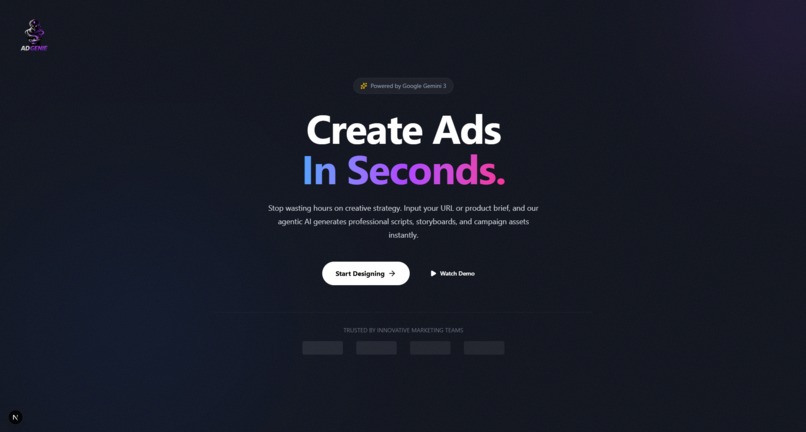
Dashboard
-
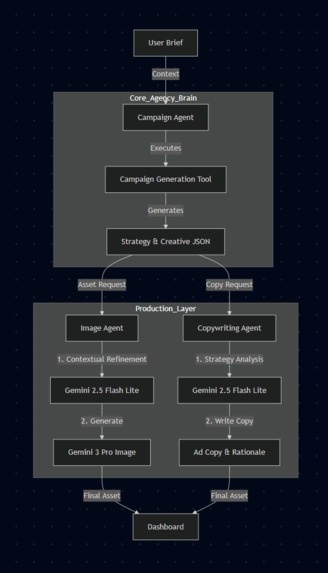
AI Agent Design
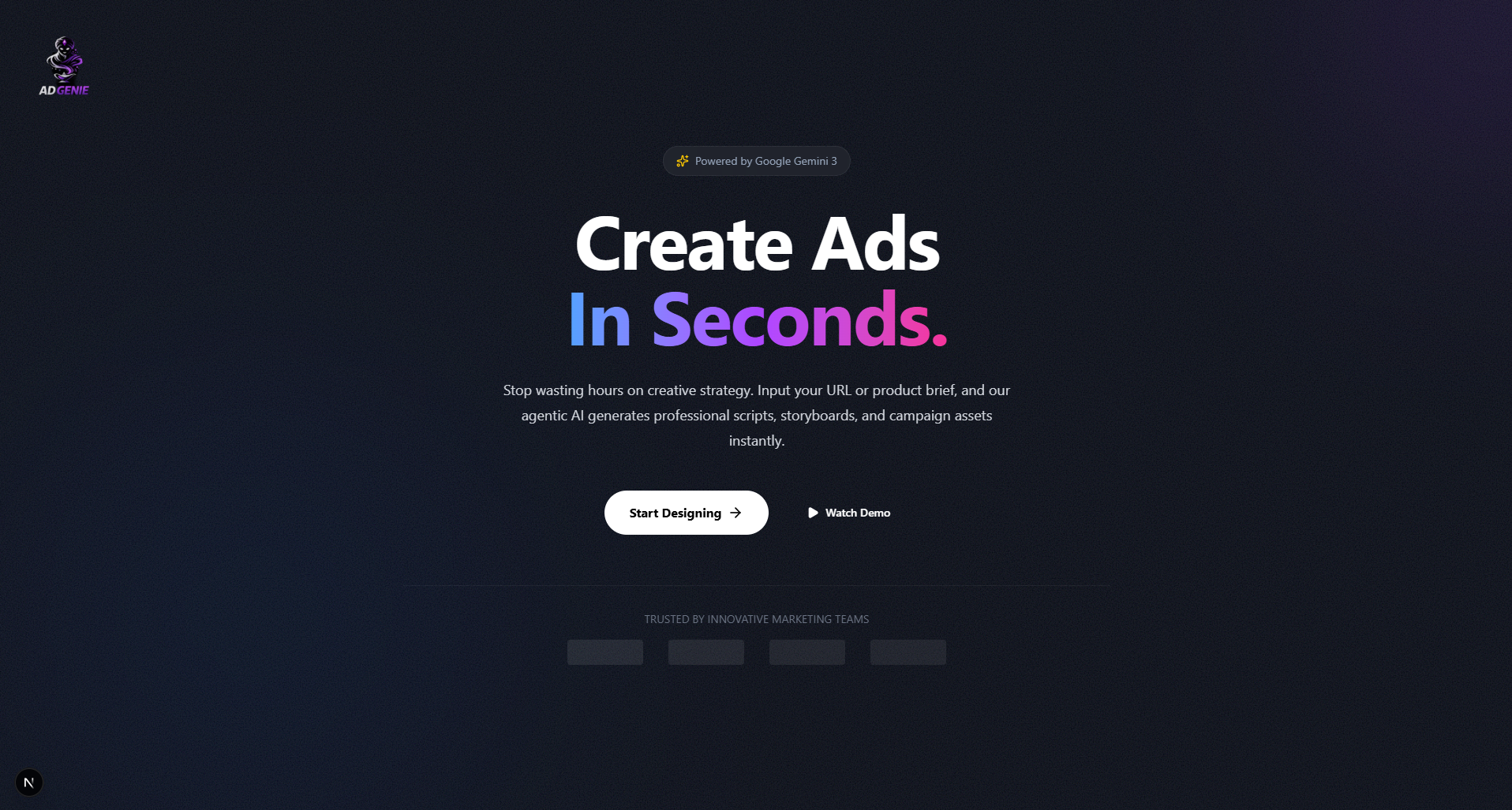
Inspiration
I am a freelance marketer trying to advertise client products and services, but I find creative fulfillment to be extremely time consuming. Between audience research, scripting, filming, editing, and testing variations, I end up spending more time in production tools than actually growing my business. That frustration is what inspired AdGenie: I wanted an “always-on creative agency” that could handle the heavy lifting while I focus on strategy, relationships, and scaling my clients’ results.
What it does
In the new age of AI, entrepreneurs all over the world are trying to streamline marketing functions so they can focus on what matters: growing their business. Our platform does exactly that. It turns a simple product brief into a complete mini-campaign: personas, angles, high-fidelity ad visuals, and conversion-focused copy. In just a few minutes, AdGenie simulates a strategist, photographer, and copywriter working together, so founders can worry about marketing performance and business growth—not fighting with ad creatives.
How we built it
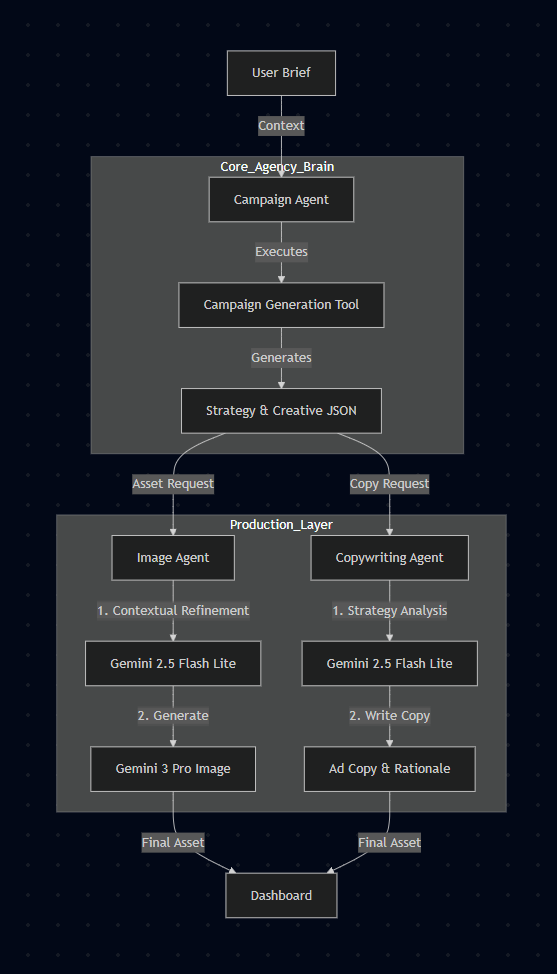
We built AdGenie as a true multi-agent “agency in a box,” with each agent owning a specific role in the creative pipeline and talking to the others through a custom Agent‑to‑Agent (A2A) framework.
Campaign Agent (Agency Brain)
We designed the Campaign Agent as a Creative Director and Strategist. It takes the user’s brief and, using Gemini 2.5 Flash Lite, generates a structured JSON “campaign spec” that includes target personas, pain points, emotional hooks, content pillars, and suggested visual directions. This JSON becomes the contract that downstream agents follow.Image Agent (Creative Director / Photographer)
The Image Agent reads the campaign spec and decides how to translate strategy into visuals. It uses Gemini 2.5 Flash Lite to refine the raw idea into a detailed image prompt (lighting, mood, camera specs, composition, background, and platform-specific aspect ratio), then calls Gemini 3 Pro image preview to generate high‑fidelity, ad‑ready product photography. It also respects placement presets (feed, story, TikTok, LinkedIn) and can embed user‑provided text into the scene.Copywriting Agent (Senior Copywriter)
The Copywriting Agent consumes both the campaign spec and the image context (either the prompt or metadata from the generated image). With Gemini 2.5 Flash Lite, it writes headlines, body copy, and CTAs that are aligned with the persona, emotional hook, and the actual visual composition (e.g., leaving room for text in negative space, matching tone to lighting and mood).Custom A2A Orchestration Layer
Instead of chaining prompts in one big LLM call, we implemented a small A2A framework in our Next.js backend. Each agent:- Receives a typed input payload (often JSON),
- Can call tools (e.g., “generate_campaign_spec”, “generate_image_prompt”, “generate_copy_block”) backed by Gemini APIs,
- Returns a strictly validated JSON output that becomes input for the next agent.
This makes the system more reliable, easier to debug, and closer to how a real team passes briefs and assets around.
Frontend + UX
On the frontend, we used Next.js 16 (App Router) with React 19, Tailwind CSS v4, and Framer Motion to build a responsive dashboard. Users can:- Enter a brief and brand details,
- Choose placement/aspect ratios,
- Trigger the full agent pipeline,
then review the generated images and copy side‑by‑side, like reviewing work from an internal creative team.
Gemini API Integration
All of this is wired through the Google Generative AI SDK for Node.js. We configured separate clients/prompts for:- Gemini 2.5 Flash Lite (fast reasoning, JSON enforcement, multimodal copy),
- Gemini 3 Pro image preview (photorealistic, ad‑grade visuals with text rendering).
Environment variables are handled via.env.localso the project can be spun up quickly with a singleGEMINI_API_KEY.
Challenges we ran into
- Designing agent roles that felt realistic: it took several iterations to get the Campaign, Image, and Copywriting Agents to collaborate instead of conflicting or repeating work.
- Enforcing strict JSON structures for the internal “campaign spec” while still giving Gemini enough creative freedom to come up with fresh ideas.
- Prompting Gemini 3 Pro in a way that consistently produced commercial-grade, platform-specific visuals (e.g., different aspect ratios and compositions for TikTok vs. LinkedIn).
- Managing latency and UX: balancing fast responses with high-quality outputs so the app still feels snappy during live demos.
- Handling multimodal context so the Copywriting Agent could reliably “react” to the visual mood and layout, not just the original brief.
Accomplishments that we're proud of
- Building a true multi-agent “virtual agency” where strategy, imagery, and copy are all aligned around a single campaign brief.
- Achieving a workflow where the Copywriting Agent can “see” the generated image (or its prompt) and tailor headlines and CTAs to the actual visual composition.
- Shipping a polished, end-to-end experience—from environment setup to live demo—that a non-technical founder could realistically use to generate their first campaign.
- Translating real freelance marketing pain points into a product that meaningfully cuts down on time spent in creative production.
- Designing an A2A framework that could be reused for other Gemini-powered, multi-agent workflows beyond advertising.
What we learned
- How powerful agent-to-agent orchestration becomes when you treat each agent like a real teammate with a clear role, inputs, and outputs.
- How sensitive multimodal prompts are: small changes in how we describe lighting, mood, or framing can dramatically change the perceived brand vibe.
- The importance of guardrails and structure (schemas, tools, validation) when you want reliable, repeatable outputs for something as subjective as “good creative.”
- That many of the headaches marketers face—iteration speed, consistency across platforms, and alignment between copy and visuals—are ideal problems for Gemini to help solve.
- How to design prompts and tools so that non-technical users still get predictable, on-brand assets from a very powerful, flexible model.
What's next for AdGenie
- Adding performance feedback loops: piping in basic ad metrics so future campaigns can be optimized based on what actually converts.
- Expanding channel presets (email sequences, landing page sections, and organic social content) that are automatically aligned with the core campaign strategy.
- Introducing team collaboration features so agencies can use AdGenie as a shared workspace between strategists, designers, and copywriters.
- Exploring integrations with ad platforms to push creatives directly into draft campaigns, reducing even more friction between idea and launch.
- Experimenting with additional agents (e.g., a Testing/Analytics Agent) that can propose A/B tests and interpret performance data for the next round of campaigns.
Built With
- framer-motion
- gemini
- gemini-2.5-flash-lite
- gemini-3-pro
- google-generative-ai-sdk-for-node.js
- javascript
- next.js
- node.js
- react
- tailwind-css
- typescript


Log in or sign up for Devpost to join the conversation.