-
-
Vigil-AI
Inspiration
Across developing regions like Zimbabwe and India, aging infrastructure often goes uninspected until failures occur. In cities such as Harare, Chitungwiza, and Bulawayo, cracks in bridges, leaking sewer pipes, and corroded water systems pose constant health and safety risks. Similarly, in Vijayawada, Guntur, and Hyderabad, frequent monsoons and high urban load accelerate road and drainage degradation.
Traditional inspection is manual, expensive, and inconsistent — especially in areas where skilled inspectors and advanced sensors are scarce. This inspired us to create VIGIL-AI — an autonomous, affordable guardian that can “see” and “hear” the health of structures using simple sensors and AI. Our vision: Give every structure a voice — and make sure it’s heard before it fails.
What it does
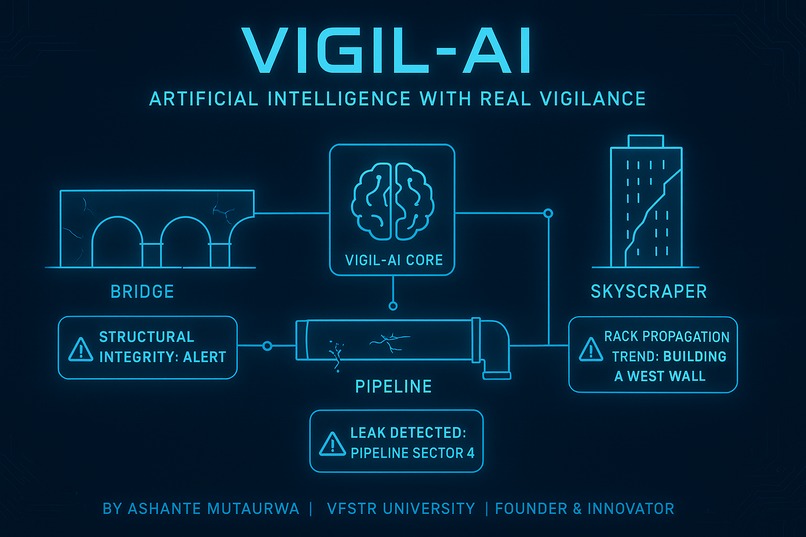
VIGIL-AI combines acoustic, vibration, and visual monitoring to create a living, learning “digital twin” of any structure. It detects early signs of cracks, leaks, corrosion, or stress using a fusion of microphones, sensors, and cameras — analyzed locally by an AI model. The system sends real-time alerts, severity scores, and predictive insights to engineers and city administrators through a cloud dashboard.
How we built it
Hardware: Low-cost acoustic emission sensors, vibration microphones, and camera modules integrated on ESP32 / Raspberry Pi boards.
Software:
Signal analysis: Python with TensorFlow Lite and SciPy
Computer vision: YOLOv8 for crack/rust detection and classification
Predictive AI: LSTM model trained on time-series data for stress forecasting
Dashboard: Flask + Firebase + Plotly Dash visualization with digital twin simulation
Network & Power: Mesh-based IoT communication using MQTT, powered by small solar modules for off-grid areas.
We also used Replit for demo monitoring app.
Challenges we ran into
Differentiating harmless vibrations from real damage signals.
Merging multi-sensor data in real-time with low latency.
Ensuring power and connectivity in remote or rural areas.
Creating a universal model adaptable to different structures and materials.
Accomplishments that we're proud of
Built a hybrid sensing prototype that can detect visual and acoustic anomalies simultaneously.
Developed an AI-driven dashboard that visualizes live stress data and health indicators.
Designed a solar-powered, modular system deployable in both rural and urban environments.
Created a digital twin simulation capable of showing stress propagation in real-time.
What we learned
Sensor fusion drastically increases accuracy and reliability.
Edge computing minimizes cost and network dependency — critical for developing regions.
Collaboration across disciplines (mechanical + electrical + AI) produces real-world solutions with social impact.
What's next for VIGIL-AI
Partnering with municipal authorities in India and Zimbabwe for live pilot installations on bridges, pipelines, and towers.
Integrating drone-based inspections for larger coverage areas.
Launching VIGIL-AI Cloud, a SaaS platform offering infrastructure health analytics to governments and industries.
Scaling globally to make infrastructure monitoring smart, predictive, and universally accessible.


Log in or sign up for Devpost to join the conversation.