Inspiration
AcuPill was inspired by a problem one of our engineers saw in their own family. Their grandparents took multiple prescription medications and often needed someone to regularly check whether they had taken them. Family members cared deeply about them, but with work, school, and other responsibilities, it was difficult to provide constant attention throughout the day.
We realized that this is not just one family’s problem. Many older adults, especially those living with conditions such as Alzheimer’s, Parkinson’s disease, arthritis, or other motor impairments, may need help staying consistent with medication while also experiencing symptoms such as tremor, stiffness, or difficulty with fine motor tasks.
What it does
AcuPill is a smart rehabilitation and medication-support system that turns a regular prescription bottle into a connected sensing device. It detects meaningful bottle interactions, logs medication activity, tracks movement patterns over time, stores important changes for future appointments, and gives caregivers or clinicians a clearer view of adherence and motor trends.## How we built it Our hardware uses an Arduino UNO R4 WiFi connected to a Grove touch sensor and a Grove three-axis accelerometer. Sensor data is streamed to the MathWorks MATLAB and processed using our interaction-detection logic.
Instead of treating every movement as a medication event, our software looks for a sequence of touch, handling, tilt, return, and release. Once an interaction is accepted, the system extracts motor telemetry and compares it with the patient’s recent baseline.
The processed events are sent through our backend API and stored in Tiger Data, where medication interactions, patient check-ins, schedules, and major changes can be preserved over time. This allows the patient and caregiver dashboards to use the same longitudinal record rather than relying only on temporary browser data.## Challenges we ran into
Accomplishments that we're proud of
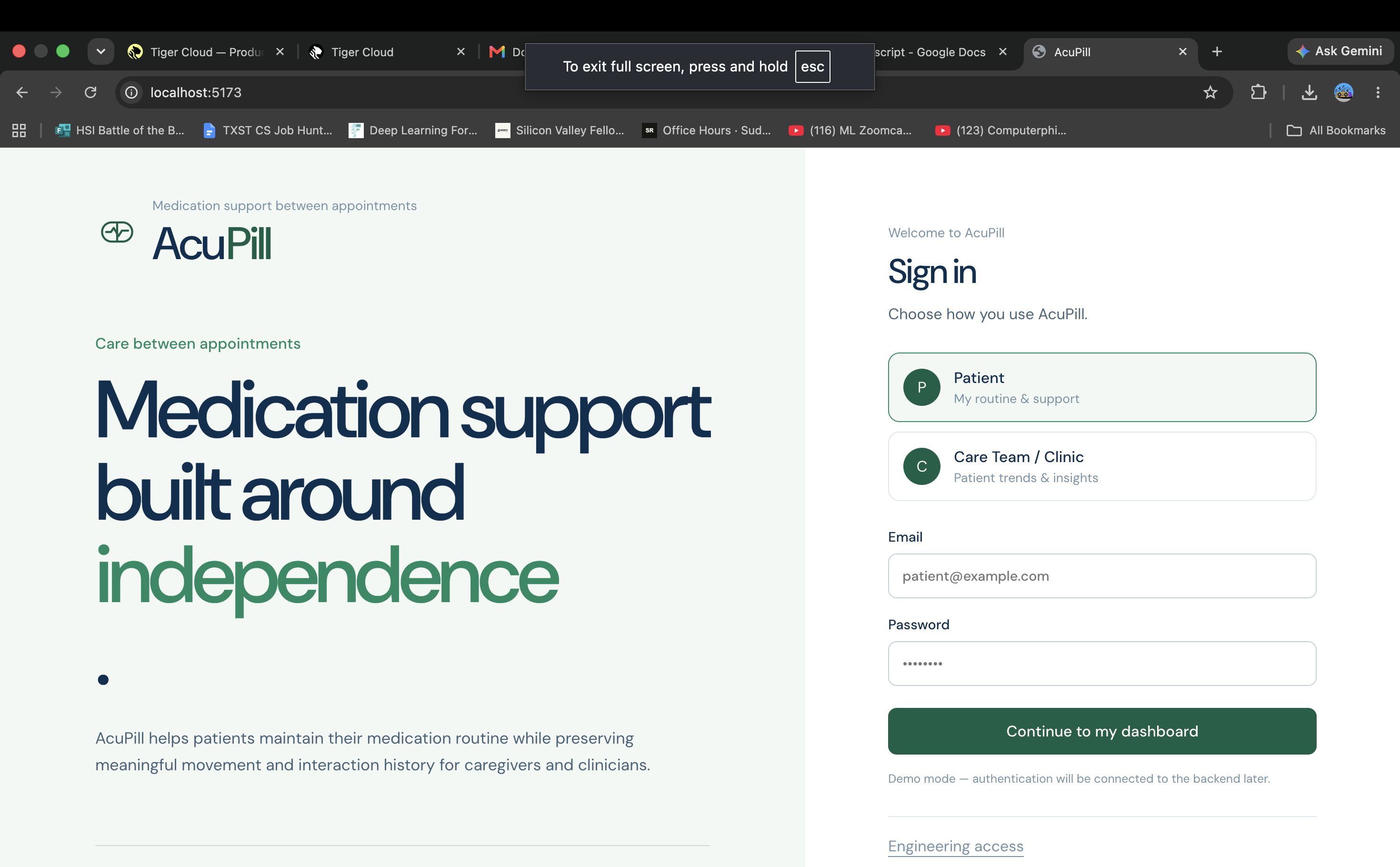
We built AcuPill as a real end-to-end hardware and software system, not just a mockup. We created a smart bottle prototype, custom interaction-detection logic, motor telemetry, Tiger Data storage, and separate patient and caregiver dashboards.
We’re especially proud of the Major Changes / Appointment Memory feature, which preserves important events for future doctor visits while keeping the patient experience simple and reassuring.
What we learned
One of the biggest things we learned was that raw sensor data by itself is not useful to most patients. Numbers such as acceleration values or movement variability can easily become confusing or even anxiety-provoking.
Because of that, we designed AcuPill so that the technical data remains in the backend while patients receive calm, understandable messages. A patient might see that their movement was “a little different from their recent routine,” while a caregiver or clinician can see the numerical change and when it occurred.
We also learned that a single unusual interaction should not automatically be interpreted as a meaningful change. Our design therefore looks for repeated deviations before creating a major-change marker.
What's next for AcuPill
In the future, We want to miniaturize the prototype into a lightweight reusable device that fits around standard prescription bottles. Future hardware could include additional sensing, such as pressure or weight-related measurements, to improve confidence about how the bottle was handled while still avoiding claims that the system can directly confirm medication ingestion.
Beyond medication adherence, this continuous data collection will unlock a new level of care for conditions affecting motor control, such as arthritis and Parkinson’s. By analyzing movement patterns, micro-tremors, and handling difficulty over time, AcuPill will be able to generate objective insights into the severity of a patient's condition. This transforms an ordinary routine into vital health data, giving doctors a clear, data-driven window into how a patient is physically functioning at home between clinical appointments.
Ultimately, we want AcuPill to become an accessible bridge between the patient’s everyday life at home and the limited time they spend with caregivers and clinicians.
Built With
- arduino-c++
- arduino-uno-r4-wifi
- custom
- grove-3-axis-accelerometer
- grove-touch-sensor
- matlab
- motion-analysis
- node.js
- postgresql
- react
- rest-apis
- tiger-data/timescaledb
- vite
- web-serial-api

Log in or sign up for Devpost to join the conversation.