Inspiration
Anyone can say "Redis" or "pub/sub." Far fewer can say why, or what it costs. A Palantir engineer told us the skill that lasts is knowing the trade-offs, not memorizing tools.
We surveyed 54 participants at HackPrinceton. Of the 14 interviewing for software engineering roles, 13 had already taken an AI-assisted interview. All 14 said AI is making routine coding and standard LeetCode patterns less valuable as signals, and system design and architectural judgment more important.
That's the skill we built Acumen to teach. Computer systems weren't invented from nothing. They borrow from the real world, so we start there. In a coffee shop, you can see a line growing before you know the term "request queue."
What it does
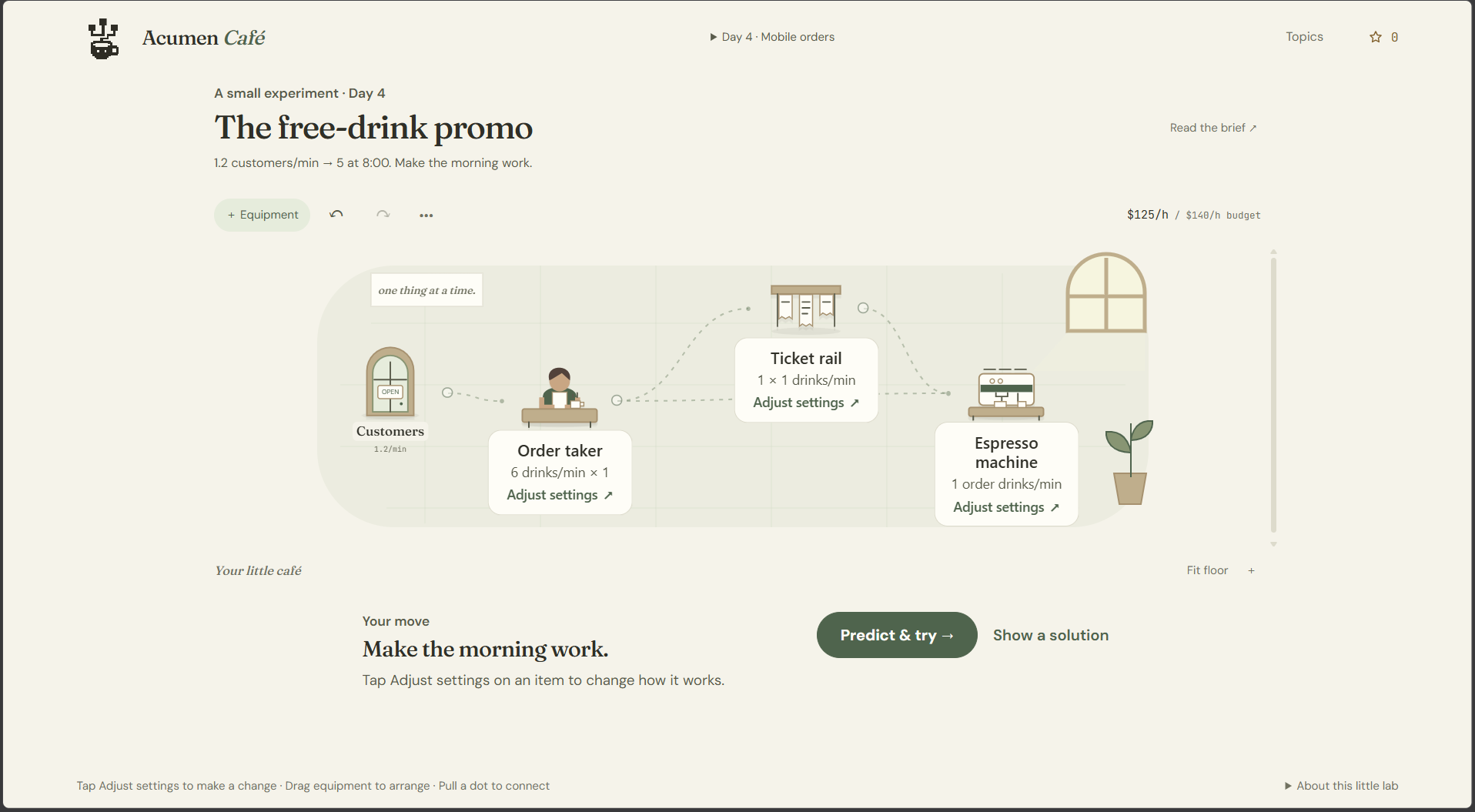
It's 8 a.m. and customers arrive faster than one barista can serve them. Pick a chapter and Acumen shows you the model and its trade-offs first. Then you get a brief, a budget, and tests to pass.
- Build with real limits. One barista can only work so fast, and every extra copy costs money, so you can't max everything out. Copies are drawn as separate icons: a design with four baristas looks different from one with a single barista.
- Predict before every run. You say where it will break and by how much, then watch customers flow through and see the bottleneck form.
- Graded on more than one morning. Your design faces the sample and hidden mornings. A survival map shows where it holds as conditions change, and a "Why it worked" summary uses numbers from the run.
- Compared with the best design. We search every design the palette can build under the budget. You see your cost against the cheapest design that passes.
- Explain it like an interview. Write why you built it that way. An AI reviewer marks each claim as holds, contradicted, or not tested, citing the simulator's numbers.
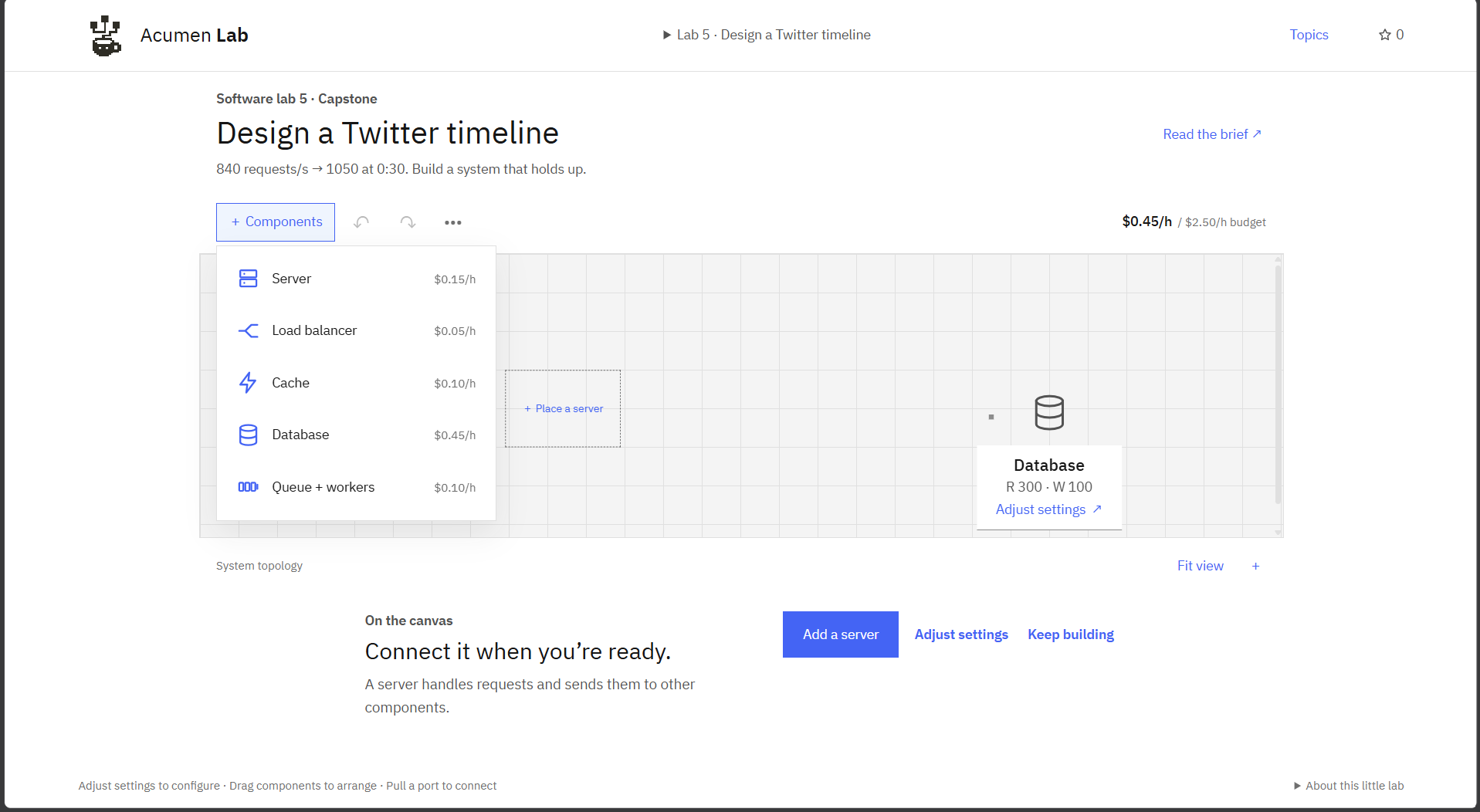
- Flip to software. One click turns the café into the software lab. The barista becomes a server, the fridge a cache, and the line a request queue. The reasoning carries over.
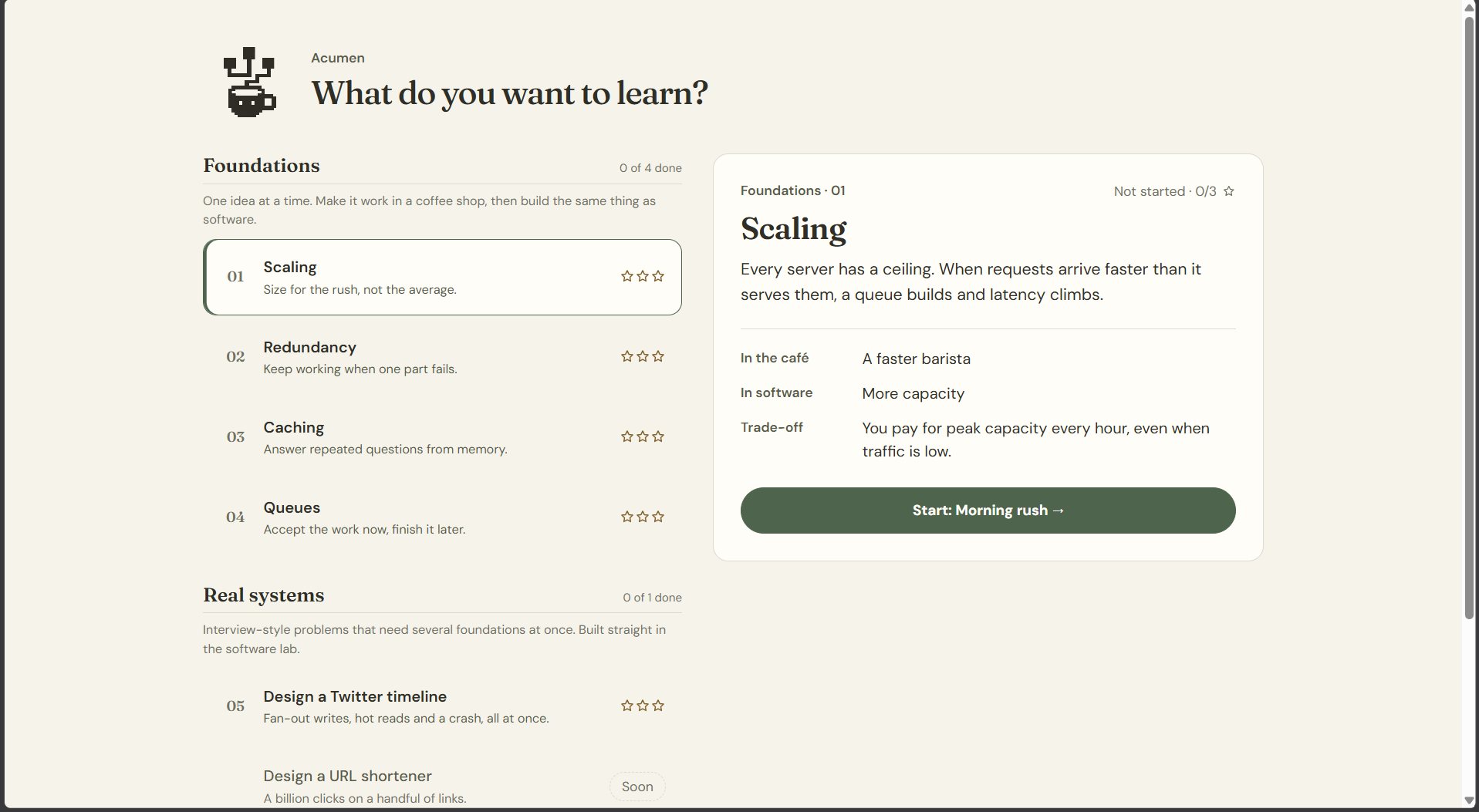
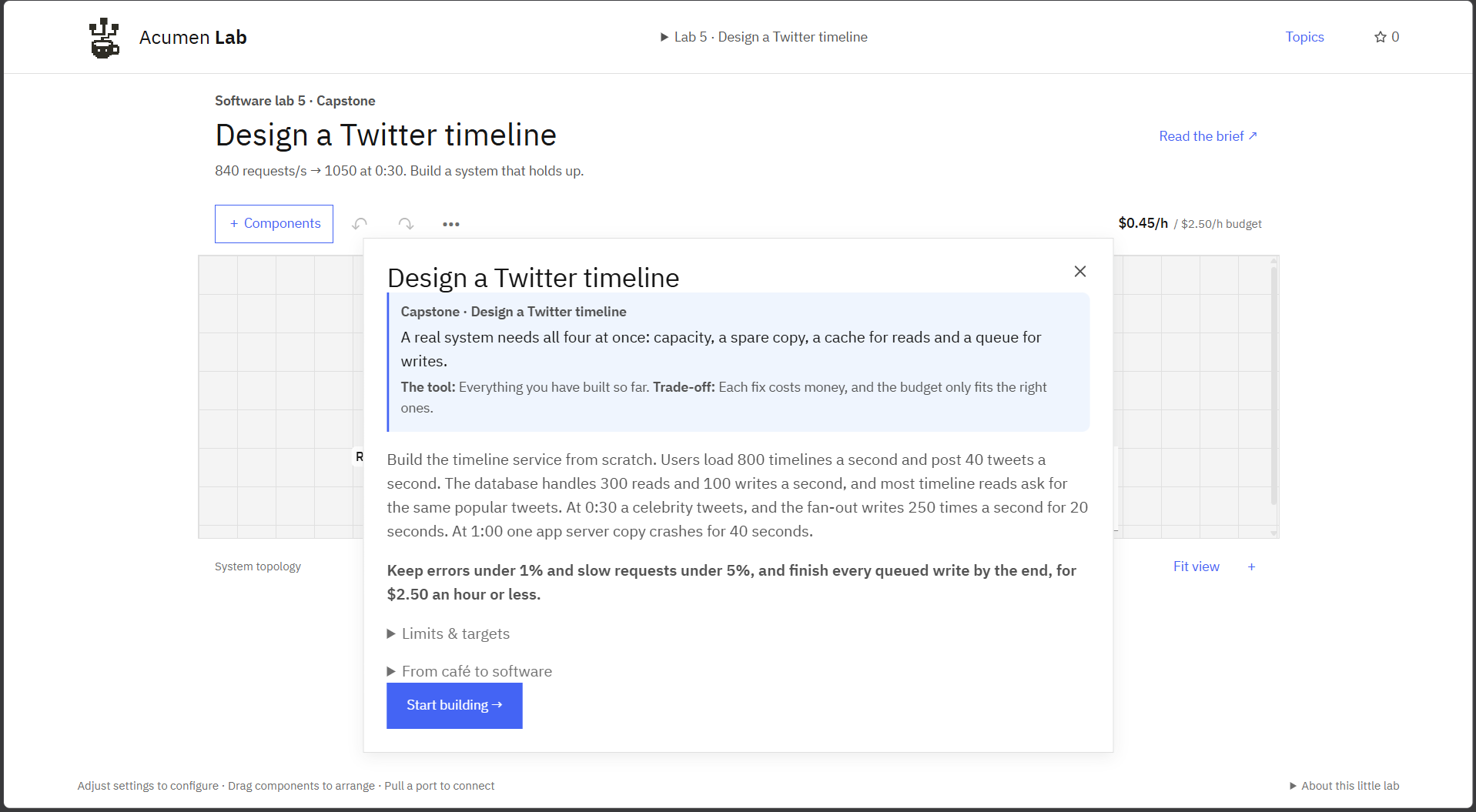
Foundations covers scaling, redundancy, caching, and queues. In the capstone you combine all four to design a Twitter-style timeline that handles heavy reads, a burst of writes, and a server outage. If you're short on time, Show a solution loads the cheapest passing design to run, predict, and study.
How we built it
Both scenes run on one deterministic simulator, written as plain JavaScript modules with no dependencies and covered by 106 tests. It tracks queue buildup, latency, dropped requests, and cost. The café and software versions of each level give the same answer, because the café is the software numbers scaled down.
Gemini writes words, never grades. It powers tutor hints grounded in the run log, a chaos agent whose attack is shown only after the simulator confirms it breaks your design, and the design review. The reviewer's numbers must appear in what the simulator measured. The simulator decides every pass and fail. The Gemini key lives only in serverless functions.
Challenges
- Cost model: at first, many tiny, cheap copies beat everything. We added real per-copy limits and a fixed cost per machine, then regenerated every best design.
- Teaching signal: the prediction number and the pass/fail are different measurements, and they confused testers until we explained them in the result.
Accomplishments we're proud of
- The moment the coffee shop turns into a software diagram, you can already explain why a short spike leaves a long queue.
- Trade-offs are enforced by real limits and cost, not just described.
- Every number a learner sees, including the AI's feedback, traces back to the simulator.
Industry consultation (FDE Track)
- Business: Palantir
- Person consulted: Dylan Nguyen (Software Engineer)
- What we asked: how well the candidates he interviews understand system design
- Direct quote: "Most candidates I've interviewed could talk through system design concepts, but none understood the tradeoffs well enough to explain their choices, and that's what matters, because a design that works at one scale can become a bottleneck at another."
- How it shaped Acumen: this is why every level makes you predict where a design breaks, build under real limits and cost, and explain your trade-offs. The app teaches the reasoning behind the tools, not their names.
Built With
- gemini-api
- html/css
- javascript-(es-modules)
- node.js
