-
-
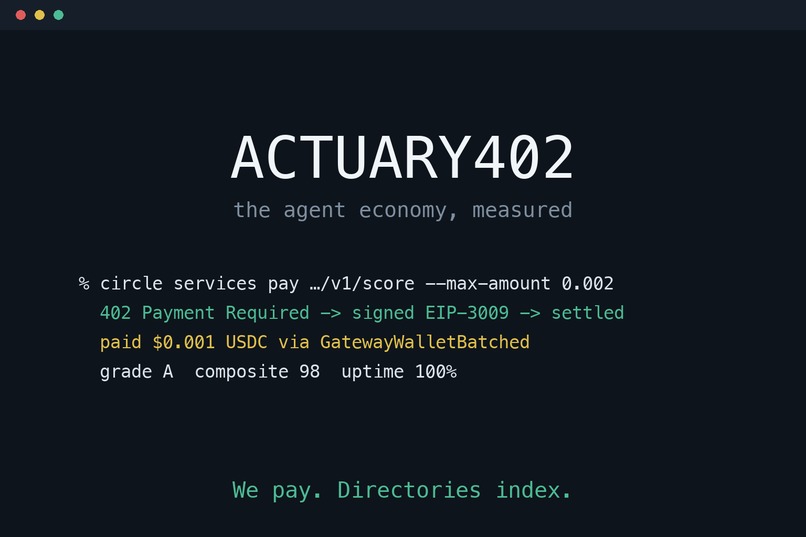
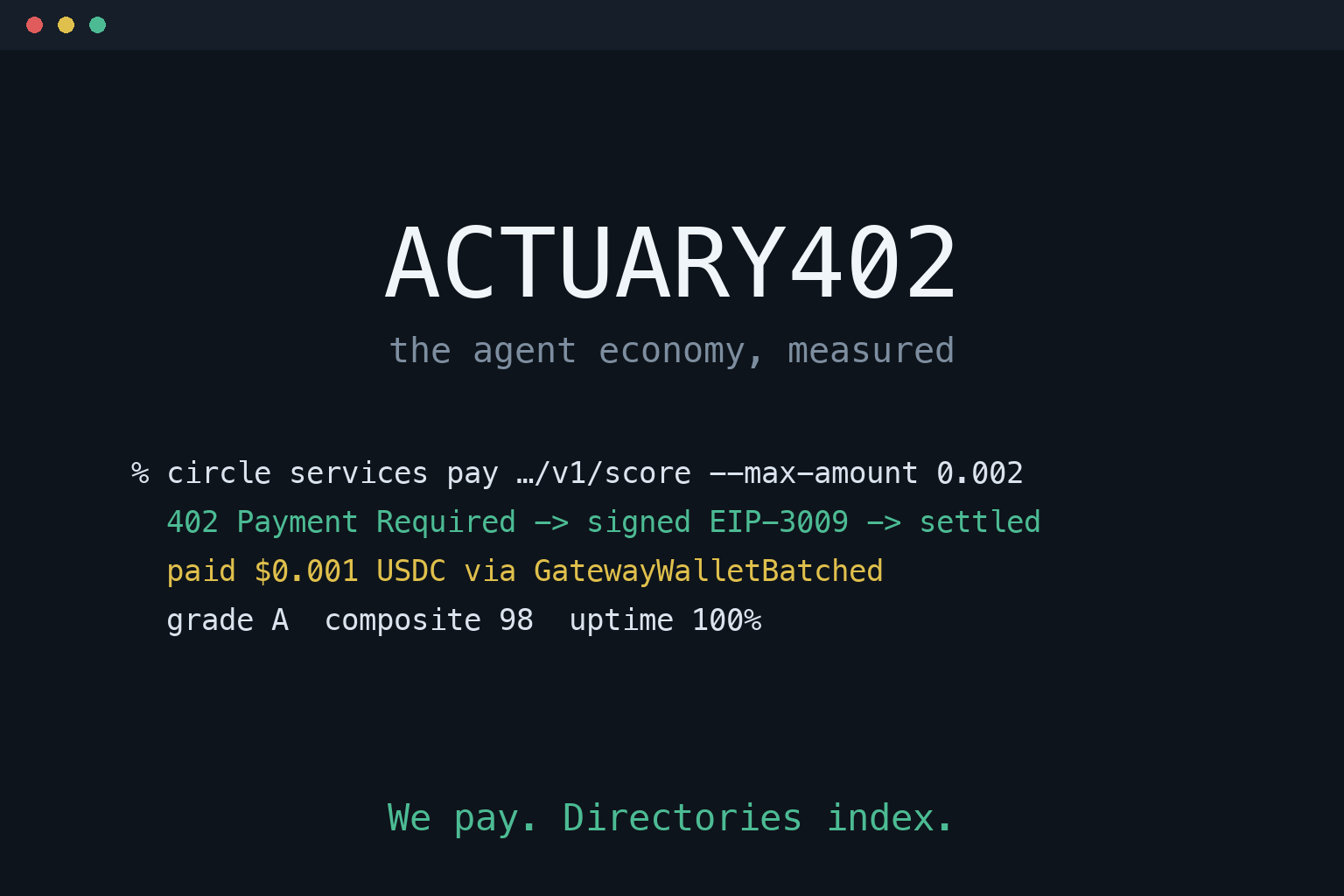
Actuary402: autonomous probes buy from agent services with real USDC and sell trust scores back at $0.001 a lookup.
-
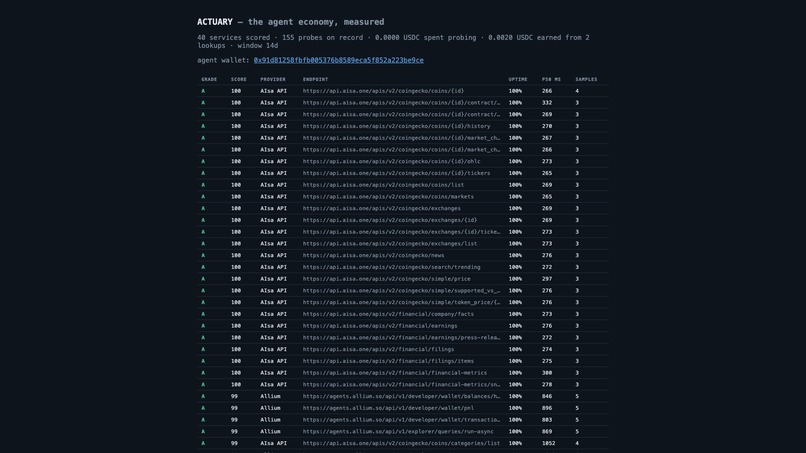
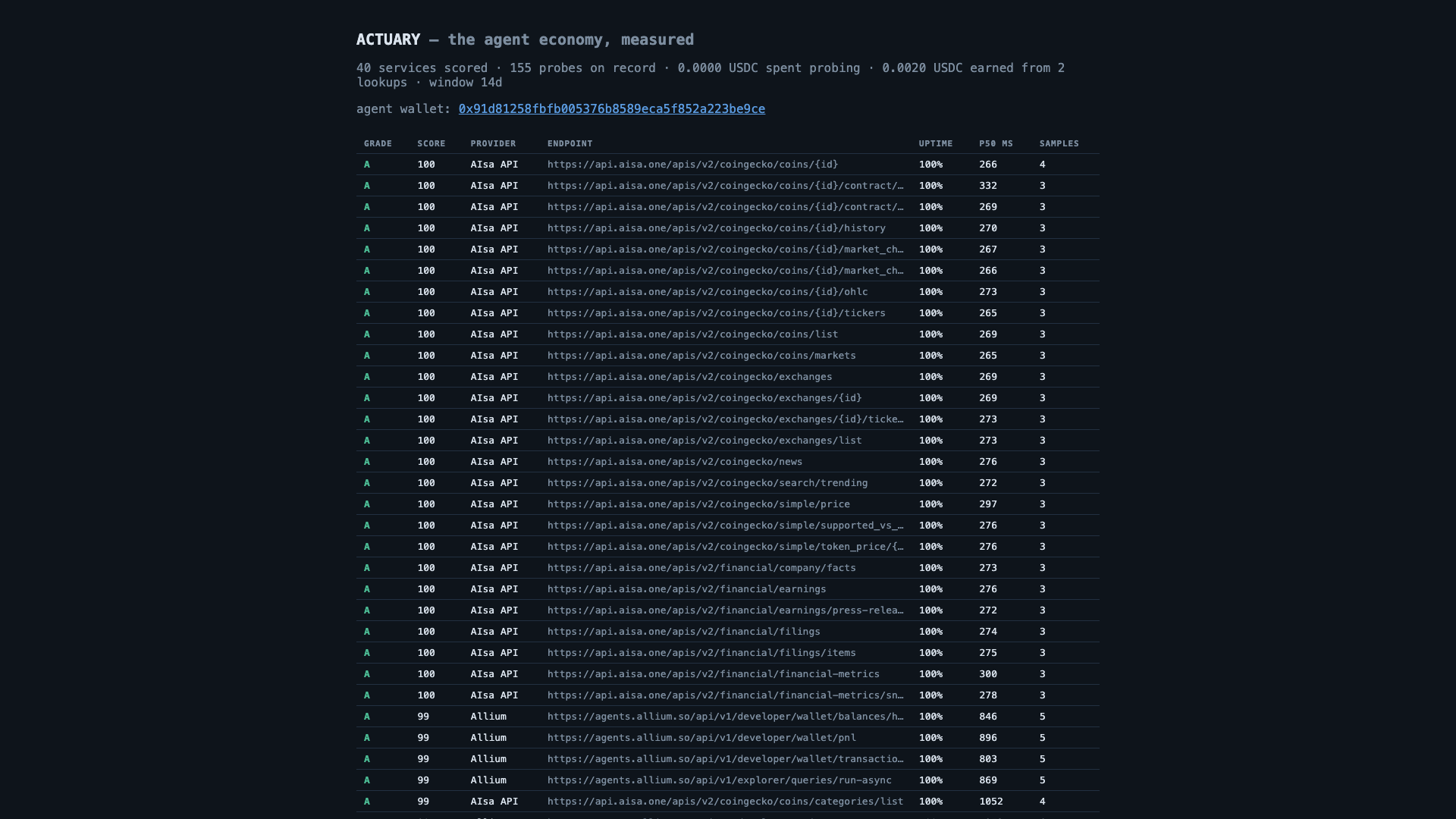
The live leaderboard on Cloud Run: every grade backed by real probes, with the agent wallet linked to the block explorer.
-
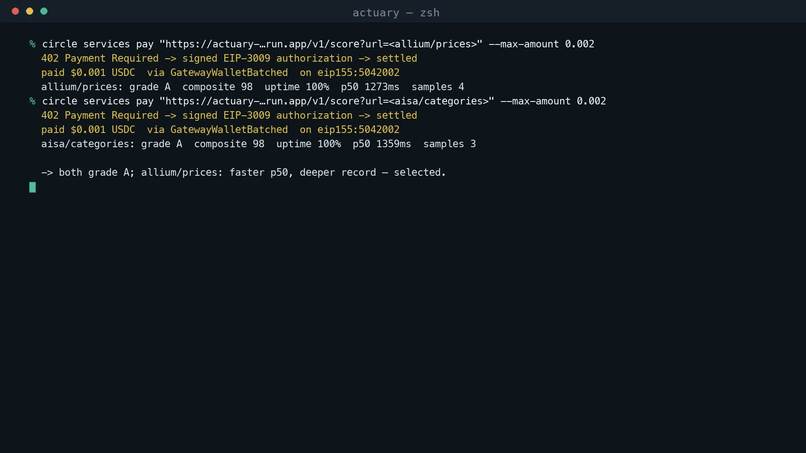
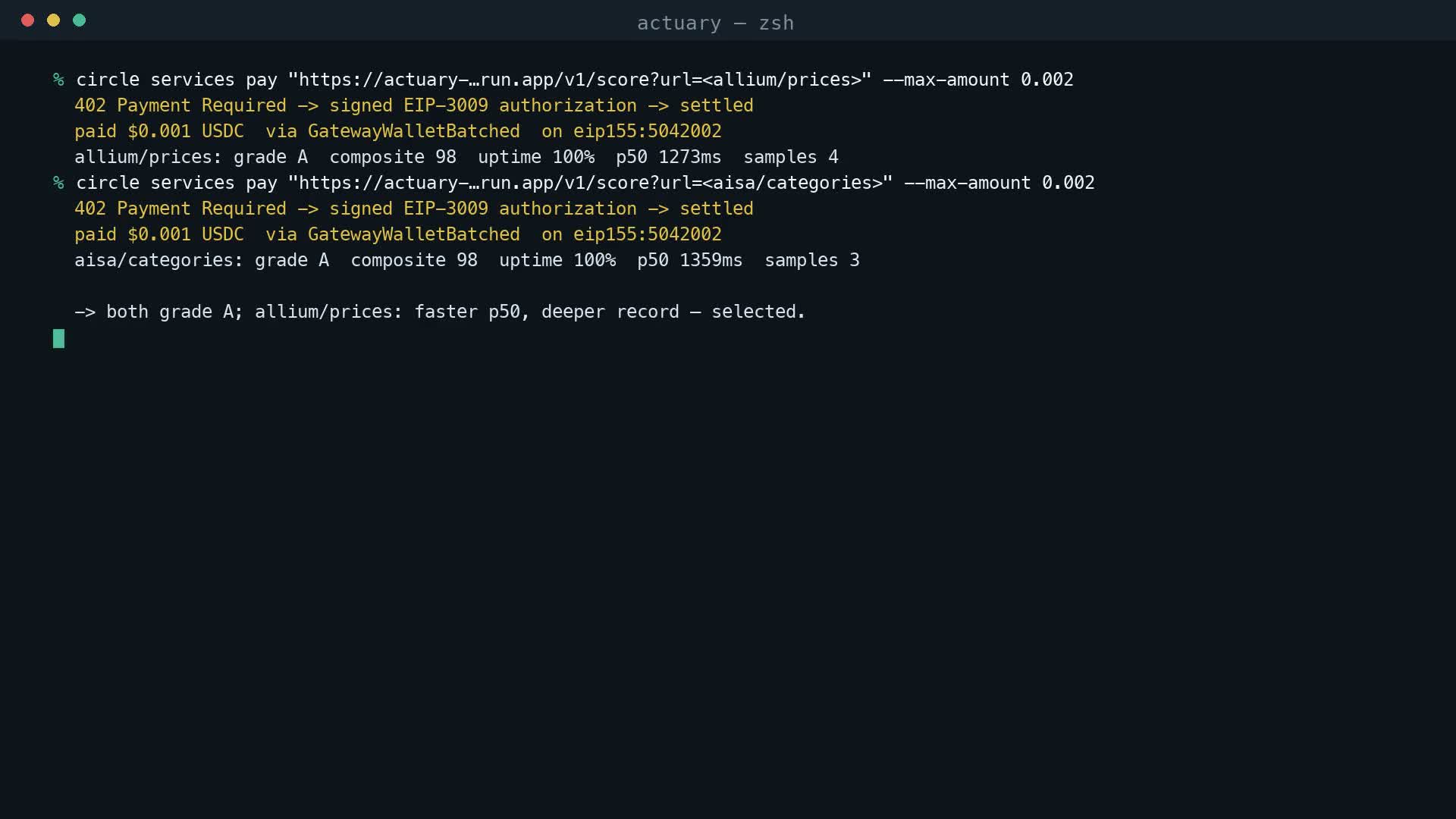
Two real USDC scorecard purchases settling through Circle Gateway (x402), then the agent picks the stronger service.
-
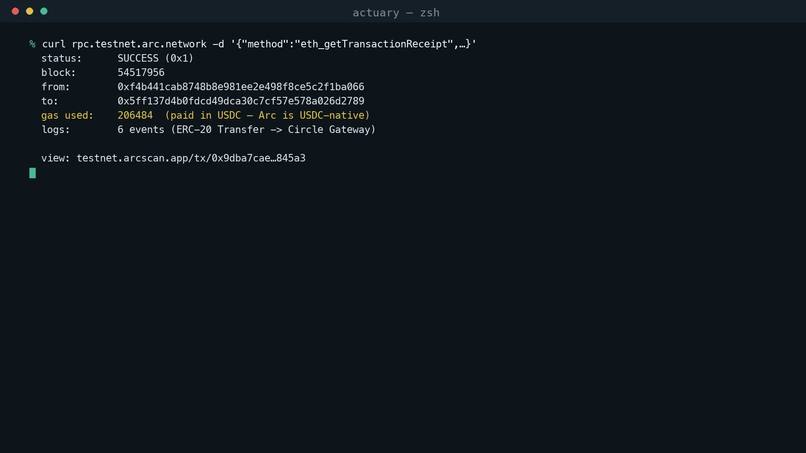
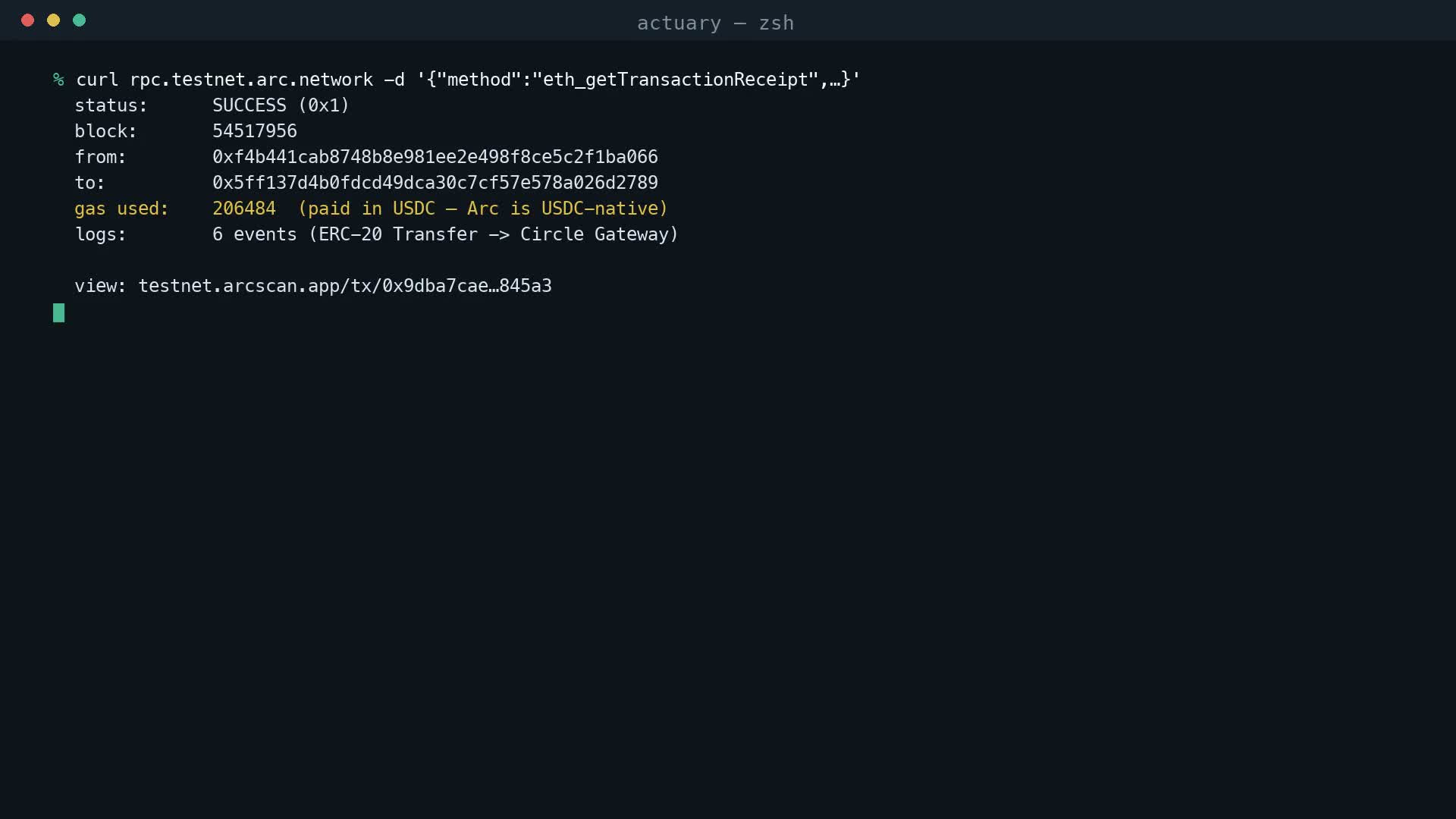
On-chain proof: the settlement receipt fetched straight from Arc RPC (status SUCCESS), verifiable by anyone.
-
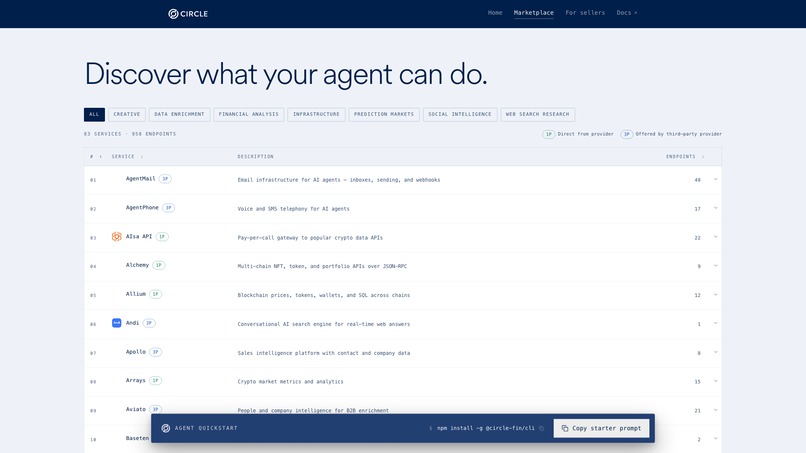
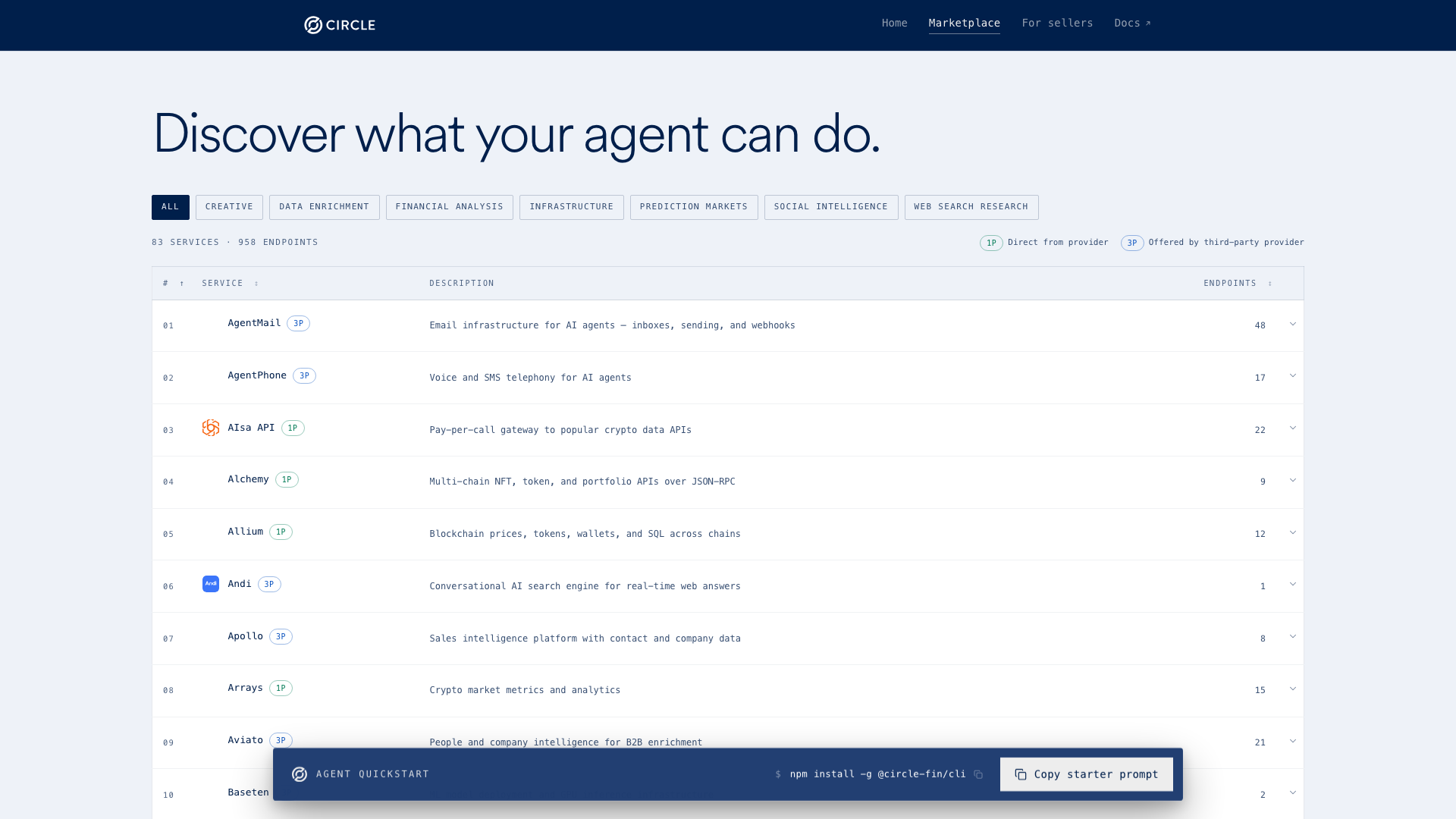
Circle's Agent Marketplace: hundreds of paid endpoints agents can buy with no accounts or API keys. Actuary402 measures which ones deliver.
What it is
Actuary is the reputation layer for the machine economy: an autonomous watchdog that continuously buys from the 600+ x402 services on Circle's Agent Marketplace with real, policy-capped USDC, measures what actually comes back (uptime, latency, protocol conformance), has Gemini grade every paid response in production, and sells the resulting trust scores back to other agents at $0.001 per lookup. Moody's plus Pingdom, for machine commerce.
We pay. Directories index.
The problem
Agentic payments crossed a threshold this year: agents hold wallets, x402 settles machine-to-machine purchases in USDC, and Circle's marketplace lists hundreds of paid services with no signups and no API keys. What nobody built is the trust primitive underneath. A buyer agent choosing between services has listings and prices, but no way to know which endpoints actually deliver this week. Directories index claims; nobody measures delivery. The skeptic's critique of machine commerce ("it's all demos") survives because the evidence layer is missing.
How it works
A probe fleet enumerates the marketplace through Circle's public Discovery API and probes every service on a schedule: free x402 liveness checks (reading the 402 challenge itself) plus paid purchases executed via the Circle CLI from a Circle Agent Wallet. Spending runs inside two layers of rules: per-call and daily budget caps enforced in code, and the Agent Wallet's own MPC-enforced spending policy behind them. Payments the fleet makes and payments it receives both settle as Circle Gateway nanopayments (x402 v2, EIP-3009 signed authorizations, batched on-chain settlement).
Gemini is the production brain: every paid response is graded 0-10 against what the service advertises (substance, coherence, usability), and that grade feeds 25% of the composite score. Scoring is honest by construction: probe-side failures (our expired session, our empty balance) are excluded so a seller is never penalized for the watchdog's bad day, and unknown services answer 404 free. A buyer never pays to learn "we don't know."
The sell side is one paid endpoint: before an agent spends $0.30 on a service, it spends $0.001 asking Actuary whether that service has been delivering. No account, no key. The payment is the authentication. A drop-in agent skill (check-before-you-pay) makes the habit one install away for any agent framework.
What's real today
Everything in the demo runs live: the score API on Google Cloud Run, the probe fleet on a 30-minute schedule, real USDC settlements through Circle Gateway's facilitator, and every observation appended to an auditable log. The agent's wallet, its Gateway deposits, and its settlements are on-chain and publicly verifiable (wallet 0x91d81258fbfb005376b8589eca5f852a223be9ce, explorer: testnet.arcscan.app). Producing the demo video surfaced a broken explorer link on our leaderboard; the evidence pipeline caught it, which is the product thesis in miniature.
We are candid about stage: this is day-old infrastructure whose first paying customer is itself. Marketplace probes run on Arc Testnet today (zero marketplace services currently accept testnet payment for full paid probes, itself a finding our estimate-mode probes document), with the production roadmap running the same loop against Base mainnet, where the fleet's purchases become Basescan-visible receipts. Revenue is measured in tenths of cents, not dollars. What the 90-day window proves is the loop, not the volume: agents autonomously buying observation, agents autonomously paying for trust data, every cent with a receipt.
Business model and category
Actuary sells trust, priced for machines: $0.001 scorecard lookups at effectively zero marginal cost, a planned seller-side "verified reliable" badge (paid by the seller's own agent), and the probe fleet as subscription-grade monitoring for marketplace sellers. The customers of the agent economy are overwhelmingly small teams, solo builders selling API services and small businesses whose agents buy them, which is why we submit under Small Business Services: Actuary protects small buyers' spend and gives small sellers a public reliability record that big incumbents get from brand alone.
Why this is AI-native
There is no version of this business without AI in the loop. Gemini grades every paid response in production and its judgment moves the score that moves buyers' money. The probe fleet decides, pays, records, and re-prices autonomously around the clock; the "days unattended" counter on our leaderboard is the operations dashboard. The humans set policy; the agents run the business.
Built on
Circle Agent Stack (Agent Wallets, Gateway Nanopayments, Agent Marketplace, Circle CLI, Circle Skills) · Gemini via AI Studio · Google Cloud Run · x402 v2.
Evidence pack (P&L, user evidence, production evidence, on-chain tx hashes): github.com/mattspaulding/actuary/tree/master/submission
Built With
- circle
- gemini
- google-cloud
- typescript
- usdc
- x402


Log in or sign up for Devpost to join the conversation.