Inspiration
I wanted to take a normal rear wing and make it more functional by giving it the ability to react to different driving conditions. Active aero systems on high-performance cars gave me the idea to create a simpler version that I could model and assemble in CAD.
What it does
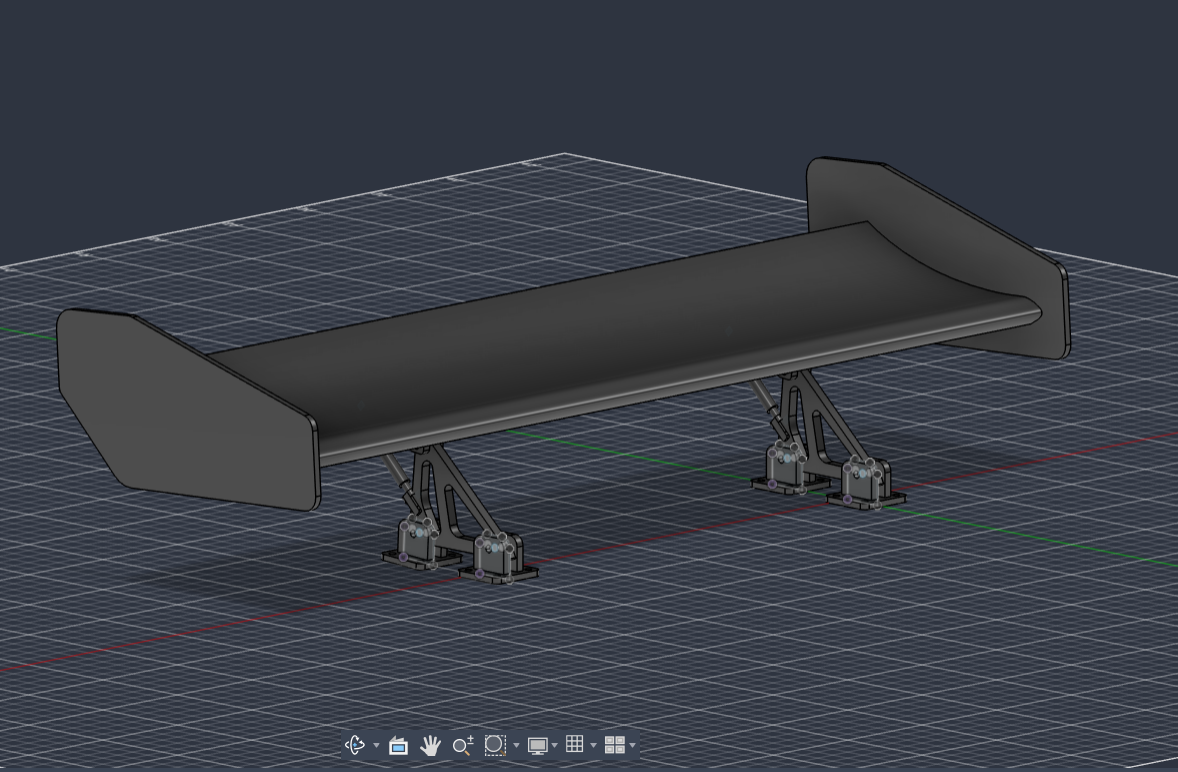
The wing changes its angle using a motor-driven mechanism, allowing it to prioritize either lower drag or more downforce depending on the situation. This gives the car more flexibility than a fixed rear wing.
How I built it
I designed the wing, supports, pivot points, and actuator mechanism as separate parts and then brought them together in an assembly. I focused on making sure the moving parts had enough clearance and that the actuator could rotate the wing through the range I wanted.
Challenges I ran into
One of the biggest challenges was figuring out a mechanism that was simple enough to build but still moved realistically. I also had to constantly adjust dimensions and mounting locations so the parts would not interfere with each other.
Accomplishments that I'm proud of
I'm proud that I was able to create a complete moving assembly instead of just designing a stationary wing. Getting the actuator, linkage, and wing to work together made the project feel much more like a real mechanical system.
What I learned
I learned a lot about designing moving assemblies, especially how important pivot locations, clearances, and part geometry are. I also got more experience thinking about how something would actually be manufactured and assembled instead of only focusing on how it looks in CAD.
What's next for the Active Aero Rear Wing
The next step would be improving the aerodynamic design of the wing and testing different angles to find the best positions for drag and downforce. I could also add sensors and a control system so the wing could automatically respond to speed, braking, or cornering.
Built With
- autodesk
- fusion

Log in or sign up for Devpost to join the conversation.