Inspiration
Remote commerce has made it possible for people to buy physical products from sellers they may never meet. However, the same convenience has created a major trust problem: buyers are often asked to send money before they can properly confirm that the seller, payout destination and physical product are genuine.
A scammer can copy legitimate product photographs, impersonate a real business, create a convincing social-media account, request payment to an unrelated beneficiary and disappear after receiving the money. By the time the buyer discovers the problem, the transaction has already happened and recovery may be difficult.
Existing systems address parts of this problem. Scam-intelligence tools can warn users about suspicious behaviour. Identity-verification providers can confirm that a person exists. Seller ratings provide historical reputation. Protected-payment services can control how money moves.
However, these protections are often fragmented. They do not always connect the seller, payout beneficiary, product listing, live physical product and relevant location evidence into one transaction-specific decision before payment.
That gap inspired ActionReceipt.
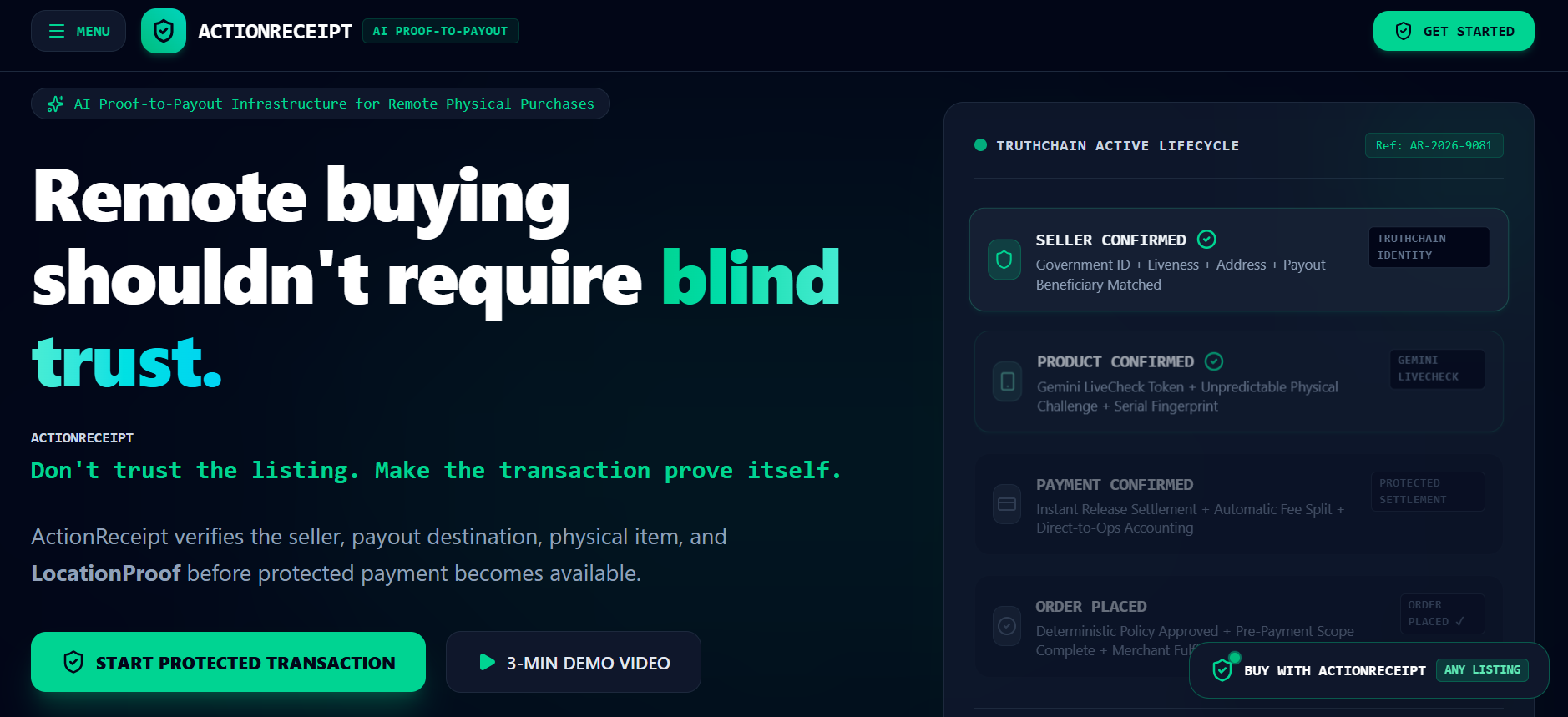
Don’t trust the listing. Make the transaction prove itself. ActionReceipt was created to move the most important verification to the point where it matters most: before the buyer pays.
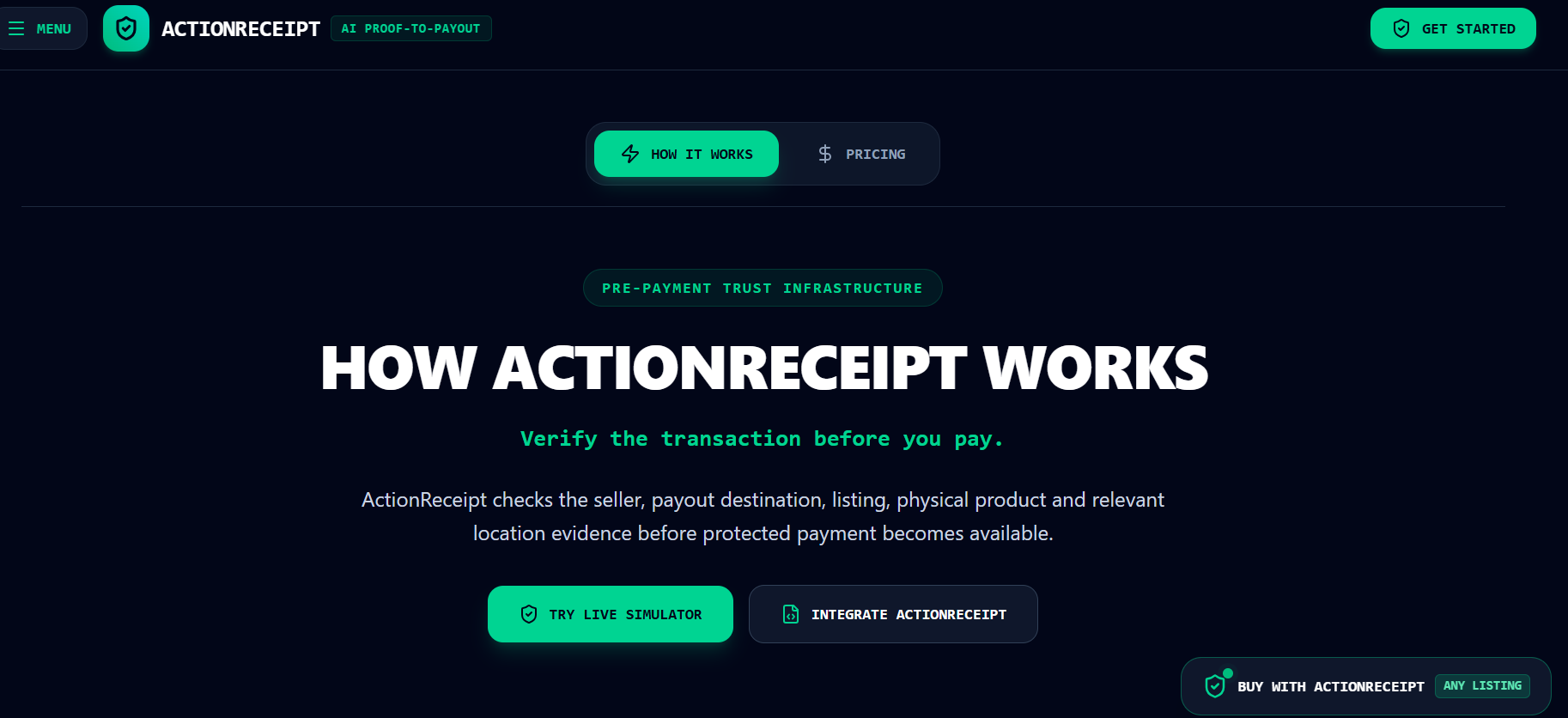
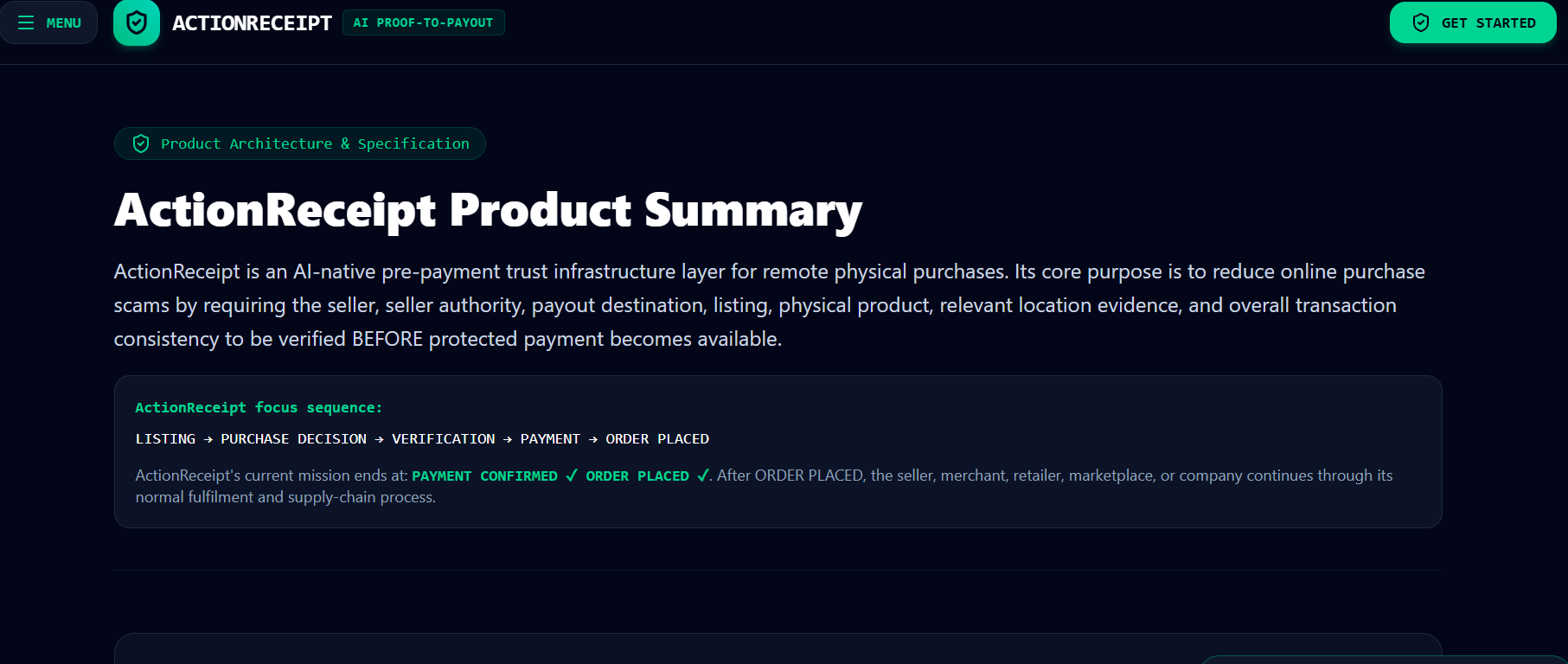
What it does ActionReceipt is an AI-powered pre-payment trust layer for remote physical purchases. When a buyer discovers a product through a marketplace, social-media seller, classified listing, independent merchant or online shop, they can select:
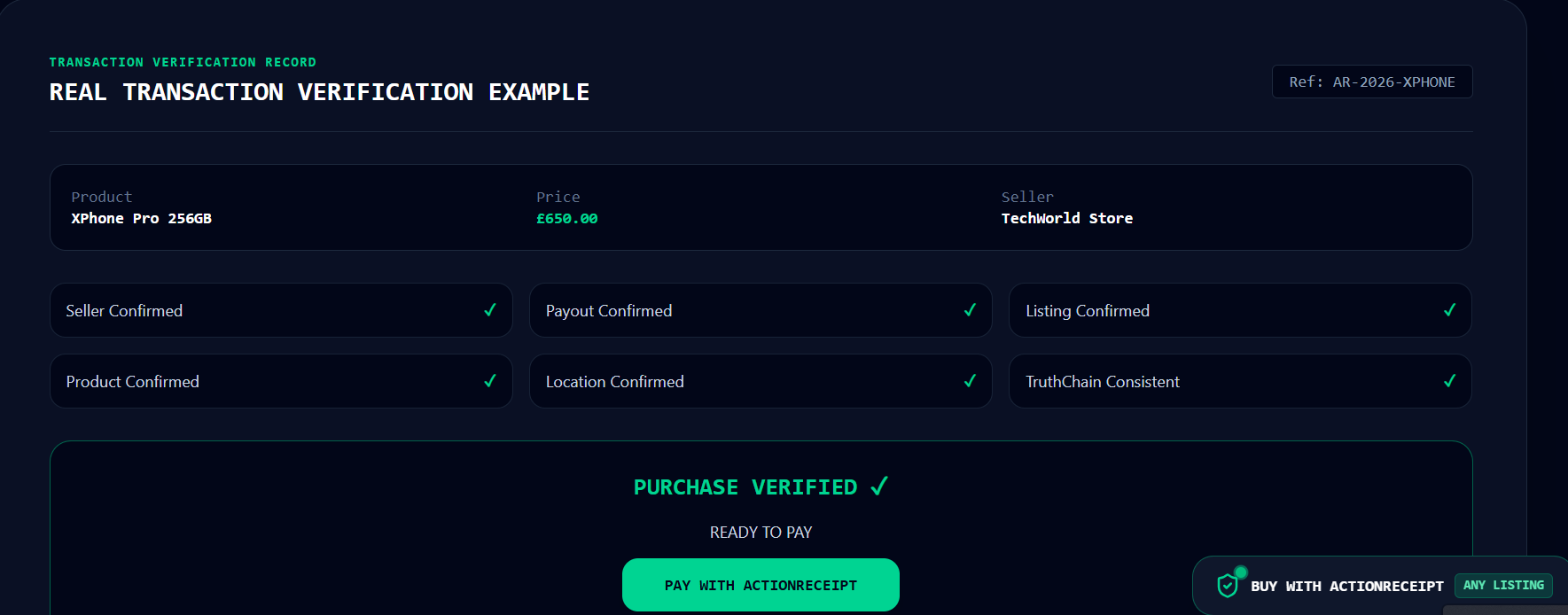
VERIFY PURCHASE ActionReceipt then creates a verification policy for that specific transaction. Depending on the product value, category and risk level, the system can evaluate:
- the identity of the seller;
- whether the seller is authorised to act for a business;
- whether the intended payout beneficiary matches the verified seller;
- whether the product listing is internally consistent;
- whether the seller genuinely possesses the physical product;
- whether relevant seller, shop and product-location evidence is consistent;
- whether all available evidence tells one coherent story.
For purchases requiring stronger verification, ActionReceipt can generate a dynamic LiveCheck challenge. For example, a smartphone seller may be asked to show the front and back of the device, rotate it, open device information or complete another unpredictable action during the verification session.
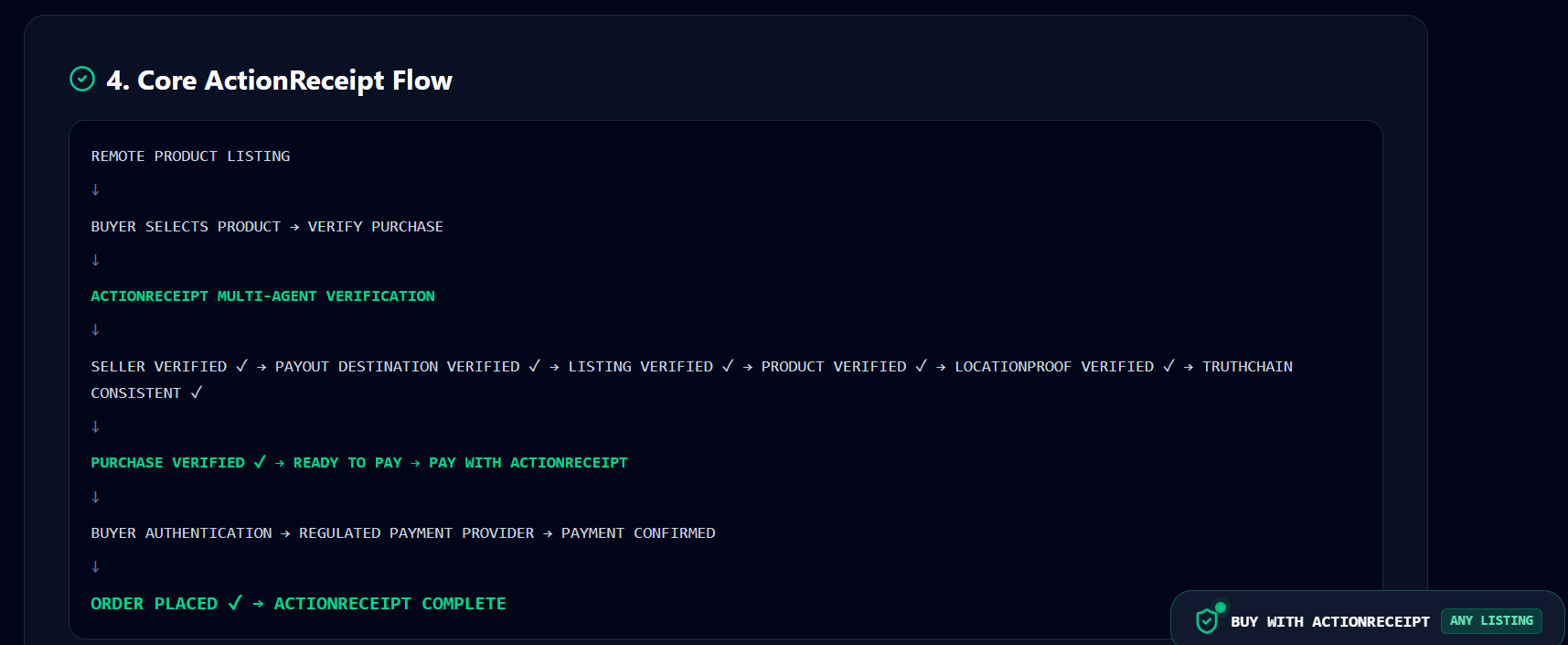
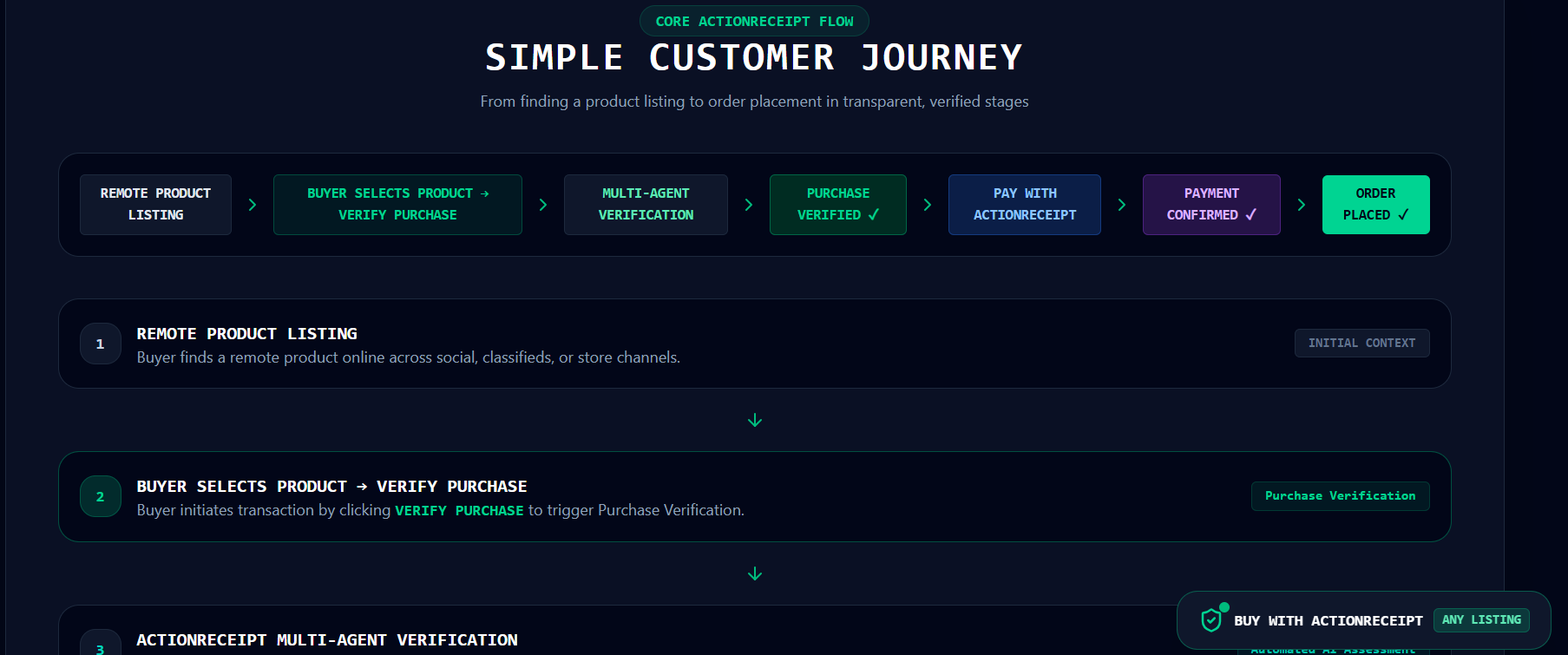
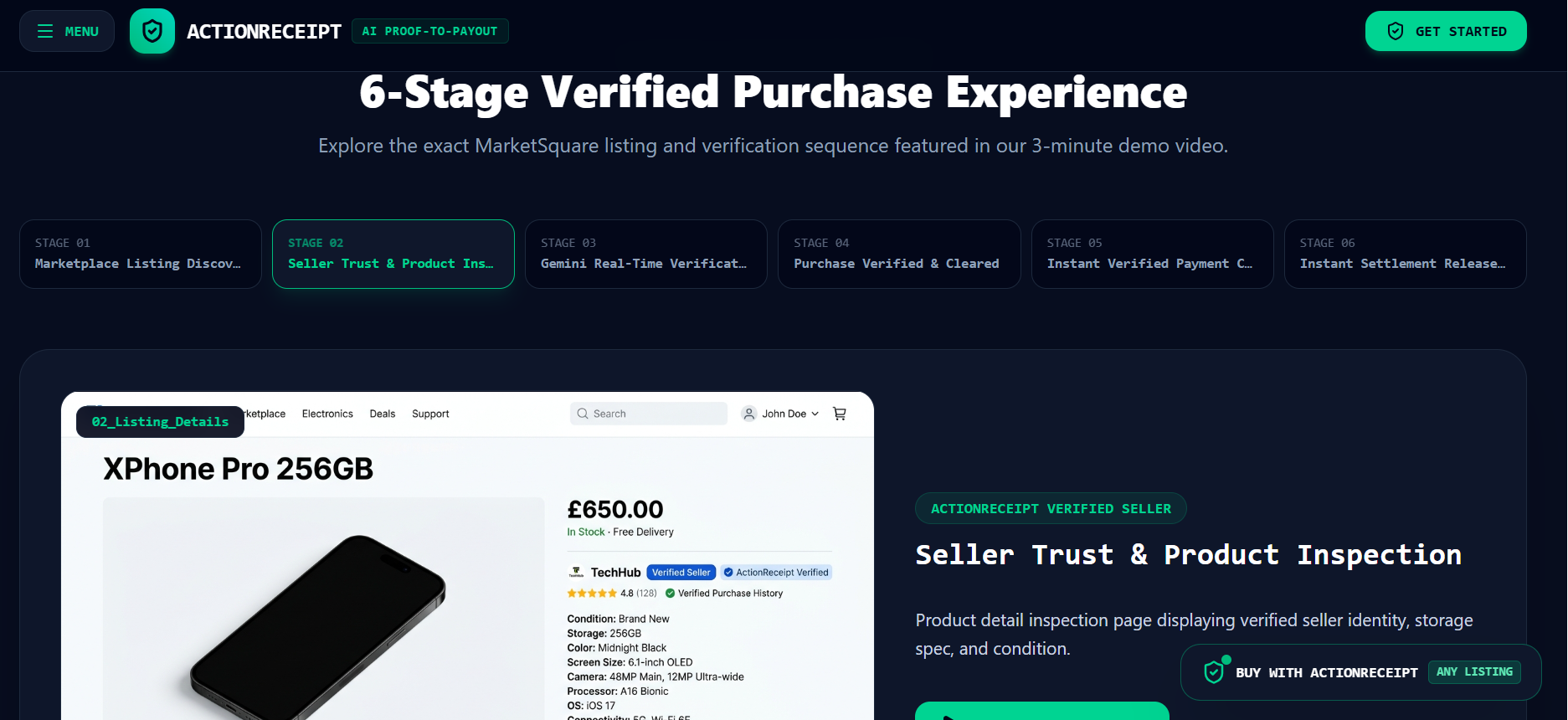
The successful ActionReceipt journey is: Product Listing → Verify Purchase → Seller Verified → Payout Verified → Listing Verified → Product Verified → LocationProof Verified → TruthChain Consistent → Purchase Verified → Payment Confirmed → Order Placed.
If mandatory checks fail, the protected payment route remains locked.
ActionReceipt currently ends at:
PAYMENT CONFIRMED ✓
ORDER PLACED ✓
The seller, merchant or marketplace then continues through its normal fulfilment process.
ActionReceipt also creates value for genuine sellers. Verified sellers can demonstrate that they are real, prove that the physical product exists and give cautious buyers more confidence to complete the purchase.
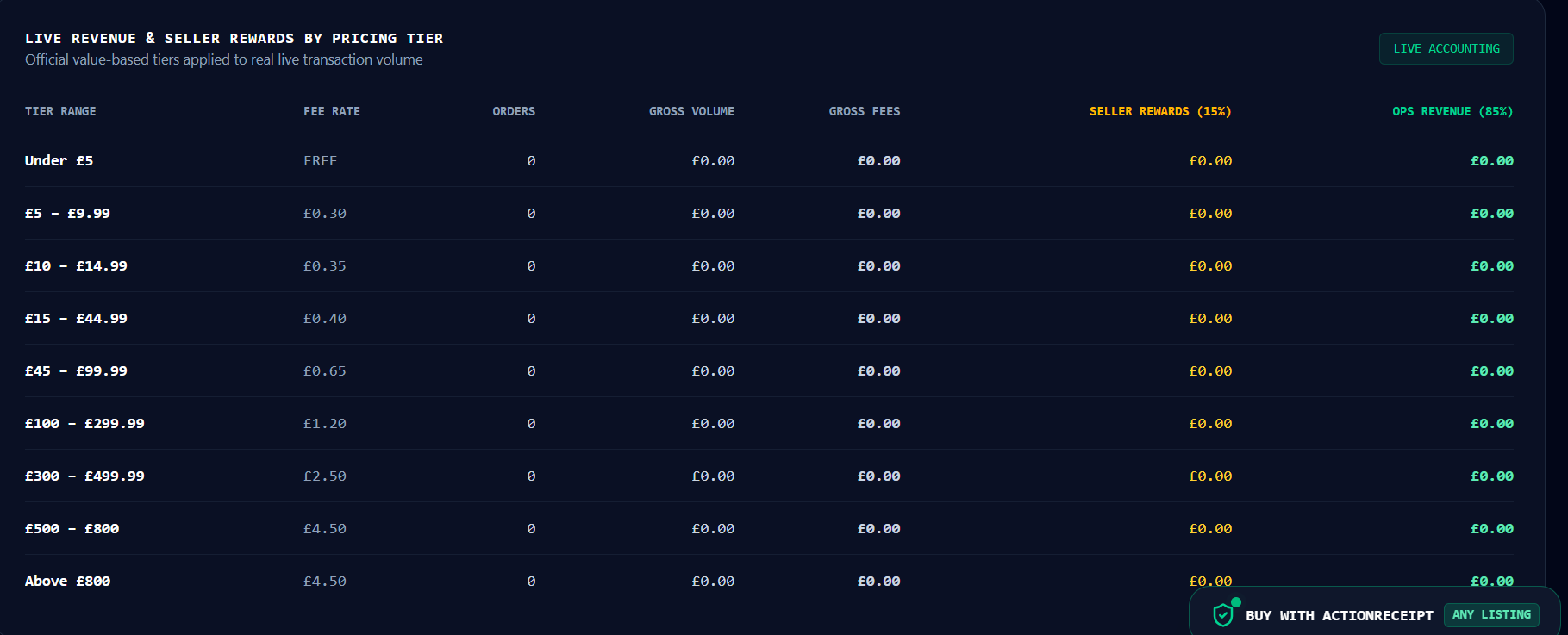
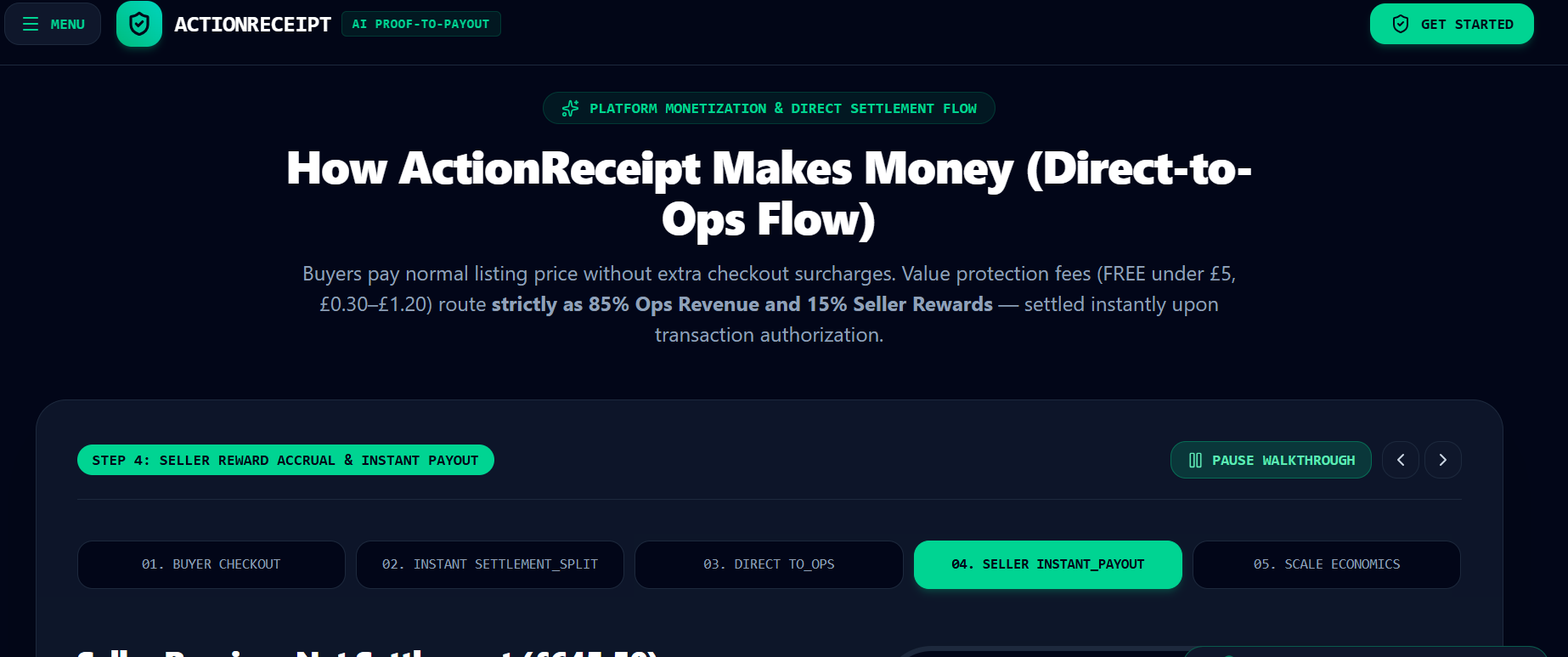
Sellers also receive 15% of eligible paid ActionReceipt protection fees, while ActionReceipt operations retain 85%. This gives legitimate sellers a direct financial reason to encourage protected transactions.
How we built it ActionReceipt was designed as an AI-native transaction-verification system rather than a traditional website with an AI chatbot added afterwards. The core system uses a Gemini multi-agent architecture consisting of one Purchase Orchestrator and six specialist logical agents.
Purchase Orchestrator The Purchase Orchestrator receives the transaction context, including the product, price, seller, listing, payout details and available evidence. It determines which checks are required and coordinates the specialist agents.
- Listing Intelligence Agent
This agent analyses the listing title, category, price, description, condition, images, timestamps and seller claims. Its purpose is to understand what is being sold and identify what evidence the transaction must provide.
- Seller Identity and Authority Agent
This agent interprets authorised identity, liveness and business-verification results. It helps establish who is behind the sale and whether that person is acting in the claimed capacity.
- Payout Integrity Agent This agent checks whether the intended payout beneficiary is consistent with the verified seller or business. A seller may appear genuine, but a mismatch between the seller and the payment destination can create a serious contradiction.
4.LocationProof Agent LocationProof evaluates authorised geographic signals such as the declared business location, seller-verification location and product-verification location. The buyer normally sees a privacy-preserving result such as:
5.Location Verified . rather than unnecessary access to a private seller’s exact live coordinates.
- Product Evidence and LiveCheck Agent This agent helps establish whether the seller genuinely possesses the physical product. It can generate a transaction-specific challenge and compare the live evidence with the original listing, product model, visual characteristics and session context.
7.TruthChain Agent TruthChain brings the specialist-agent results together. It asks whether the seller, payout destination, listing, physical product and location evidence tell one consistent story. Possible outcomes include:
Consistent Additional Proof Required Critical Contradiction After the AI agents complete their work, a deterministic server-side Policy Engine decides whether payment can become available. This separation is essential: AI interprets evidence. Code controls transaction state. The payment provider confirms money movement.
Gemini does not directly transfer funds or independently declare that payment has succeeded. The technical stack is designed around Google Cloud services: 1.Google Cloud Run: for application and backend services; 2.Gemini 3.6 Flash: for multi-agent evidence interpretation; 3.Firestore: for transactions, verification states and structured results; 4.Firebase Authentication: for authenticated buyer, seller and administrative sessions; 5.Cloud Storage: for authorised transaction evidence; 6.Secret Manager: for sensitive configuration; 7.Cloud Logging and Cloud Monitoring:for execution records and operational visibility.
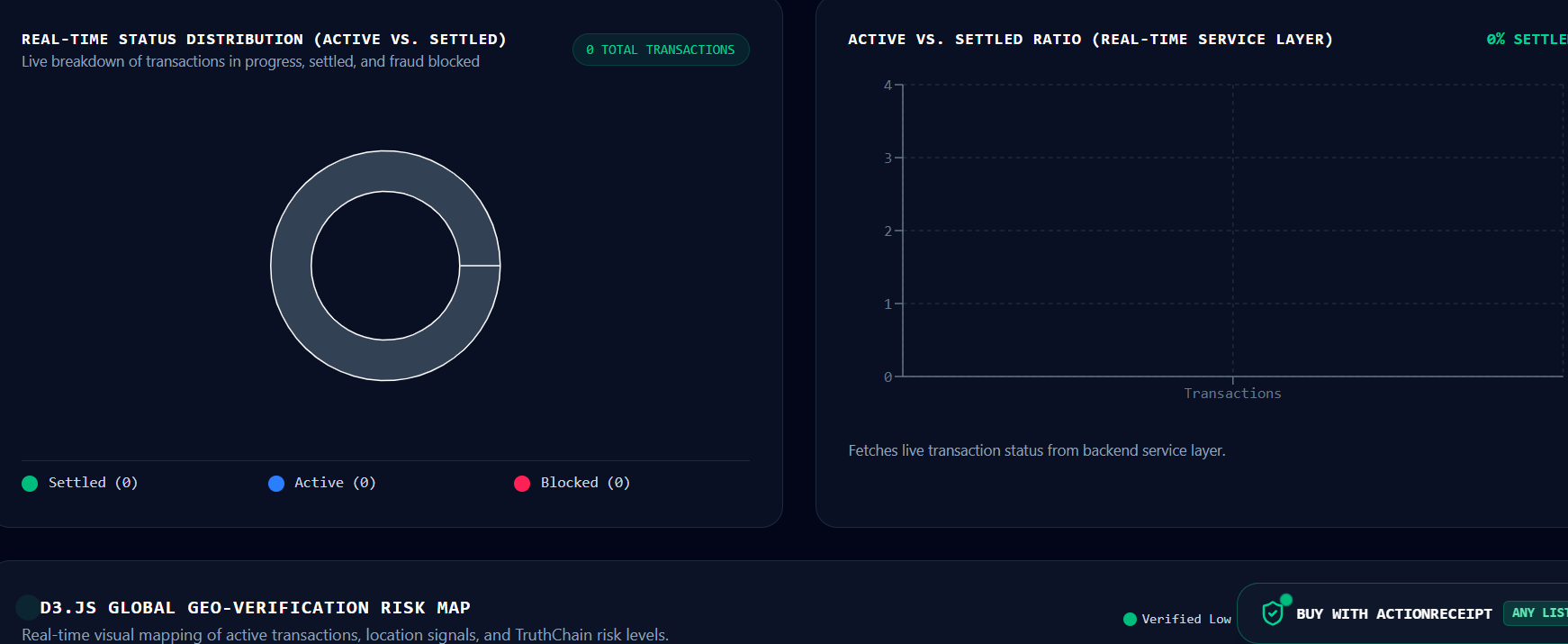
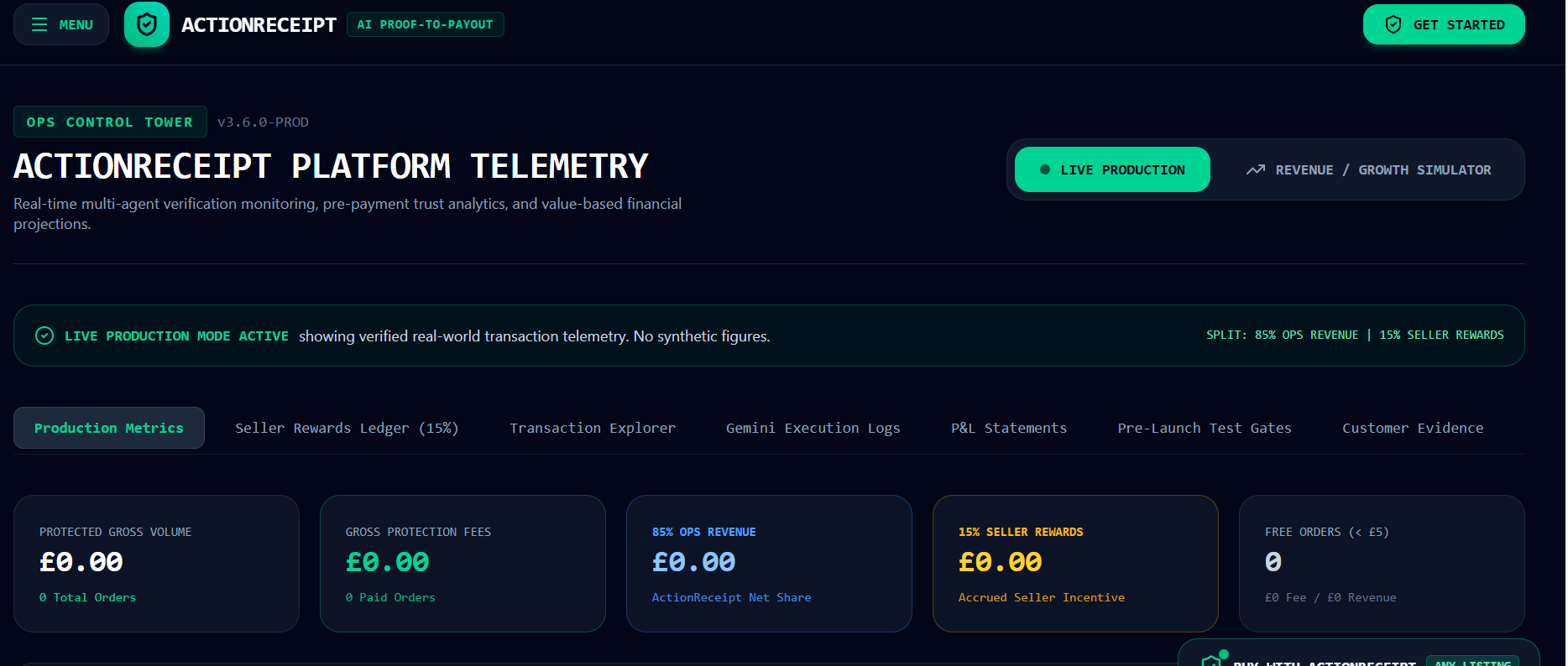
The system also separates data into three clear environments: 1.Live Production — genuine production activity only; 2.Demo/Simulator — synthetic transactions used to demonstrate the workflow; 3.Revenue/Growth Projection— hypothetical business scenarios, never presented as live revenue.
Challenges we ran into One of the biggest challenges was deciding where AI should stop. It would have been easy to allow the model to make every decision. However, payment systems require predictable rules, accountability and clear state control. We therefore separated AI reasoning from deterministic payment eligibility. Another major challenge was making a sophisticated verification process understandable to ordinary buyers and sellers. Internally, ActionReceipt may use several agents, evidence sources and policy checks. Externally, the user should see a simple experience:
Checking seller → Checking payout → Checking product → Checking location → Purchase Verified Location privacy was another important challenge. GPS and geographic information can strengthen transaction evidence, but the system must avoid exposing a private seller’s exact live position unnecessarily. LocationProof therefore focuses on consistency and privacy-preserving confirmation. We also had to solve the difference between very small and high-value transactions. A basket worth £4 should not require the same verification depth or fee as a £200 product. This led to tiered order-based 4.pricing and risk-based verification.
Another challenge was ensuring that seller incentives were strong enough. A buyer-protection system will struggle to grow if sellers see it only as an additional check. ActionReceipt therefore includes Seller Rewards, giving verified sellers a share of eligible protection fees.
Finally, we had to ensure that live data, simulated demonstrations and projected revenue remained clearly separated. This was important for transparency and credibility.
Accomplishments that I am proud of I am proud to have developed a complete pre-payment verification concept that connects AI reasoning to a controlled transaction workflow.
Key accomplishments include: 1.creating a clear buyer journey from product listing to Order Placed;
- designing one Purchase Orchestrator and six specialist Gemini agents;
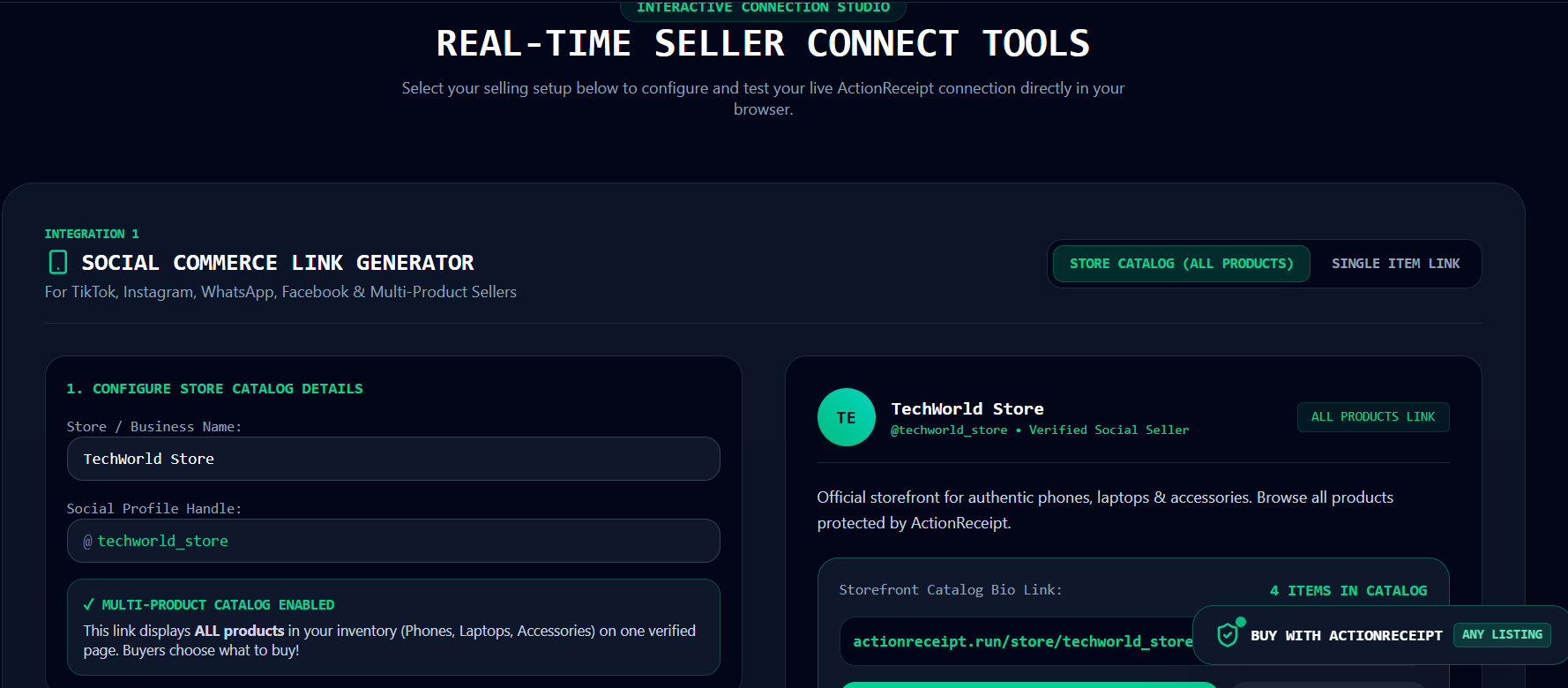
- building seller, payout, listing, product and LocationProof verification stages; 4.creating TruthChain as the final evidence-reconciliation layer; 5.separating AI interpretation from deterministic payment control; 6.developing a live transaction simulator; 7.designing separate Live Production, Demo and Revenue Projection dashboards;
- implementing order-based tiered pricing;
- creating a Seller Rewards model; 10.supporting multiple integration paths for social sellers, private sellers, small businesses and large platforms; 11.deploying the application through Google Cloud infrastructure.
We are especially proud that ActionReceipt is designed to create value for both sides of the transaction. Buyers receive stronger evidence before paying. Genuine sellers receive trust, improved conversion opportunities and Seller Rewards.
What we learned The most important lesson was that trust does not come from one badge, one identity check or one AI prediction. Trust becomes stronger when several independent pieces of evidence agree. A verified identity does not prove that a product exists. A product video does not prove that the payout account belongs to the seller. A business registration does not prove that the current transaction is genuine. ActionReceipt therefore focuses on consistency across the full pre-payment evidence chain. We also learned that AI is most useful when it handles interpretation, comparison and repetitive evidence analysis, while deterministic software controls sensitive state transitions. Another important lesson was that fraud prevention must provide commercial value to genuine sellers. Sellers are more likely to adopt a verification system when it helps them build trust, complete more sales and earn rewards. We also learned that complex technology must remain invisible to ordinary users. Buyers and sellers should not need to understand AI models, APIs, structured outputs or policy engines. They should only need to understand:
Verify before you pay.
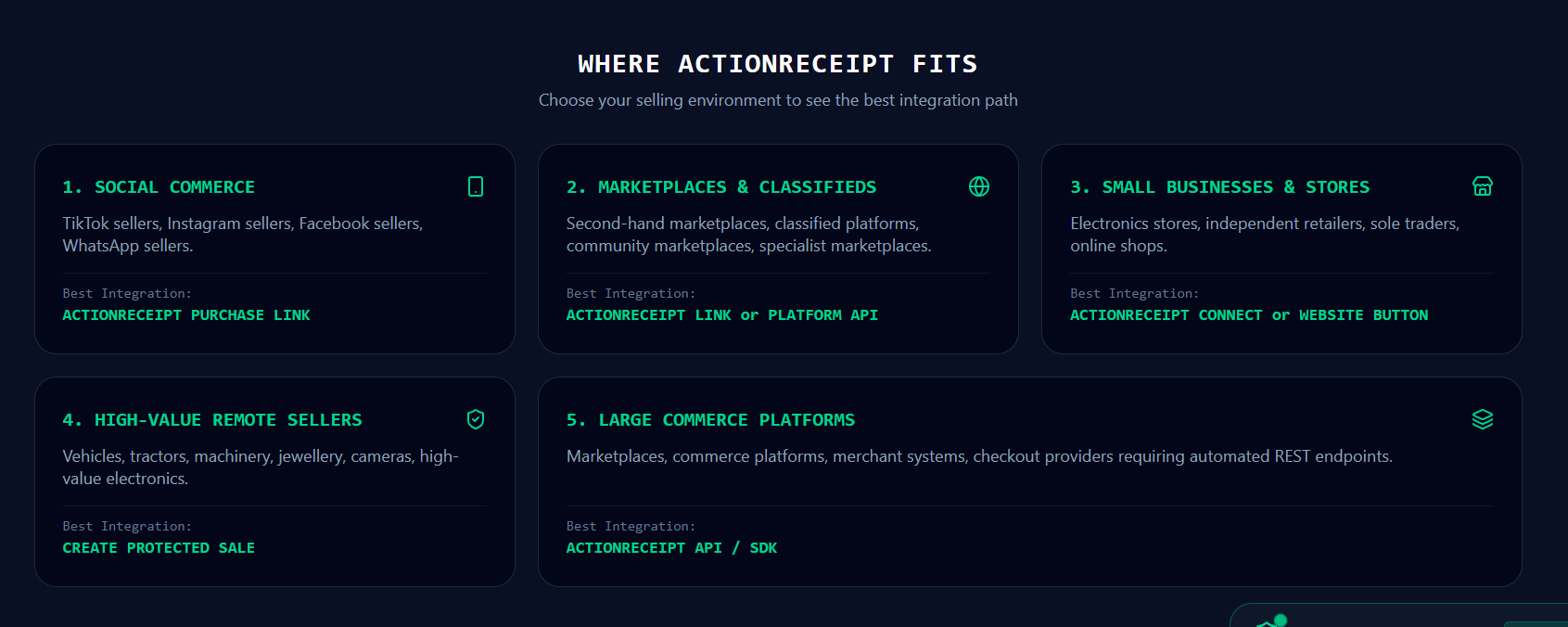
What's next for ActionReceipt The next stage is to move from a strong working prototype into controlled production pilots. Planned next steps include: 1.completing production payment-provider integration;
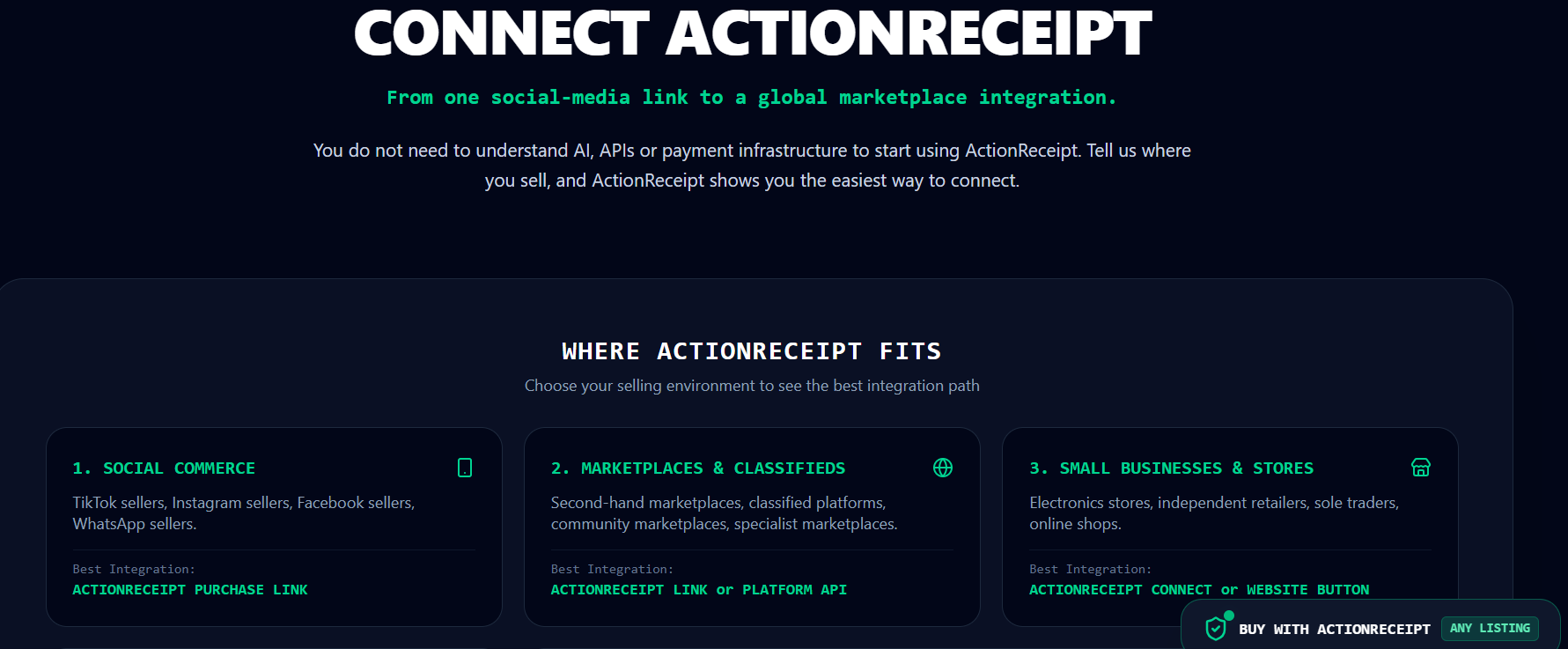
- testing the system with real buyers and verified sellers; 3.expanding identity, business and payout-verification providers; 4.improving transaction-specific LiveCheck challenges; 5.strengthening LocationProof with authorised multi-signal evidence; 6.building simpler no-code integrations for social sellers and small businesses;
- expanding API integration for marketplaces and commerce platforms;
- measuring verification accuracy, buyer conversion and seller-reward impact; 9.defining pricing for protected orders above £300;
- improving agent execution logs and production monitoring; 11.refining human-review and escalation processes for uncertain cases.
- testing the system with real buyers and unverified sellers;
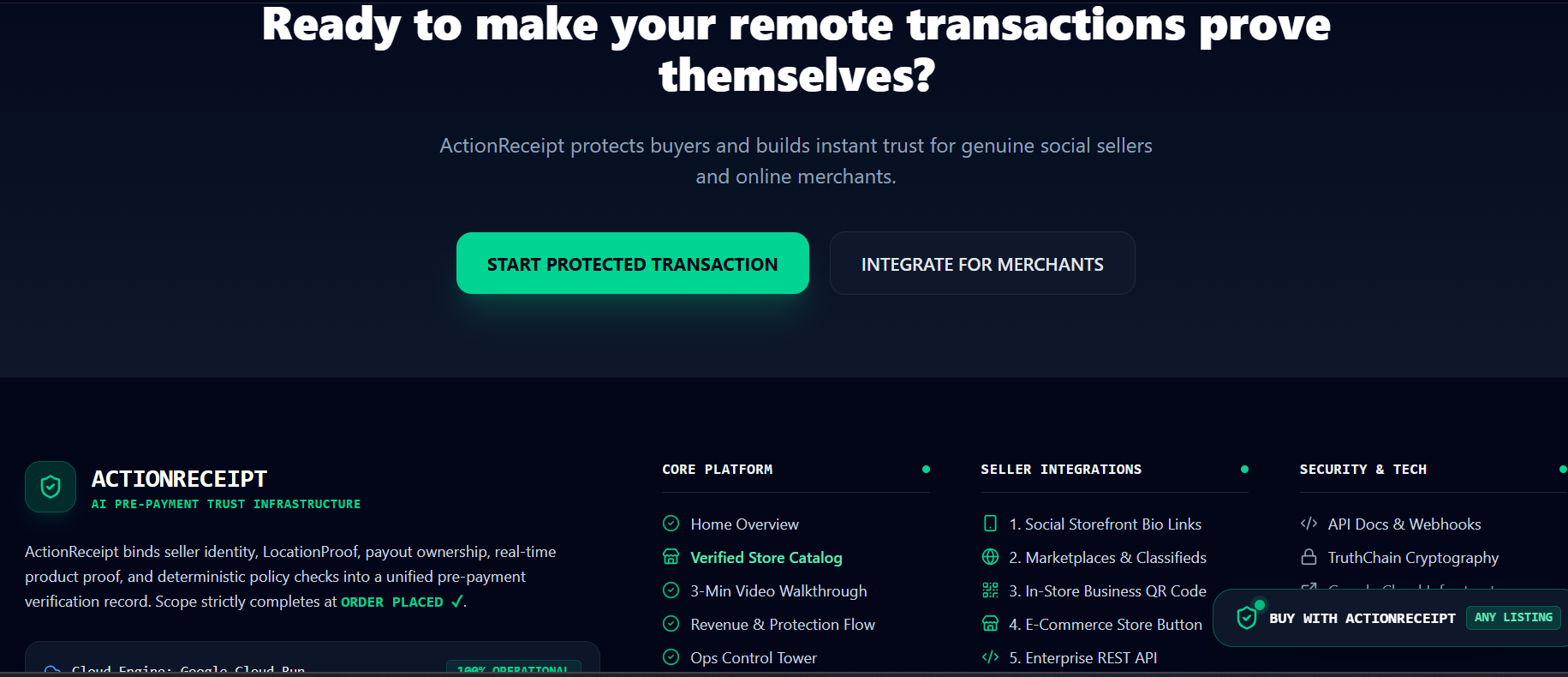
The long-term goal is for ActionReceipt to become a reusable trust layer between: I want to buy this remotely and I am ready to pay.
From a social seller sharing one ActionReceipt link to a major marketplace connecting through an API, the mission remains the same:
Verify → Prove → Pay → Order Placed
Built With
- ai
- api
- authentication
- cloud
- commerce
- computer
- e-commerce
- fintech
- firebase
- firestore
- fraud
- manager
- multi-agent
- next.js
- node.js
- payment
- prevention
- react
- rest
- secret
- security
- storage
- systems
- typescript


Log in or sign up for Devpost to join the conversation.