-
-
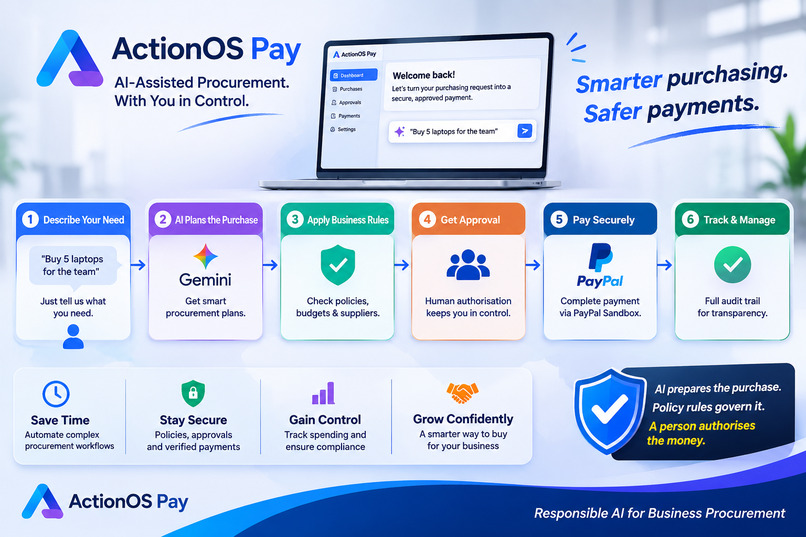
ActionOS Pay
Inspiration
Small businesses often spend valuable time managing purchases, comparing suppliers, preparing quotes, obtaining approvals, and making payments. These activities are frequently scattered across spreadsheets, emails, messaging platforms, and payment services. This can lead to delays, human errors, uncontrolled spending, and limited financial visibility.
I was inspired by a simple question: What if small businesses could use AI to simplify procurement without giving an AI system unrestricted control over their money?
As AI agents become more capable of interpreting instructions and taking actions, I believe an important question is not just what they can automate, but how we can make that automation trustworthy.
That idea became the foundation of ActionOS Pay.
Our guiding principle is:
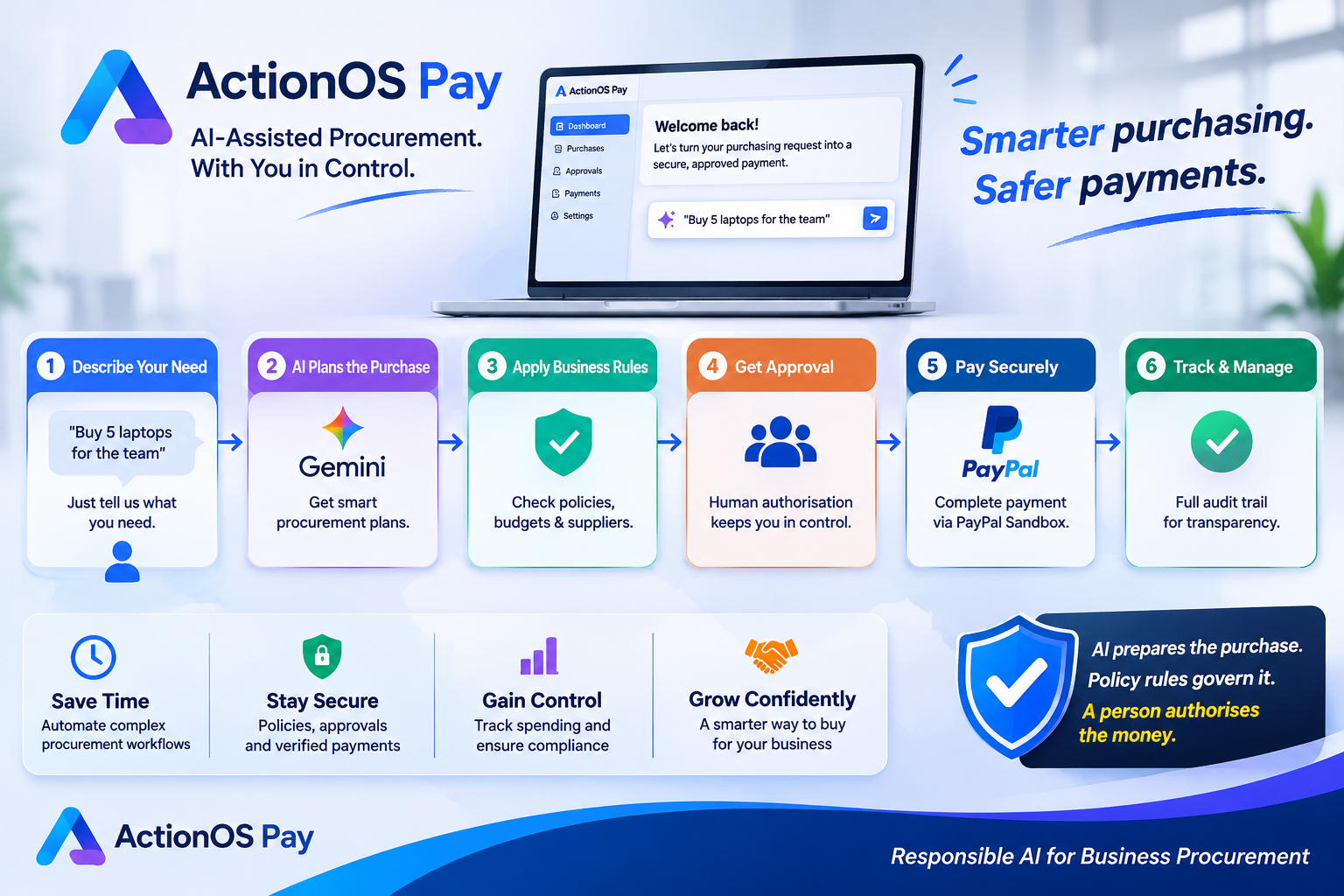
AI prepares the purchase. Policy rules govern it. A person authorises the money.
What it does
ActionOS Pay is an AI-assisted procurement and payment workflow designed to help small businesses manage purchasing decisions more efficiently and responsibly.
A user describes a purchasing requirement in natural language. The AI interprets the request and helps generate a structured procurement plan using a curated product and supplier catalogue.
The application then:
- Converts purchasing requests into structured procurement records.
- Helps identify suitable products and suppliers from the available catalogue.
- Generates quotes with calculated costs.
- Evaluates purchases against business policies, supplier requirements, and budget rules.
- Routes purchases through the appropriate human approval process.
- Uses PayPal Developer Platform Sandbox to create payment orders and process buyer-approved payments.
- Maintains procurement, payment, and audit-related records.
The key distinction is that AI does not independently authorise or execute spending. The application validates the purchase against deterministic business rules, and a human remains responsible for authorising the financial commitment.
How we built it
We built ActionOS Pay as a full-stack application, approaching it as a governed business workflow rather than simply a chatbot connected to a payment API.
The main technologies and components include:
- Gemini: Used for AI-assisted interpretation of natural-language procurement requests and structured procurement planning.
- Next.js and TypeScript: Used to build the application and its server-side API workflows.
- Supabase and PostgreSQL: Used for persistent application data, including business, procurement, approval, and transaction-related records.
- Procurement policy engine: Implements deterministic validation of supplier eligibility, budget constraints, and purchasing rules.
- PayPal Developer Platform Sandbox: Supports payment-order creation, buyer approval, and server-side payment capture.
- Automated testing: Covers application logic, financial integrity, adversarial scenarios, database migrations, permissions, concurrency, and production builds.
One of our most important architectural decisions was separating AI recommendations from financial authority.
The AI prepares the procurement plan, but the application independently validates the quote and applicable policies. Human approval is required before the payment workflow proceeds.
We also invested in automated quality gates to catch regressions and validate important security and financial behaviours as the application evolved.
Challenges we ran into
One of the biggest challenges was introducing AI into a workflow where incorrect decisions could have financial consequences.
An AI-generated recommendation should not automatically become an authorised purchase. We had to establish clear boundaries between AI-generated information, application-controlled policy enforcement, human approval, and payment execution.
Payment integration presented another challenge. Creating a PayPal order is not the same as successfully completing a payment. We needed to account for buyer approval, server-side capture, duplicate requests, transaction verification, and the relationship between the original quote and the final payment.
Security and data integrity also required considerable attention. Procurement and payment operations must respect user permissions and organisational boundaries. This meant carefully considering authentication, role-based authorisation, authoritative database records, and financial validation.
Finally, the hackathon timeline required prioritisation. Rather than attempting to build an entire international supplier marketplace or an unrestricted autonomous purchasing agent, we concentrated on delivering a focused procurement-to-payment workflow that demonstrates the core idea.
Accomplishments that we're proud of
We are proud to have developed a working foundation for a governed AI-assisted procurement workflow that connects natural-language purchasing requests with structured business decisions and payment processing.
Some of our key accomplishments include:
- Bringing AI-assisted procurement planning into a structured business workflow.
- Separating AI recommendations from deterministic business policy enforcement.
- Implementing supplier and budget policy evaluation.
- Building a human approval process before financial execution.
- Integrating PayPal Developer Platform Sandbox for the payment lifecycle.
- Establishing persistent data management with Supabase and PostgreSQL.
- Implementing automated tests for financial integrity, security scenarios, database permissions, and concurrency.
- Establishing a continuous integration workflow with successful TypeScript, ESLint, testing, database, and production-build checks.
Most importantly, we are proud of the design principle behind the product: making AI useful in financial workflows without removing human accountability.
What we learned
Building ActionOS Pay taught us that successful agentic applications require more than connecting a language model to external tools.
Our most important lessons were:
- AI needs boundaries: A model can interpret requests and recommend actions, but it should not automatically control sensitive financial decisions.
- Business rules should be deterministic: Critical decisions such as budget compliance, supplier eligibility, and approval requirements should be enforced by application logic.
- Human oversight is essential: Financial commitments should have clear approval and accountability.
- Payment integration requires lifecycle thinking: Order creation, buyer approval, capture, verification, and reconciliation are distinct stages that must be handled carefully.
- Security is an architectural responsibility: Authentication, authorisation, data ownership, and transaction integrity must be considered from the beginning.
- Focused execution creates stronger products: A well-defined end-to-end workflow is more valuable than a collection of disconnected AI features.
We also learned to treat AI as one component of a larger system, not as the entire system.
What's next for ActionOS Pay
Our next goal is to evolve ActionOS Pay from a focused hackathon implementation into a more comprehensive, secure, and scalable procurement platform for small businesses.
The roadmap includes:
- More flexible procurement policies: Allow businesses to configure approval limits, spending categories, supplier requirements, and departmental budgets.
- Improved supplier management: Expand supplier onboarding, verification, catalogue management, and quotation workflows.
- Stronger payment reconciliation: Improve transaction-state management, webhook verification, recovery workflows, and duplicate-payment protection.
- More capable AI assistance: Improve procurement recommendations, request clarification, quote comparisons, and explanations while keeping policy enforcement deterministic.
- Better financial visibility: Introduce procurement analytics, spending reports, approval histories, and budget monitoring.
- Broader payment and business integrations: Explore additional payment options and integrations with accounting and business management systems.
- Production readiness: Strengthen operational monitoring, shared rate limiting, deployment security, and end-to-end testing before handling real business transactions.
Our long-term vision is to make ActionOS Pay a trusted procurement assistant for small businesses: one that reduces administrative work, improves purchasing visibility, and makes responsible automation practical.
AI prepares the purchase. Policy rules govern it. A person authorises the money.
Built With
- agentic-ai
- ai-agents
- artificial-intelligence
- business-automation
- financial-technology
- fintech
- gemini
- generative-ai
- google-ai
- human-in-the-loop
- javascript
- next.js
- node.js
- paypal
- paypal-developer-platform
- paypal-sandbox
- postgresql
- procurement
- react
- responsible-ai
- rest-api
- small
- supabase
- typescript
- workflow-automation