
Inspiration
Most AI applications are still designed around a simple pattern: a user asks a question, the model generates an answer, and the interaction ends.
But real-world work is different. A meaningful business objective can require multiple actions, external systems, waiting for responses, handling failures, human approval, and verification before the work is actually complete.
That led us to a simple question:
What if an AI agent was responsible for completing a goal, rather than simply responding to a prompt?
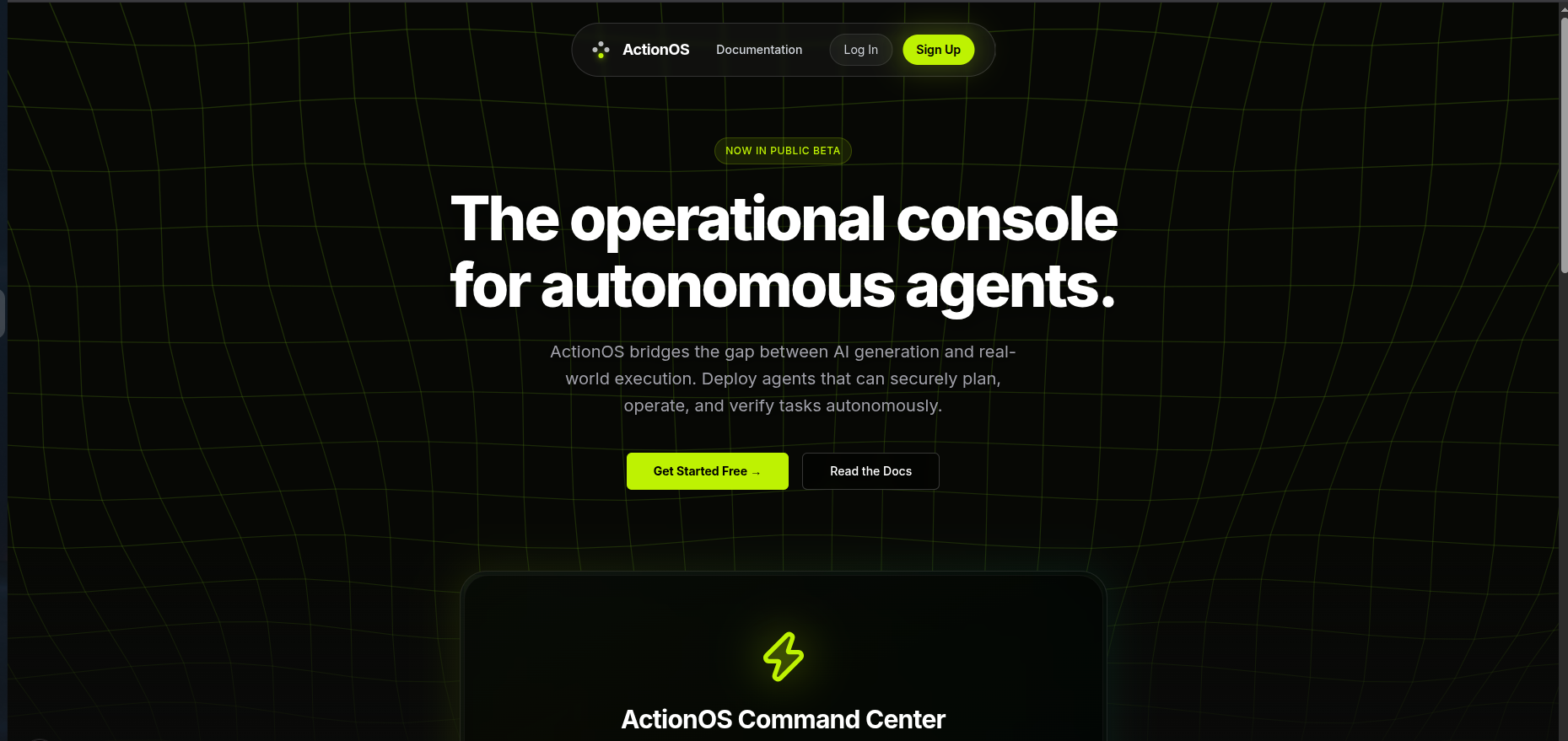
This idea became ActionOS — an autonomous AI execution platform designed around durable, goal-driven missions.
Instead of treating AI as a chatbot, ActionOS treats AI as an execution engine. A user provides a high-level objective, and the system is designed to understand the goal, create a plan, execute capabilities, observe results, verify evidence, and finally complete the mission.
What We Built
ActionOS is built around the concept of a Mission.
A mission represents an objective that the system is responsible for executing. The platform separates reasoning from execution and persistent state, allowing the agentic workflow to operate as a controlled background process.
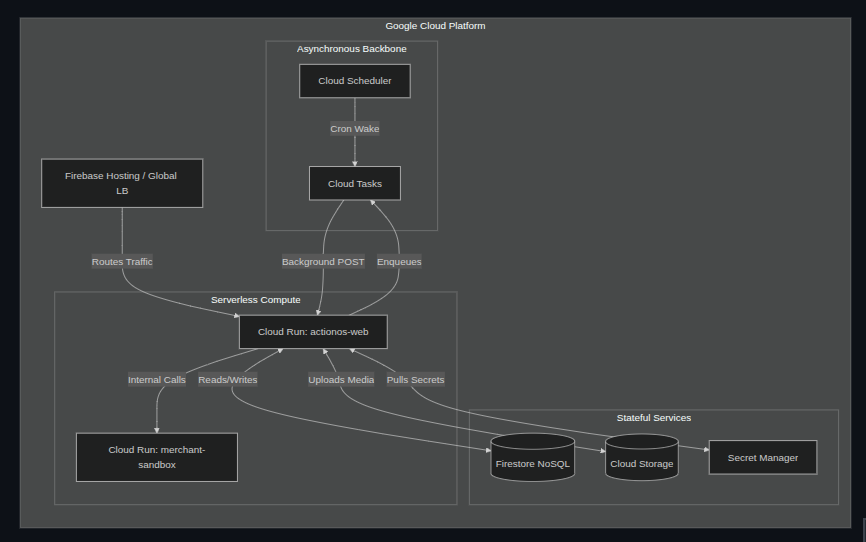
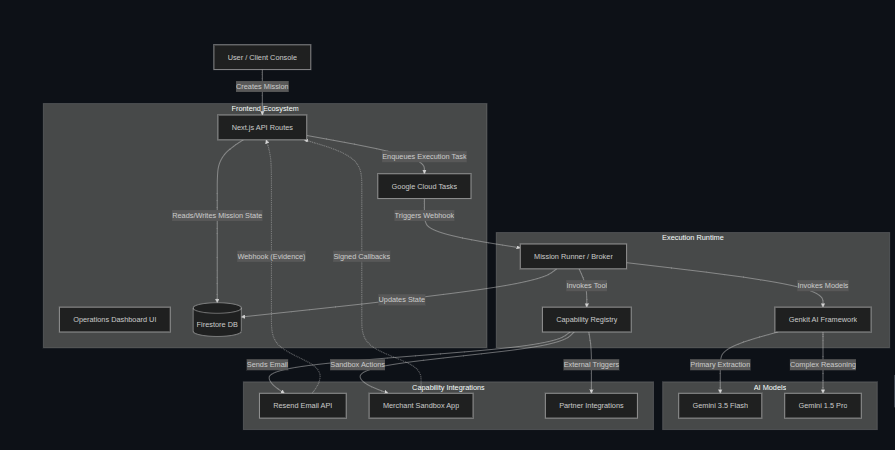
The architecture consists of several major components:
- Gemini + Genkit provide the reasoning and agentic workflow layer.
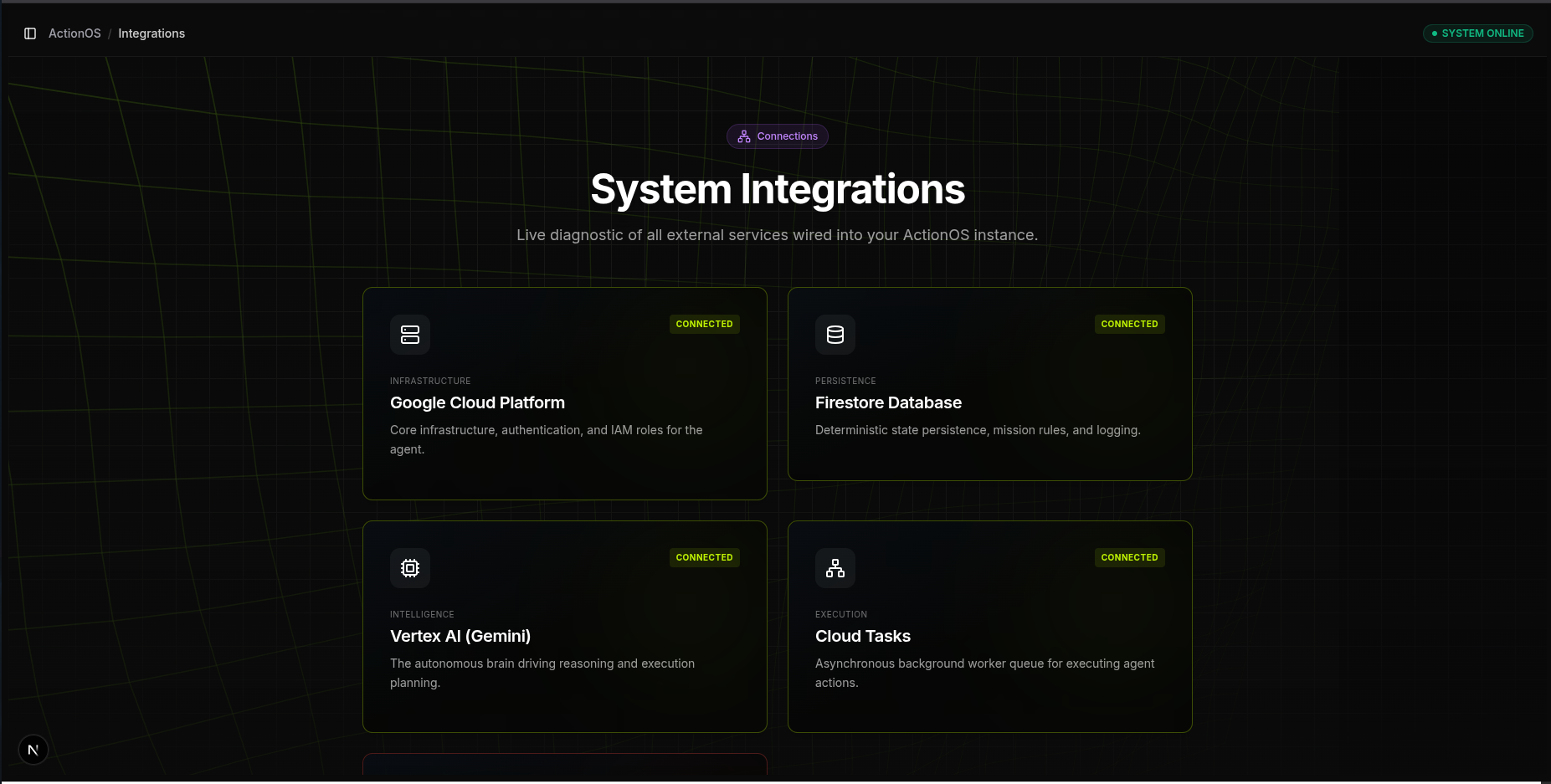
- Firestore provides persistent mission state, execution memory, and the event ledger.
- Cloud Tasks provides the foundation for asynchronous background execution and the sleep-and-wake model.
- Action Runtime manages execution and routes actions through isolated capabilities.
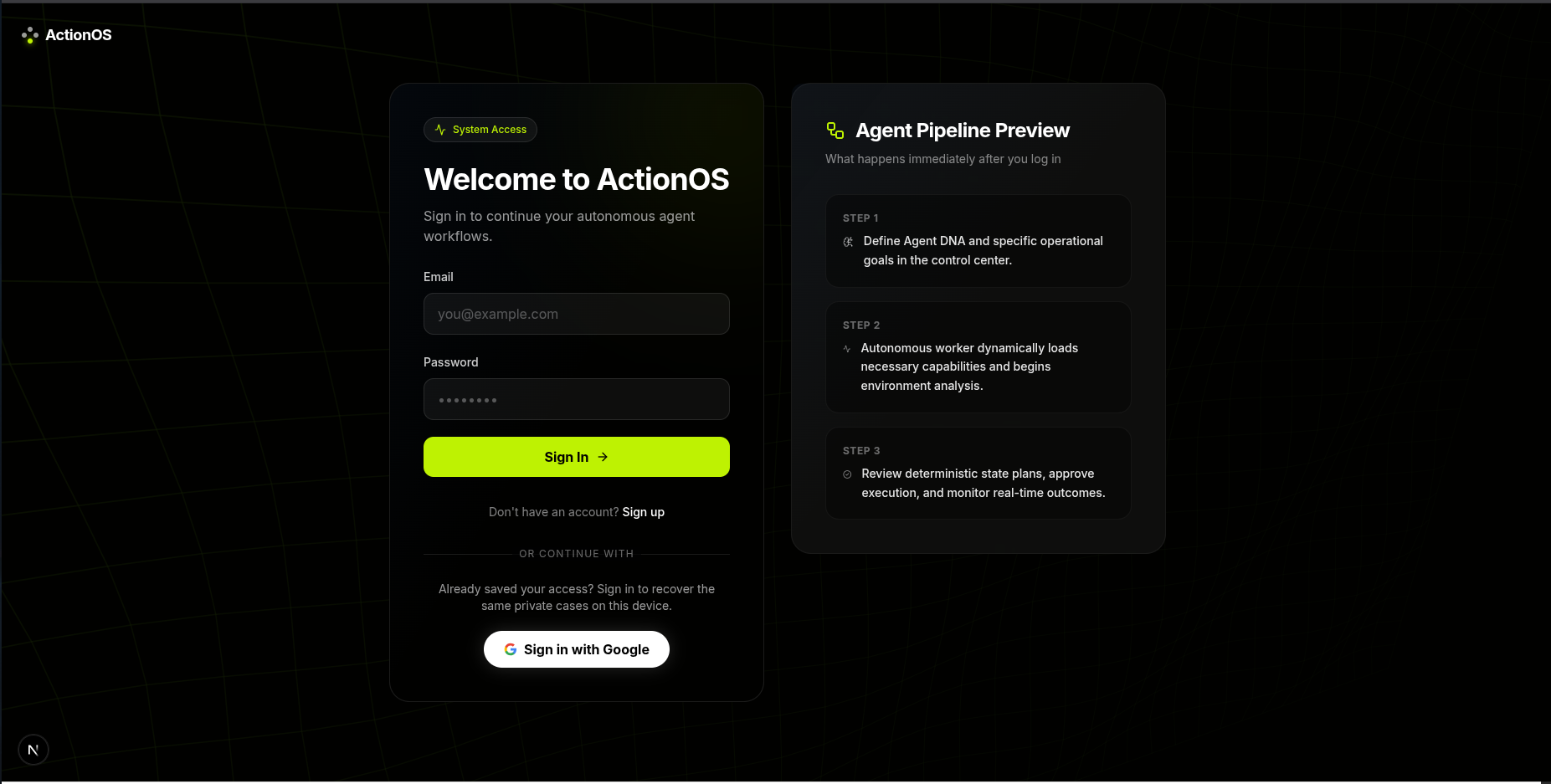
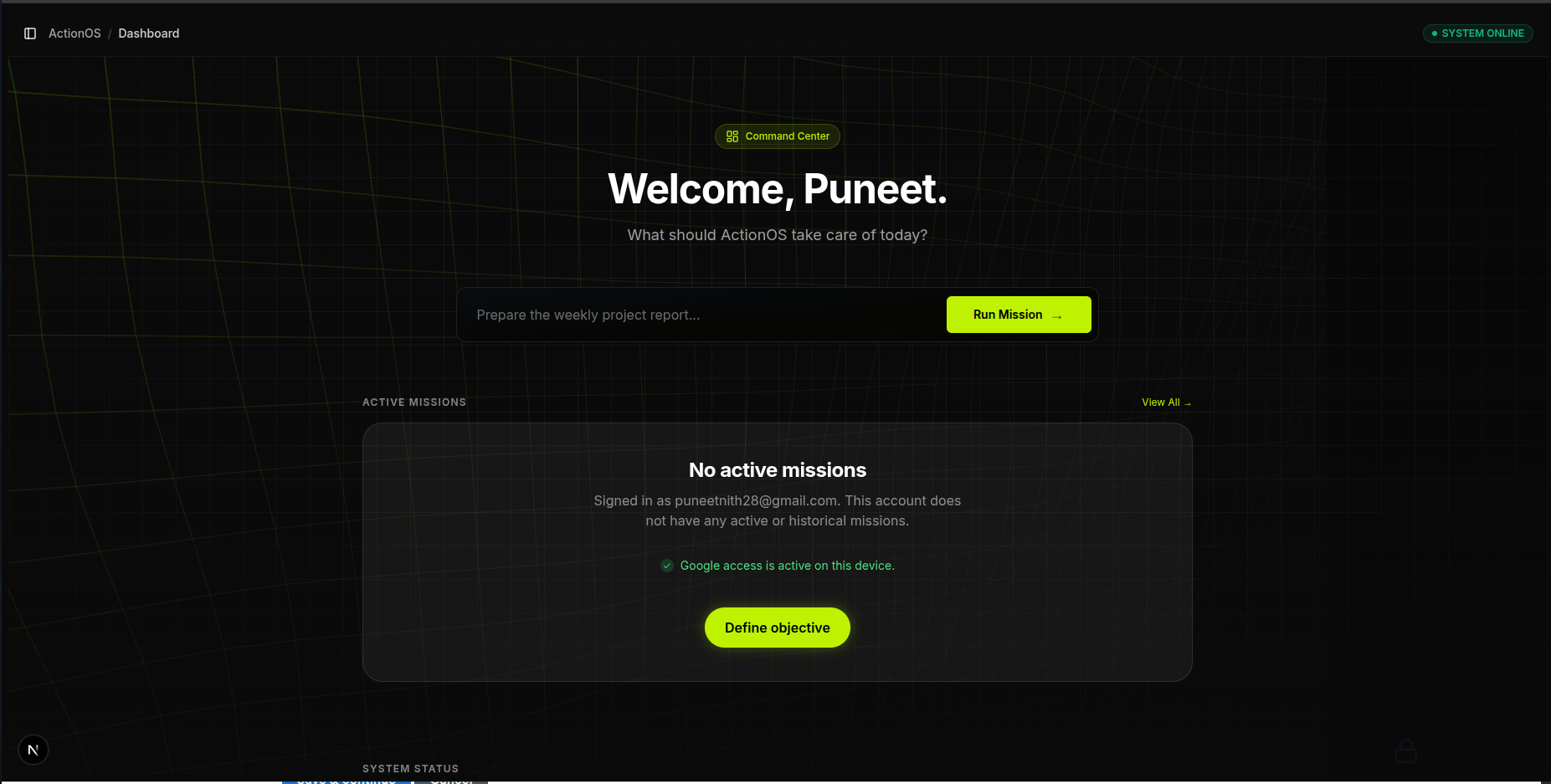
- Next.js Mission Control provides the operational interface for creating missions, observing execution, reviewing interventions, and inspecting results.
A key part of ActionOS is that execution is not hidden behind a chat response. The Mission Detail view exposes the lifecycle of a mission through structured states and an execution timeline.
The system is designed around six stages:
Understand → Plan → Execute → Observe → Verify → Complete
This allows the platform to reason about what needs to happen, perform controlled actions, collect evidence, and determine whether the original objective was actually achieved.
Agentic Execution
For example, a user can provide a goal such as:
Review a policy update, prepare a summary, and communicate the result to the engineering team.
The user does not need to manually specify every individual operation.
ActionOS is designed to determine the required execution steps, select the appropriate capabilities, execute them, observe their results, and verify the outcome.
This is what makes the system fundamentally different from a conventional chatbot.
The platform also maintains an event ledger so that execution remains traceable. Instead of only seeing a final response, we can inspect what happened during the mission and understand how the system reached its final state.
Durable Execution
One of the core architectural ideas is durable asynchronous execution.
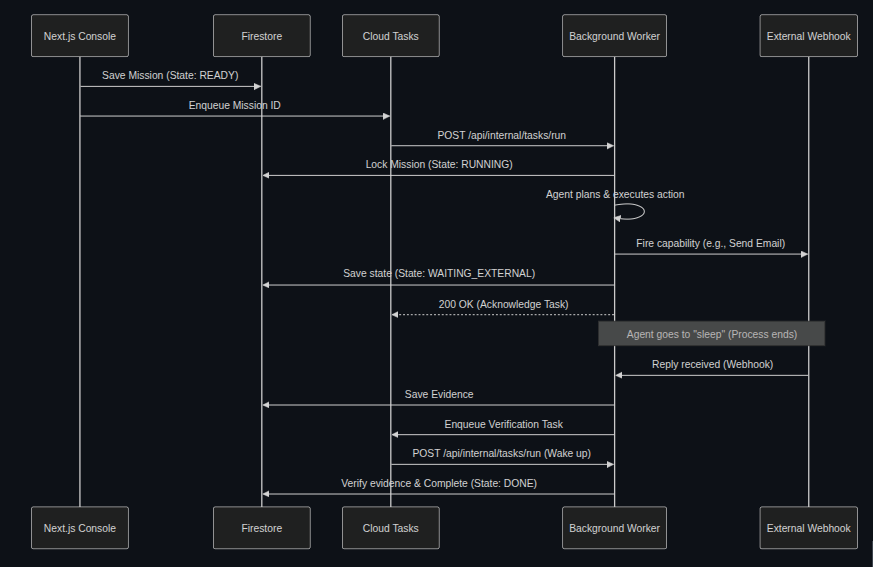
Consider an agent that sends an email and needs to wait several days for a response. A traditional synchronous application might keep a process running or repeatedly poll for updates.
ActionOS is designed differently.
The current mission state can be persisted in Firestore while the worker finishes its current execution. The mission can effectively go to sleep. When an external webhook or another event arrives, a new Cloud Task can wake the workflow and allow execution to continue from the persisted state.
This creates a durable sleep-and-wake execution model, which is particularly useful for long-running agentic workflows.
Human-in-the-Loop Safety
Autonomous execution also requires controlled intervention.
ActionOS includes a Needs Attention state for situations where an operation is ambiguous, requires approval, or should not continue automatically.
Instead of blindly allowing an agent to continue, the system can pause the mission and allow a human to review the situation before execution resumes.
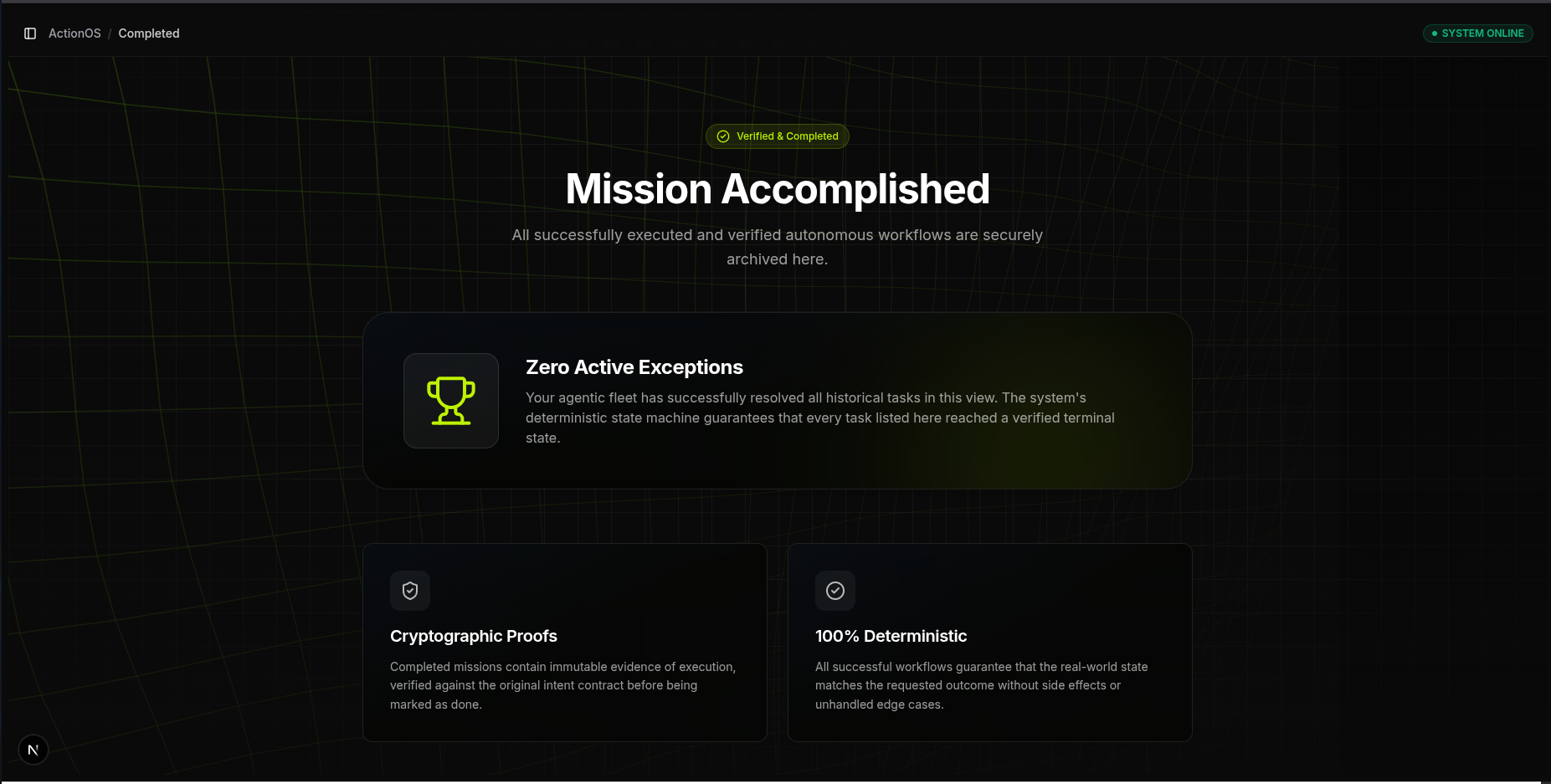
Similarly, completion is not based simply on the AI claiming that it succeeded. ActionOS is designed to collect evidence from executed capabilities and use that evidence during verification before transitioning the mission to a completed state.
What We Learned
Building ActionOS taught us that reliable agentic systems require much more than an LLM.
The difficult part is connecting reasoning with deterministic execution, persistent state, asynchronous scheduling, failure handling, human intervention, and verification.
We learned how to structure an agent around explicit state transitions instead of relying on conversational history, how to separate AI reasoning from real-world side effects, and how cloud primitives such as Firestore and Cloud Tasks can be used to build durable agentic workflows.
Challenges
One of our biggest challenges was designing the execution lifecycle so that the system could survive interruptions and asynchronous operations without losing mission state.
Another challenge was separating what the model decides from what the system is actually allowed to execute. This led us toward isolated capabilities, structured execution state, event tracking, and human intervention.
For the hackathon demonstration, we implemented and tested the platform locally using the emulator-based development environment. We also designed the production architecture around Google Cloud services such as Firestore, Cloud Tasks, and Cloud Run. Due to the billing requirement for activating the required Google Cloud services, the final demonstration focuses on the working local environment and the documented production architecture rather than claiming a live Cloud Run deployment.
The Bigger Idea
ActionOS is not simply another interface for Gemini.
It is an attempt to build an execution architecture for AI.
Gemini provides reasoning. Genkit orchestrates the AI workflows. Firestore provides durable state. Cloud Tasks enables asynchronous execution. The runtime performs controlled actions, while human intervention and evidence-based verification provide safety and reliability.
Our goal is simple:
Move AI from generating answers to reliably completing missions.
That is ActionOS — AI that takes action, not just instructions.
Built With
- cloud-run
- firebase
- firebase-auth
- gemini
- genkit
- google-cloud
- google-cloud-firestore
- google-cloud-tasks
- next.js
- node.js
- pnpm
- react
- shadcn
- tailwind
- typescript

Log in or sign up for Devpost to join the conversation.