-
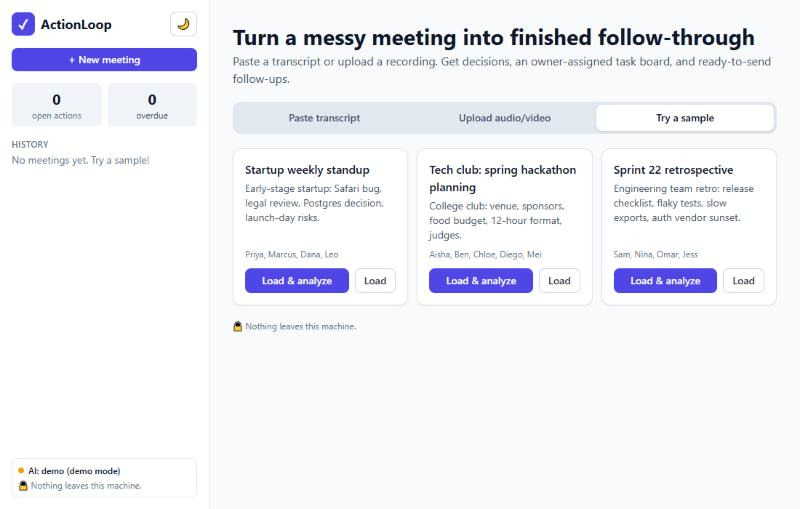
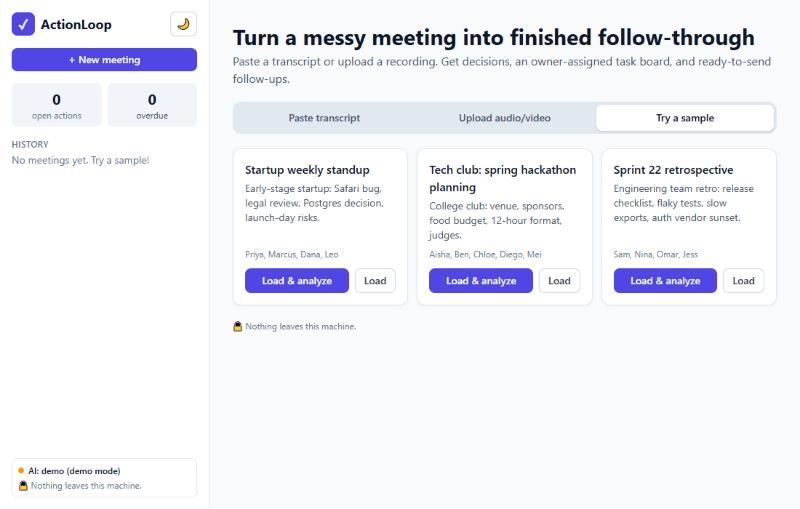
Landing
-
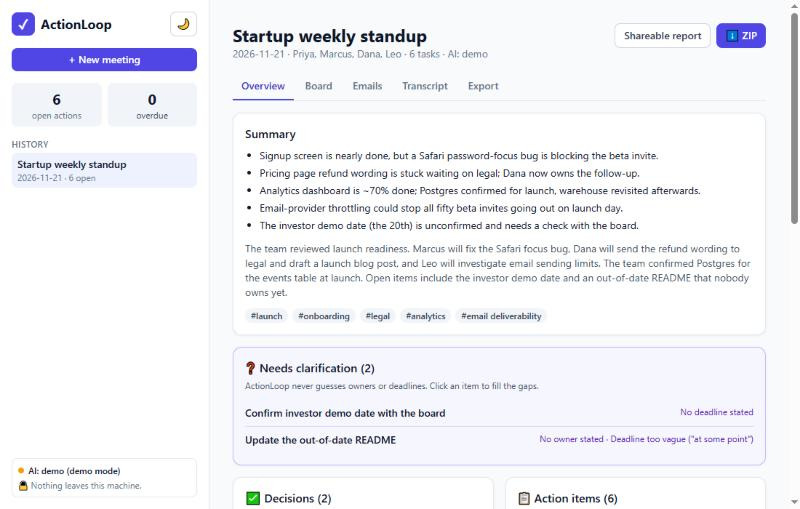
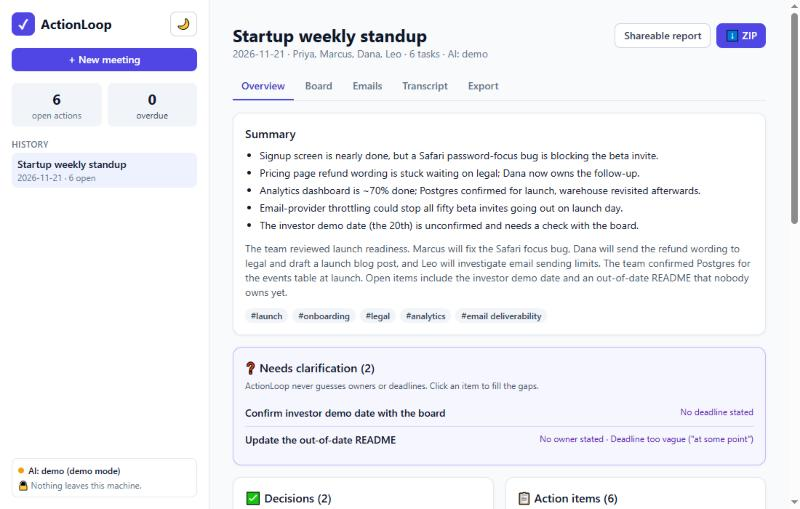
Overview
-
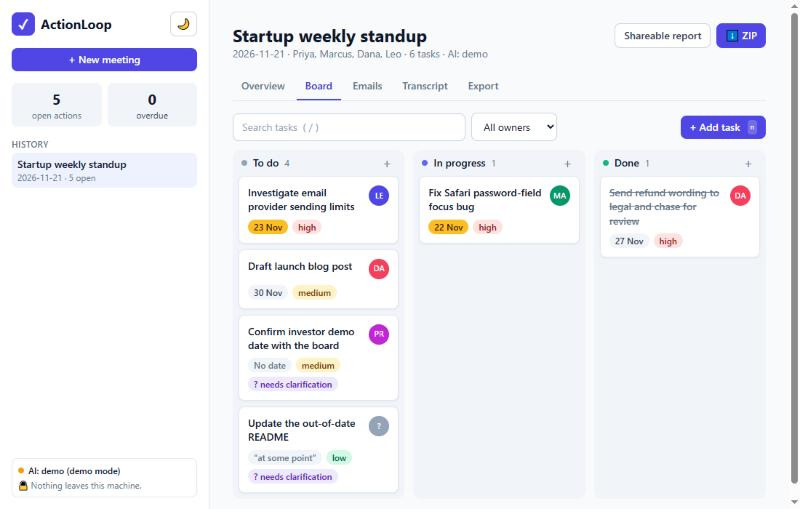
Board
-
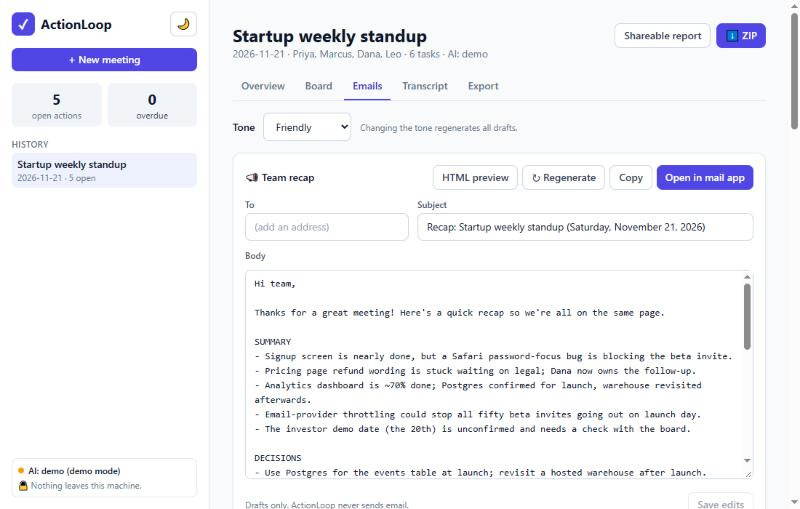
Emails
-
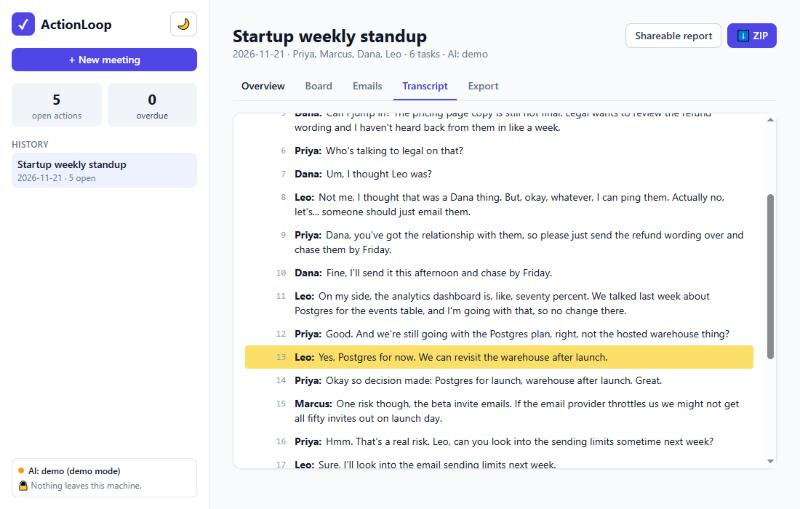
Transcript evidence
-
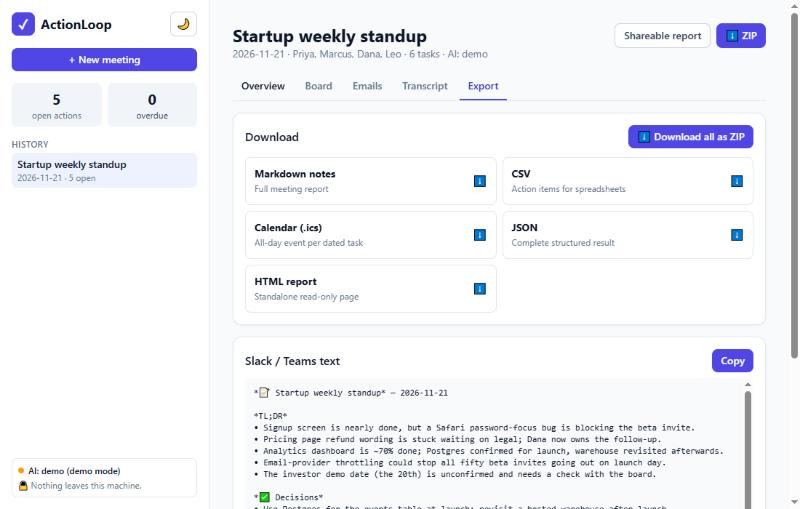
Export
Inspiration
Every club, startup and study group has the same problem: the meeting goes well, and then nothing happens. Notes are incomplete, nobody remembers who said "I'll do it", "by Friday" means different days to different people, and the follow-up email never gets written.
We wanted an agent that finishes the loop. We also wanted one that doesn't make things up, because a wrong owner or deadline is worse than a missing one.
What it does
Paste a transcript or upload audio/video, and ActionLoop:
- Transcribes locally with Whisper (mp3, wav, m4a, mp4, webm).
- Extracts a summary, decisions, action items (owner, deadline, priority), open questions and risks as strict, validated JSON.
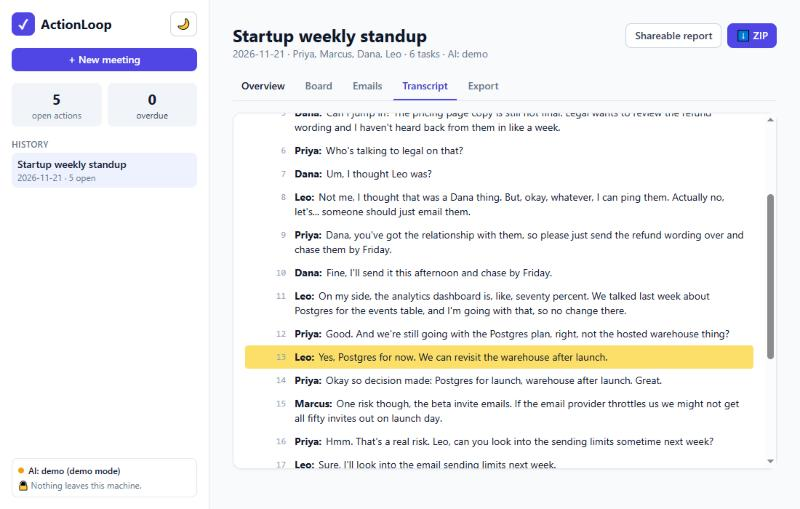
- Verifies every decision and task against a verbatim evidence quote. Click a quote to jump to and highlight the transcript line. If the quote can't be found, the item gets an unverified badge.
- Resolves dates in code: "by Friday" or "end of the month" becomes a real date relative to the meeting date, and the original wording is kept.
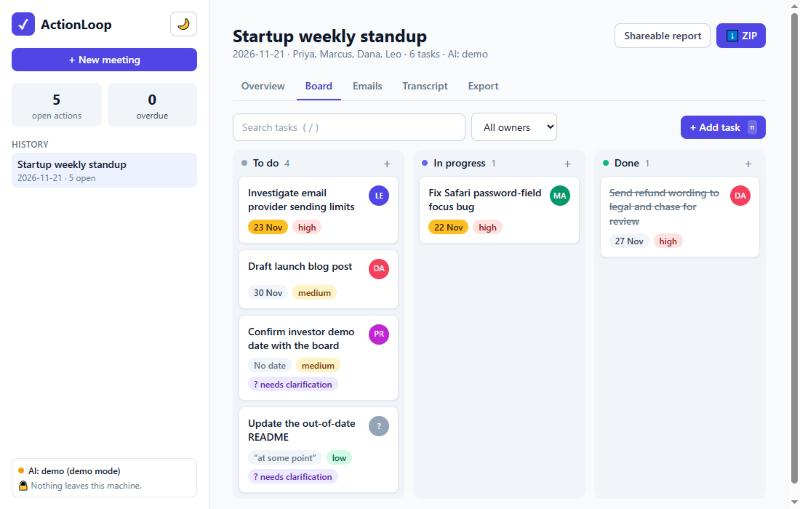
- Flags gaps in a Needs clarification panel (no owner, vague deadline) instead of guessing.
- Organises everything on a drag-and-drop Kanban board with owner filter, search and overdue / due-soon chips.
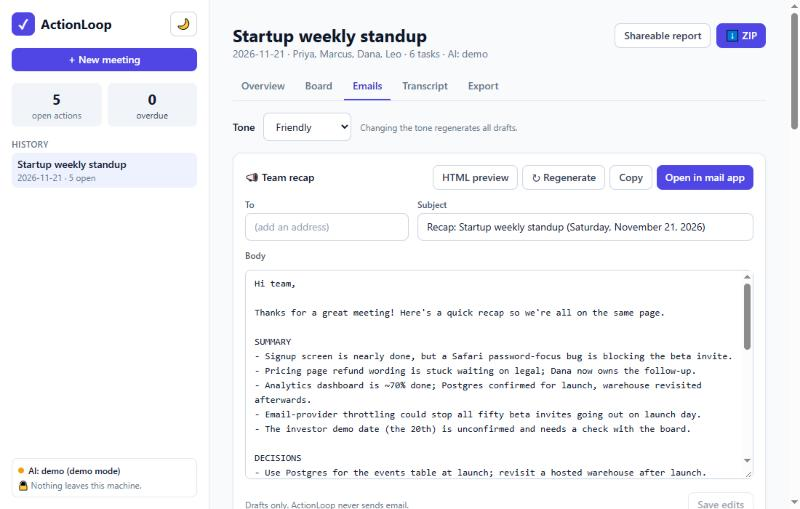
- Drafts emails: a team recap plus one personalised email per owner, in three tones. Drafts only; nothing is ever sent.
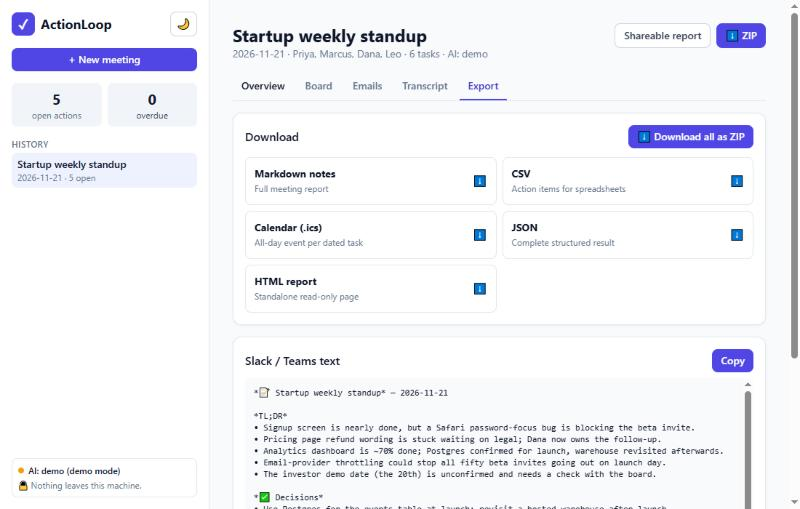
- Exports Markdown, CSV, ICS calendar events, Slack/Teams text, JSON, a ZIP of everything, and a shareable read-only report.
It runs with no API key and no internet in demo mode, or with Claude, OpenAI-compatible models, or fully local Ollama.
How we built it
- Backend: Python, FastAPI, Pydantic v2, SQLModel/SQLite. Processing runs in the background and streams progress (Transcribing → Analyzing → Drafting emails → Done) over Server-Sent Events.
- Transcription: faster-whisper plus ffmpeg, with automatic GPU/CPU fallback.
- LLM layer: an
LLMProviderinterface with Anthropic, OpenAI-compatible/Ollama, and an offline demo provider. Validation and retries live in one place, so every provider shares the same safety path. - Extraction: the model must return JSON matching a Pydantic schema. If it doesn't, the validation error is fed back and it retries (max 2). Long transcripts are chunked with overlap, then merged and de-duplicated.
- Verification: quotes are normalised and matched exactly, across neighbouring segments, then fuzzily (RapidFuzz) to tolerate small transcription differences.
- Frontend: React, Vite, TypeScript, Tailwind, @dnd-kit, with dark mode, toasts, skeleton loaders and keyboard shortcuts.
- Quality: 72 pytest and 13 Vitest tests, plus Docker and a Makefile.
Claude Code assisted development, and the README includes the AI disclosure.
Challenges we ran into
- Trust. Making the output checkable: evidence quotes and fuzzy matching that tolerate noise but not invention.
- Dates. "Next Wednesday", "end of the month" and "week after next" are ambiguous. We wrote explicit rules, tested them, and left vague phrases such as "soon" unresolved on purpose.
- No API key. A demo provider that returns realistic results for the samples and falls back to a conservative rule-based extractor, through the same validation and verification path as real models.
- Drag-and-drop. Reliable drops into empty columns, with optimistic updates and server-side reordering.
- Hardware variety. Whisper on a machine where the GPU is present but can't run float16, so it now falls back to CPU automatically.
Accomplishments we're proud of
An agent that says "I don't know" when it should, and shows its evidence when it does know. A full flow from audio to calendar events that anyone can run in one command without keys.
What we learned
Structure and verification matter more than clever prompting. Strict schemas, retries with error feedback, and programmatic checks make LLM output dependable, and keeping dates and verification in code makes the system testable.
What's next
- Follow-up check mode: compare the next meeting with open tasks and mark them done, still open or dropped.
- Speaker-name mapping for audio.
- Workload views across meetings.
- Slack, Calendar and Jira integrations.
- Optional authentication for shared reports.
Honest limitations
- The offline demo extractor is English-only and much weaker than a real LLM.
- The Anthropic, OpenAI and Ollama adapters are covered by tests against fakes but weren't run against the live services.
- The Docker image hasn't been built.

