-
-
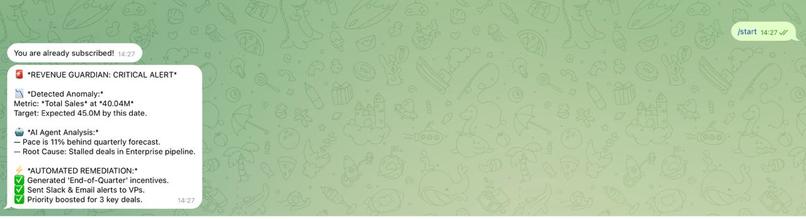
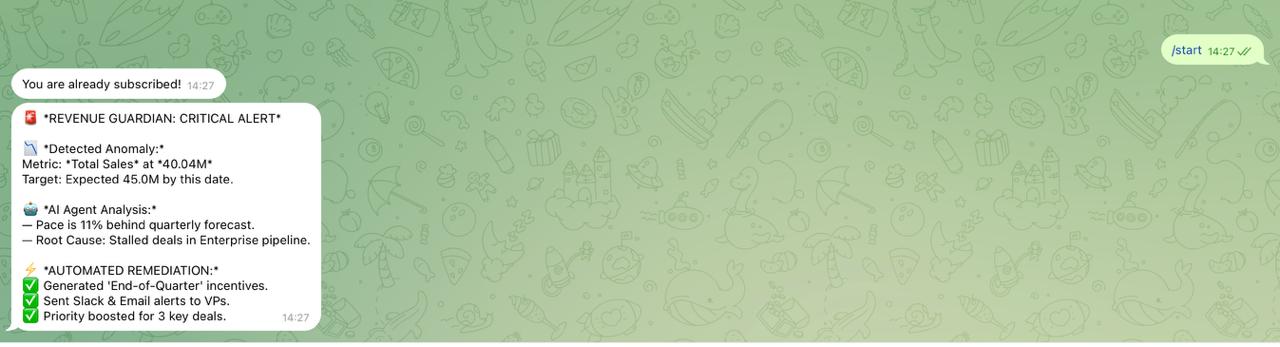
The Agent automatically analyzes the risk and notifies the user via Telegram with the executed solution
-
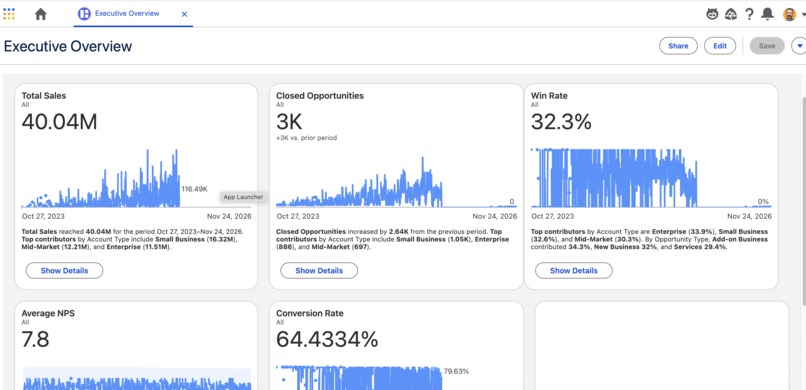
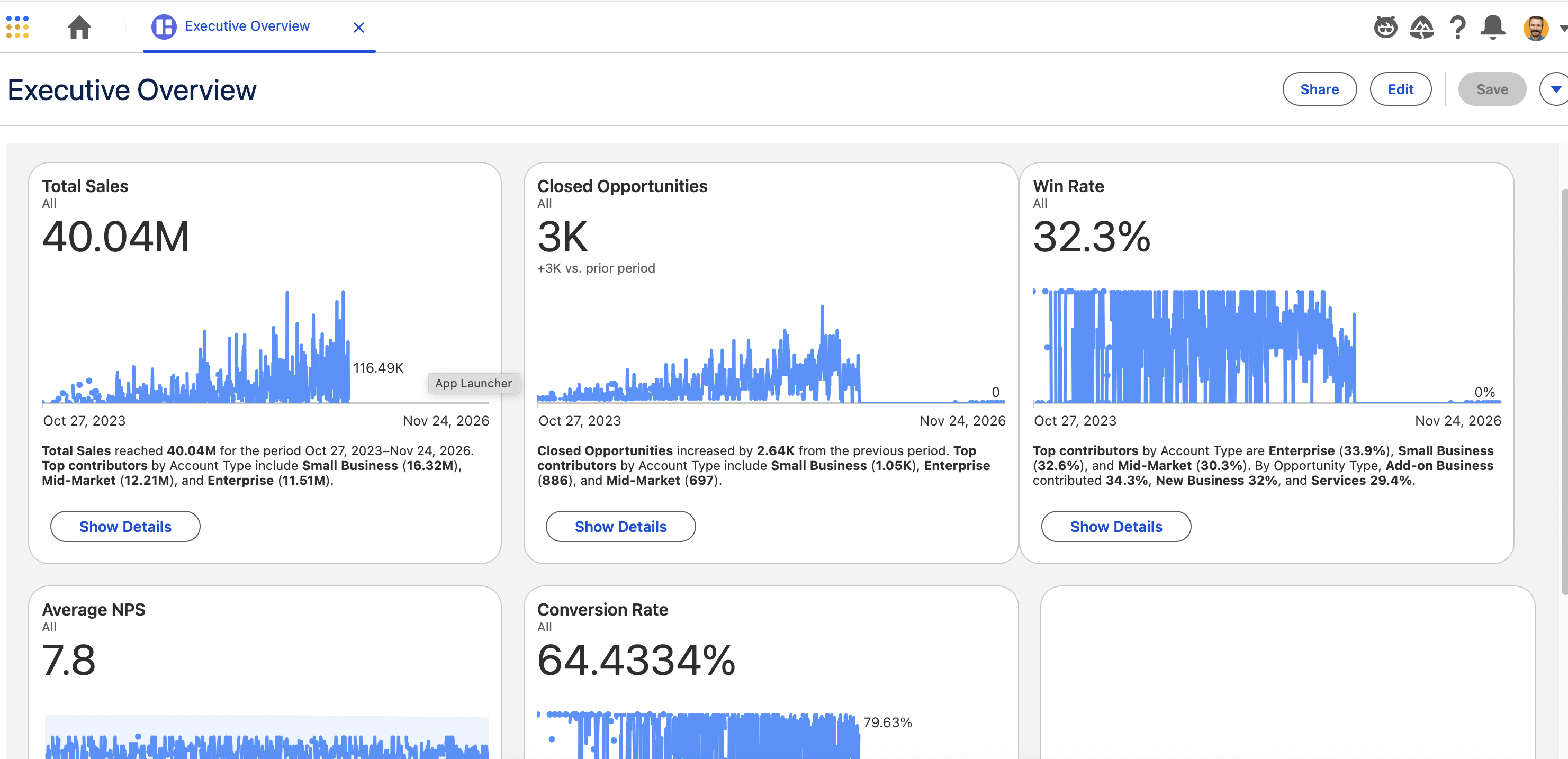
Embedded Tableau Dashboard in Salesforce with the custom "Analyze & Fix" trigger. This allows executives to act on data instantly
💡 Inspiration
We live in an era of "Data Overload" but "Action Paralysis." While working with business dashboards, we noticed a critical gap: executives see a problem (e.g., sales dropping, churn risk increasing), but fixing it requires switching context—opening CRMs, sending emails, or calling managers. This "Insight-to-Action" latency costs companies millions.
We asked ourselves: What if the dashboard wasn't just a mirror, but a steering wheel? What if you could fix a business problem instantly, right from the chart?
This inspired Revenue Guardian AI—a bridge between visual insights and autonomous resolution.
🤖 What it does
Revenue Guardian AI turns passive Tableau dashboards into active command centers.
- Detection: An executive spots a risk (e.g., low Win Rate or a specific Opportunity at risk) on the Tableau Dashboard inside Salesforce.
- Trigger: They click a single button: "Analyze & Remediate".
- Orchestration: Salesforce Flow captures the context (Opportunity ID, metrics) and securely tunnels it to our external AI Agent.
- AI Resolution: Our Java Spring Boot backend analyzes the data, determines the best course of action (e.g., "Apply 20% Retention Discount"), and executes the logic.
- Instant Notification: The system instantly triggers a Telegram Bot alert to the regional manager's phone with the analysis and the action taken.
⚙️ How we built it
We architected a multi-layer integration connecting three distinct ecosystems:
- The Frontend: We used Tableau embedded in Salesforce to visualize the data and Salesforce Flows to handle the user interaction.
- The Bridge: We utilized Salesforce External Services and Named Credentials to create a secure, authenticated pipe between the CRM and our custom backend.
- The Brain (Backend): We built a robust Java Spring Boot application. It serves as the "Agent" that receives the webhook, processes the business logic, and creates the remediation plan.
- The Notification Layer: We integrated the Telegram Bot API directly into our Java service to deliver real-time, mobile-first alerts to stakeholders.
🚧 Challenges we ran into
The biggest challenge was the security handshake between Salesforce and the external world.
- Authentication Nightmares: We faced multiple HTTP 403 Forbidden errors. Configuring the correct Principal Access in Salesforce Permission Sets and fine-tuning the Named Credential headers took significant debugging.
- Data Transport: ensuring the JSON payload correctly passed dynamic variables (like
OpportunityID) from the dashboard visual through the Flow and into the Java controller required precise mapping.
🏅 Accomplishments that we're proud of
- End-to-End Latency: We achieved a near-instantaneous response. From the moment the button is clicked to the phone vibrating with a Telegram notification, it takes less than 1 second.
- Clean Architecture: We implemented a clean
Controller->Service->DTOpattern in Java, making the agent scalable for future AI model integration. - User Experience: We successfully hid all the complex complexity behind a single, simple button.
🧠 What we learned
- We mastered Salesforce Flow Builder and its ability to act as an API gateway.
- We deepened our understanding of Spring Boot REST controllers and handling cross-origin (CORS) requests from enterprise platforms.
- We learned how to integrate ChatOps (Telegram) into business workflows effectively.
🚀 What's next for Revenue Guardian AI
- LLM Integration: Connecting the Java backend to Gemini Pro to generate personalized emails for clients based on the specific sales data.
- Multi-Channel Support: Adding Slack and Microsoft Teams as notification targets.
- Auto-Pilot Mode: Allowing the agent to monitor the dashboard 24/7 and trigger fixes without human intervention when metrics hit critical thresholds.


Log in or sign up for Devpost to join the conversation.