Inspiration
AI assistants are becoming increasingly capable of understanding natural language, but turning a request into a completed task can still require users to navigate multiple applications. I wanted to explore a different approach: an assistant that does not just tell users what to do, but helps them actually do it.
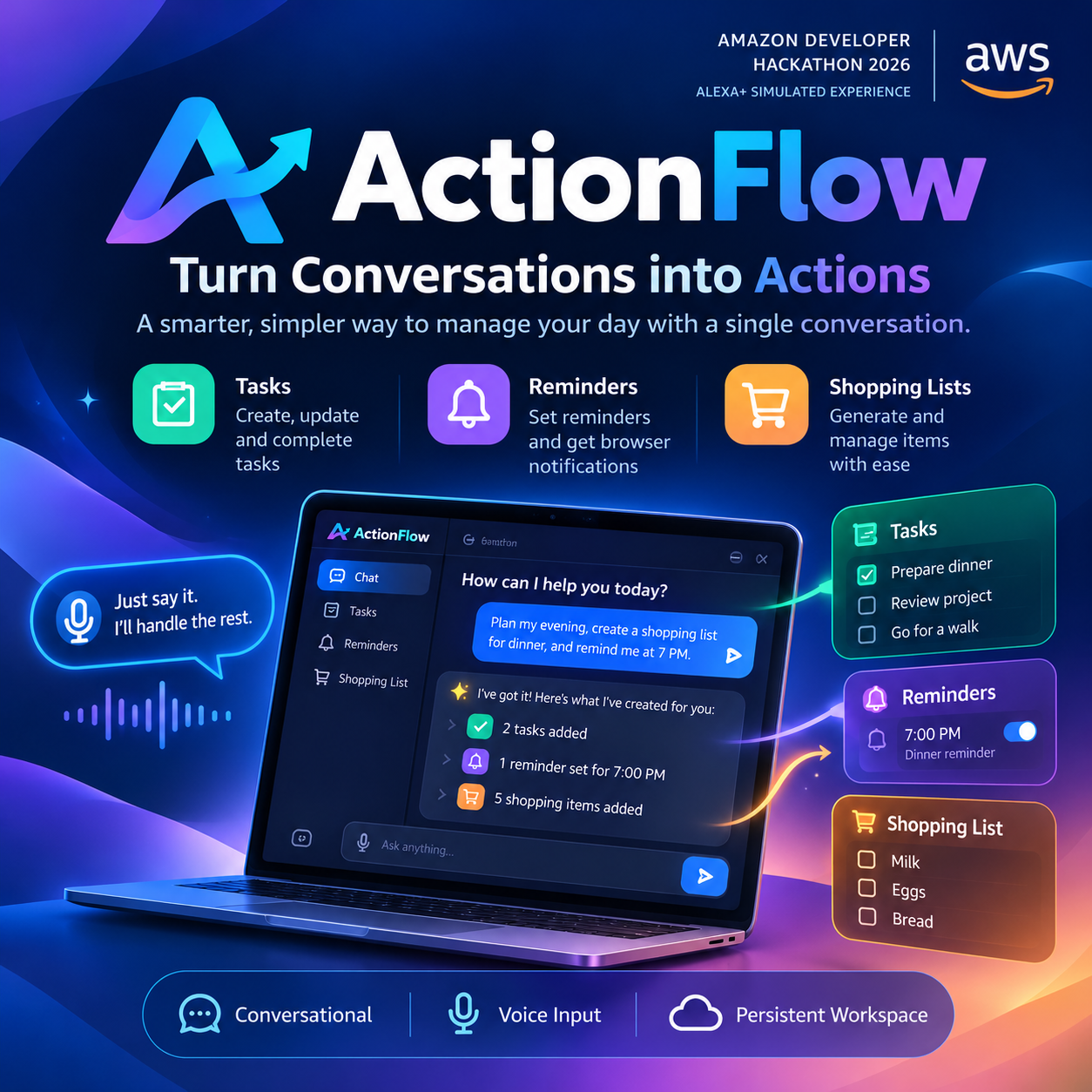
That idea inspired ActionFlow, a simulated Alexa+ experience built around a simple principle: turn conversations into actions. Instead of separately opening a task manager, setting a reminder, and creating a shopping list, users should be able to describe what they need in one conversation and let the assistant coordinate the work.
What it does
ActionFlow transforms natural-language requests into practical, coordinated actions through a conversational interface.
For example, a user can say, “Plan my evening, create a shopping list for dinner, and remind me at 7 PM.”
ActionFlow can interpret the request and coordinate multiple operations through its tools.
Key features include:
- Task management: Create, update, complete, and delete tasks.
- Smart shopping lists: Generate and manage shopping items from natural-language requests.
- Reminders: Save reminders and display browser notifications when supported and when the application is running under the required conditions.
- Conversational interface: Interact through text, with voice input in supported browsers.
- Persistent workspace: Store tasks, reminders, and shopping-list data through a backend.
- AI-assisted planning: Include an optional Amazon Bedrock integration, with a deterministic fallback for supported workflows.
The goal is to make an assistant's actions visible and useful, rather than producing a response that leaves the user to complete everything manually.
How we built it
We built ActionFlow as a web-based simulation for the Alexa+ hackathon track.
The frontend uses React, TypeScript, Vite, and Tailwind CSS to provide a responsive conversational interface and an organized workspace. The backend uses Node.js and Express.js to expose APIs, validate requested actions, and manage persistent application data.
The application separates planning from execution. Requests are mapped to supported operations, validated by the backend, and then applied to the relevant workspace data. This structure helps distinguish actual state changes from the assistant's conversational output.
We designed an optional Amazon Bedrock integration for AI-assisted planning. A deterministic fallback supports the core workflows when model access is unavailable, helping keep the demonstration usable without making every interaction dependent on an external AI service.
The result is a practical prototype for exploring how conversational interfaces, tool execution, and persistent state can work together in an agentic application.
Challenges we ran into
Moving beyond a chatbot: The assistant needed to perform real operations rather than merely describe what it would do. We addressed this by implementing backend action handlers and separating planning from execution.
Handling multiple requests together: A single sentence can contain several different intentions. Mapping those intentions to appropriate tools while keeping their results understandable was an important design challenge.
Keeping data consistent: Changes need to appear in the workspace and survive page refreshes. We introduced backend APIs and persistent storage instead of relying exclusively on temporary interface state.
Building a reliable demonstration: AI services and development environments can introduce unexpected failures. We designed a deterministic fallback for supported workflows and worked through dependency and frontend/backend configuration issues.
Managing realistic expectations: Simulating an Alexa+-style experience is different from integrating directly with Alexa+. Similarly, browser-based reminders have execution and permission limitations. We focused on demonstrable functionality while keeping those boundaries explicit.
Accomplishments that we're proud of
We are proud to have taken ActionFlow beyond a static chatbot concept and developed a functional architecture for coordinating everyday actions.
Our key accomplishments include:
- Bringing task management, reminders, and shopping lists into one conversational workspace.
- Building backend endpoints that validate and execute supported actions.
- Adding persistent storage so workspace data can survive application and server restarts on the same machine.
- Designing an AI-assisted planning path with a deterministic fallback.
- Creating an extensible structure that can support additional tools and more sophisticated multi-step workflows.
Most importantly, ActionFlow demonstrates how a single natural-language request can become a coordinated series of practical operations.
What we learned
This project taught us that a useful AI agent requires more than a capable language model. It also needs well-defined tools, reliable execution, input validation, persistent state, error handling, and clear feedback.
We learned the importance of keeping planning separate from execution, designing fallbacks for external dependencies, and ensuring that the application reflects what actually happened instead of simply trusting generated text.
We also learned to consider the entire user experience: fewer steps are valuable only when actions remain understandable, predictable, and easy to verify.
What's next for ActionFlow
Our next goal is to make ActionFlow more intelligent, reliable, and connected to real services.
We plan to explore:
- MCP-based integrations: Enable a structured tool interface that can be extended to additional services.
- Better multi-step planning: Handle more complex requests and dependencies between actions.
- Real AI-powered orchestration: Validate and strengthen the Amazon Bedrock integration in a configured AWS environment.
- Confirmation and recovery: Ask for approval when appropriate, handle failed actions gracefully, and make execution status transparent.
- More integrations: Explore calendars, productivity services, and other tools that can help users complete everyday workflows.
- Stronger testing: Expand automated tests for multi-action requests, API failures, persistence, and edge cases.
Our long-term vision is to make ActionFlow an assistant that helps people spend less time managing applications and more time accomplishing what matters.
ActionFlow: Turn conversations into action.
Built With
- awssdk
- bedrock
- express.js
- javascript
- node.js
- react
- restapi
- speechapi
- typescript
- vite


Log in or sign up for Devpost to join the conversation.