Inspiration
Across the Greater Horn of Africa, communities face recurring floods, droughts, food insecurity, disease outbreaks, displacement, and other interconnected risks. Many organizations already produce valuable forecasts and early-warning information. However, a warning does not automatically become action.
We were inspired by a simple question:
What happens after an early warning is issued?
A warning may be technically accurate, but affected households may not understand it, receive it in time, know what action to take, or have the resources needed to respond. Decision-makers may also lack visibility into whether communities received the message, completed the recommended action, or required additional support.
This inspired us to create ActionBridge GHA, a platform designed to bridge the gap between early-warning information and measurable early action.
Our goal was not to replace existing forecasting platforms. Instead, we wanted to build an operational layer that helps transform trusted warnings into clear responsibilities, localized instructions, community responses, and timely escalation.
What It Does
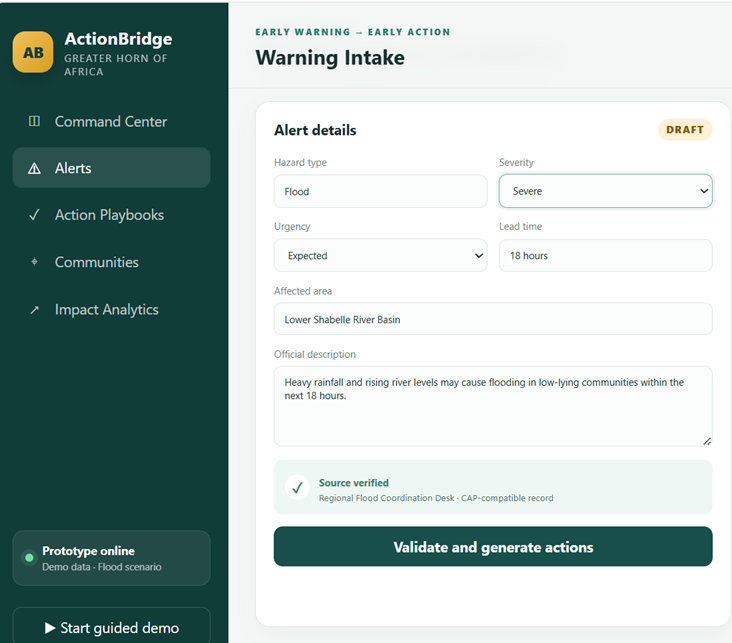
ActionBridge GHA receives an authorized hazard warning and converts it into practical actions for different users. For our prototype, we focused on a flood-warning scenario. When a warning is entered into the platform, the system:
- Identifies the affected geographic area.
- Determines the hazard severity, urgency, and expected timing.
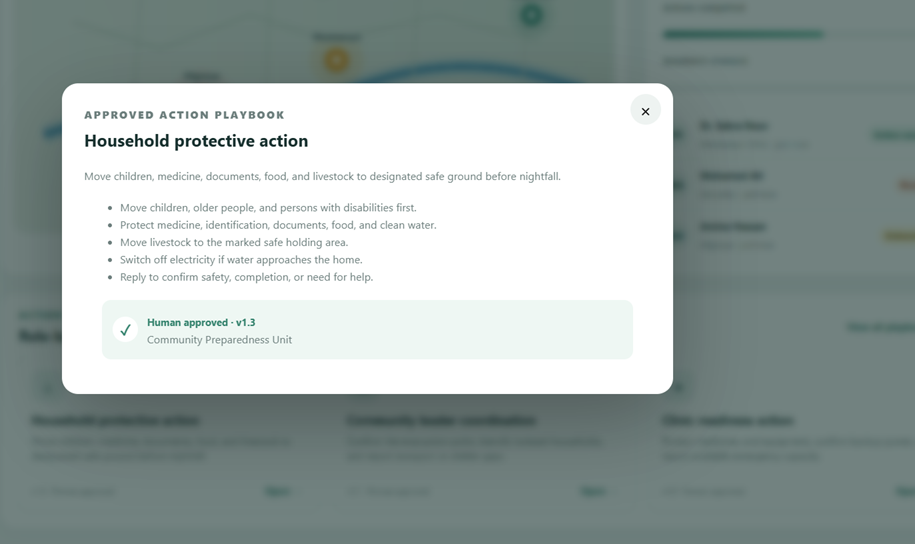
- Selects an approved action playbook.
- Creates role-specific instructions for households, community leaders, health facilities, livestock owners, and humanitarian responders.
- Simplifies and translates the instructions into locally understandable language.
- Delivers the information through an offline-capable web application and SMS.
- Allows recipients to respond with:
- Safe
- Action completed
- Need help
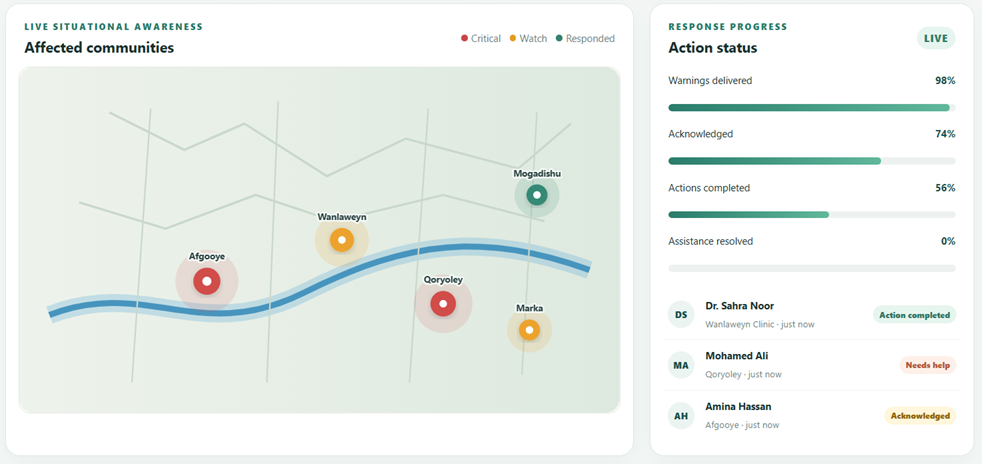
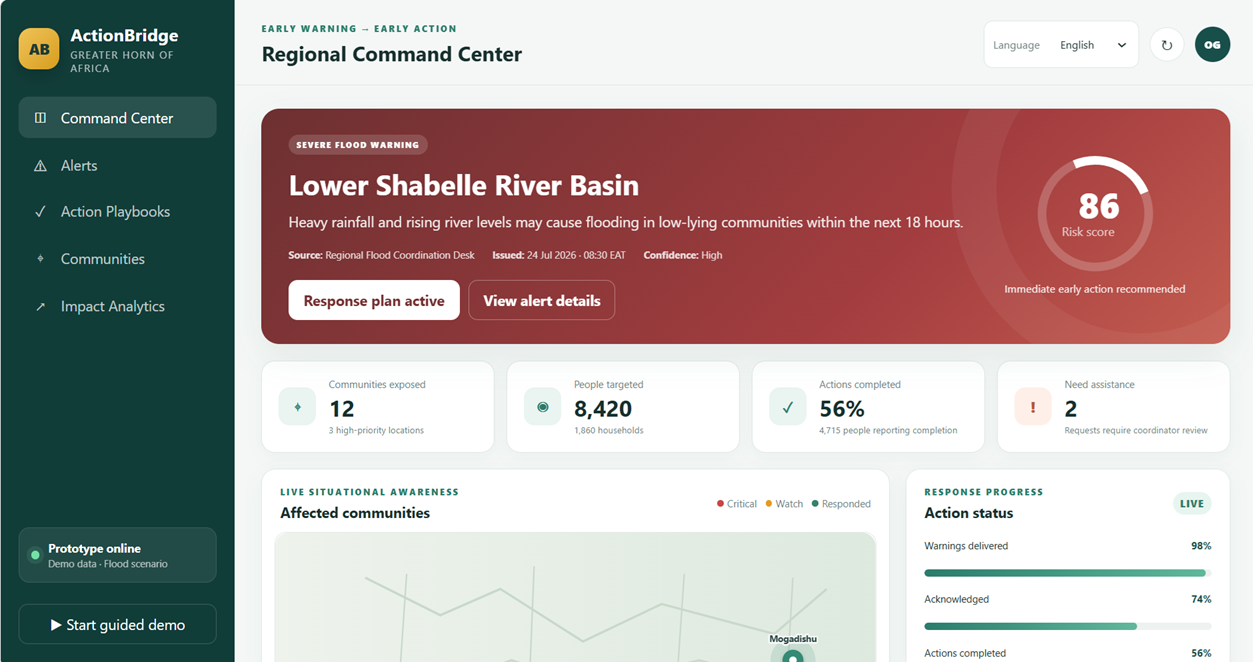
- Displays responses on a dashboard for emergency coordinators.
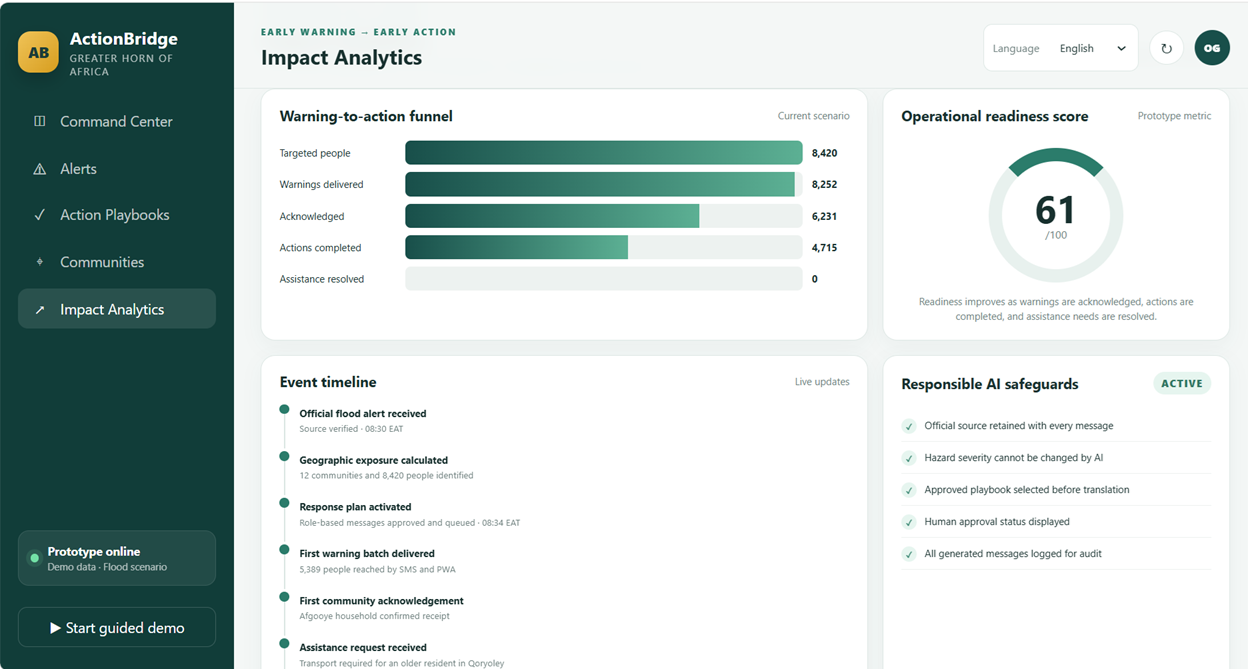
The platform therefore measures more than the number of warnings sent. It helps decision-makers monitor whether warnings were acknowledged, whether recommended actions were completed, and where additional assistance is required.
How We Built It
We designed ActionBridge GHA as a modular, standards-based platform that could eventually integrate with existing regional and national early-warning systems.
The prototype uses:
Next.js and React for the user-facing progressive web application Python FastAPI for backend services and warning-processing logic PostgreSQL and PostGIS for geographic and operational data MapLibre or Leaflet for mapping affected locations and response status Common Alerting Protocol-compatible data for structured warning information Gemini API for controlled language simplification, translation, and role-specific communication Africa’s Talking sandbox for SMS delivery and two-way responses GitHub Actions for testing and deployment automation
The warning workflow begins with a structured alert containing the hazard type, location, severity, urgency, start time, and recommended actions.
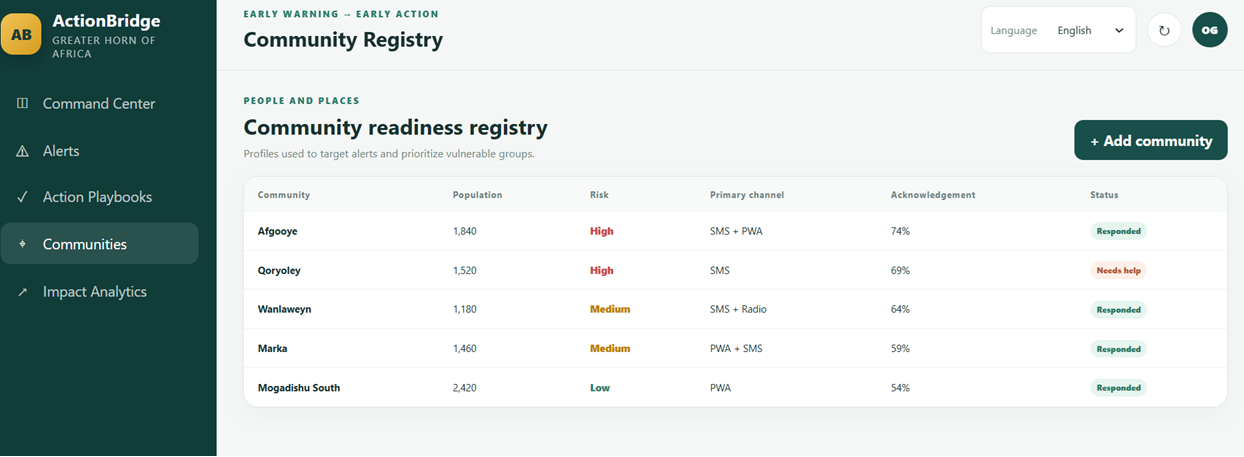
A geospatial process compares the warning area with registered communities and facilities. The system then uses a deterministic rules engine to select an approved action playbook based on factors such as:
[ \text{Selected Action} = f(\text{Hazard}, \text{Severity}, \text{Lead Time}, \text{Location}, \text{User Role}) ]
Artificial intelligence is applied only after the official hazard information and action playbook have been selected. AI helps simplify technical language, translate approved content, and tailor instructions to specific user roles.
This separation was an important design decision. The AI does not independently issue warnings, change hazard severity, or invent emergency procedures.
Challenges We Faced
Converting technical warnings into practical actions
Hazard alerts may contain technical terminology that is difficult for non-specialist users to interpret. We addressed this by separating the official warning from the communication layer and using approved action playbooks.
Supporting different users
Households, clinics, local officials, pastoralists, and humanitarian organizations have different responsibilities. We developed role-based action cards instead of sending one general message to everyone.
Limited connectivity
Many vulnerable communities may experience weak internet access. We designed the platform as an offline-capable progressive web application and included SMS as an alternative communication channel.
Multilingual communication
Direct translation may not always communicate urgency or local meaning correctly. We therefore designed AI-generated translations to remain connected to approved source instructions and human review.
Preventing AI misinformation
We did not want the AI to create unsupported emergency recommendations. Our rules engine first selects approved actions, while AI is limited to simplifying, translating, and adapting those actions.
Building a realistic prototype within limited time
The full vision could support multiple hazards, countries, languages, institutions, and communication channels. To deliver a reliable prototype, we limited the initial demonstration to one flood scenario, selected user roles, and a focused end-to-end workflow.
Accomplishments We Are Proud Of
We are proud that ActionBridge GHA demonstrates a complete journey from warning to response.
The prototype shows how a trusted warning can be:
Geographically targeted Converted into role-specific tasks Communicated in accessible language Delivered through multiple channels Acknowledged by recipients Monitored through an operational dashboard Escalated when people report that they need help
We are also proud that the solution complements existing forecasting and early-warning platforms instead of attempting to duplicate them.
What We Learned
One of our most important lessons was that early-warning effectiveness is not only a forecasting problem. It is also a communication, coordination, accountability, and service-delivery problem.
We learned that the same warning cannot be communicated identically to every user. A household needs short protective instructions, while a clinic needs operational preparedness tasks. A community leader may need to identify vulnerable households, while a humanitarian organization needs information about unmet needs.
We also learned that warning delivery should be measured as a process rather than a single event.
A more meaningful operational model is:
[ \text{Warning} \rightarrow \text{Received} \rightarrow \text{Understood} \rightarrow \text{Acknowledged} \rightarrow \text{Actioned} \rightarrow \text{Verified} ]
This approach creates measurable indicators such as:
Warning delivery rate Acknowledgement rate Average acknowledgement time Action-completion rate Number of assistance requests Number of locations without a response
We also gained a deeper understanding of responsible AI. In emergency situations, AI-generated content must be traceable, constrained, reviewable, and connected to an authoritative source.
What Is Next
Our next step is to test ActionBridge GHA with disaster-management professionals, humanitarian organizations, community representatives, health workers, farmers, and pastoralist groups.
Future development could include:
Drought, disease, heat, food-security, and conflict-related alerts Voice and interactive voice response messages Additional regional languages Integration with official ICPAC and national warning systems Community vulnerability and accessibility profiles Predictive identification of locations at risk of non-response Resource and evacuation coordination Anonymous community feedback Post-event performance analysis
Our long-term vision is for ActionBridge GHA to become a shared early-action coordination layer that connects regional warnings, national institutions, local authorities, humanitarian partners, and communities.
The principle behind the project is simple:
An early warning should not end with information. It should lead to understood, assigned, supported, and verified action.
Built With
- api
- gemini
- gethub
- maplibre
- next.js
- postgis
- postgresql
- python
- react
- translation
