Inspiration
The inspiration for this project came from observing the daily challenges faced by non-verbal individuals in communicating their needs and emotions. Simple interactions become obstacles without effective ways to convey messages, often resulting in misunderstandings and isolation. We wanted to create a solution that empowers these individuals to express themselves and be understood, fostering a more inclusive environment in both educational and social contexts.
What it does
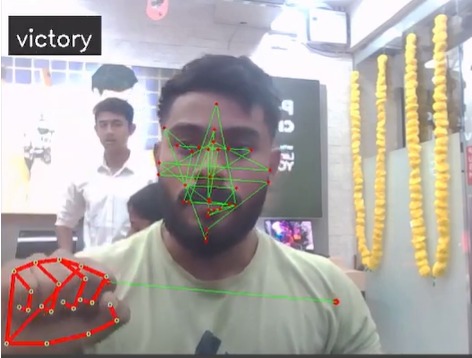
The Action-to-Text Communication Aid is an AI-driven tool designed to help non-verbal individuals communicate by translating their actions and gestures into readable text in real-time. Using computer vision and machine learning, the system detects various gestures, facial expressions, and movements. These actions are then instantly converted into text messages, displayed on a screen or mobile device, allowing others to read and understand what the non-verbal person wants to communicate. This tool makes everyday communication easier, especially in educational and social settings, helping reduce misunderstandings and enabling non-verbal individuals to express their needs, emotions, and responses independently. It fosters inclusivity by providing a simple yet powerful way to break down communication barriers, empowering non-verbal individuals to engage more freely and confidently.
How we built it
Technology Stack: We used TensorFlow for training and implementing our machine learning models, focusing on computer vision techniques to detect gestures and facial expressions. To make the solution portable, we integrated TensorFlow Lite, optimizing the model for mobile devices. Model Training: We curated a dataset of common gestures and non-verbal cues, using this to train our model to recognize specific actions and expressions. By leveraging pre-trained models within TensorFlow, we were able to build and fine-tune our system efficiently. Prototyping and Testing: We iteratively tested the system to ensure accurate detection and real-time translation of actions to text. Feedback from initial users was crucial, as it helped us improve the model’s accuracy and adjust the user interface for clarity and ease of use.
Challenges we ran into
We encountered several challenges during development, they are as follows: Data Collection and Accuracy: Gathering a diverse dataset that represents a wide range of gestures was challenging, as subtle differences in gestures could affect model accuracy. Fine-tuning the model to reduce false positives required careful adjustments. Real-Time Performance: Optimizing the model for real-time processing was essential for usability. TensorFlow Lite helped with this, but achieving low latency on mobile devices required additional model optimization. User Experience: Designing a seamless and intuitive interface that accurately displays the translated text was vital. We had to ensure the interface was easy to navigate, especially for non-verbal individuals and their caregivers.
Accomplishments that we're proud of
Developing a Real-Time Communication Solution: We’re proud to have built a tool that can detect and translate gestures into text in real-time, providing immediate communication support for non-verbal individuals. This responsiveness is key to creating meaningful interactions and empowering users in their everyday lives. Achieving High Accuracy with TensorFlow: Through careful training and tuning, we achieved high accuracy in recognizing a diverse set of gestures and facial expressions. By leveraging TensorFlow’s powerful libraries, we created a model that performs reliably and consistently, even with subtle gestures. Optimizing for Mobile Use with TensorFlow Lite: Making the solution portable and accessible on mobile devices was a challenging but rewarding accomplishment. With TensorFlow Lite, we optimized the model to run efficiently on smartphones, allowing for flexible, on-the-go use that maximizes accessibility and convenience. Creating an Inclusive Solution for Real-World Impact: Most importantly, we’re proud to have developed a solution that can make a real difference in people’s lives. This project has the potential to enhance inclusivity and well-being by empowering non-verbal individuals with a tool that enables them to communicate, be understood, and connect more deeply with those around them.
What we learned
Working with TensorFlow taught us how to harness AI and computer vision to create impactful, real-world applications. We learned how to train, fine-tune, and deploy models that can accurately recognize and interpret non-verbal gestures, which was a challenging but rewarding process. Real-time communication was essential for this project, so we learned a lot about model optimization techniques to reduce latency, especially for mobile devices. Using TensorFlow Lite, we were able to make our solution both responsive and portable, a crucial lesson in balancing performance with accessibility.
What's next for Action-to-Text Communication Aid for Non-Verbal Individuals
Expanding Gesture Recognition for Broader Communication- We plan to enhance our model’s ability to recognize a wider range of gestures and expressions, making the system more adaptable for various non-verbal cues and sign languages. By expanding the gesture library, we can enable more nuanced communication, covering both basic needs and complex expressions. Implementing Speech Synthesis for Voice Output- Adding a speech synthesis feature to convert detected text into spoken words will further improve accessibility. This would allow non-verbal individuals to engage in conversation more naturally, where others can not only read but also hear their intended messages.
Built With
- apis
- firebase
- google-cloud
- opencv
- tensorflow
- tensorflow-lite
- text-to-speech
- we-used-python

Log in or sign up for Devpost to join the conversation.