-
-
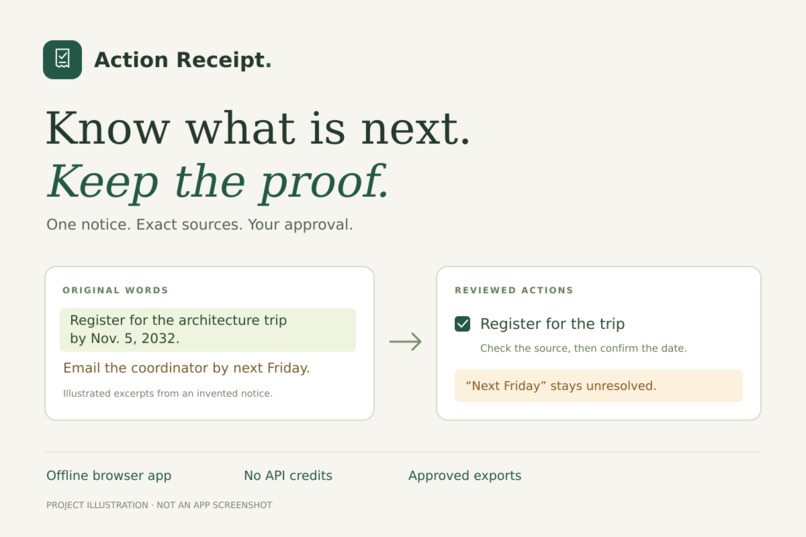
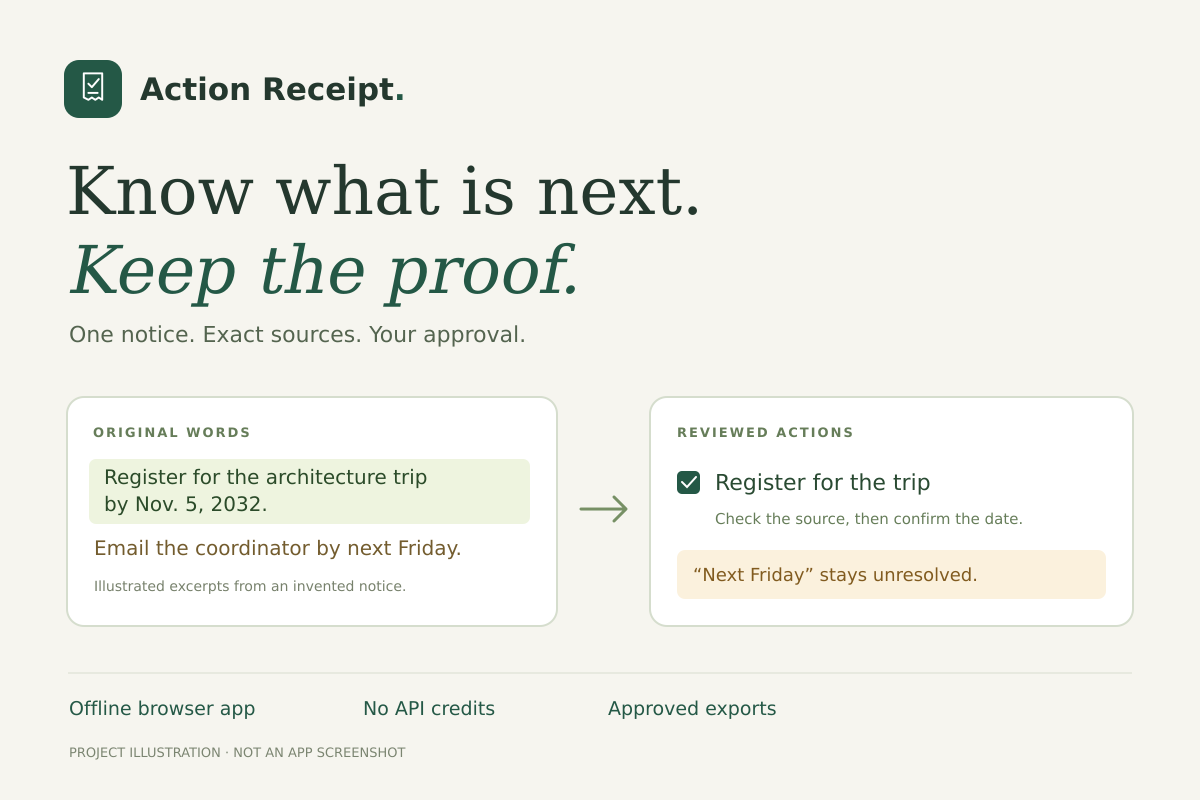
Original project illustration: review source-linked actions and resolve dates before exporting.
The problem and audience
A student notice can mix registration, payment, required documents and conditional instructions in a few paragraphs. A short summary can hide the distinctions that matter: which action has which deadline, whether an instruction applies, and which dates are still unclear.
Action Receipt explores a narrow solution for students reviewing school, club and administrative notices. Its usefulness with students has not yet been established through participant testing.
What it does
Paste one notice and get proposed actions beside the original text. Open an exact supporting passage, correct wording, add a missed instruction from its quotation, and record why a flagged passage is an obligation, a clarification request or not an action.
Action approval and calendar-date confirmation are separate. An approved task with an unresolved date can stay in the checklist. It cannot enter the calendar until its date, and any required cutoff time and UTC offset, are complete and confirmed. Edits clear the affected approval. Original warnings and corrections remain in the exported receipt.
The invented practice notice separates registration and payment deadlines, exposes a missed consent-form instruction and preserves a conditional "next Friday" without guessing its date. A completed review yields four checklist tasks and only two calendar entries. Preview shows the exact Markdown and iCalendar content before download. Nothing is automatically added to a calendar or sent to another person.
The design choice is to keep source inspection, omissions and uncertainty inside the same small review loop. Exact quotations and separate task/date checks make a correction inspectable later. Offline files keep that workflow usable without an account or service budget. The tradeoff is limited language coverage and deliberate human review.
How it was built
The official Devpost Learn Skill Pack was installed and used with Codex. Its generated scope.md, prd.md and spec.md are in the public repository, alongside workflow and installation evidence. The interface uses React and TypeScript; Vite packages it as one self-contained HTML file. Standard starter code and dependencies are disclosed in the repository notices.
The finished app uses bounded English text rules, not a runtime AI model. It runs offline without an account, API key, paid credits or model download. Source matching checks quotation presence; it does not certify interpretation or completeness. Users must read the full notice and repair omissions.
Engineering findings and validation
The implementation separates quotation matching from meaning, action approval from date confirmation, and imported data from current-session trust. Regression work covered abbreviated dates, contradictory weekdays, malformed clocks, conditional scope, cutoff conversion, review-file recovery and download failure states. Automated verification includes 186 regression tests, 14 fresh synthetic notice checks and a reproducible source-to-export rehearsal. These are technical checks, not human usability findings. Participant testing remains unverified.
What's next
Observe students reviewing unfamiliar notices, fix the points where they need help, and assess whether the source-and-uncertainty workflow earns a place in their routine. Expand language coverage in response to that evidence.
Try it
The public repository includes a ready-to-run standalone HTML app and a judge guide. Download release/action-receipt.html and open it in a current desktop browser. No installation or API key is required.
Source and offline app | Judge guide
This project description was prepared with AI assistance at the entrant's request. It describes project facts, not participant results.

Log in or sign up for Devpost to join the conversation.