Inspiration
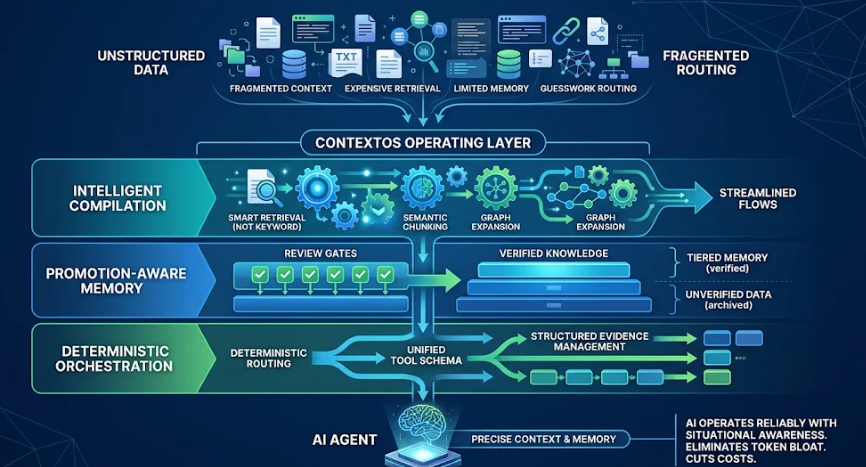
AI systems have too much information and not enough sense of what to do with it. Context gets fragmented, retrieval is expensive, personalization is weak, memory is limited, and routing across different sources is mostly guesswork. Keyword search doesn’t solve this, and neither does putting a chatbot on top of it.
What it does
This system solves the core fragmentation and scaling problems of modern artificial intelligence by functioning as an intelligent context and memory operating layer that sits directly between your applications and the language model. Rather than forcing models to blindly parse unstructured data or struggle with overflowing context windows, it governs how information is captured, organized, and retrieved.
At its core, the platform replaces chaotic information handling with a structured, multi-stage compilation pipeline. When a request is processed, it does not rely on simple keyword matching or expensive full-repository ingestion. Instead, it uses intelligent retrieval, graph expansion, and semantic chunking to pull only the precise context required for the task. This eliminates unnecessary token bloat and keeps execution costs low while maintaining pinpoint accuracy.
Furthermore, the system approaches memory and routing with advanced orchestration rather than guesswork. It features a promotion-aware memory architecture where captured data goes through rigorous review and filtering gates before being stored across tiered memory levels, ensuring that only verified, high-value knowledge is reused. By combining a unified tool schema, deterministic routing, and structured evidence management, it provides AI agents with the stable foundation and situational awareness they need to operate reliably in production.
How we built it
Web intelligence. Telem is the default discovery/fetch router;
Tavily provides parallel search, extraction, cited research, map and crawl.
TELEM_API_KEY= TELEM_BASE_URL=https://router.telem.ai/v1 TAVILY_API_KEY= TAVILY_SEARCH_DEPTH=advanced TAVILY_RESEARCH_MODEL=auto
When examining how modern intelligent software architectures integrate external web capabilities to empower autonomous agents and knowledge systems, the implementation relies heavily on the advanced search and content extraction features provided by Tavily. Rather than depending on rudimentary keyword matching or fragile scraping scripts, the system leverages Tavily's specialized AI-optimized search engine to gather real-time data, fetch clean markdown or text content, and synthesize comprehensive research reports directly within the application workflow.
The core functionality harnessed throughout the integration centers on Tavily's primary search and extraction endpoints, which are specifically engineered to provide LLM-ready content without the typical noise, boilerplate, or JavaScript rendering barriers found on modern web pages. By utilizing Tavily's search capabilities, the system dynamically queries the web for current, highly relevant sources, applying advanced depth parameters and domain filtering to ensure that the retrieved information is both precise and contextually accurate. This enables the application to perform robust discovery tasks, gathering structured intelligence from diverse online repositories with minimal latency and high reliability.
Furthermore, the integration makes extensive use of Tavily's content extraction features to pull clean, structured data from individual URLs discovered during the research process. When dealing with complex web pages, documentation sites, or dynamic JavaScript-heavy applications, the extraction layer processes the raw HTML and delivers pristine markdown text that can be seamlessly consumed by downstream language models. This capability ensures that the information ingested into the system maintains high fidelity, allowing the AI components to reason over complete articles, technical documentation, and web publications without encountering formatting artifacts or missing sections.
The incorporation of these specific Tavily features transforms the application into a powerful, web-connected knowledge assistant capable of autonomously exploring, retrieving, and synthesizing external information. By relying on Tavily's purpose-built web layer for AI agents, the software bypasses the traditional limitations of web navigation, establishing a stable and efficient pipeline for real-time data retrieval. Ultimately, the deployment of these search and extraction tools underpins the entire external intelligence gathering mechanism of the project, ensuring that every query is met with clean, verified, and deeply contextualized web data.
Challenges we ran into
When implementing or scaling architectures that rely on comprehensive contextual orchestration frameworks like ContextOS, engineering and operations teams must navigate a series of intricate challenges. These hurdles typically span state synchronization, data governance, performance bottlenecks, and the inherent complexities of distributed environments.
State Management and Context Drift
Maintaining a consistent, real-time single source of truth across diverse operational layers presents a continuous engineering hurdle. As systems process continuous streams of operational stimuli, user interactions, and external data updates, state synchronization must happen instantaneously to prevent stale context from influencing automated decisions or agentic workflows. When disparate services, databases, and agent loops attempt to read and write to shared context stores concurrently, minor race conditions or latency spikes can lead to conflicting state views. This drift degrades the reliability of automated routing and decision-making, requiring rigorous transactional guarantees, deterministic validation, and conflict-resolution mechanisms that do not sacrifice operational velocity.
Governance, Privacy, and Security Boundaries
Centralizing heterogeneous operational, historical, and enterprise data into a unified context layer inherently expands the surface area for security and compliance vulnerabilities. Because context layers ingest sensitive information—ranging from proprietary business logic and operational policies to user histories and transactional records—enforcing granular, context-aware access control becomes exceptionally difficult. Ensuring that automated agents, external tools, and multi-tenant services only access the precise subset of data authorized for their specific scope requires strict data isolation, bulletproof payload redaction, and auditable authorization boundaries that resist prompt injection or privilege escalation attempts.
Scalability and Performance Overheads
As the volume of ingested events, workflow threads, and historical knowledge grows, the computational overhead of enriching signals and querying context stores escalates dramatically. Real-time enrichment and dynamic retrieval demand rapid vector searches, policy resolutions, and database lookups on every single lifecycle event. If the underlying infrastructure is not meticulously optimized, these operations introduce compounding latency into the execution loop. This delay can disrupt time-sensitive automations, slow down human-in-the-loop handoffs, and drive up infrastructure costs associated with high-frequency vector embeddings and extensive state persistence.
Operational Observability and Debugging Complexity
When an autonomous system powered by a unified context layer makes an unexpected decision, tracing the root cause across multi-layered execution loops and asynchronous worker threads is remarkably difficult. Traditional debugging tools often fail when applied to non-deterministic agent behaviors, dynamic tool selections, and complex decision graphs. Without comprehensive, structured audit trails and deterministic replay capabilities, operations teams struggle to isolate whether an error originated from flawed input retrieval, an outdated policy manifest, a corrupted memory artifact, or an unintended model output.
Accomplishments that we're proud of
When evaluating what a development team, an open-source community, or an architectural project centered around ContextOS should genuinely take pride in, the focus shifts toward the fundamental paradigm shift it introduces in how AI systems interact with information. Rather than treating artificial intelligence as a passive query-response wrapper or a statistical search engine, building or contributing to a context-first operating layer establishes several profound achievements to celebrate:
1. Moving Beyond Dumb Retrieval to Structured Memory
Traditional AI workflows rely heavily on chunking documents and running naive vector similarities—systems that answer “where was this written?” but fail entirely at tracking how decisions evolve. A project built on ContextOS excels because it models work as a temporal, provenance-aware graph. Being able to track what was decided, what changed, why a rationale shifted, and what remains unresolved over time represents a massive leap forward in making AI genuinely useful for professional execution.
2. Radical Transparency and Local-First Privacy
In an era dominated by cloud-heavy dependencies and opaque data processing, a robust context operating system champions user sovereignty. Whether implemented via local storage layers or strict domain exclusions, ensuring that sensitive artifacts, meeting transcripts, and repository logic remain private, verifiable, and completely purgeable via explicit data deletion creates a standard of trust that is rare in modern software. Celebrating a fail-closed, provenance-tracked architecture means taking pride in engineering systems that respect user boundaries.
3. Embracing Operational Realism and "Honest" AI
Many agent frameworks over-promise by hiding model flaws behind brittle mocks or ideal conditions. A true point of pride for systems like ContextOS is architectural honesty—designing pipelines that anticipate small-model reasoning noise, salvage-parse malformed outputs, and rigorously ground every extracted fact against verifiable source spans. Building software that acknowledges model limitations and structures its kernel to defend against them makes the entire engineering effort exceptionally grounded and resilient.
Ultimately, we are proud of pioneering an architecture that treats context not as an afterthought or a bloated prompt window, but as a first-class operating substrate—bridging raw human activity with deterministic, verifiable machine reasoning.
What we learned
Reflecting upon the journey of developing, architecting, and exploring advanced orchestration platforms like ContextOS, the insights gained offer a profound blueprint for how engineering teams can better build, scale, and reason about AI-driven systems. Building software that attempts to bridge human intent with autonomous execution reveals fundamental lessons about software design, cognitive load, and systemic resilience.
The True Cost of State Complexity
One of the most defining lessons centers on the realization that state is rarely just a passive variable; it is an active, living record that dictates system behavior. When managing deeply interconnected workflows, distributed data structures, and asynchronous background operations, developers quickly learn that implicit state sharing is a recipe for fragile behavior. The architectural takeaway is that state must be treated as a first-class, immutable, and fully observable citizen. Every transformation, rationale shift, and environmental update needs explicit provenance so that debugging ceases to be an exercise in guesswork and becomes a matter of reading a deterministic timeline.
Grounding Over Prompts
Another vital realization is that pouring more instructions into a system prompt can never substitute for architectural grounding. Early engineering iterations often attempt to solve reasoning failures by adjusting system prompts or adding descriptive clauses. Experience proves instead that reliability comes from structural constraints: validating schemas, strictly pairing data fragments with their original source spans, and designing pipelines that fail fast when data integrity cannot be verified. Trust in an autonomous system is not earned through eloquent phrasing, but through verifiable, verifiable proofs of where information originated.
Embracing Incremental System Evolution
Finally, the process teaches a humbling lesson about the balance between ambition and operational reality. Building complex orchestration layers demonstrates that trying to solve every edge case simultaneously leads to heavy, brittle monoliths. True system maturity comes from modular design—building small, highly focused components that communicate through clean, standardized contracts. By prioritizing observability, incremental verification, and fault-tolerant fallback mechanisms from day one, engineering teams learn how to build software that can gracefully weather the inherent non-determinism of modern artificial intelligence.
What's next for ContextOS
Moving from architectural exploration and core implementation into production readiness for ContextOS requires shifting focus from capability to resilience, observability, and developer ergonomics. Based on the system’s trajectory, here is a prioritized roadmap for what to tackle next:
1. Harden the Context Graph & Provenance Layer
- Formalize Temporal Versioning: Implement strict event-sourcing or append-only snapshot semantics for your context nodes so that state changes, rationale shifts, and resolved conflicts can be deterministically replayed and audited.
- Enforce Schema & Span Validation: Guarantee that every ingested artifact or LLM-extracted insight is cryptographically or structurally bound to its source span, failing closed rather than allowing ungrounded hallucinations into the graph.
2. Build Deterministic Evaluation & Replay Harnesses
- Golden-Dataset Regression Testing: Capture real multi-turn research and ingestion sessions (including edge cases like malformed payloads, provider rate limits, and conflicting sources) into a deterministic test suite.
- Provider-Neutral Benchmarking: Since your architecture abstracts web and AI providers (e.g., routing between Tavily, Telem, and multiple LLM backends), build automated benchmarks that measure latency, token cost, and extraction accuracy across providers under identical workloads.
3. Implement Granular Access Boundaries & Redaction
- Scope-Aware Context Filtering: Before exposing ContextOS to multi-user or multi-agent environments, enforce policy-based access control at the retrieval layer so agents only receive context nodes cleared for their specific execution scope.
- Pre-Ingestion Sanitization: Add automated PII and secret redaction pipelines prior to persistence and external search/extraction calls to protect local-first data sovereignty.
4. Optimize Retrieval Latency & Cost Controls
- Tiered Routing & Caching: Introduce semantic caching and adaptive depth routing—defaulting to fast, low-cost retrieval tiers for routine lookups and escalating to deep multi-source extraction only when confidence scores drop below a set threshold.
- Context Pruning & Summarization: Establish background compaction jobs that roll up stale or low-signal graph edges into concise, high-density summaries so active context windows stay fast and lean.
Built With
- json
- tavily
- telem
- ts
