-
-
stack
-
-
Inspiration
This project was inspired by challenges encountered in Southeast Asia and Korea, where it often takes too long for authorities, such as police or hospitals, to be notified about accidents or emergencies. Even when emergency calls are made, accurately locating the scene of an incident can be difficult. In Indonesia alone, the Central Bureau of Statistics recorded 139,258 accidents in 2022, with 28,131 fatalities. These figures underscore the urgency of addressing the rising death toll due to delays in first aid and the difficulty in identifying hit-and-run perpetrators. The goal of this project is to expedite and streamline the emergency response process, enabling authorities to act faster and save more lives.
What It Does
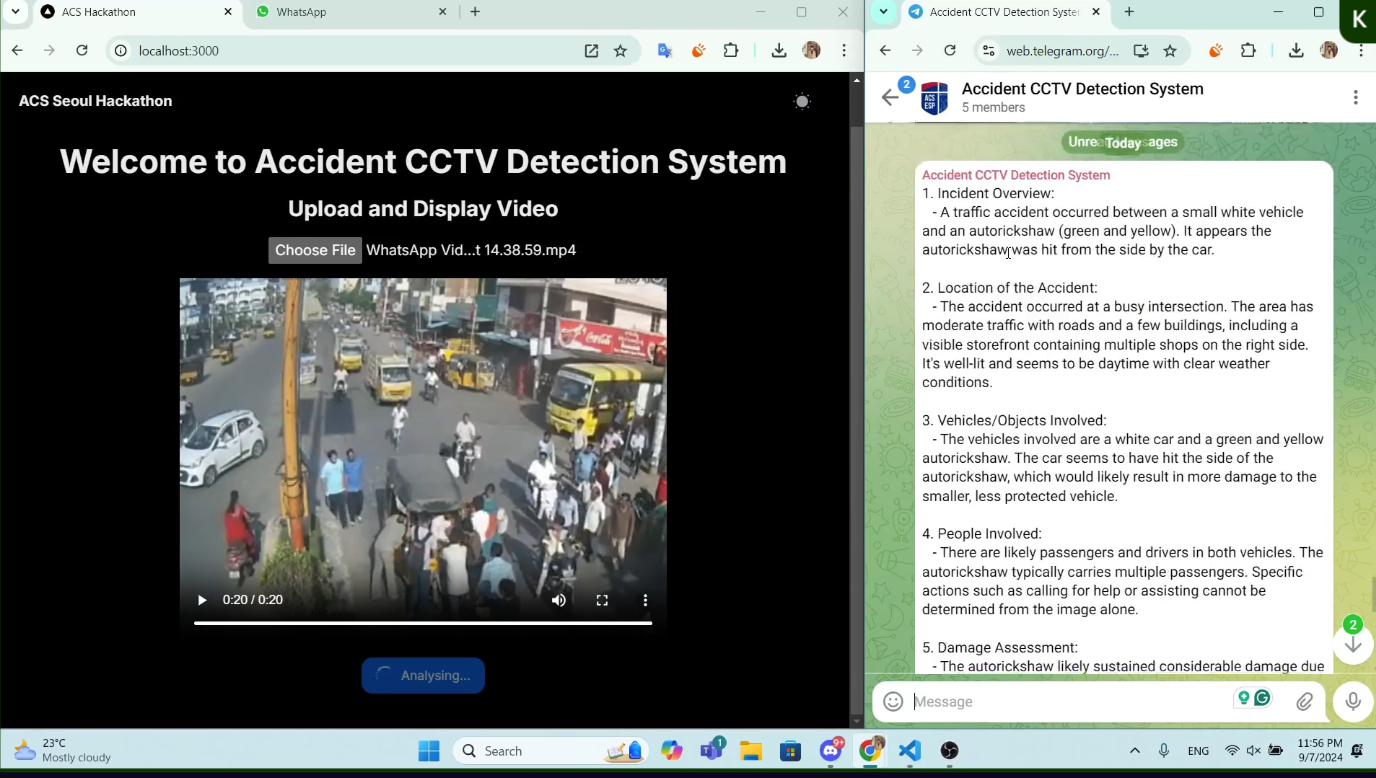
This AI-powered system integrates with CCTV networks to automatically detect incidents in public spaces. The key features include real-time detection of accidents, fires, altercations, and robberies. When an incident is detected, the system sends an automatic alert to relevant authorities, accompanied by a brief description of the event. Additionally, it provides analytical data about the incident to facilitate faster and more informed responses.
How We Built It
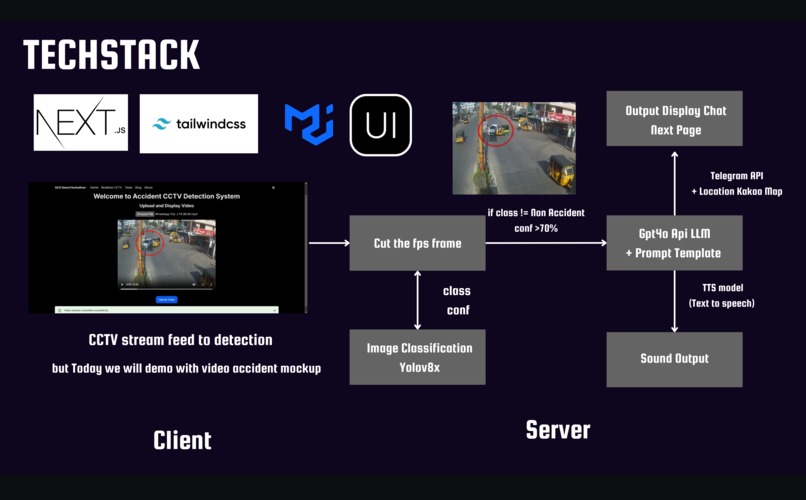
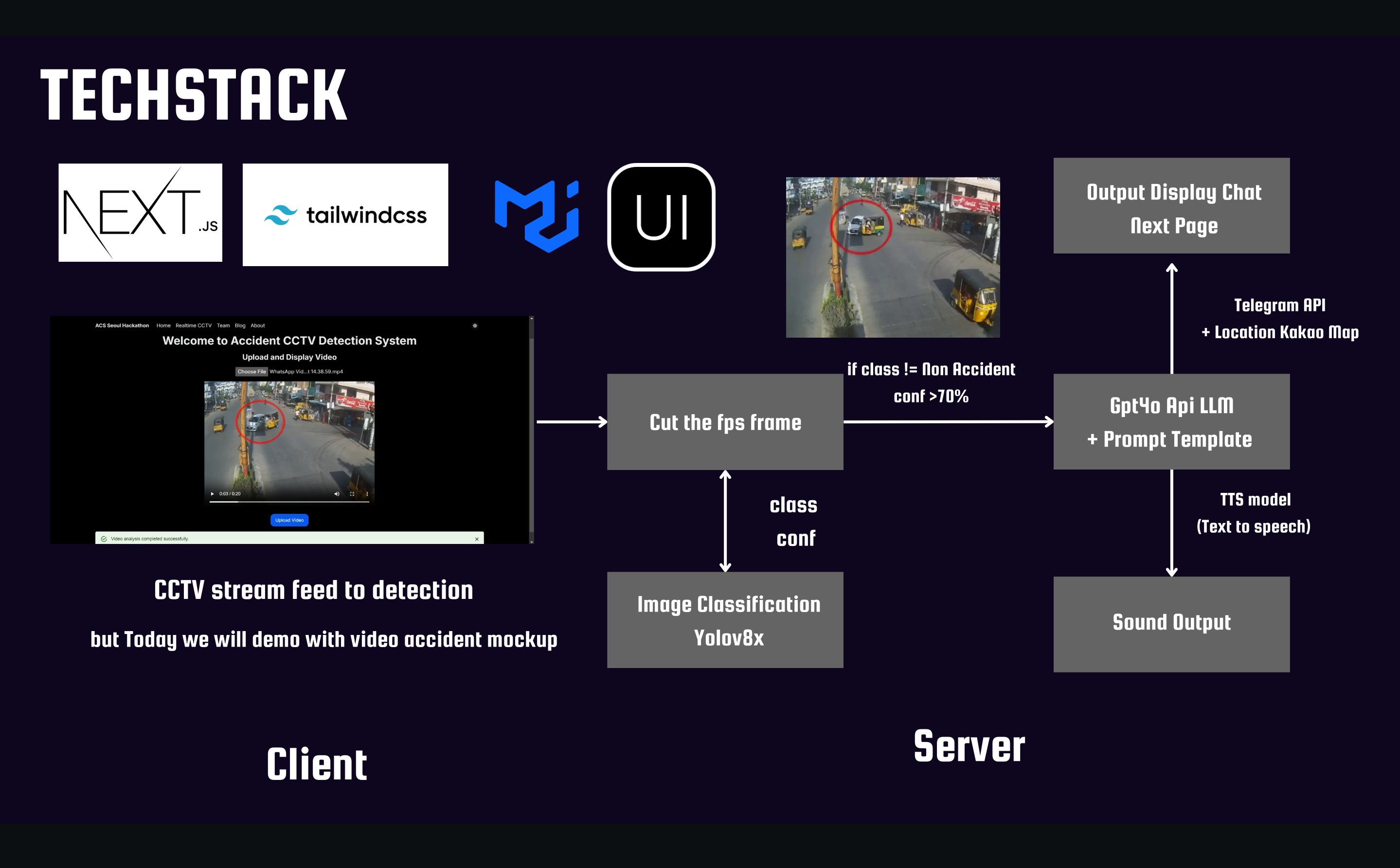
1. Tech Stack
Front-End:
- Next.js: A React-based framework for building user interfaces.
- TailwindCSS: A utility-first CSS framework for styling.
- Material-UI (MUI): A UI component library for building sleek interfaces.
Back-End:
- YOLOv8: An AI model used for real-time incident detection.
- GPT-4 API: Used to generate descriptive summaries of detected incidents.
- Telegram API: For sending incident alerts directly to authorities.
- Kakao Map API: Provides location data for incident reporting.
- TTS (Text-to-Speech) Model: Converts incident descriptions into audio alerts.
2. Steps to Build
Front-End (Client):
- Set up a Next.js project and configure TailwindCSS.
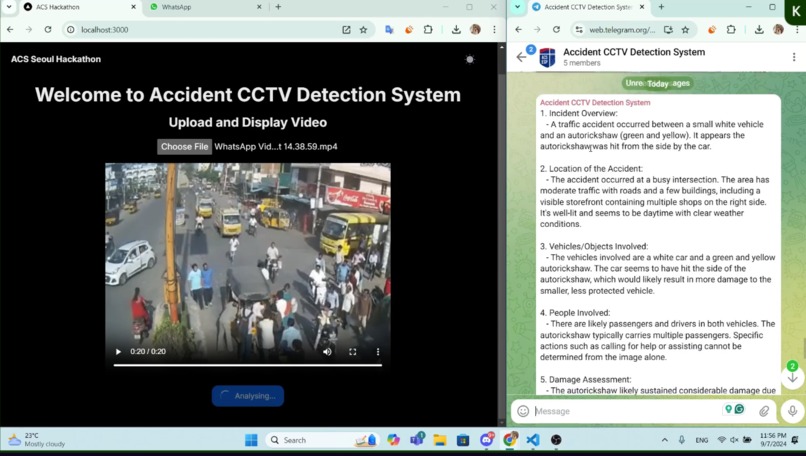
- Create a user interface for uploading CCTV video footage.
- Use React Player or similar libraries to play the uploaded videos.
Back-End (Server):
- Use OpenCV to extract frames from the uploaded video.
- Apply YOLOv8 to detect accidents and incidents in the video frames.
- Generate descriptive summaries of detected incidents using GPT-4.
Notifications & Feedback:
- Send real-time alerts via the Telegram API.
- Convert text-based incident descriptions into audio alerts using a TTS model.
- Use the Kakao Map API for live location tracking of incidents.
3. Deployment
- Test the system with mock CCTV footage to evaluate its effectiveness.
- Host the server on cloud platforms like AWS or GCP for scalable deployment.
Workflow image is show on the top screen
Challenges We Faced
One of the main challenges was the lack of access to live CCTV footage, limiting our ability to fully test the system in real-world conditions. As a result, we relied on mock projects using pre-recorded CCTV accident footage. We also encountered issues with connecting the front-end and back-end systems and faced technical hurdles while training models, such as running out of free Google Colab resources.
Accomplishments We're Proud Of
We are proud to have developed an AI model that can detect multiple types of incidents with high accuracy in a simulated environment. Furthermore, we successfully created an automated alert system that helps authorities respond quickly and effectively. This innovation reduces the risk of undetected incidents in public spaces, promoting a safer environment through smart technology.
What We Learned
Through this project, we gained a deeper understanding of the importance of high-quality data for effective AI performance. For real-time systems like this, speed and efficiency are critical. We also learned about the need to develop systems that can adapt to various environments and situations to ensure scalability and wider applicability.
What's Next for ACS - Accident CCTV Detection System
Looking ahead, we aim to integrate ACS with live CCTV networks across different regions. We plan to enhance the accuracy of the system’s incident detection and hope to collaborate with emergency services such as the police, hospitals, and fire departments to ensure faster response times and better accident management.

Log in or sign up for Devpost to join the conversation.