
Inspiration
Last year I joined a startup in Berlin for my first full-time software engineering role. I was also responsible for the working students. Three weeks in, my boss nudged me to have a serious conversation with one of them about the quality of their work. To make it harder: it was the working student who had been there for two years, had helped onboard me, and had been the first to invite me out for lunch.
I rehearsed that conversation for three days on the way to work, but nothing of it has been said in the real conversation.
My friends told me similar stories. Some lead teams and postpone critical feedback for months, only to end up saying "nice job". Others don't dare to ask their manager for a raise. You can rehearse a presentation out loud. Why not the conversation that keeps you up at night - with someone who pushes back the way people push back?
When this Shipaton came up, I knew this was the category for me.
I started early and had something working by mid-August: a catalogue of conversations, an AI partner that talks back, a debrief. Then I gave it to seven people. They were kind, and they all said some version of the same thing: "Nice - but my problem isn't talking to an Emily. It's talking to my Emily. The one who onboarded me."
A catalogue can teach you a conversation. It doesn't know your colleague, what was agreed in March, or what you have been putting off since. So I rebuilt Bravy around a work journal, and the practice grew out of it: you rehearse with what actually happened in front of you. A library of curated conversations at work is, of course, still included and growing.
What it does
36 conversations · 7 characters · 2 languages · 29 hand-checked sources · 0 accounts · infinite conversations due to the work journal
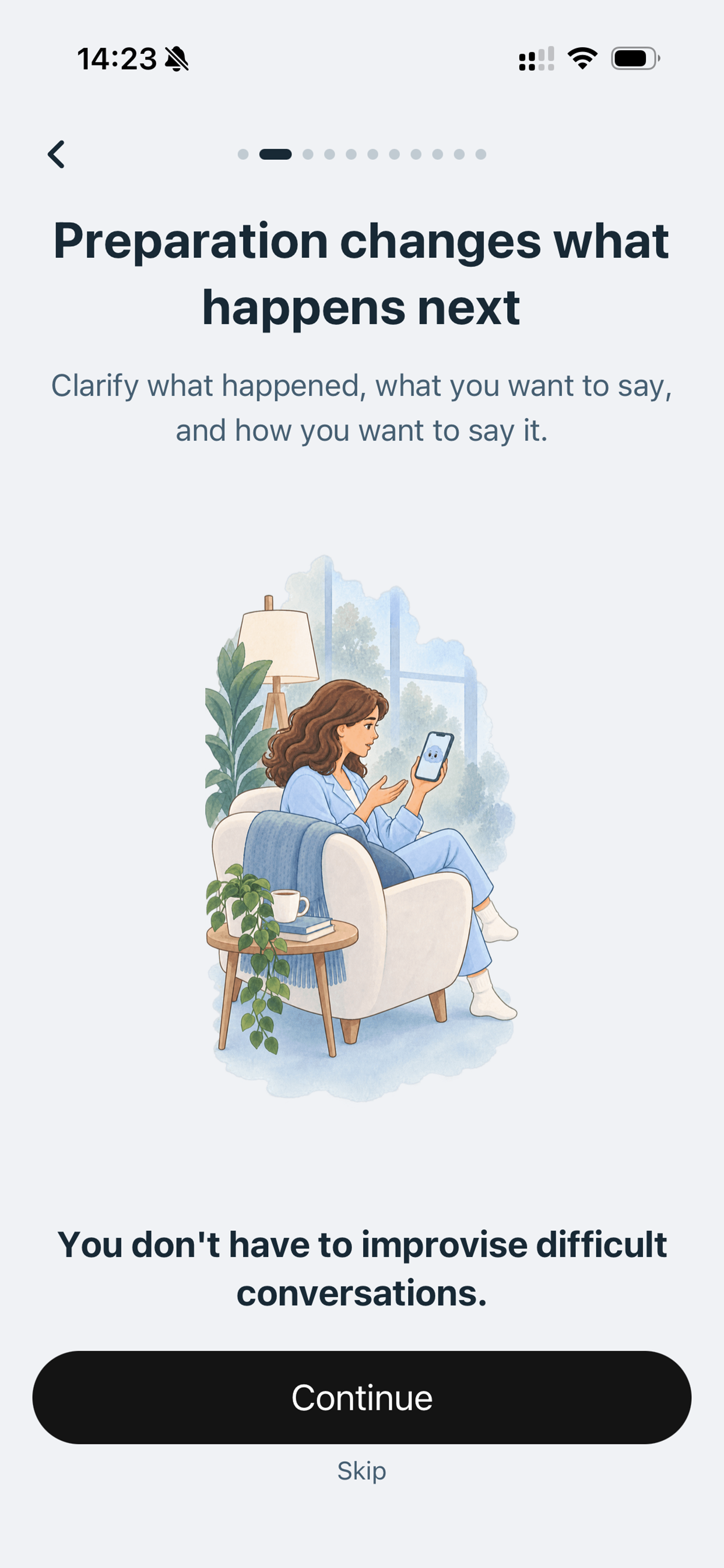
Bravy helps you prepare the difficult conversations at work - before you have them.
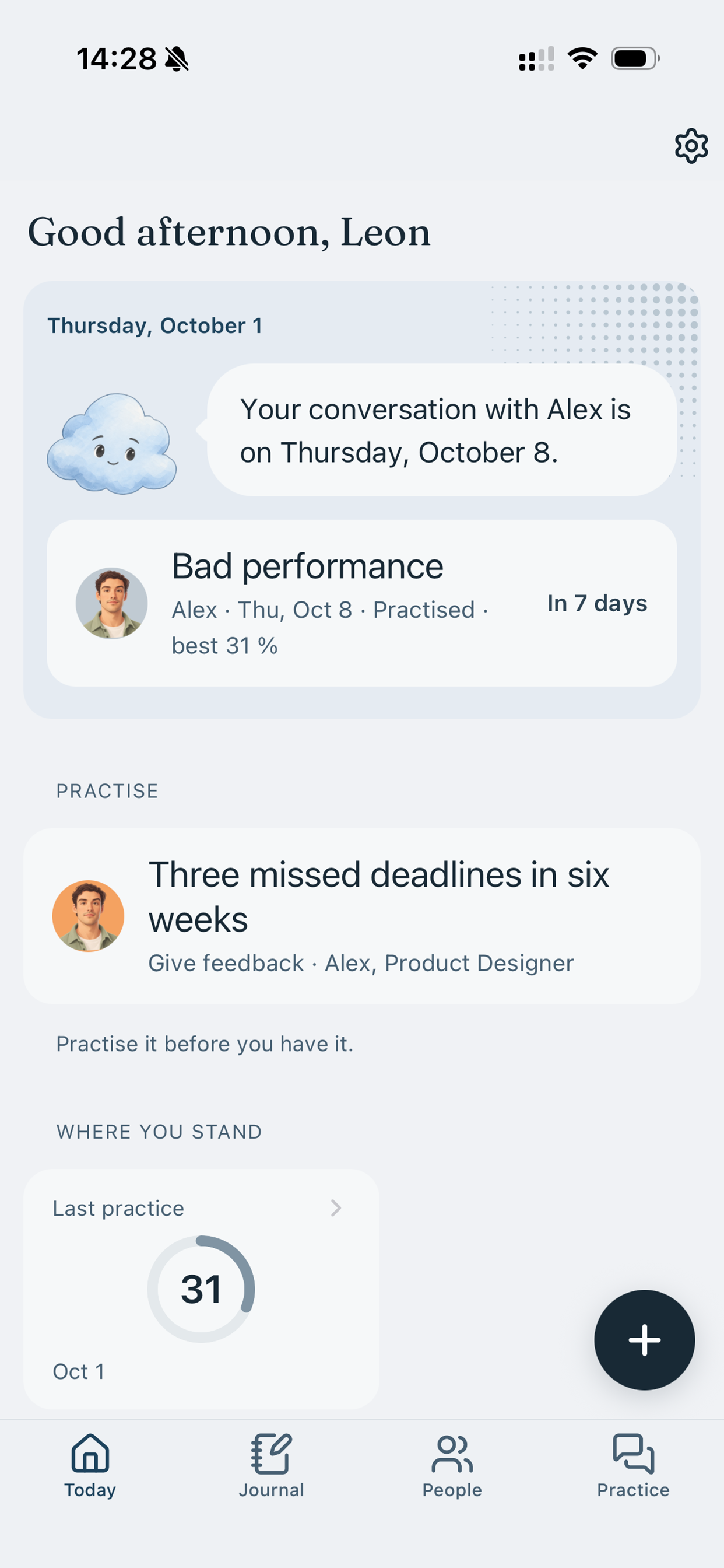
- Keep a journal of the people you work with: what happened, what was agreed, what is coming up. The deadline that slipped. The promise nobody wrote down. The meeting that turned.
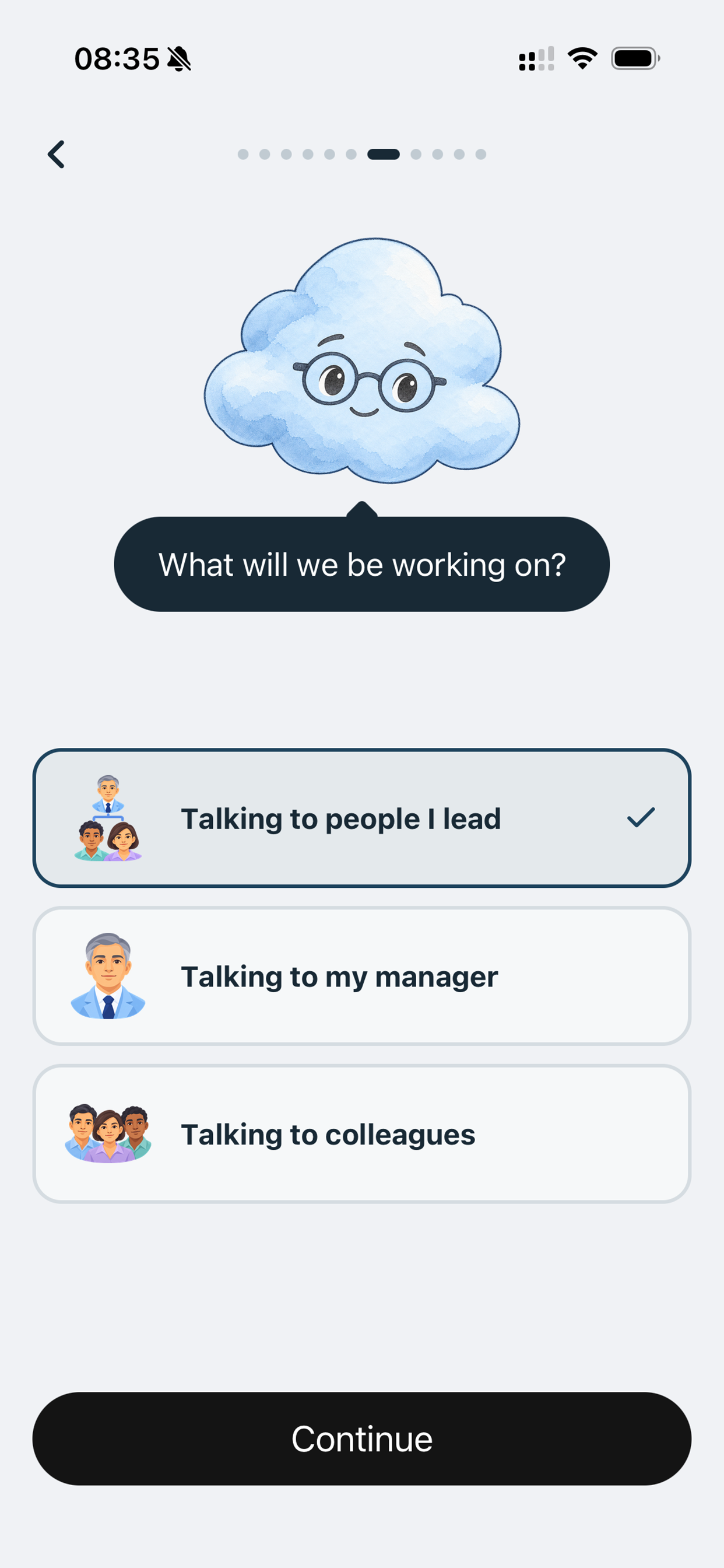
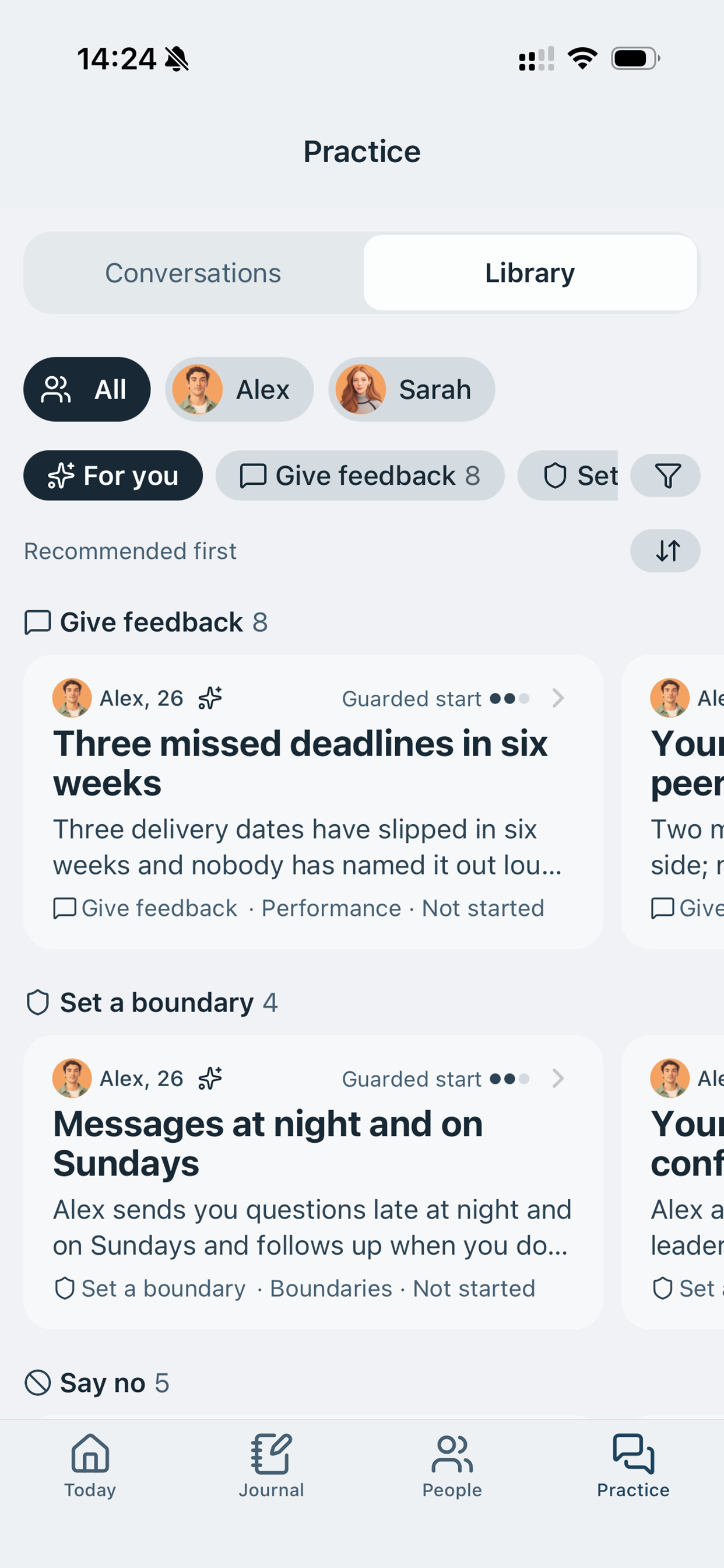
- Pick a conversation. One of 36 from the library - with someone you lead, your manager or a peer - or plan the real one from your journal. Bravy can also suggest one from what you wrote about a person.
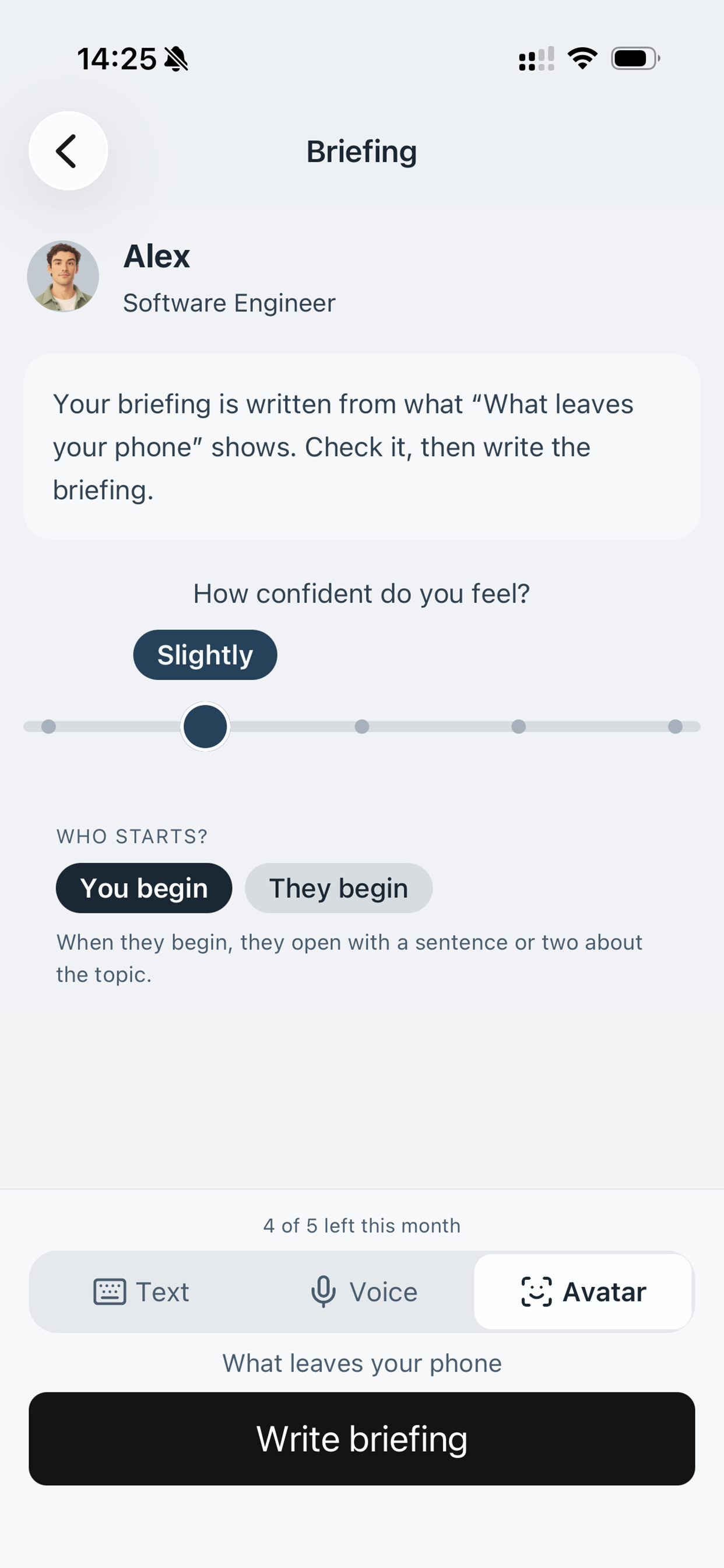
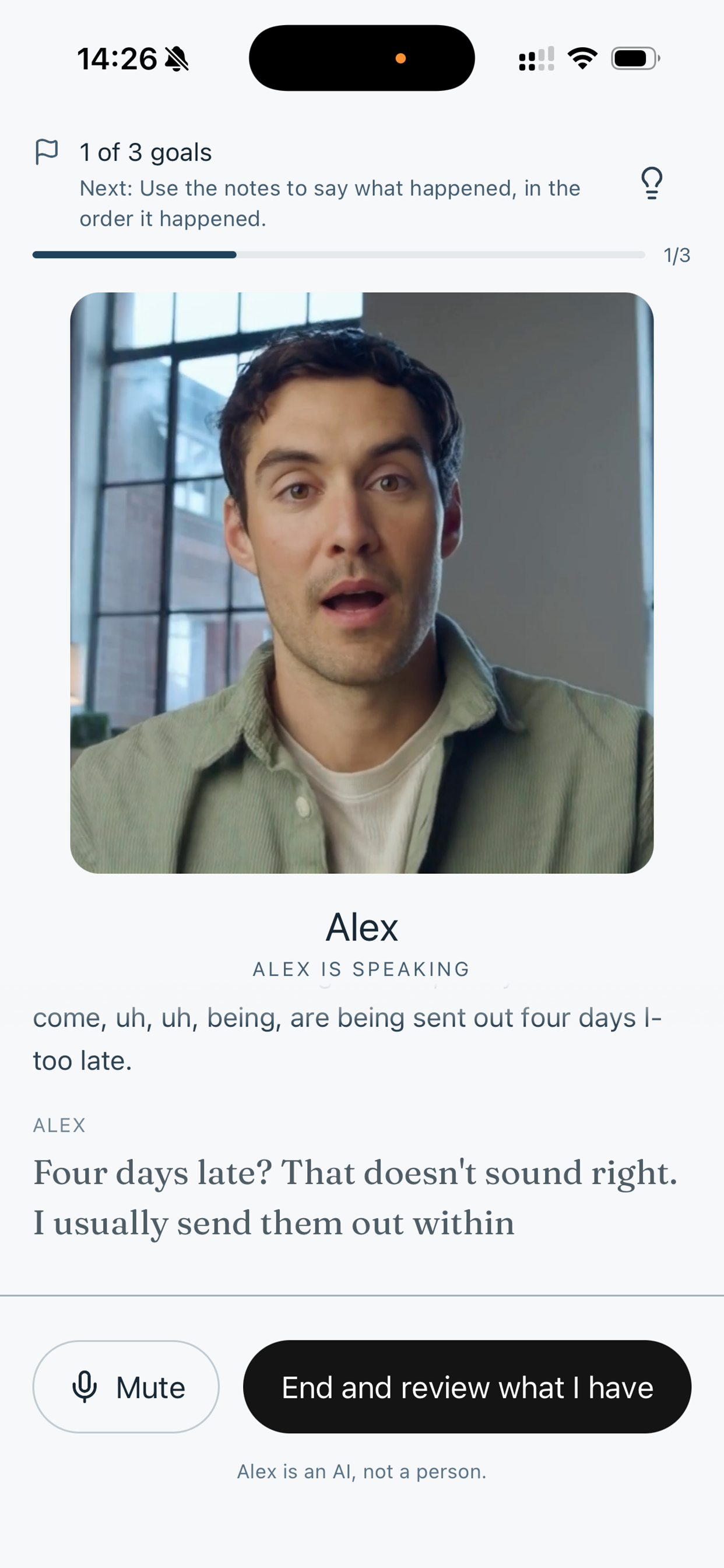
- Have it. Out loud, in writing, or face to face with a video avatar. Each character walks in warm, guarded or cold, and knows things you don't. Emily won't tell you why the deadline slipped unless you ask - and goes quiet if you grade her.
- Watch the goal bar fill while you talk. Or not.
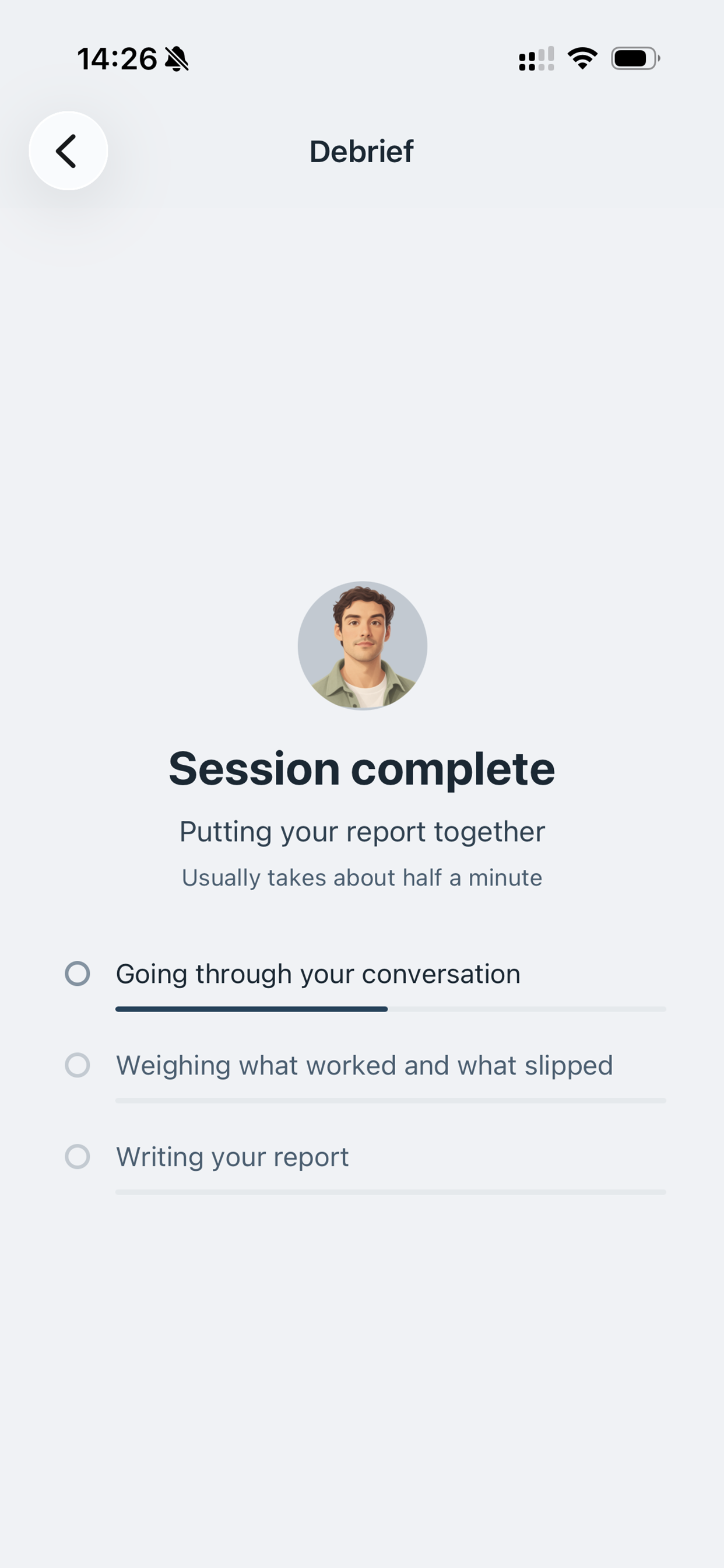
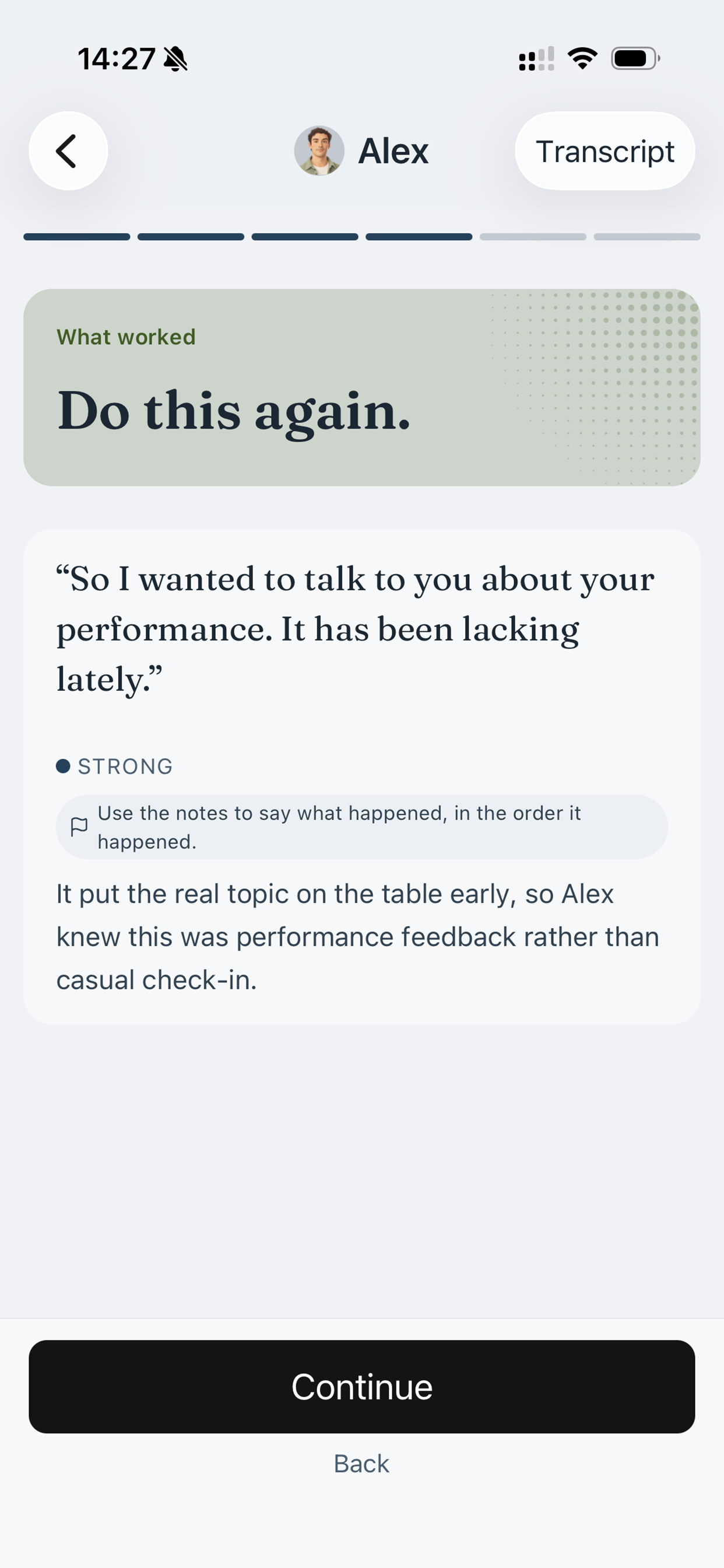
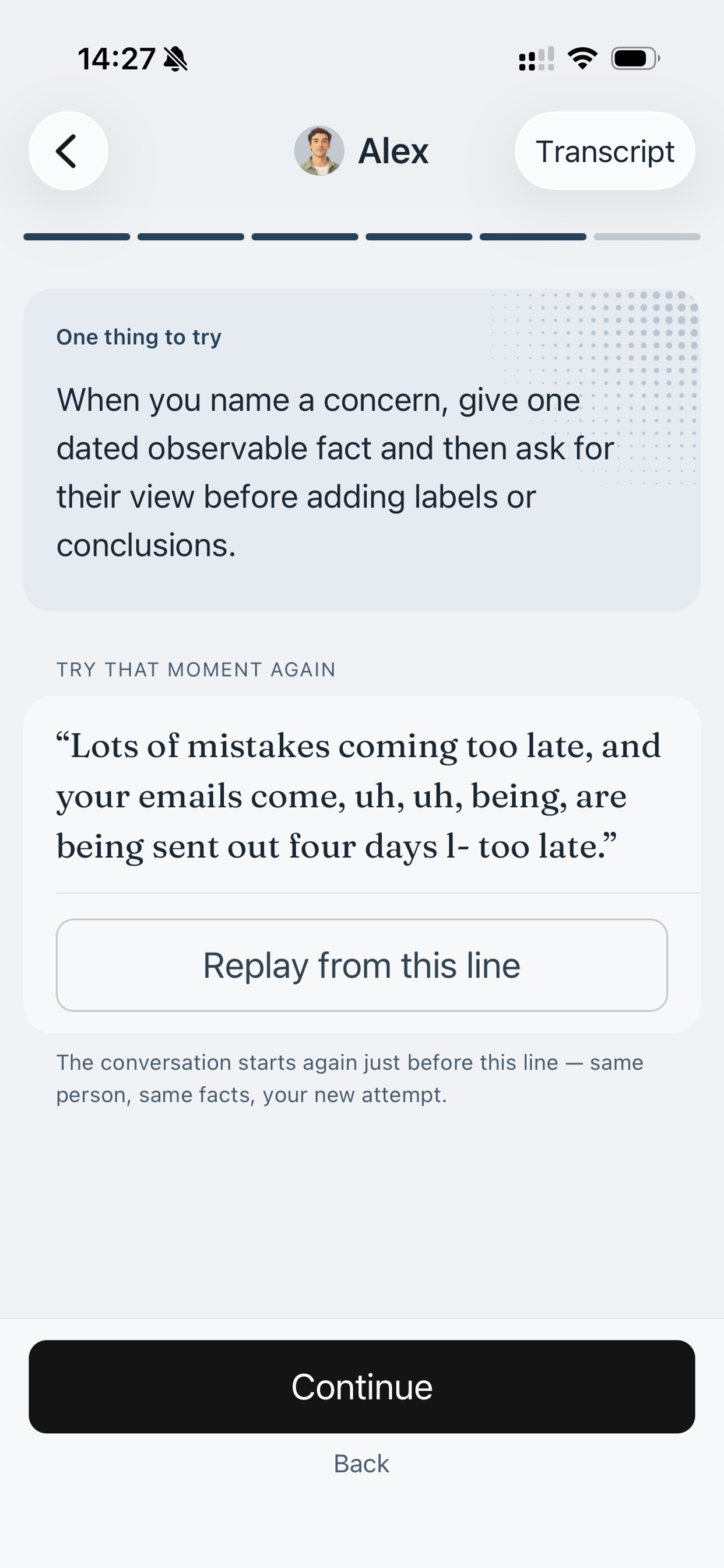
- Read the debrief. Not a grade: the moment it turned, what you said, why it landed that way, a line to say instead. It ends with what the other person walked away thinking and one thing to try next time.
- Replay from the line that went wrong, or run the whole thing again.
The debrief looks at five things - clarity, directness, empathy, firmness, commitment - and, beside them, your tone, where the middle is right: too soft is as much a finding as too hard. The other person's takeaway is honest.
Bravy never hands you a script. If you are stuck mid-conversation, you can ask for one line - and then it is your turn again.
The bridge to the real conversation. A planned conversation gets a reminder the day before. Agreements get a due date and come back when they are due. The journal keeps the relationship over months, so the next rehearsal starts from the last real conversation, not from zero.
Element of surprise. New managers rarely see the hard conversation coming. So if you let it, Bravy takes the people and notes in your journal and proposes the conversations that could realistically come up next - so the surprise happens in practice, not in the meeting. (The feature my seven testers kept coming back to.)
Something to read. After a debrief, Bravy points to a few sources for your weakest dimension - from 29 that I opened and checked myself (not in-depth to be honest), each labelled research or practitioner: Amy Edmondson's paper on psychological safety (1999), Detert and Burris on whether employees can really speak freely (HBR, 2016), Frank Flynn on asking for help (Stanford GSB), Givi and Kirk on the fear of saying no (2024).
If something sounds like a crisis, the character stops being a character and names help.
Private by construction. There is no account. The names of your colleagues never leave your phone: a request to the AI has no field a name could go in. Before anything from your journal is sent, a screen shows you exactly what goes. No recording of your voice is kept.
How I built it
Bravy is an iPhone app built with Expo and React Native, a small server of my own, and a shared data model between the two, so a scenario, a session and a debrief mean the same thing on both sides. The journal lives on the phone, in a local database. The server knows an anonymous identifier, a quota and a subscription status - and nothing else about you.
For spoken practice, the server creates short-lived credentials and hands the conversation to ElevenLabs Agents. Written practice uses the same characters and the same facts, with OpenAI writing the replies. After a run, the transcript goes through a structured analysis that writes the debrief, checks the goals and picks what to read next. Avatar practice adds Anam: the other person gets a face, shown in a page my own server serves inside the app. It is the expensive part, so Pro comes with a small monthly avatar allowance.
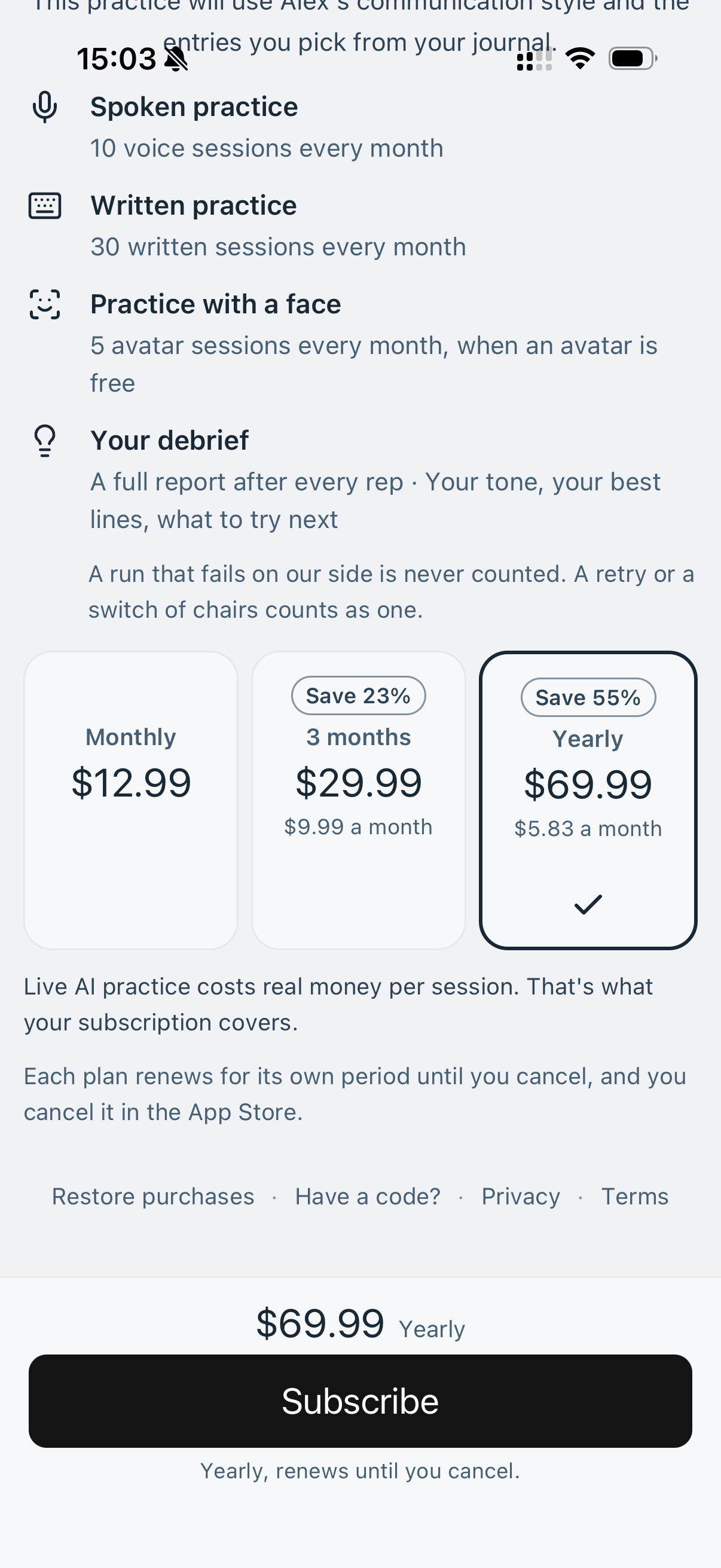
RevenueCat does more here than subscriptions. Pro comes in 1, 3 or 12 months from one offering, and the paywall works out the saving from the store's own prices. Since I am doing small numbers with LinkedIn Ads (now that my app is polished, I want to increase it), there is a web-funnel built with RevenueCat & Stripe (see attachment): buy on the web, open one link on your iPhone, and Pro is active in the app - still without an account.
OneSignal sends at most two messages a week - a short check-in and a scenario of the week - each with its own switch, and nothing is sent before you say yes.
Analytics and error monitoring are self-hosted, so no conversation content ever reaches a third party for either. I love Coolify.
Challenges
- Making the other side feel like a person. The faster the AI answers, the shallower the answers get. I spent weeks having the same conversations over and over until the pushback felt like someone thinking rather than a service loading.
- You cannot unit-test a conversation. Whether Emily pushes back the way a real person would is not something a test can tell you. The structured parts of the app are tested like any software; the conversational parts went through hundreds of runs that I read myself, line by line.
- Costs. Every spoken minute costs real money, and there is no free run. So there are limits per month, limits per hour, and a code for the jury instead of a free trial - a free trial with ten spoken sessions is an open door.
- Apple. Eight days in review for the first version, one expedited request, and a lot of staring at a status page.
- Updating without breaking anyone. The new version speaks a different language to the server than the old one. Instead of forcing an update, the old server keeps running for the old app, and the new one has its own address. Nobody was logged out, because nobody is ever logged in.
- The video. Shooting it was fun. Cutting it was another task I had severely underestimated.
- Getting out there. Building a business and growing a community means being seen, and I honestly prefer working alone or in a small team, somewhere in the backend. But in an international hackathon there is no sense in not showing up. So that is what I am trying - at least.
- Design. As a backend developer, I underestimated everything that happens on the screen. Every row, every colour and every empty state took longer than the feature behind it.
Accomplishments that I'm proud of
- Among hundrets of never-finished side-projects, I am proud that Bravy is actually in the App Store.
- Seven testers changed what the app is, and I am glad they did. The journal came from them.
- 36 conversations with 7 characters, in English and German, each with hidden context you have to earn.
- The names of your colleagues never leave your phone. Not as a promise, but as a fact.
- A crisis protocol that puts the person before the practice.
What I learned
- Seven honest users are worth more than seven hundred ideas.
- A catalogue teaches a conversation; a journal teaches your conversation.
- Ship earlier. Parkinson's law found me again.
- Actually, a lot about having conversations and managing people.
What's next
- Courses built on the sources: read, practise, prove it - without streaks or badges.
- "Take it back": withdraw your last line mid-conversation and try again, without hanging up.
- More conversations for first-time managers, and more avatar time for those who want it.
- Switch-Chairs Feature
- AI-Work-Buddy Feature
Attachment
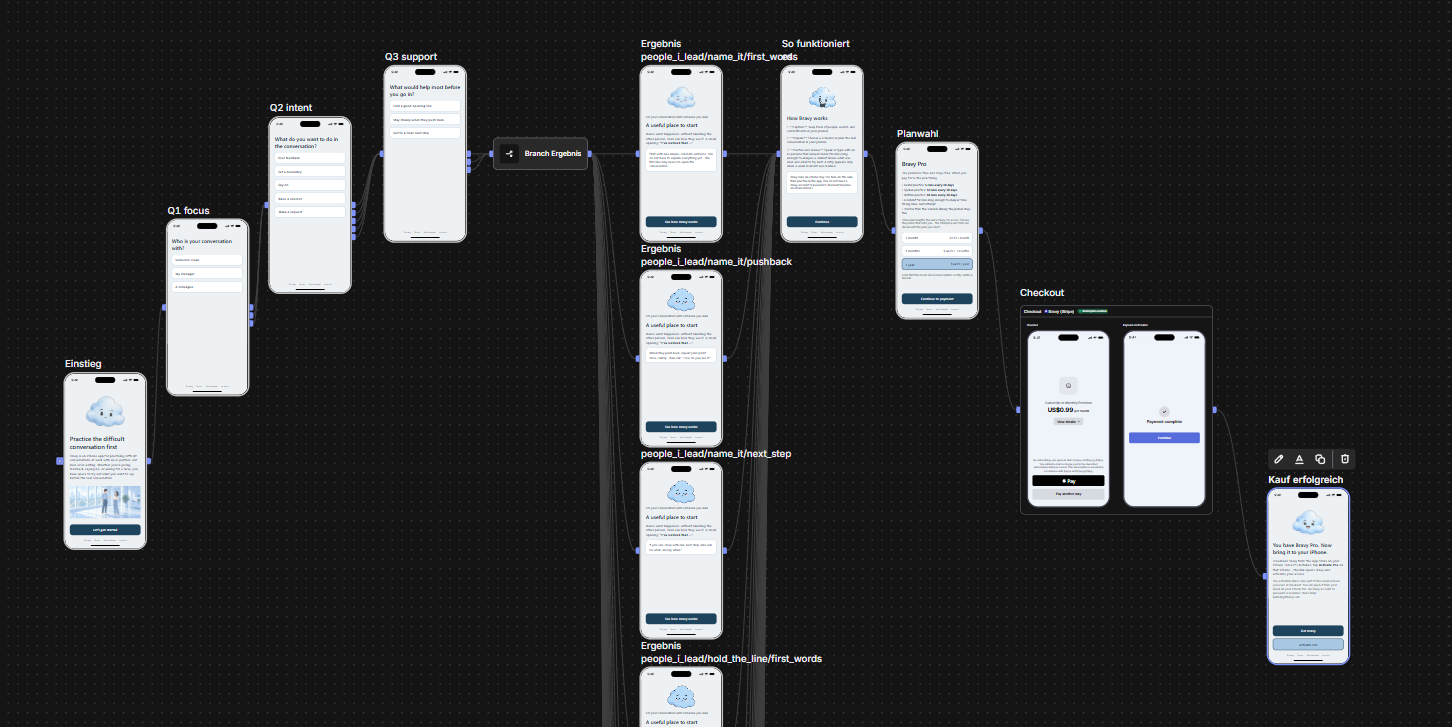
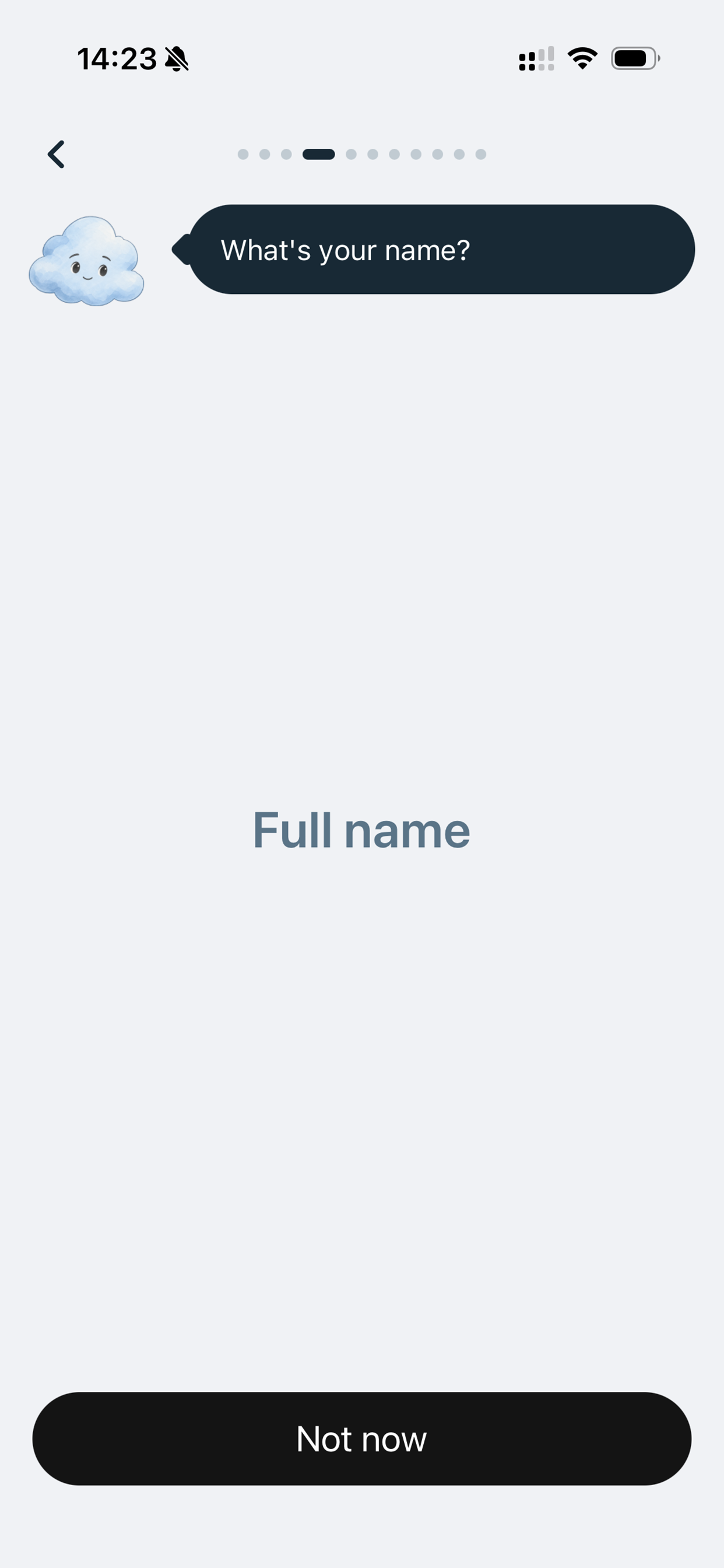
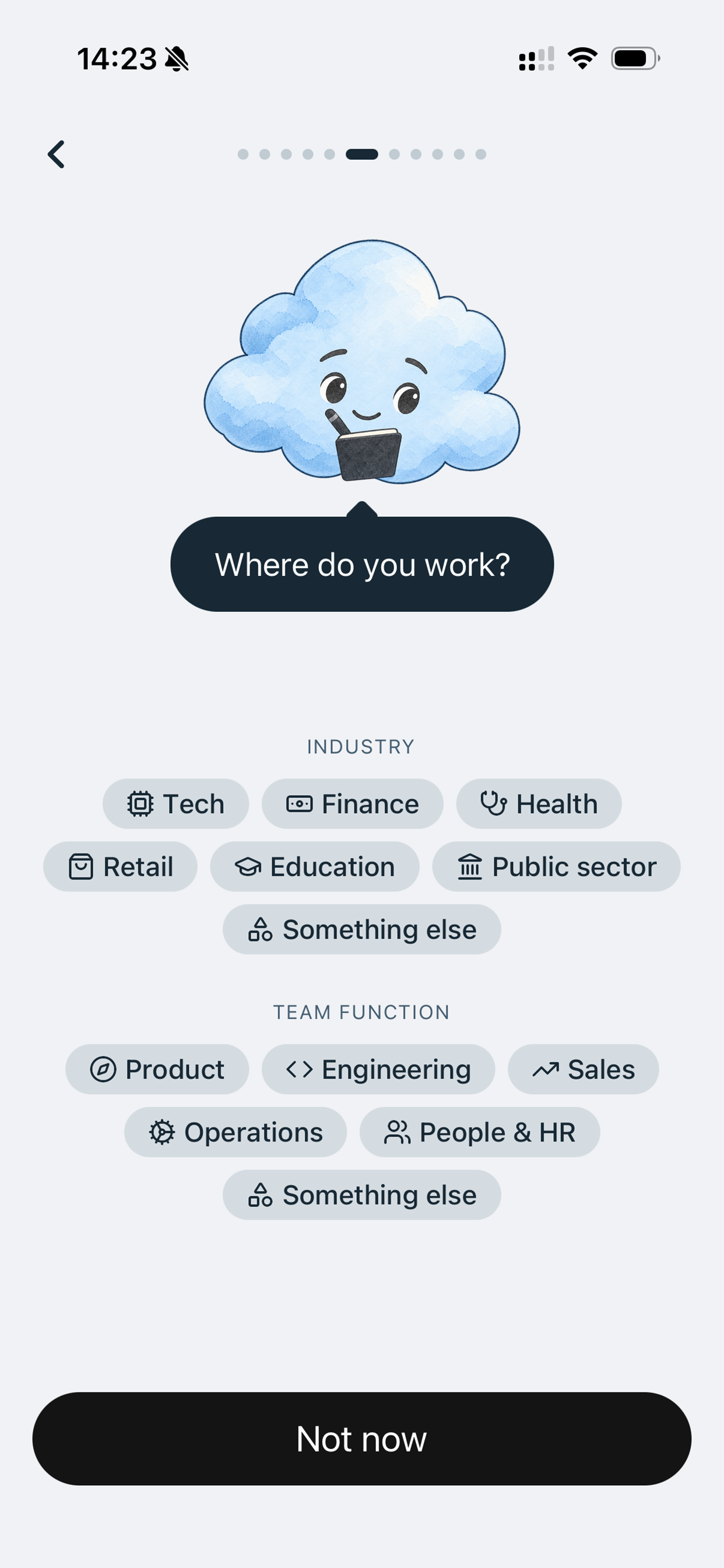
The funnel asks three quick questions and immediately gives a tailored opening line and practice tip, so visitors get value before paying. It then sells Bravy Pro through Stripe for less than the App Store price and unlocks the app with a one-tap activation link, with no account or password needed.

Log in or sign up for Devpost to join the conversation.