Inspiration
Agriculture is one of the cornerstones of California's economy. As the largest agricultural producer in the United States, California generates over $61 billion in annual agricultural output and exports nearly $24 billion worth of agricultural products each year.
Despite its scale, modern agriculture faces significant challenges that reduce crop yields and profitability. Plant diseases are estimated to cause 10–16% of global crop losses annually, while pests, invasive weeds, labor shortages, and insufficient field monitoring contribute to billions of dollars in additional agricultural losses. Farmers often need to manually inspect large areas of land, making it difficult to identify problems quickly and efficiently. We wanted to create a solution that could automate crop monitoring, provide actionable insights, and help farmers make better decisions while reducing manual workload.
This challenge inspired us to build Acre, an intelligent crop scouting and farmland surveillance platform designed to modernize agricultural monitoring through edge computing and automation.
What it does
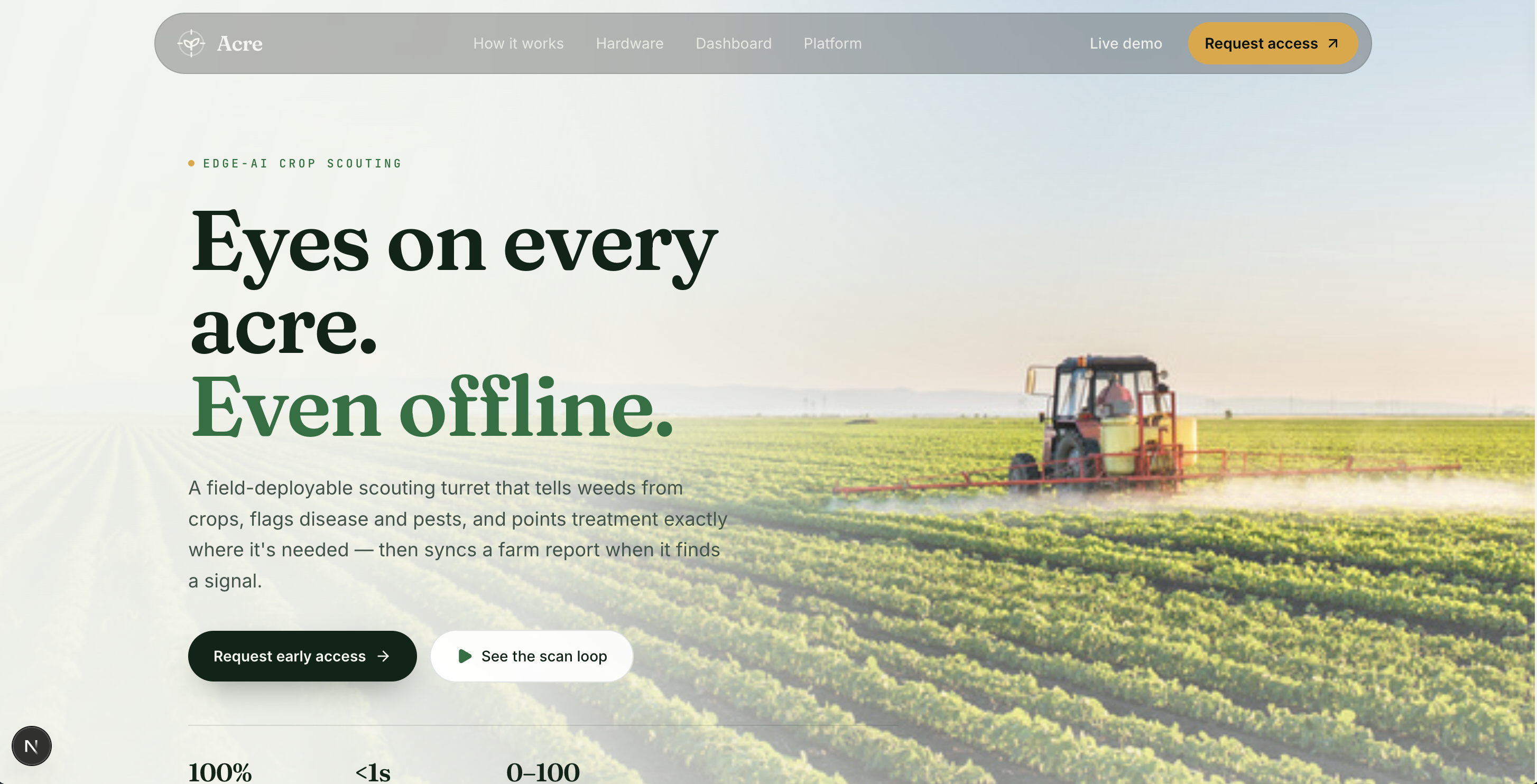
Acre is a crop scouting and surveillance system that continuously monitors farmland to help farmers detect issues before they impact yields.
The platform can:
- Detect and identify weed growth throughout fields
- Monitor crop health and field conditions
- Track pesticide and treatment applications
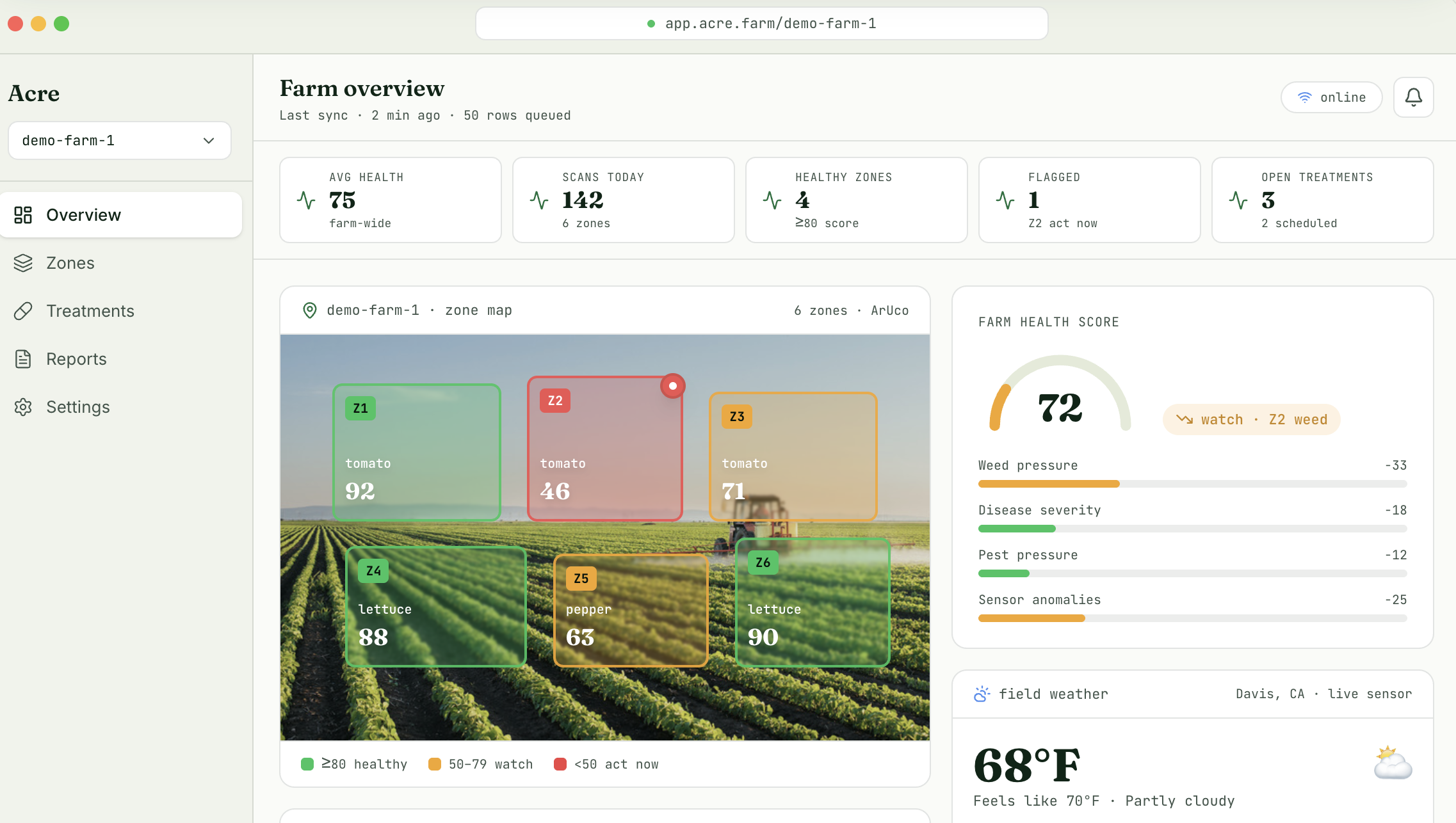
- Provide centralized monitoring of farmland operations
- Generate actionable insights to support farm management decisions
Acre performs its analysis locally on QNX, allowing it to operate reliably even in remote agricultural environments with limited or unreliable internet connectivity. This makes it particularly well-suited for farms where cloud-based solutions may not always be practical.
How we built it
We built Acre by combining embedded systems development, computer vision, AI-powered analytics, and real-time data processing into a unified platform.
The system collects information from cameras and field sensors deployed throughout the farm. Computer vision models analyze captured images to identify weeds and monitor crop conditions, while additional monitoring systems track field treatments and pesticide usage. All processing is performed locally on hardware running QNX, enabling low-latency decision making and reducing dependence on cloud infrastructure.
To present information in an accessible way, we developed a monitoring interface that aggregates field data and provides farmers with a clear view of farm conditions and potential issues requiring attention.
Challenges we ran into
One of the biggest challenges was integrating multiple components, including sensors, cameras, AI models, and embedded software into a cohesive system also required significant testing and debugging to ensure reliable communication and data processing.
Accomplishments that we're proud of
We are proud of successfully creating a complete edge-based agricultural monitoring platform that can operate independently of cloud connectivity.
Some of our key accomplishments include:
- Developing an automated crop scouting system capable of monitoring large areas of farmland
- Successfully deploying the platform on QNX for reliable edge operation
- Integrating computer vision to automate weed detection and crop monitoring
- Creating a centralized dashboard that simplifies farmland oversight
- Demonstrating how embedded AI can be applied to real-world agricultural challenges
Most importantly, we built a solution that addresses a meaningful problem and has the potential to improve efficiency for farmers operating in remote environments.
What we learned
Throughout the project, we gained valuable experience in embedded systems development, edge AI deployment, and real-time data processing.
We learned how to optimize computer vision workloads for resource-constrained hardware, how to design software for unreliable network environments, and how to integrate multiple sensing technologies into a single platform. We also gained a deeper understanding of the challenges faced by modern agriculture and the importance of building technology that is both practical and reliable in real-world deployments.
Working with QNX also gave us insight into developing applications for mission-critical systems where stability, fault tolerance, and deterministic performance are essential.
What's next for Acre
Moving forward, we plan to expand Acre's capabilities by incorporating additional agricultural analytics and predictive intelligence.
Future improvements include:
- Advanced crop disease detection using AI models
- Yield prediction and crop growth forecasting
- Automated irrigation recommendations based on environmental data
- Drone integration for large-scale field coverage
- Historical trend analysis and reporting tools
- Expanded support for additional sensor types and monitoring equipment
Our long-term vision is to transform Acre into a comprehensive smart farming platform that empowers farmers with real-time insights, reduces manual labor, and helps maximize agricultural productivity through intelligent edge computing.
Built With
- c
- embedded-linux
- python
- qnx
- raspberry-pi


Log in or sign up for Devpost to join the conversation.