-
-
Unify Overview
Prototype link (Please submit a link to a playable prototype, not a link to your design file) Link
Describe your project (max 150 words) Unify is more than just a way to connect; it's a vibrant hub, a pathway for college students to socialize, collaborate, and thrive together. Transforming the college experience, Unify empowers students to break down barriers, fostering meaningful connections.
Whether organizing events, sharing academic insights, or networking with like-minded peers, Unify is the dynamic platform for students to engage. University life can be lonely and challenging without someone to confide with. Our research proves that finding that someone is a challenge for most individuals. But, we have a solution.
Join Unify and amplify your college experience—connecting students, building communities, and making every moment memorable.
- Describe your research process and findings. If you conducted any surveys or interviews, please include the survey form and/or interview questions here. If you conducted secondary research by pulling from online sources, please include a link to your sources. (Max 500 words) Write your answer here.
Introduction to Research Methods: Our team, ACRE of Ideas, embarked on a comprehensive research journey to inform the development of our Unify project. Leveraging both primary and secondary research methods, we strategically approached understanding the needs and preferences of our target audience. To achieve this, we employed various research avenues, including firsthand surveying via Google Forms and extensive secondary research, not limited to industrial reports, academic journals, and online sources.
Google Form and Survey: To gather firsthand insights, we designed an engaging Google Form survey distributed to our local participants in the Rice Design-a-thon. The survey delved into various aspects, from socialization preferences to challenges faced in current networking platforms. With a response rate of 15+ participants, we discovered a common desire for a platform that seamlessly integrates social and academic elements than a dating platform. [Google Form] Link
Secondary Research: In parallel, we conducted extensive secondary research by exploring online sources. Insightful articles from reputable educational platforms, industry reports, and success stories of similar platforms inspired our vision. An in-depth analysis of user behaviors and trends guided the strategic decisions in refining Unify's features. Noteworthy sources include Öztürk and Mutlu's study on 'The Relationship between Attachment Style, Subjective Well-Being, Happiness, and Social Anxiety among University Students' (Procedia - Social and Behavioral Sciences, Elsevier, 2011), shedding light on psychological aspects. Additionally, Schroeder's work on 'The Globalization of On-Screen Sociability: Social Media and Tethered Togetherness' (International Journal of Communication, USC Annenberg, 2016) provided vital perspectives on evolving digital social interaction and the cultivation of social media to combat the issues of social anxiety. These sources played a pivotal role in shaping Unify's development decisions.
Link to Sources: Öztürk, Abdülkadir, and Tansu Mutlu. “The Relationship between Attachment Style, Subjective Well-Being, Happiness and Social Anxiety among University Students’.” Procedia - Social and Behavioral Sciences, Elsevier, 26 Jan. 2011, www.sciencedirect.com/science/article/pii/S1877042810025036.
Schroeder, R. “The Globalization of On-Screen Sociability: Social Media and Tethered Togetherness.” International Journal of Communication, University of Southern California, Annenberg School for Communication & Journalism, 1 Nov. 2016, ora.ox.ac.uk/objects/uuid:c71e6961-30bb-42ef-80aa-18181dceb992.
This combination of primary and secondary research positioned our team to build a platform that addresses current challenges and anticipates the evolving needs of college students. Unify is a product shaped by the collaborative effort of our team and the Rice University community we engaged with during our research process.
- Describe your most important design decisions. What research findings and/or user testing results led you to make these decisions? (Max 500 words)
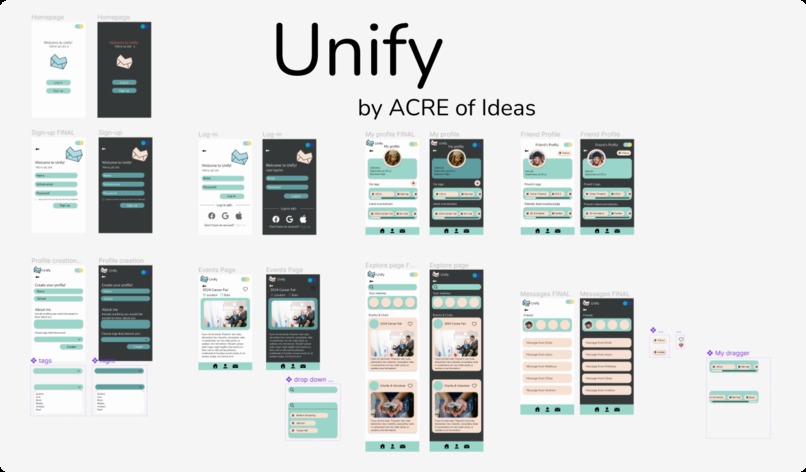
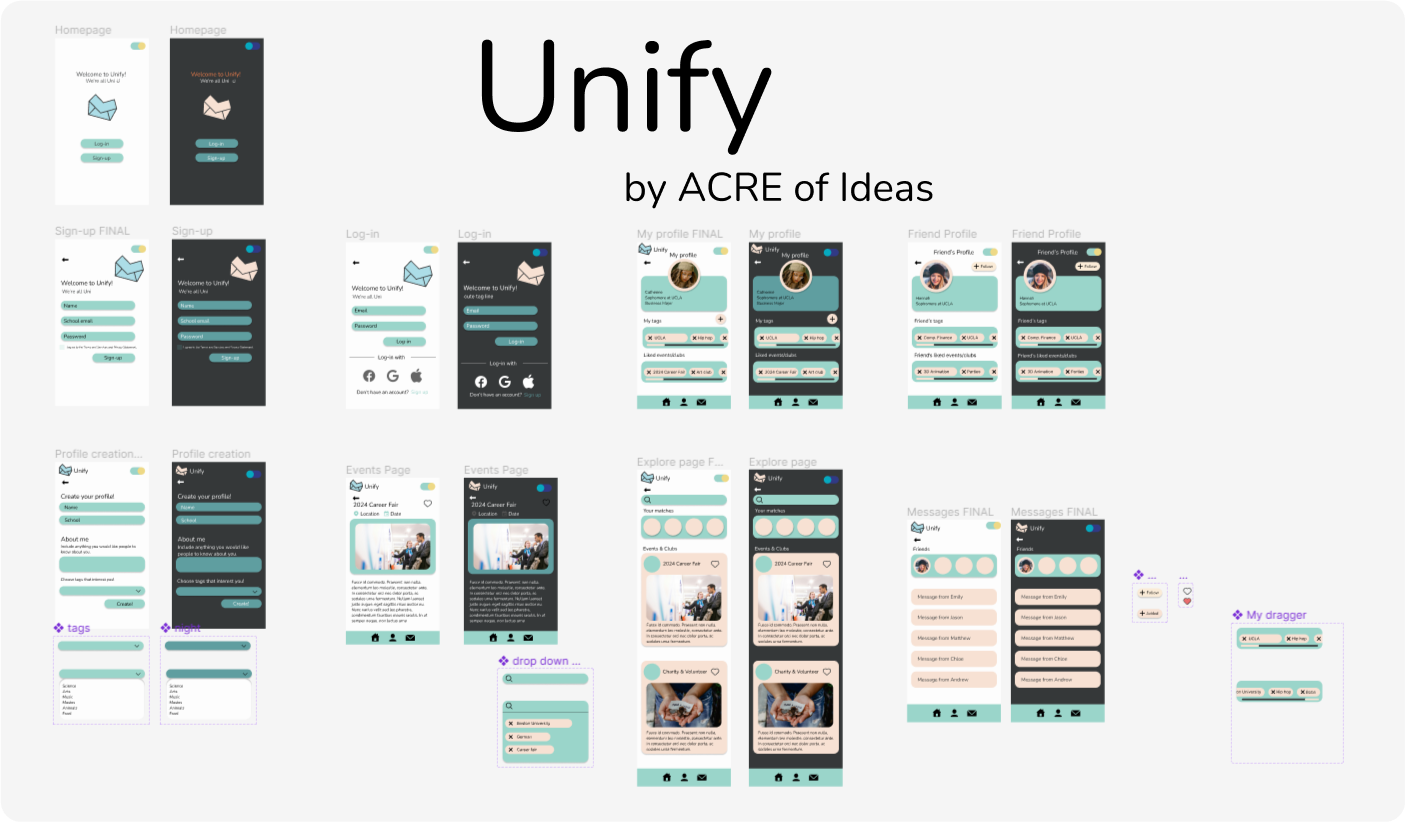
Following our initial testing, we realized some faulty errors in our design. After agreeing on color palettes, we used a grayscale contrast technique only to find out the colors were not very accessible. This was proven when we were designing the navigation bar and realized that the bar was barely visible against the background of our application. Wanting to prioritize accessibility, we had to re-vote on more accessible and minimalistic color choices so all students were able to use the app effortlessly. We also wanted to add a dark mode to ensure we had contrasting colors. In terms of navigation, we added a back button to allow seamless user flow. On top of that, we added a feature where selecting profile pictures would take the user to different places in the app. With the time crunch, we found Figma’s variant component to be useful for simplifying edits made to the components. With thorough inspection and extensive user testing after each major revision of our high-fidelity prototype, we were able to create Unify. The accessible app to curate events and plant the seeds for long-lasting friendships.
Built With
- figma
- ui/ux



Log in or sign up for Devpost to join the conversation.