-
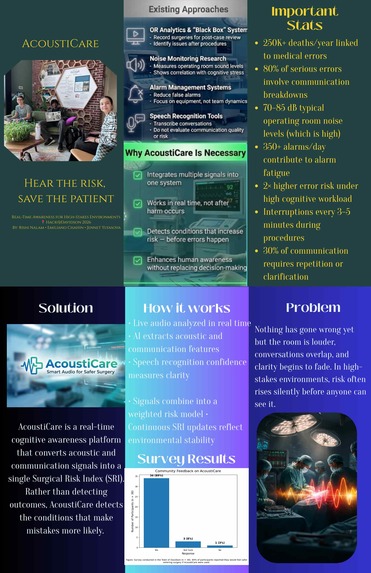
AcoustiCare Brochure
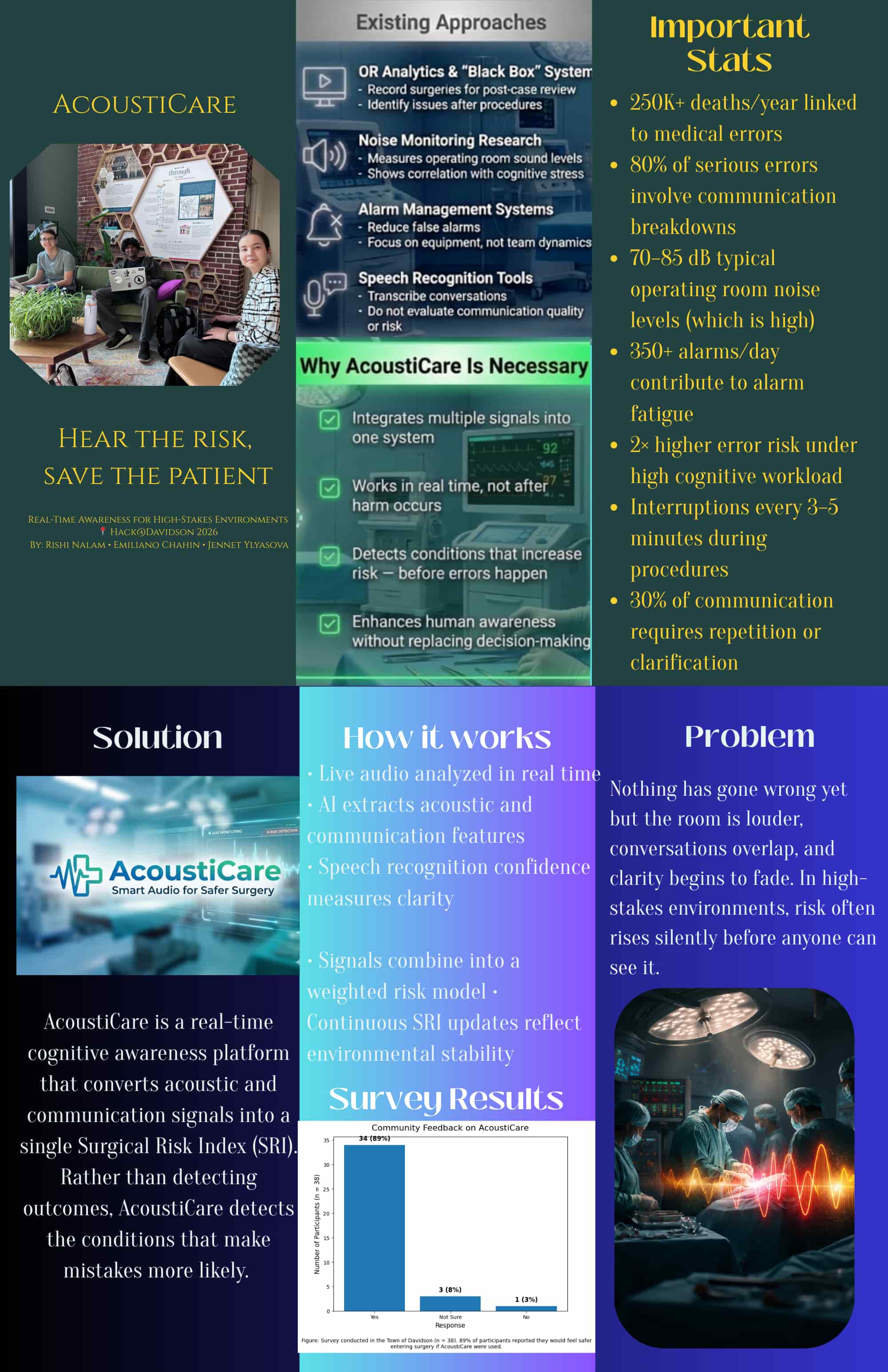
Nothing has gone wrong, yet the operating room feels different. Alarms beep more frequently; conversations overlap, and instructions must be repeated over rising noise. In these moments, cognitive strain increases long before any visible mistake occurs.
Inspiration
AcoustiCare was inspired by real experiences inside the operating room, where one of our team members worked as a surgical technologist assisting surgeons during procedures. We observed how environmental stressors — noise, interruptions, and miscommunication — can subtly affect team performance even when clinicians are highly skilled.
What it does
While medicine continuously monitors patients' vital signs, there is no system monitoring the conditions affecting people making life-critical decisions. AcoustiCare addresses this gap by analyzing environmental and communication signals in real time and translating them into a single Surgical Risk Index. Rather than detecting errors after they happen, AcoustiCare helps make rising instability visible early, enhancing situational awareness and supporting safer decision-making.
How we built it
We built AcoustiCare by starting with a simple idea: make invisible stress visible. Using live audio input, we analyzed environmental signals such as noise variability, alarm activity, and communication clarity. We integrated AI-based speech recognition to understand how clearly teams were communicating and combined these signals into a single Surgical Risk Index that updates in real time.
The core math behind our index is calculated as a weighted sum of normalized environmental stressors, where each variable is scaled by its respective weight W:
$$SRI = (V_{norm} \times W_{vol}) + (A_{prob} \times W_{alarm}) + (S_{prob} \times W_{speech}) + (L_{volat} \times W_{volat}) + (S_{norm} \times W_{spikes})$$
Or, expressed as a standard summation: $$SRI = \sum_{i=1}^{5} (Metric_i \times W_i)$$
Our focus was not just on technical accuracy, but on creating a system that communicates complex conditions in a way people can understand instantly.
Challenges we ran into
The hardest challenge was measuring something we could not directly see: cognitive strain. Stress, distraction, and miscommunication don’t come with clear numerical values, so we had to thoughtfully choose signals that realistically reflect human performance under pressure. We also struggled to balance sophistication with simplicity; a powerful system means little if users cannot interpret it quickly. Finally, we were intentional about designing AcoustiCare as a support tool, ensuring it enhances human judgment rather than attempting to replace it.
Accomplishments that we're proud of
We are proud of turning lived clinical experience into a working prototype that addresses a real, human problem. AcoustiCare does not focus on mistakes themselves, but on the moments leading up to them — when instability quietly builds. Creating a system that integrates multiple signals into one meaningful insight felt like translating intuition into something measurable and actionable.
What we learned
This project taught us that safety depends not only on expertise but also on environment and awareness. We learned how strongly human performance is shaped by surrounding conditions and how technology is most effective when it supports people rather than overwhelms them. Most importantly, we learned that meaningful innovation begins with careful observation and empathy for the people working in high-pressure environments.
What's next for AcoustiCare
Our next step is to test AcoustiCare in simulated clinical environments to better understand how teams respond to environmental awareness in real scenarios. We plan to refine the Surgical Risk Index using additional data and explore how the system can support training and reflection after complex situations. In the long term, we envision AcoustiCare expanding beyond operating rooms into emergency response, aviation, and disaster coordination, helping people maintain clarity when decisions matter most.
Try it out
To run our live Sentinel Monitor locally on your machine, clone the repository and run:
streamlit run live_dashboard.py


Log in or sign up for Devpost to join the conversation.