-
-
Interoperable Clinical AI for Precision Prescribing
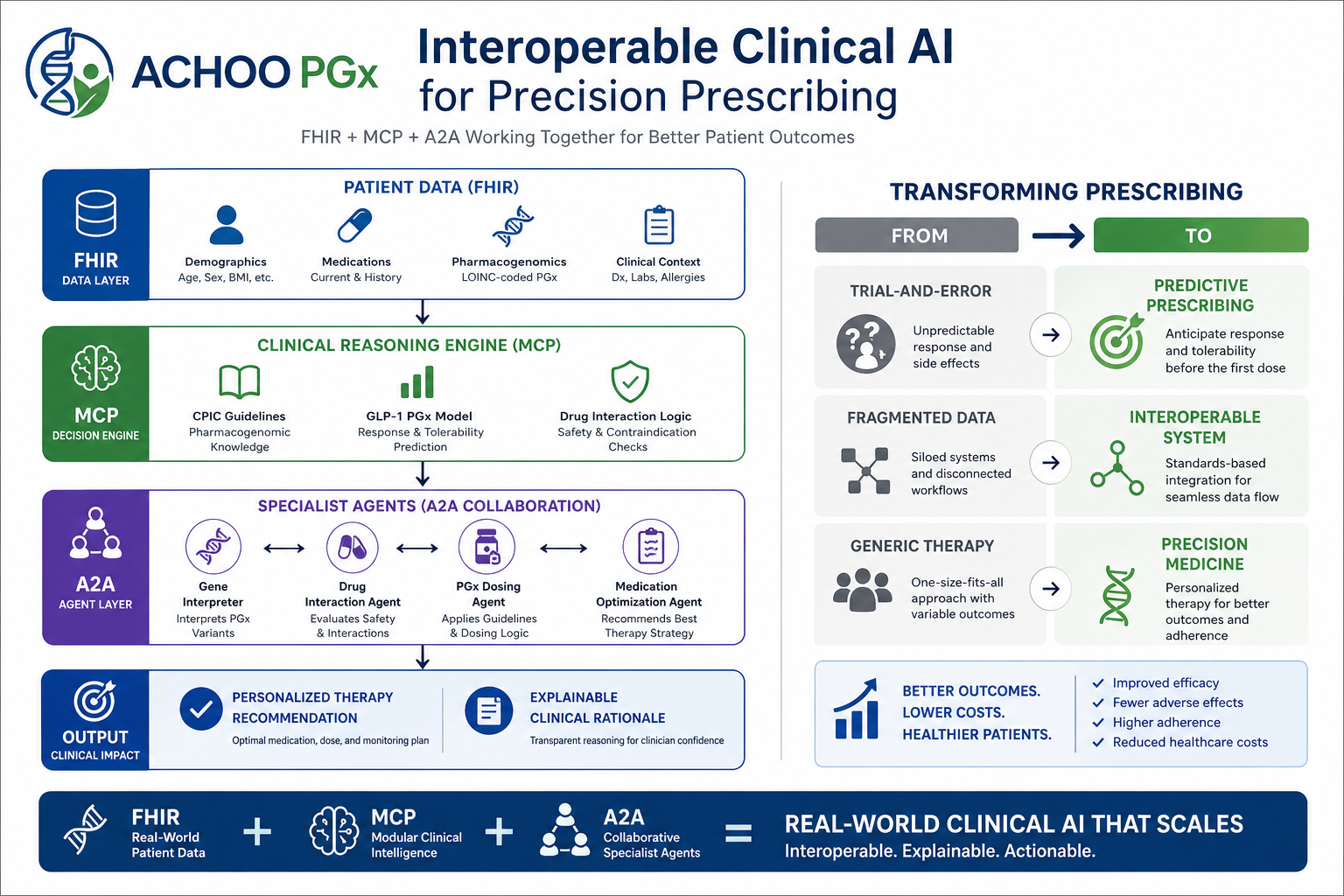
Inspiration
After nearly 30 years as a pharmacist, I became increasingly frustrated watching patients go through trial-and-error prescribing, unnecessary side effects, repeated therapy failures, and difficult prior authorization barriers. I have always believed in one core principle:
The right drug for the right patient at the right time and to make things special for the patients
That challenge became especially visible with GLP-1 therapies. I watched patients discontinue medications because of severe nausea and gastrointestinal side effects, even when these therapies had the potential to significantly improve their health. At the same time, many patients were paying out of pocket for treatment because insurance coverage was inconsistent or unavailable. I began asking myself:
What if we could better predict who would respond well before the first prescription was written?
My pharmacogenomics training at the University of Florida aligned perfectly with emerging GLP-1 pharmacogenomic evidence, especially the Nature 2026 publication involving GLP1R and GIPR variants. At the same time, I was introduced to interoperability, FHIR-based healthcare data exchange, and artificial intelligence in pharmacy practice. These experiences completely changed how I viewed the future of clinical decision support and patient advocacy.
What it does
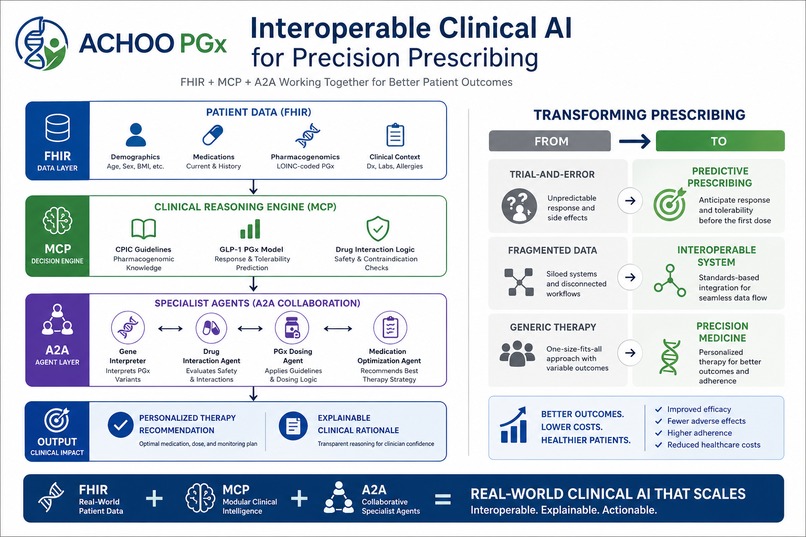
ACHOO PGx Clinical Orchestrator is an AI-powered pharmacogenomic clinical decision support platform that transforms fragmented genetic and EHR data into explainable medication recommendations.
The platform uses:
- FHIR interoperability
- MCP-enabled clinical tools
- multi-agent AI orchestration
- CPIC pharmacogenomic guidance
- structured genomic interpretation
- emerging GLP-1 pharmacogenomic evidence
The system coordinates multiple specialized AI agents that:
- interpret genotypes into clinical phenotypes
- evaluate drug-gene interactions
- generate genotype-informed dosing recommendations
- optimize GLP-1 therapy selection
- synthesize clinician-friendly recommendations
The platform compares therapies such as semaglutide and tirzepatide using both pharmacogenomic and clinical patient factors to improve safety, tolerability, and efficacy.
How we built it
The project was built using:
- Prompt Opinion agent orchestration
- MCP-enabled clinical tools
- Google Gemini models
- FHIR-based structured patient context
- LOINC-compatible healthcare data concepts
- CPIC pharmacogenomic guidelines
- multi-agent AI workflows
- structured JSON response contracts
The architecture includes:
- Gene Interpreter Agent
- Drug Interaction Agent
- PGx Dosing Agent
- Precision Medication Optimizer
- PGx Clinical Orchestrator
The orchestrator coordinates the specialist agents and synthesizes outputs into explainable clinical decision support recommendations.
Challenges we ran into
One of the biggest challenges was learning entirely new concepts outside traditional pharmacy practice, including:
- interoperability
- FHIR architecture
- MCP orchestration
- AI prompting strategies
- structured response engineering
- multi-agent coordination
There were many moments where I made mistakes, revised workflows, rebuilt prompts, and refined outputs. However, those iterations became one of the most valuable parts of the experience.
Another major challenge was balancing emerging GLP-1 pharmacogenomic evidence with responsible clinical interpretation. Genetic effects are probabilistic, not deterministic, so maintaining safety and avoiding overstatement of certainty was extremely important.
Accomplishments that we're proud of
I am proud that this project successfully integrates:
- patient advocacy
- pharmacogenomics
- interoperability
- explainable AI
- clinical decision support
- forward-thinking healthcare innovation
Most importantly, I am proud that this project transformed an idea that once only existed in my head into a functional clinical orchestration system.
This project represents more than technology to me. It represents a vision for the future of pharmacy where pharmacists help lead precision medicine implementation using explainable and clinically responsible AI systems.
What we learned
This project taught me the importance of curiosity, adaptability, and lifelong learning.
I learned:
- how healthcare interoperability works
- how FHIR and LOINC support structured healthcare data
- how AI agents can coordinate clinical workflows
- how prompt engineering directly affects clinical output quality
- how structured clinical reasoning can be transformed into reusable AI workflows
Most importantly, I learned that innovation requires humility. There is nothing wrong with being wrong if you are willing to learn, improve, and keep moving forward.
This experience inspired me to become:
- a better pharmacist
- a better educator
- a better learner
- a stronger patient advocate
What's next for ACHOO PGx Clinical Orchestrator
The future goal for ACHOO PGx Clinical Orchestrator is to continue evolving into a scalable precision medicine platform that supports real-world clinical workflows.
Future directions include:
- deeper FHIR EHR integration
- expanded pharmacogenomic guideline coverage
- additional disease-state optimization agents
- real-world clinical validation
- clinician-facing dashboards
- patient education support
- broader explainable AI decision support
I also hope to continue learning the programming and interoperability skills necessary to further develop this platform and help teach others how AI, pharmacogenomics, and patient advocacy can work together to improve healthcare.
Most importantly, this project reinforced a belief I have carried throughout my career:
*Anything can be done if you are willing to pursue your vision, keep learning, and continue advocating for patients. *
Built With
- ai
- clinical-decision-support-(cds)-workflows
- cpic-pharmacogenomic-guidelines
- explainable
- fhir-interoperability-concepts
- glp-1-pharmacogenomic-evidence-(nature-2026)
- google-gemini-3-flash-preview
- healthcare-interoperability-principles
- hl7-fhir
- loinc-concepts
- mcp-(model-context-protocol)
- multi-agent-ai-orchestration
- openai-chatgpt-(clinical-workflow-design-and-ai-orchestration-refinement)
- pharmgkb-resources
- prompt-engineering
- prompt-opinion-ai-platform
- structured-json-response-schemas
- vectorstore-collections


Log in or sign up for Devpost to join the conversation.