-
-
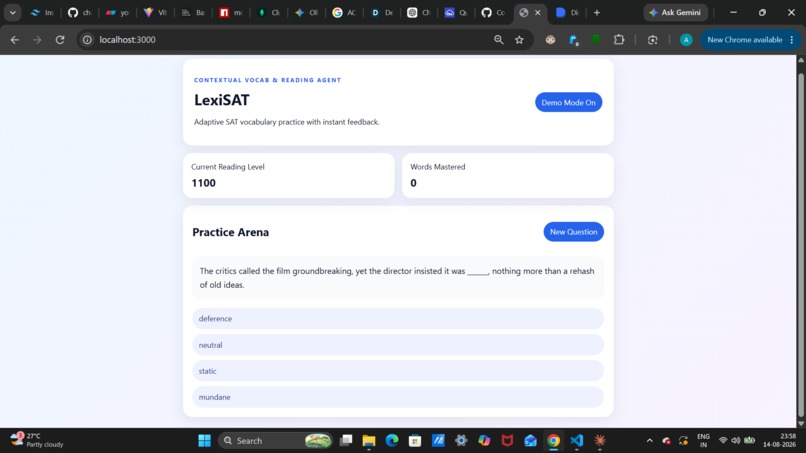
Dashboard
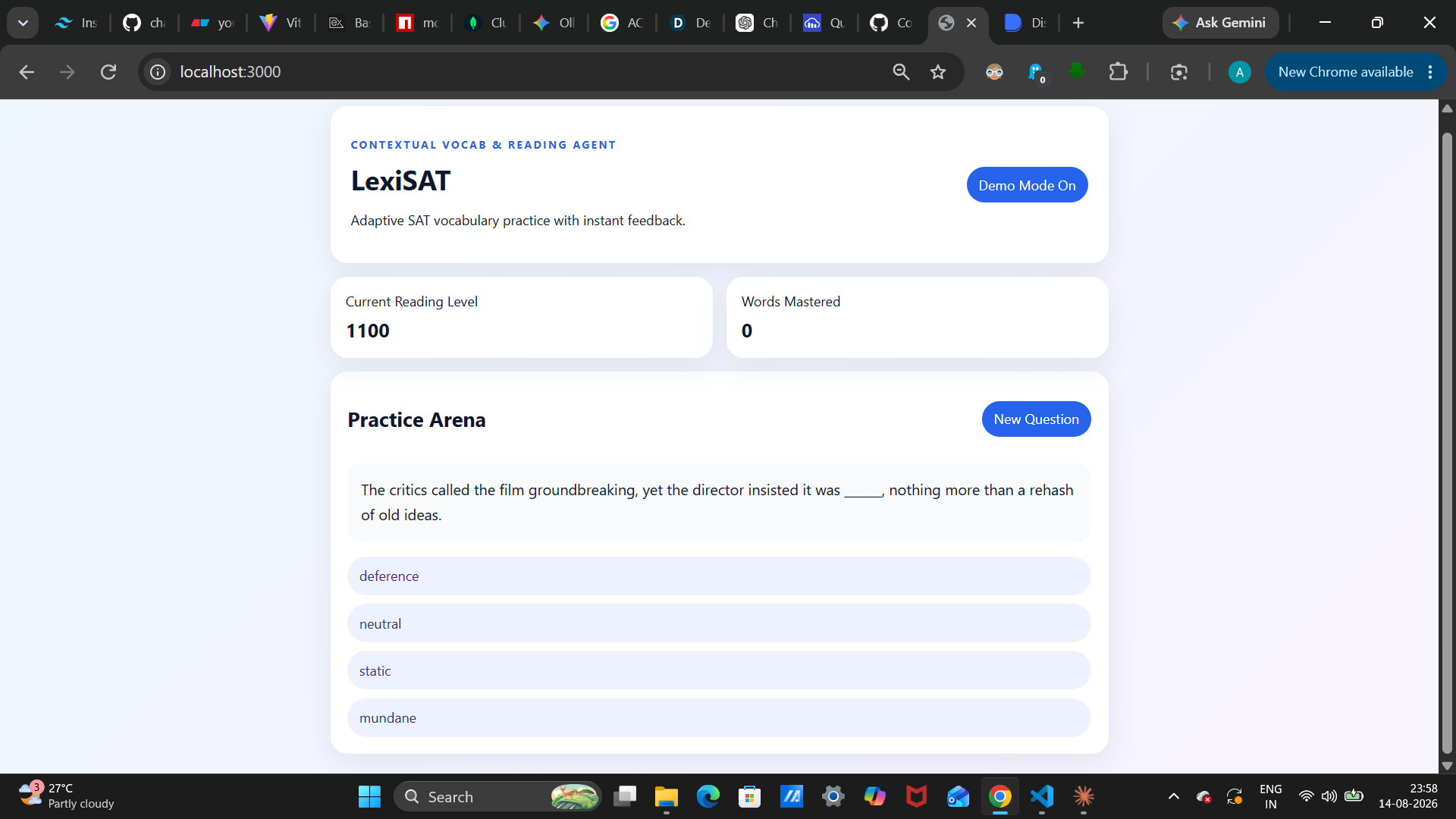
Inspiration
Preparing for the SAT requires more than memorizing vocabulary,it requires understanding how words are used in context. We wanted to build a system that could identify a student’s vocabulary weaknesses and continuously adapt practice material around those weaknesses.
This led to LexiSAT, an adaptive SAT vocabulary platform that uses an agentic feedback loop to personalize reading practice. Instead of giving every student the same passages, LexiSAT uses previous mistakes and learning progress to determine what vocabulary and difficulty should come next.
What it does
LexiSAT provides an adaptive vocabulary practice experience focused on contextual learning and lexical inference.
- Tracks words a student struggles with and uses them to personalize future practice.
- Uses spaced-repetition concepts to reinforce previously failed vocabulary.
- Dynamically generates reading passages containing targeted vocabulary.
- Adjusts the student’s reading level based on performance.
- Provides a dashboard showing learning progress, reading level, and mastered words.
The goal is to transform vocabulary preparation from static memorization into a continuously personalized learning experience.
How we built it
LexiSAT was built as a full-stack application with a React/Vite frontend and FastAPI backend.
The backend uses SQLAlchemy and SQLite to persist student progress, vocabulary performance, and learning data. The application implements an adaptive loop that analyzes failed words and previous performance before determining what vocabulary should be reinforced.
For passage generation, we designed an LLM layer with an Ollama-compatible local model fallback and a deterministic mock response, allowing the project to demonstrate the adaptive workflow even without depending entirely on an external model.
The frontend provides a mobile-first student experience with an interactive practice interface and progress dashboard.
Challenges we ran into
One of our biggest challenges was designing an adaptive learning loop that could respond meaningfully to a student's mistakes instead of simply increasing or decreasing difficulty.
We also had to balance LLM-generated content with predictable application behavior. Generated passages need to remain relevant to the targeted vocabulary while still fitting the student's current reading level.
Other challenges included connecting the frontend and backend cleanly, persisting learning progress, implementing vocabulary tracking and spaced repetition logic.
Accomplishments that we're proud of
We are proud of building a complete working prototype that connects adaptive learning logic, persistent student data, an LLM layer, and a modern frontend into one application.
Some highlights include:
- Building an end-to-end full-stack architecture.
- Implementing vocabulary weakness tracking.
- Creating adaptive passage generation.
- Adding spaced-repetition-inspired reinforcement.
- Building a student progress dashboard.
- Supporting a local Ollama-compatible LLM workflow.
- Designing the experience with a mobile-first approach.
What we learned
Through LexiSAT, we learned that building an AI-powered educational application is not only about integrating an LLM. The surrounding feedback loop, data persistence, user modeling, and deterministic application logic are equally important.
We also learned how to combine traditional backend logic with AI-generated content, structure an adaptive learning workflow, and design an interface that makes the student's progress understandable.
Most importantly, we learned that effective personalization comes from continuously using user feedback to influence the next learning interaction.
What's next for AceSat
Our next goal is to expand LexiSAT into a more intelligent and comprehensive SAT preparation platform.
Potential improvements include:
- More advanced agentic learning strategies.
- Personalized SAT reading and vocabulary curricula.
- Better spaced-repetition algorithms.
- Difficulty estimation based on student performance.
- More sophisticated LLM-based passage and question generation.
- Automated evaluation of lexical inference answers.
- Student performance analytics and learning insights.
- User accounts with long-term learning history.
- Integration with additional LLM providers and models.
- A production-ready deployment with scalable databases and authentication.
- May make transition into mern stack
Ultimately, we want AceSat to become an adaptive SAT learning companion that continuously understands a student's weaknesses and intelligently guides them toward mastery.


Log in or sign up for Devpost to join the conversation.