-
-
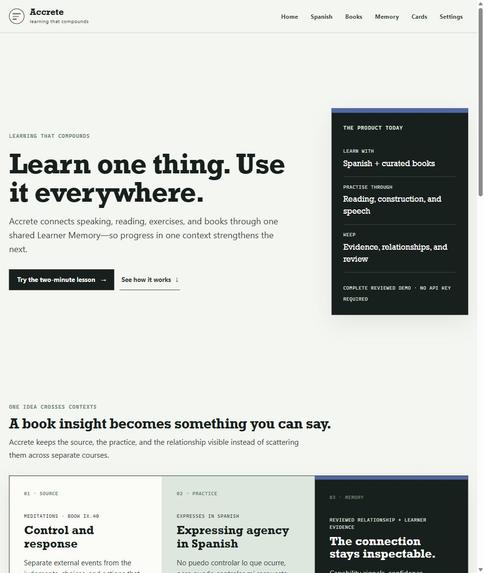
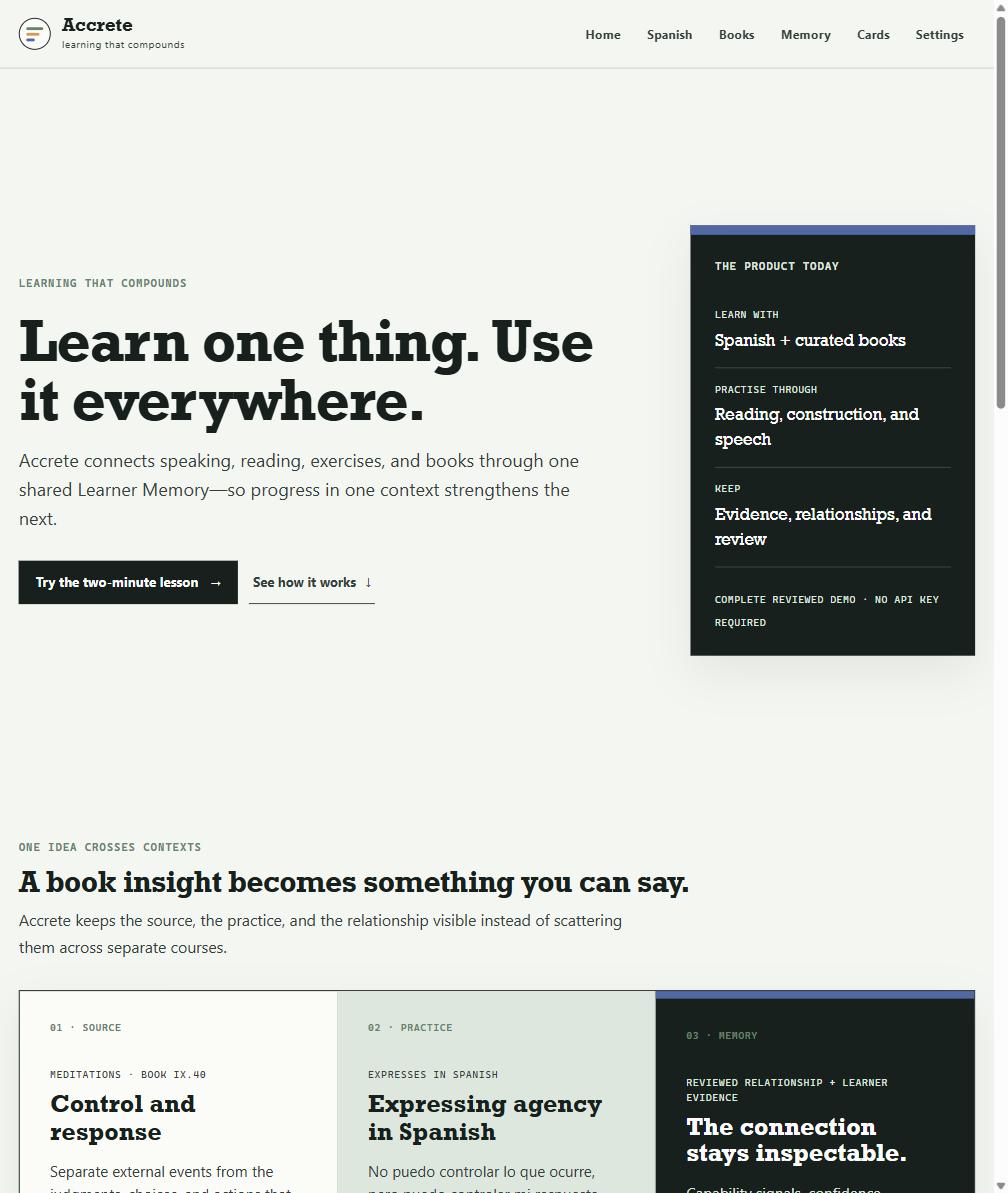
One shared Learner Memory across speaking, reading, exercises, and books.
-
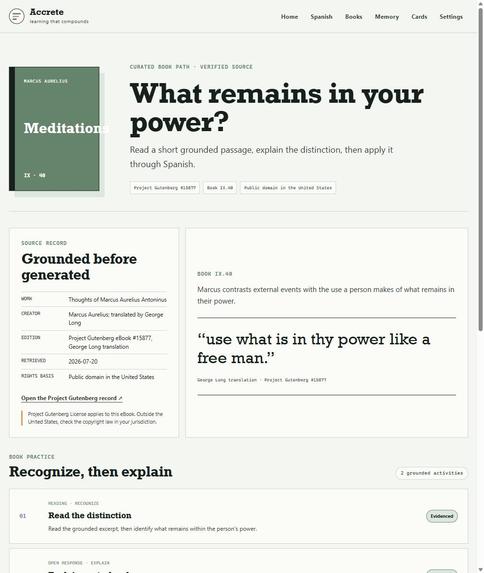
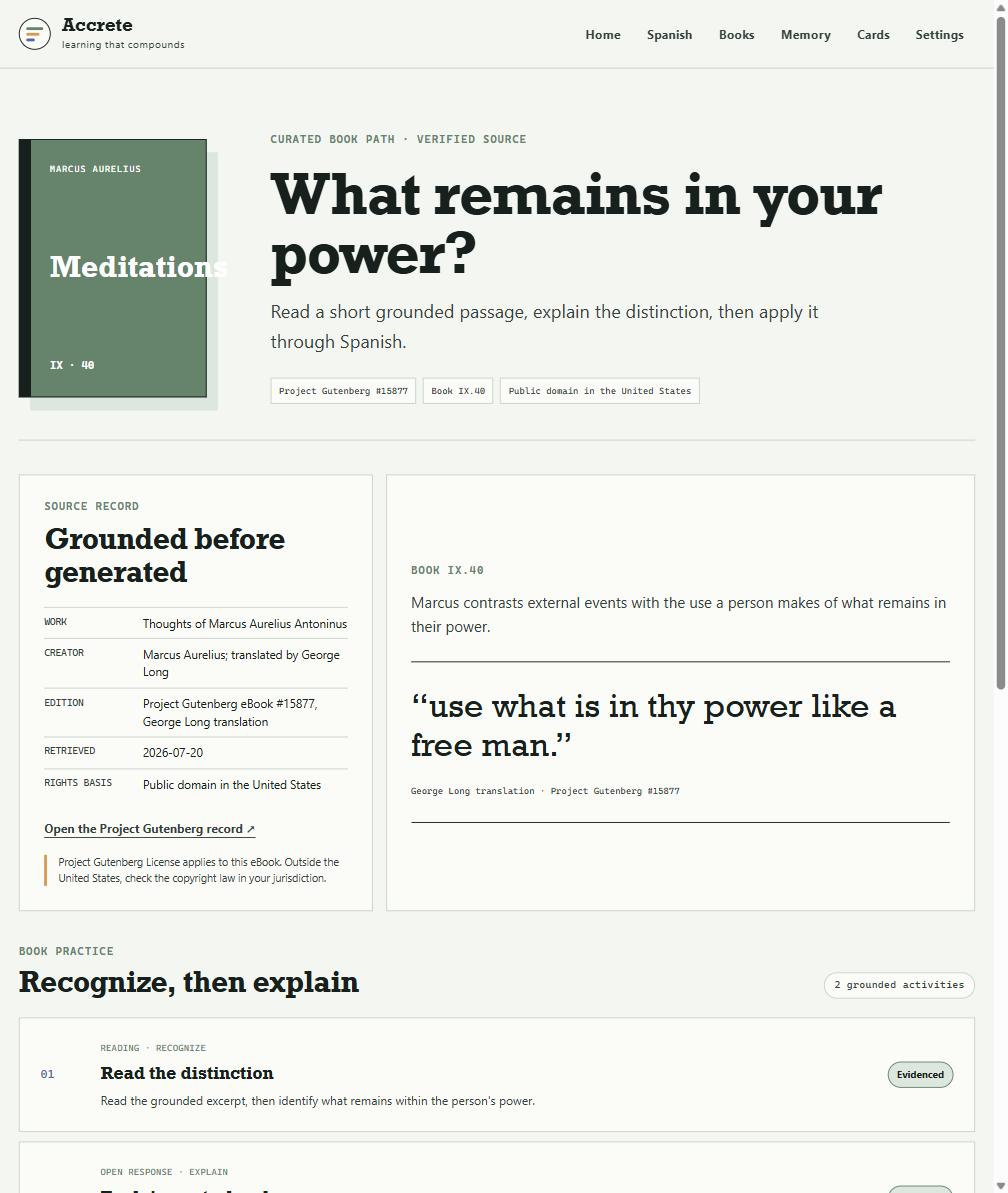
Every passage traces to a real source — nothing generated, nothing faked.
-
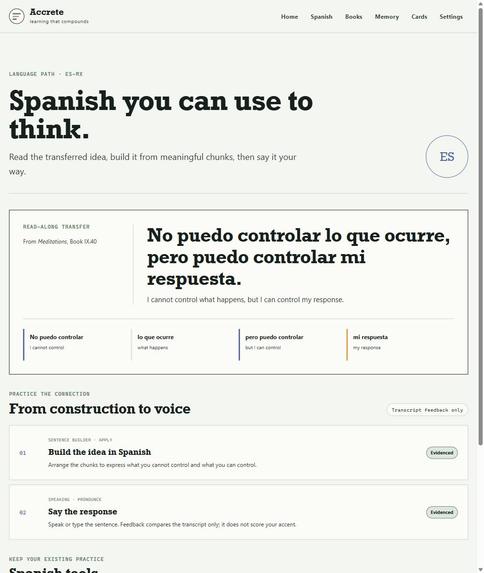
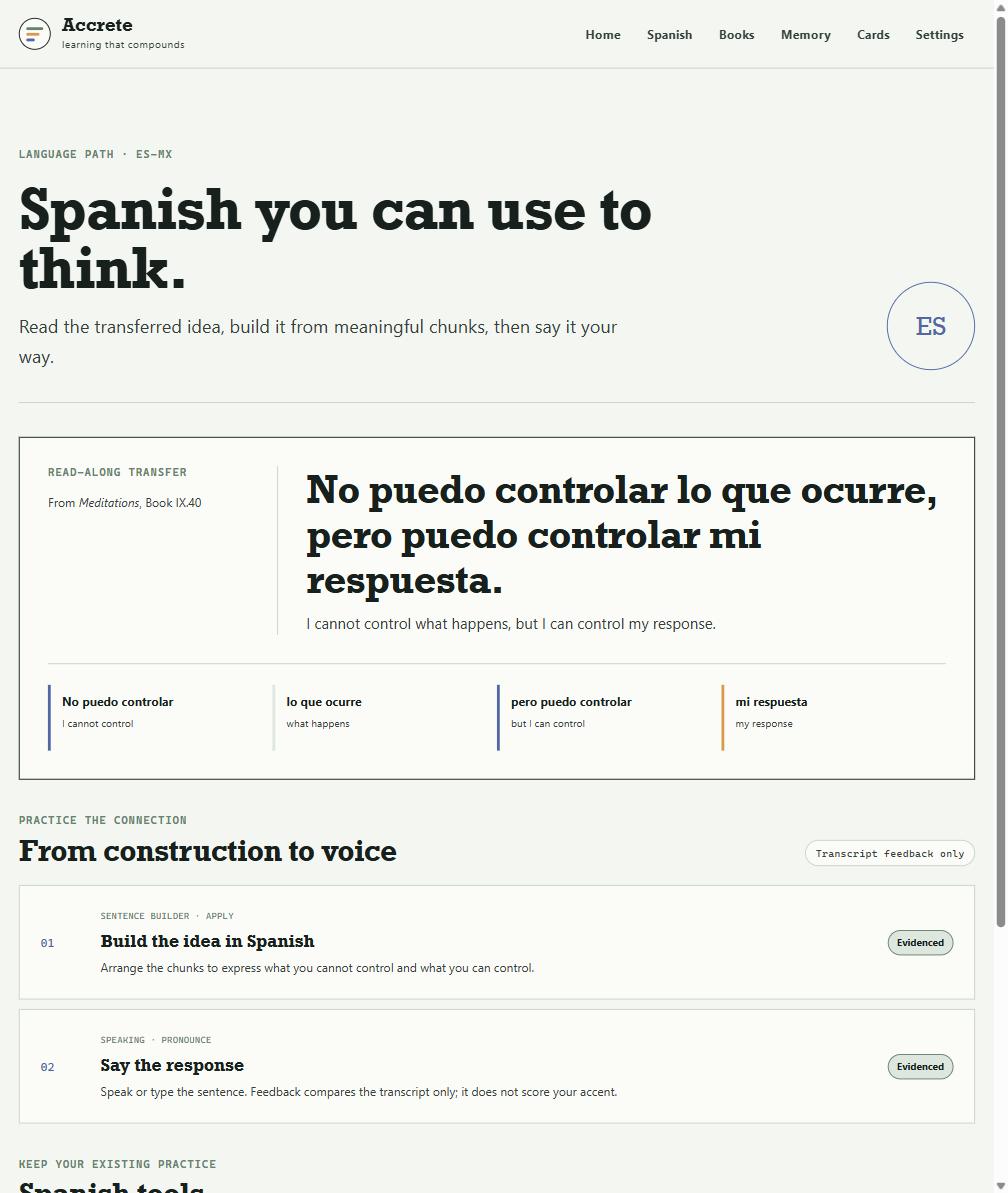
A book concept becomes a Spanish construction you build and say.
-
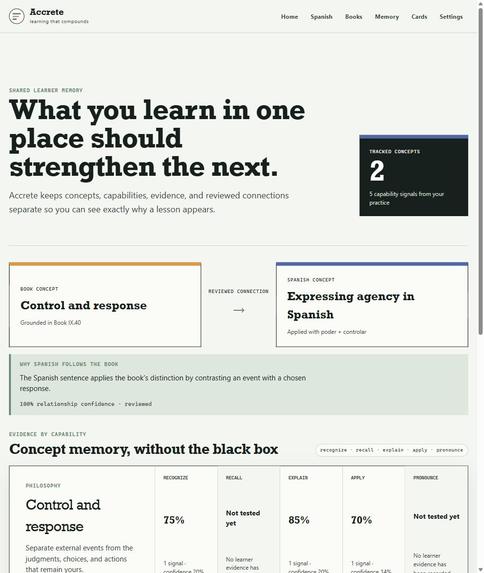
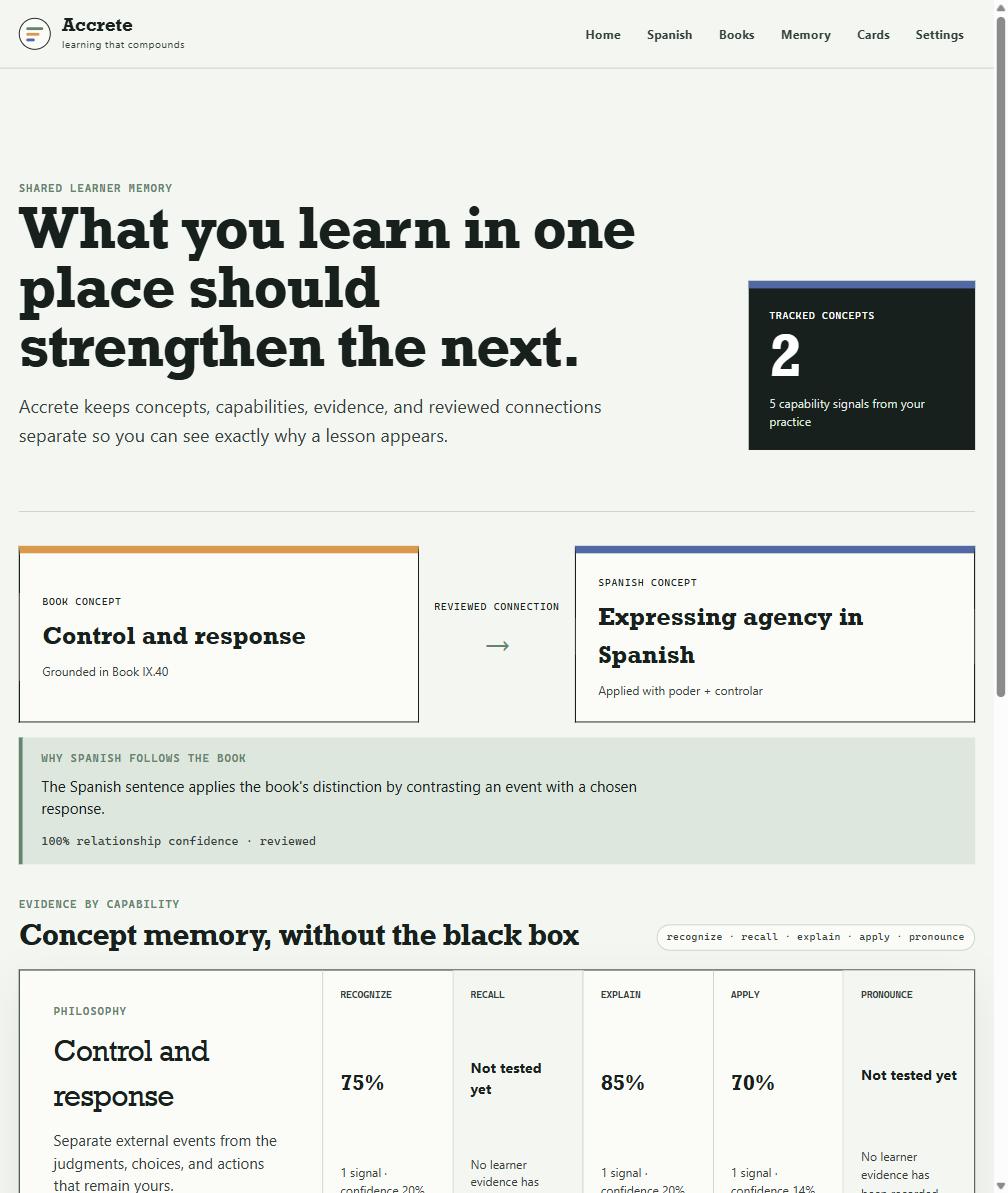
Inspectable memory: concepts, reviewed connections, and capability evidence — no black box.
Inspiration
Learning products usually split a person's progress into course silos. A learner can understand an idea in a book, struggle to express the same distinction in another language, and receive no benefit from the connection. Accrete starts from a different premise: courses are the surface, but the learner's accumulating memory is the product.
What it does
Accrete launches as a Spanish learning app with reading, sentence construction, speaking practice, transcript feedback, typed/self-grade fallbacks, vocabulary, and spaced repetition. It also includes a curated public-domain book experience.
The Build Week demo studies a source-grounded idea from Marcus Aurelius, records evidence from the learner's explanation, connects that idea to a Spanish construction, and recommends the next exercise with a plain-language reason. Learner Memory then exposes both concepts, the reviewed relationship, source provenance, mastery by capability, confidence, evidence count, and next review.
How we built it
The app uses Next.js 16, React 19, TypeScript, and local SQLite. Course adapters normalize Spanish and book content into a shared concept graph. Activity attempts update capability-specific mastery in one transaction. A deterministic planner ranks the next activity and explains why.
GPT-5.6 sits behind a narrow semantic provider. The optional live path uses the Responses API, low reasoning effort, store false, and strict structured output. A reviewed cached GPT-5.6 Sol artifact makes the complete judge flow reliable without credentials.
Codex GPT-5.6 Sol was used to design, implement, test, audit, debug, and document the Build Week extension. The repository preserves the earlier Lengua history and provides a commit-level contribution ledger.
Challenges
- Designing memory as inspectable structured evidence instead of raw chat history
- Connecting a philosophical concept to language practice without fabricating a quotation or source location
- Keeping the judging path deterministic while retaining a real live-model boundary
- Preserving the existing Spanish audio/SRS product while changing the primary information architecture
- Supporting speech without overstating transcript matching as accent assessment
- Making private-note and content-rights boundaries honest within a local hackathon build
Accomplishments
- One memory model spans two different course types.
- A single Spanish construction updates both book-application and language capability evidence.
- Every curated book claim retains edition, rights, and locator metadata.
- The app works without network access or API credentials.
- The four-step recommendation sequence is deterministic and resettable.
- The final gate passes 116 tests, lint, typecheck, production build, all route smoke checks, and a complete API replay.
What we learned
The hard part is not generating more content. It is deciding what the system may claim, what counts as evidence, which capability changed, and why the next activity deserves the learner's time. Separating those deterministic responsibilities from semantic model work made the product more reliable and more explainable.
What's next
- Account-scoped cloud storage and sync
- A larger reviewed Spanish curriculum
- Additional language adapters using the same shared contract
- Rights-confirmed private document ingestion
- Better open-response evaluation and pronunciation feedback
- Measured personalization based on review outcomes and modality—not hidden personality claims
- Publisher and educator tooling for licensed catalogs
Codex session
Codex /feedback Session ID: 019f7878-6aed-7993-820e-8874a6249938
Built With
- codex
- edge-tts
- ffmpeg
- gpt-5.6
- next.js
- react
- responses-api
- sqlite
- typescript
- vitest

Log in or sign up for Devpost to join the conversation.