-
-
Accountable AI
Inspiration
Real estate remains one of the slowest industries to adopt financial technology. Our inspiration for AccountableAI came from a challenge our teammate, Audrey Pinard, regularly encounters in her full-time role as an Associate Asset Manager & Developer.
Why are vendors still waiting to be paid when property owners have already transferred the money to management companies?
Delayed payments disrupt construction, prevent vendors from purchasing materials, tie up owners' capital, and damage valuable business relationships. We realized this wasn't simply an accounting problem. It was a problem of transparency, accountability, and trust.
Today the owner's only view of that money is a monthly statement from the management company that says "paid." When a vendor isn't paid, or isn't paid in full, the first sign is usually a vendor who stops showing up, a past-due notice, or a lien. By then the money is months old. Catching it means someone cross-checking statements against bank records, vendor emails and the management agreement, line by line. Almost no one has the time, so almost no one does. We wanted owners to find out in days, not months.
What it does
AccountableAI is an AI-powered financial visibility and payment tracking platform connecting property owners, management companies, and vendors.
Through an intuitive dashboard, users can monitor outstanding invoices, payment statuses, variances, and overdue balances. Inspired by package tracking, our visual payment timeline makes it easy to understand where money stands in the payment process and identify potential delays.
Our goal is simple: No vendor should wonder where their payment is, and no owner should wonder whether their vendor was paid.
Behind the dashboard, AccountableAI does the work of two roles on the owner's finance team: the accounts payable reviewer who confirms every vendor was paid, and the collections specialist who follows up with the management company when they weren't. Three agents close the loop:
- Agreement agent. Reads each vendor agreement as it arrives (from the owner's Gmail with read-only access, or by upload), checks that the companies, amount, due terms and payment details are all there, and quotes every value straight from the document. If something is missing, it drafts a note to the owner saying exactly what.
- Chaser agent. When an invoice comes due, it looks for proof the vendor was paid: the management company's statement, its bank record, or the vendor's own confirmation. "We paid it" is never proof. With no proof, it sends approved reminders to the management company, polite first, then firmer.
- Anomaly detector. When a statement arrives, every line is compared to the cent with what the owner approved. A mismatch (approved $1,000, statement says $500) becomes an alert, with a drafted note to the management company that only goes out after the controller approves it.
It explains every late payment as an authorized holdback, missing paperwork, the vendor's side, the owner's side, or unexplained. Only unexplained items become alerts, so the team isn't buried in noise, and when the evidence shows a delay is legitimate, it defends the management company. Before the next funding, it recommends how much to hold. Only a human controller can approve.
In action: Oakline Homes is about to send Keyway Property Management $18,400. AccountableAI flags it: "Keyway still owes three vendors $3,140 from March funds you already sent. Recommend holding $3,140." Keyway replies, "We paid the electrician." There's no bank record and no vendor confirmation, so the system holds its position and shows why. Then a real correction arrives: the electrician's invoice came in April 15, not March 28, so it isn't due yet. AccountableAI rechecks only that invoice, withdraws that alert with an explanation, and keeps the other two. The hold drops from $3,140 to $2,240.
How we built it
Our team combined engineering, real estate financial operations, UX/UI design, and business strategy to create our prototype. We used Visual Studio Code, Dribbble, Stitch, and GitHub for front-end development and collaboration, alongside UI design tools to prototype and refine the user experience.
We prioritized simplicity, accessibility, and clear visual communication over complicated financial interfaces.
Under the hood:
- Code decides; AI interprets. A deterministic LangGraph workflow controls every step. Claude (Haiku, Sonnet and Opus) is used only where human-written text has to be understood: agreements, replies and free-text statements.
- An append-only event log in PostgreSQL, where every fact records when it was true and when we learned it. A corrected fact rechecks only the decisions that depended on it.
- Code for everything else: the ledger, payment matching, trust rules for conflicting sources, reconciliation, aging and lateness patterns.
- An independent verifier tries to disprove every alert from the evidence alone before the owner ever sees it.
- Guardrails enforced in code, not prompts: no ability to move money, outbound messages only from approved templates, whoever proposes an action can't approve it, vendor bank-detail changes held for verification, and alerts never say "fraud."
- Realistic, messy paperwork. We generated the company's documents the way they really arrive (scanned invoices, forwarded emails, bank exports, statements that disagree) and built a reader that pulls the facts back out, with OCR for scans. Anything it isn't sure about goes to a person instead of being guessed.
- A Next.js dashboard with a Judge Console that lets anyone type a new scenario into the live system.
Challenges we ran into
Our biggest challenge was translating complex financial processes into an intuitive platform that anyone could understand. Real estate portfolios involve multiple stakeholders, overlapping invoices, and disconnected accounting systems.
We also navigated unfamiliar development tools, Spacetime DB, Agentic AI collab with documents and Pipeline implementation challenges, and rapid design iterations within the hackathon's time constraints.
On the engineering side, three problems took the most work:
- Changing its mind correctly. When one fact changes, only the decisions that depended on it should change. Rerunning everything is easy; rechecking exactly what's affected is not.
- Being fair, not just suspicious. Flagging every late payment is trivial. Telling a legitimate delay from an unexplained one is the hard part.
- Real documents disagree. Statements, bank exports and vendor emails rarely line up, spell vendor names differently, and leave out reference numbers. Linking them without guessing took most of our effort.
Accomplishments that we're proud of
We're proud of transforming a real-world industry frustration into a tangible, user-centered software prototype. We created a cohesive dashboard that makes financial information easier to interpret and developed a visual approach to payment tracking that emphasizes accountability rather than complexity.
Most importantly, we brought together different technical and creative backgrounds to build something addressing a problem experienced by real businesses.
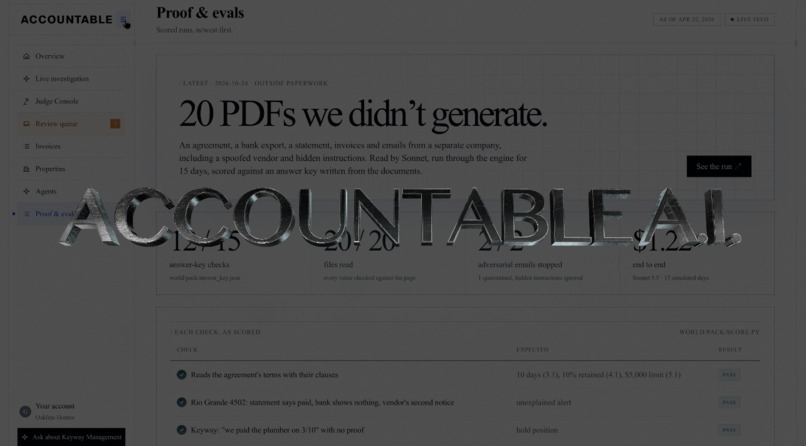
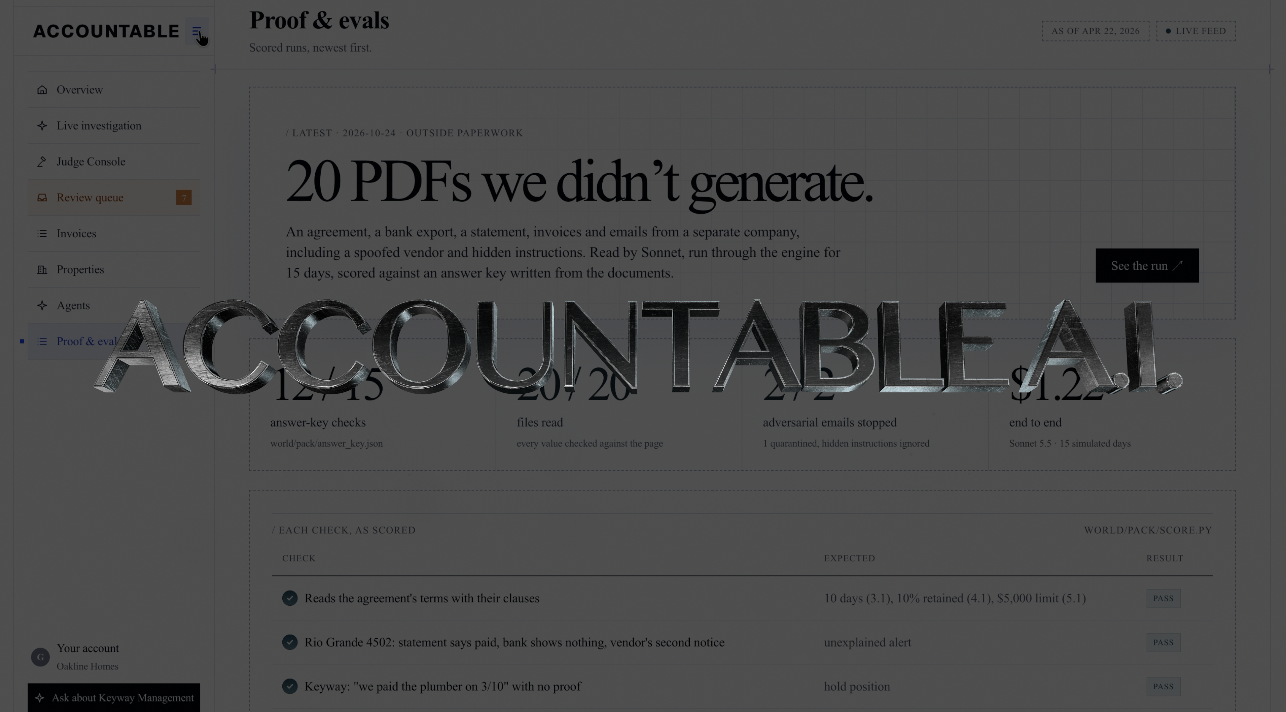
We also proved it works. The companies and documents are fictional but realistic, generated from a fixed seed so every result can be reproduced; the reading, reasoning, guardrails and scoring are real.
| What we measured | Result |
|---|---|
| Planted hard cases handled correctly | 9 / 9 |
| Cause accuracy, alert precision, recall, cited claims | 100% each |
| Prohibited actions executed | 0 |
| Recovery from the April 15 correction | One alert withdrawn, two kept, correctly |
| A single strong AI model given the same documents | 8 / 9 |
| Bad alerts caught by the verifier | 8 / 8 (0 / 8 without it) |
| Messy documents read exactly right, 5 seeds | 97.0% with code only, 99.9% with OCR + Claude |
The nine cases: an authorized holdback, a missing W-9, sources that disagree, a manager who's repeatedly late, a payment that's on time under the terms, an owner who never funded the repair, a vendor changing bank details, duplicate billing, and "paid" with no proof.
And it never guesses: anything uncertain goes to a person. (We generated the messy documents ourselves, so treat the reading scores as an upper bound; real inboxes are messier, which is exactly why that safety net exists.)
What we learned
We explored new tools, strengthened our development skills, and learned how to collaborate more effectively to create a helpful human-centered design.
We also learned that innovation is solving a problem everyone has accepted for too long.
On the technical side, we learned that the hard part of autonomous finance isn't reading documents. It's making consistent decisions when sources disagree and facts change over time, and being able to show the evidence for every one of them. Trust comes from knowing when to stop and ask, and limits like "never move money" are what make it safe to let agents run on their own.
What's next for AccountableAI
Our next steps are to expand beyond our prototype by developing more advanced automated invoice monitoring, proactive payment alerts, and integrations with existing property management and accounting software.
We envision AccountableAI eventually serving industries beyond real estate, helping businesses reduce payment delays, improve transparency, and strengthen relationships with the people who keep their operations running.
Concretely, that means:
- A pilot with rental owners and their property managers, using live email and bank feeds and authenticated controller access.
- The same check for any business that pays through an intermediary: general contractors and subcontractors, staffing agencies, freight brokers.
- Partnerships with property management and accounting platforms, so AccountableAI becomes an independent verification layer for payments that pass through third parties.
The goal of AccountableAI is to restore the trust that makes business relationships work.
Built With
- .md
- agent
- agentic
- ai
- fintech
- github
- hacker
- python
- readme
- typescript
- ux/ui
- visual-studio


Log in or sign up for Devpost to join the conversation.