🚗 Accident Severity Prediction using AI/ML 💡 Inspiration
Every year, thousands of people lose their lives or get severely injured in road accidents. Often, the lack of timely insights into accident severity delays emergency response. Our motivation was to use AI/ML to build a system that can predict the severity of accidents—both at the individual injury level (P_ISEV) and the overall collision level (C_SEV)—to aid faster decision-making for healthcare providers, traffic authorities, and insurance systems.
🛠️ What it does
Our project leverages machine learning ensemble models to classify accident severity into categories. The system analyzes accident record data and predicts:
P_ISEV (Person Injury Severity): Severity of injury at the individual level.
C_SEV (Collision Severity): Overall severity of the collision.
Key capabilities:
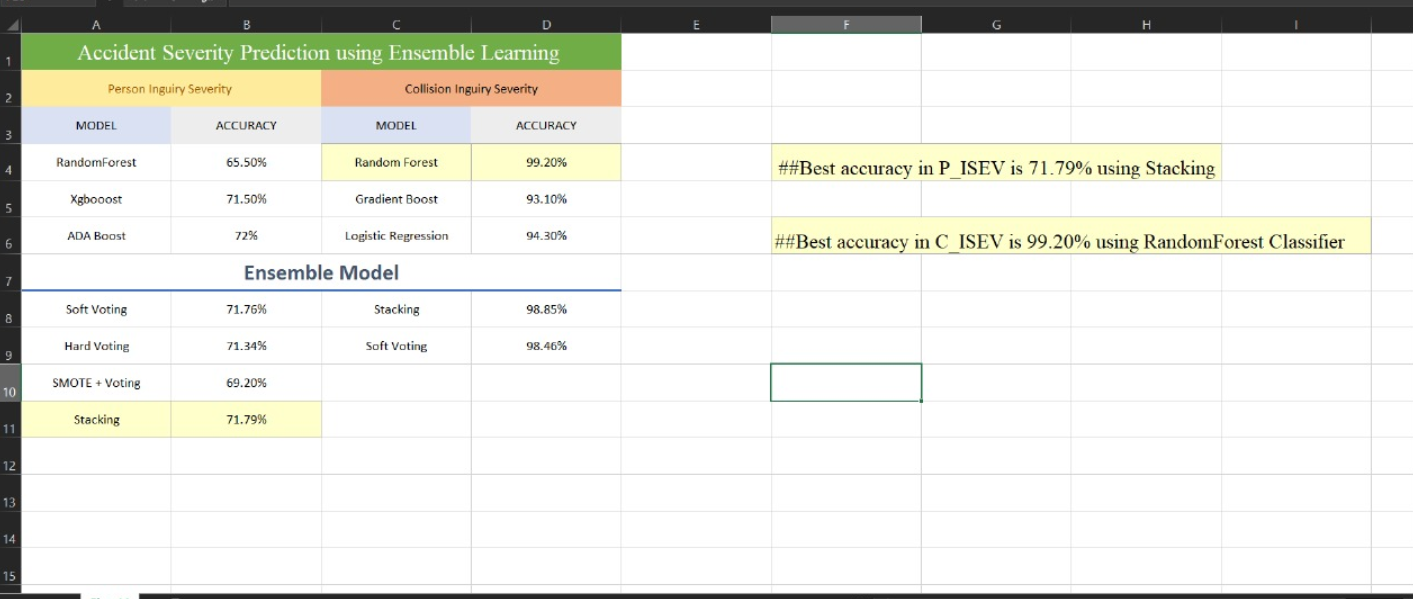
Multiple ensemble approaches tested (Random Forest, XGBoost, AdaBoost, Voting, Stacking).
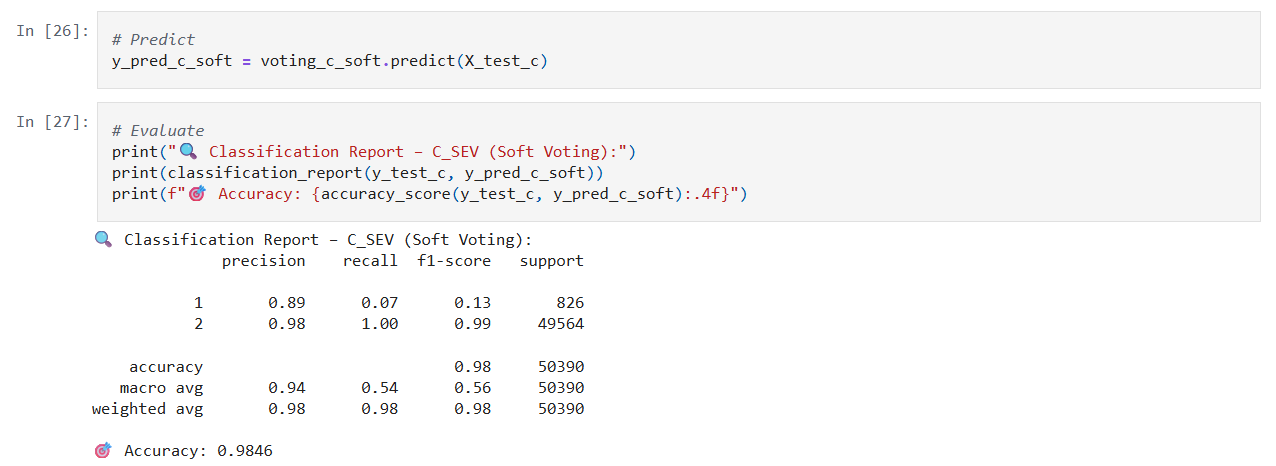
High accuracy in predicting collision severity (C_SEV: 99.20%).
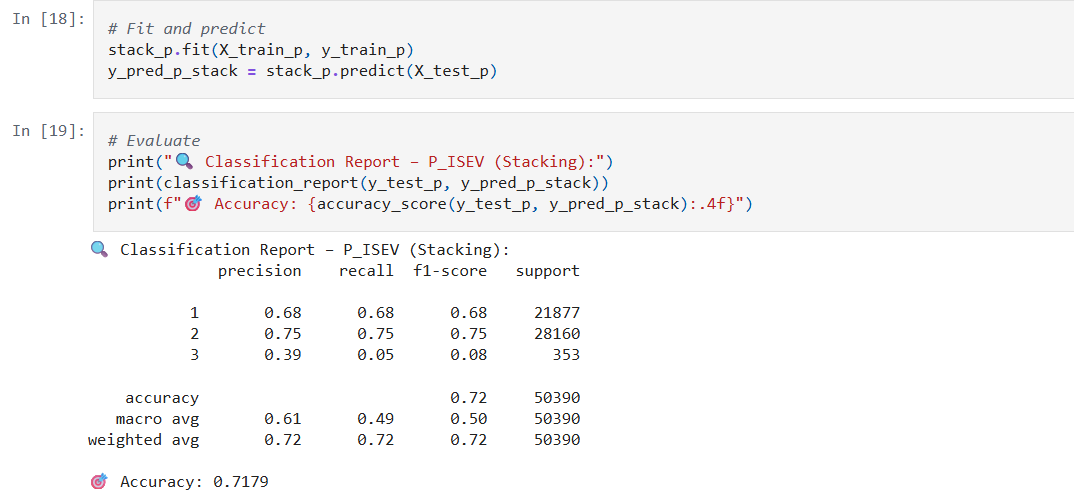
Reliable insights for person-level severity (P_ISEV: 71.79%) using stacking models.
⚙️ How we built it
Data Preprocessing:
Cleaned and structured a real-world accident dataset.
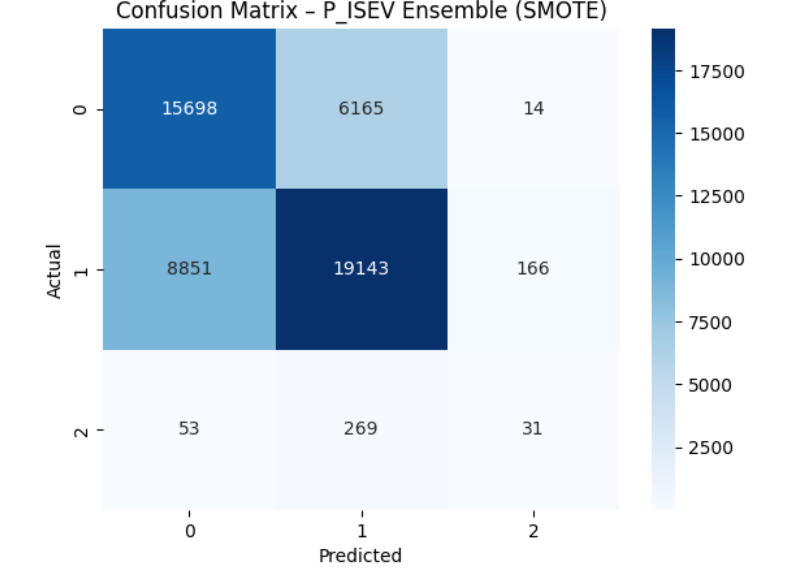
Balanced imbalanced classes using SMOTE to ensure fair predictions.
Model Development:
Implemented base learners: Random Forest, XGBoost, AdaBoost, Logistic Regression, Gradient Boost.
Developed ensemble models: Soft Voting, Hard Voting, Stacking.
Evaluation Metrics:
Accuracy, Precision, Recall, and F1-score were calculated.
Confusion matrices were plotted to visualize class-level performance.
Results:
Best Accuracy in P_ISEV: 71.79% using Stacking.
Best Accuracy in C_SEV: 99.20% using Random Forest.
🚀 Challenges we ran into
Handling imbalanced datasets where severe accident cases were fewer compared to minor ones.
Balancing between high overall accuracy vs. fair performance across all classes.
Optimizing ensemble models to ensure robustness without overfitting.
🌟 Accomplishments we’re proud of
Achieved 99%+ accuracy in predicting collision severity.
Designed a stacking-based ensemble that improved predictions for person-level severity.
Built a scalable framework that can be extended to real-time accident alert systems.
📚 What we learned
Importance of class balancing (SMOTE) in classification problems.
Ensemble learning can significantly outperform individual classifiers.
Even with high accuracy, analyzing precision & recall per class is critical in healthcare-related predictions.
🔮 What’s next
Integrate the model into a real-time traffic monitoring system.
Extend predictions to include time-to-hospital arrival suggestions.
Build a mobile/web application that notifies emergency services with accident severity levels
Built With
- aiml
- data-analysis
- jupyter
- machine-learning
- python


Log in or sign up for Devpost to join the conversation.