-
-
IMG3
-
IMG1
-
IMG4
-
IMG5
-
IMG2
Inspiration
Digital accessibility is essential to an inclusive web, yet accessibility findings frequently become disconnected tasks across UX designers, developers, QA engineers, and product teams.
We created AccessRelay — The Open Accessibility Agent Network to explore how open, interoperable AI agents can help teams understand accessibility issues, prioritize remediation, and keep humans in control of changes.
Our vision is an agentic web where accessibility becomes part of the product development workflow rather than an afterthought.
What it does
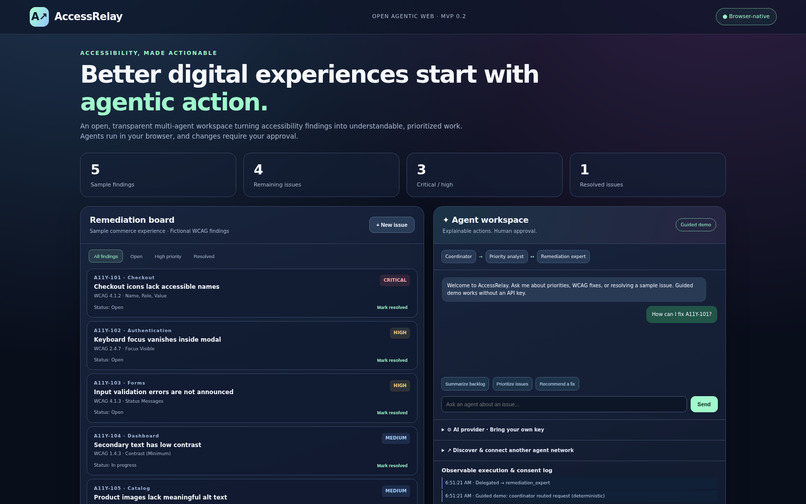
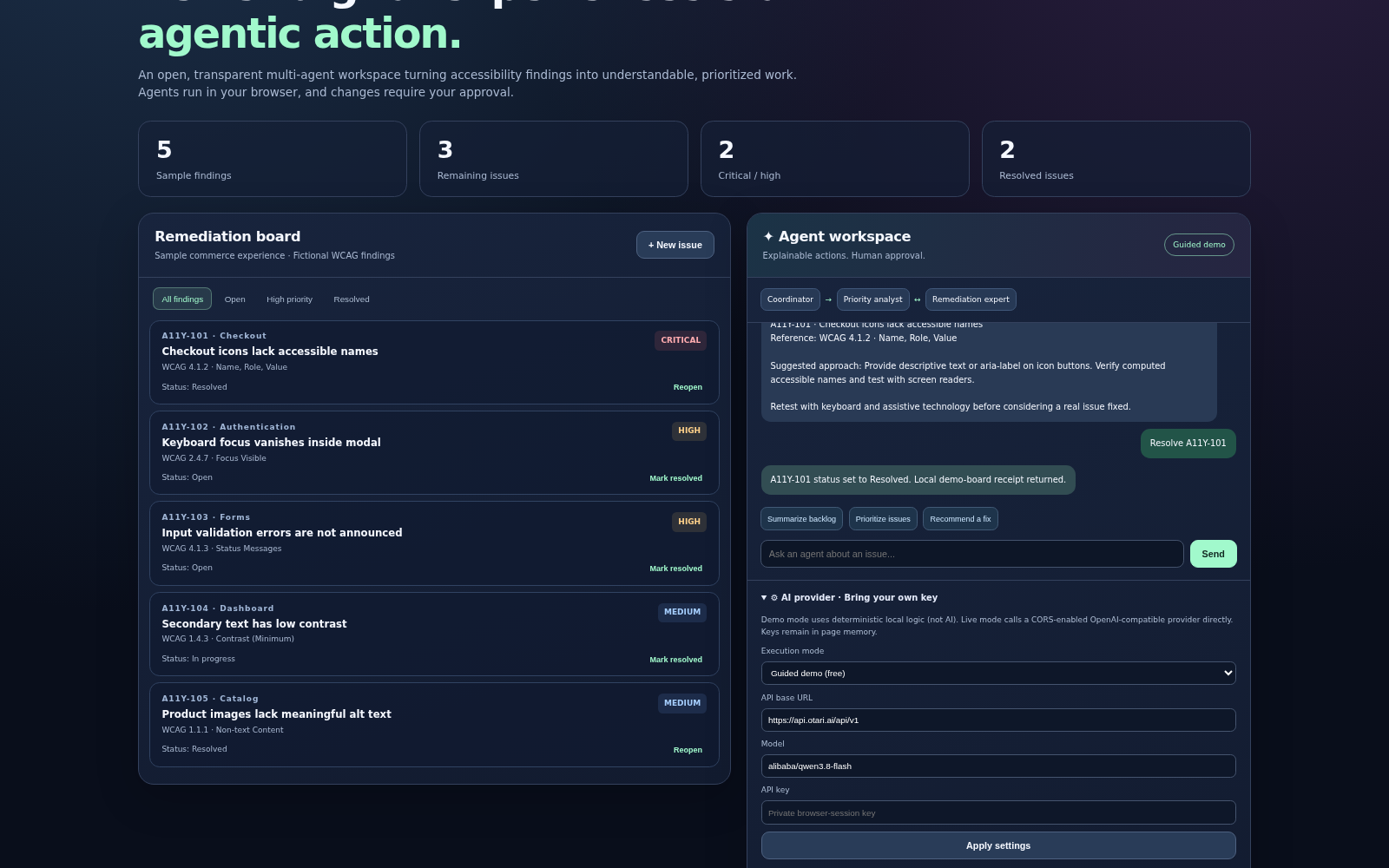
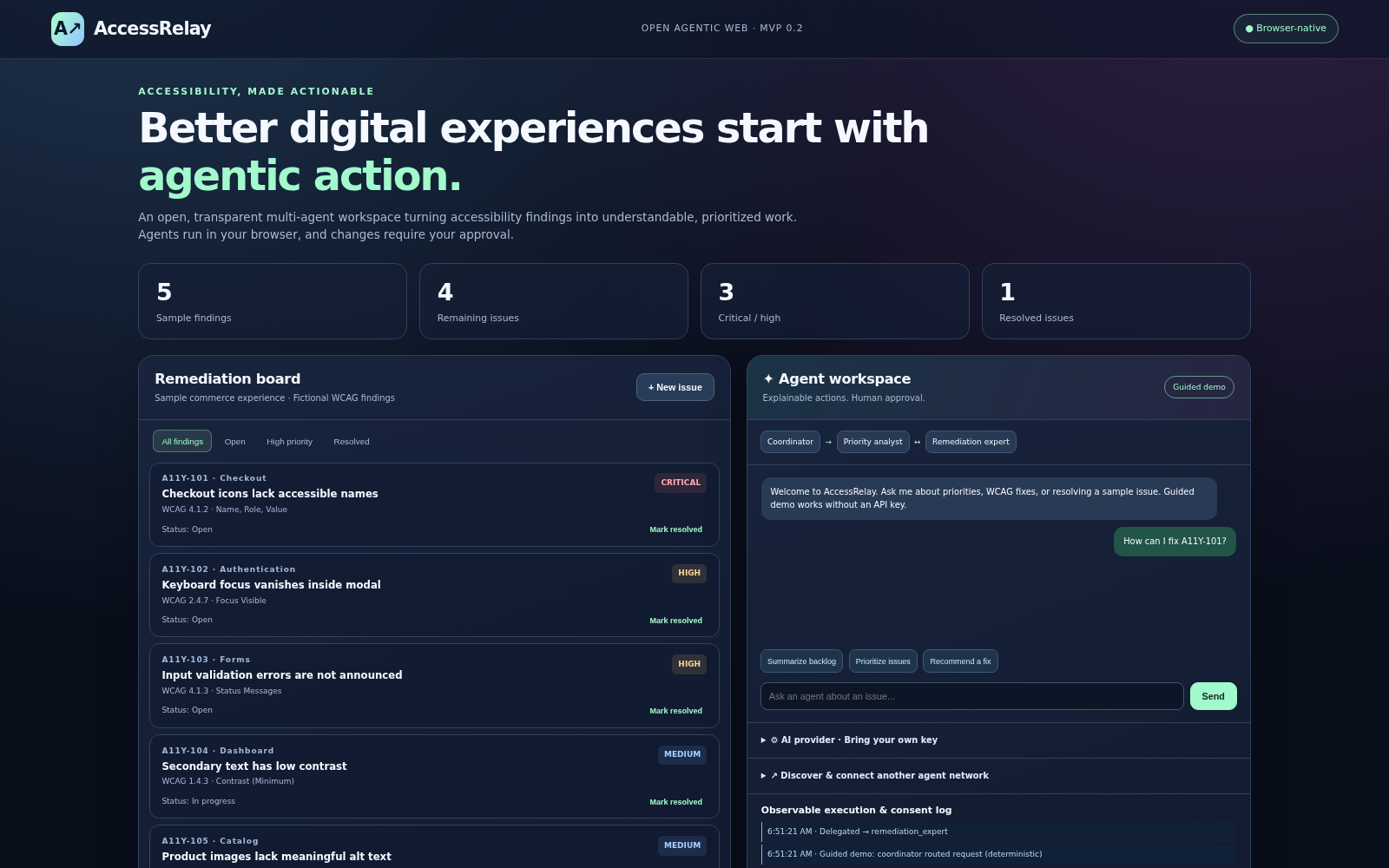
AccessRelay is an open-source, browser-native accessibility remediation workspace built around three specialized agents:
Coordinator Agent: Routes requests, coordinates specialist agents, and manages interactions with the website.
Priority Analyst: Helps evaluate recorded accessibility findings based on severity and potential user impact.
Remediation Expert: Provides actionable, WCAG-aligned recommendations and suggested verification steps.
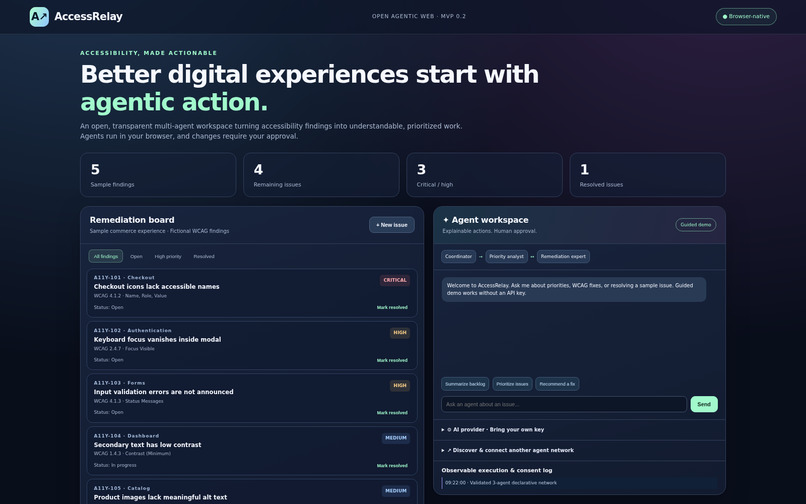
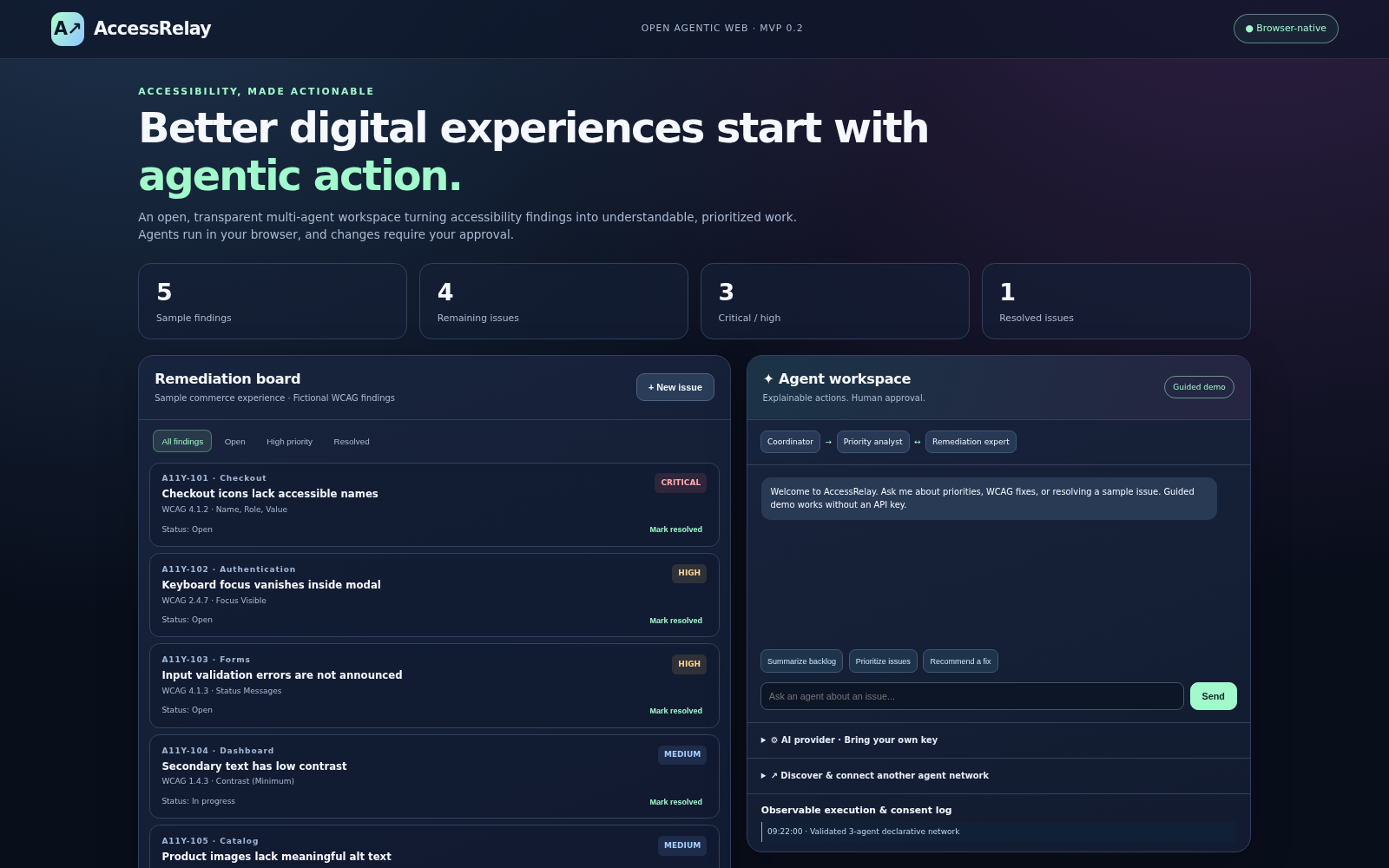
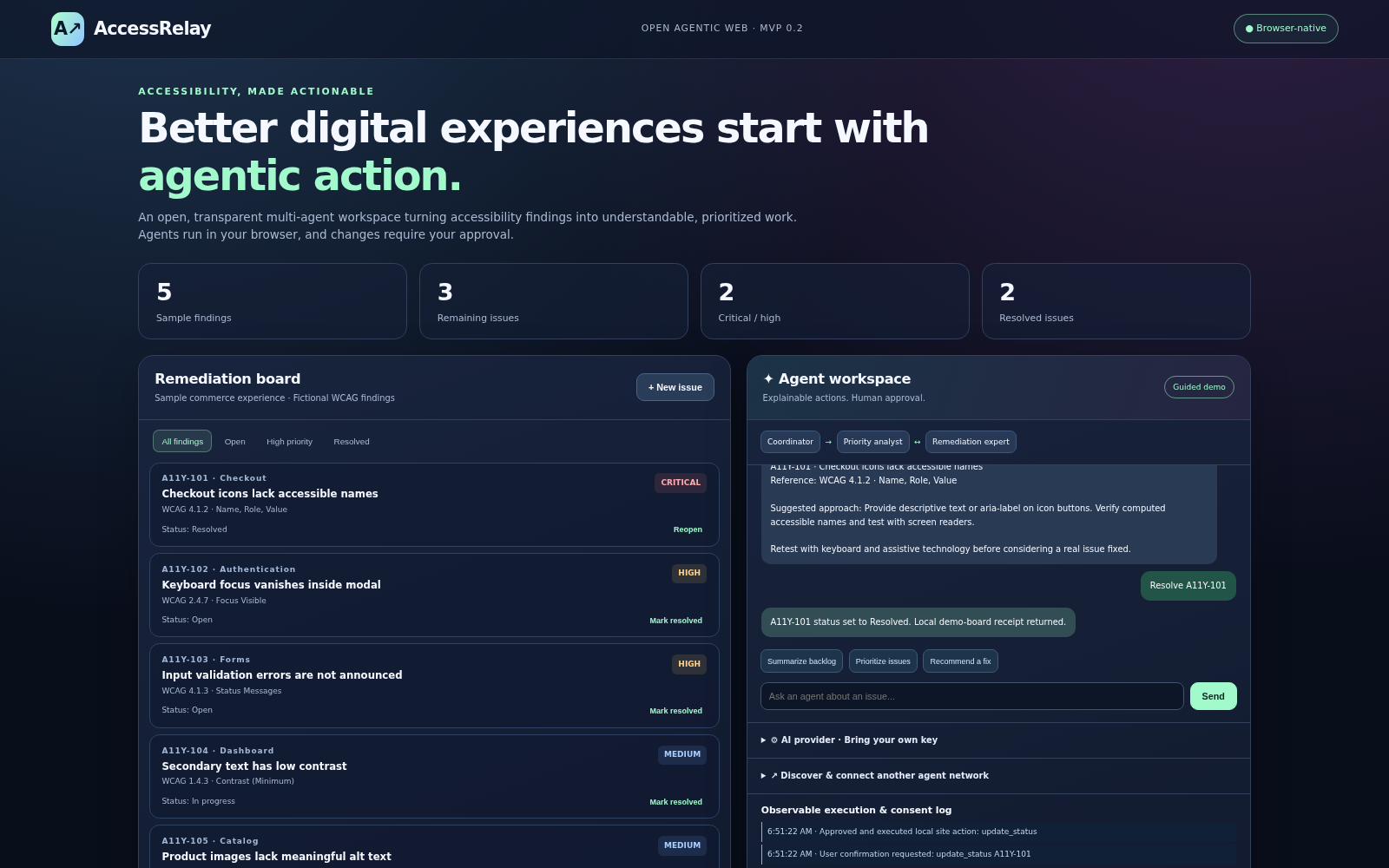
The application features an interactive accessibility dashboard where users can review, filter, create, update, and resolve sample issues.
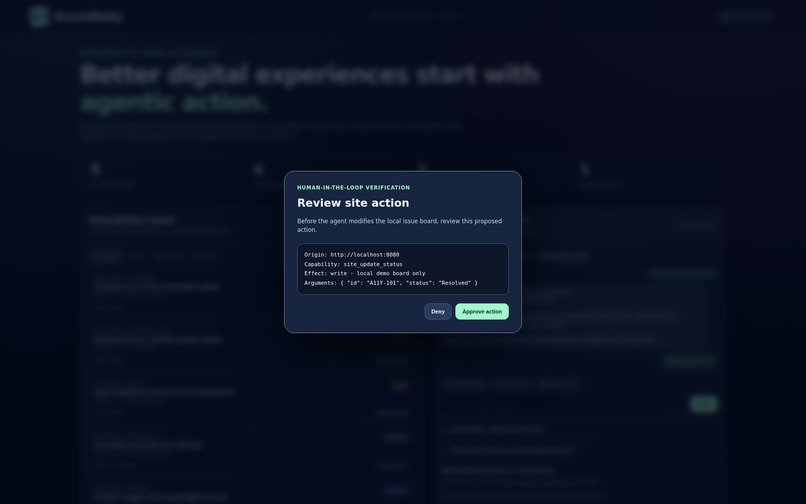
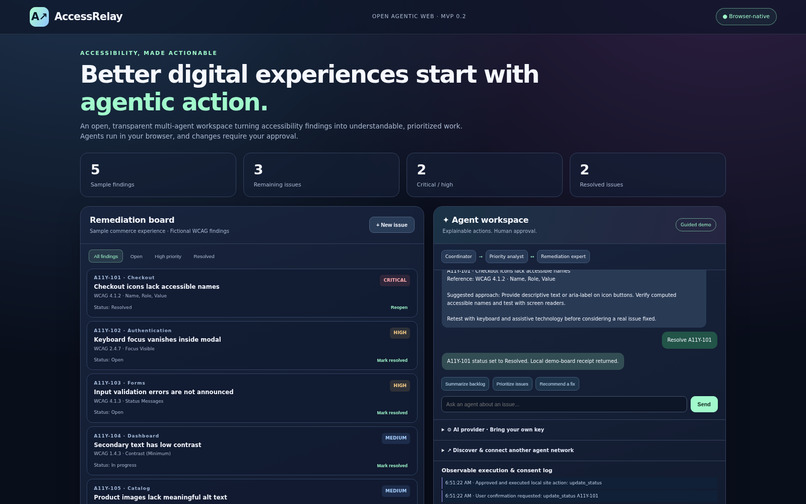
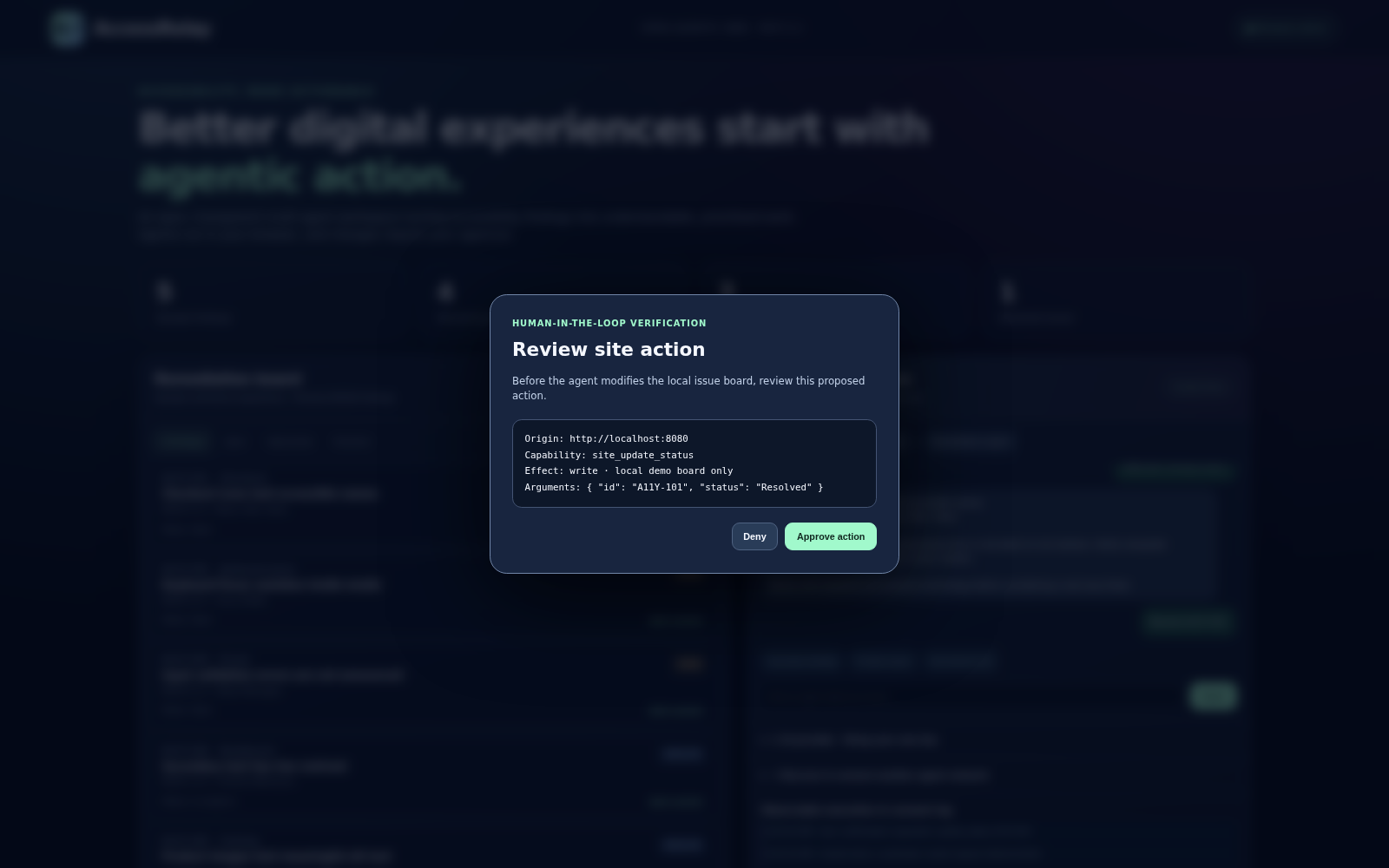
Every modification requires explicit human approval. The browser runtime validates action parameters and records execution outcomes to support transparency and accountability.
AccessRelay also publishes a portable, declarative agent-network definition that other compatible agentic websites can discover. Its experimental peer-network interface supports permission-based network loading and browser-local agent execution.
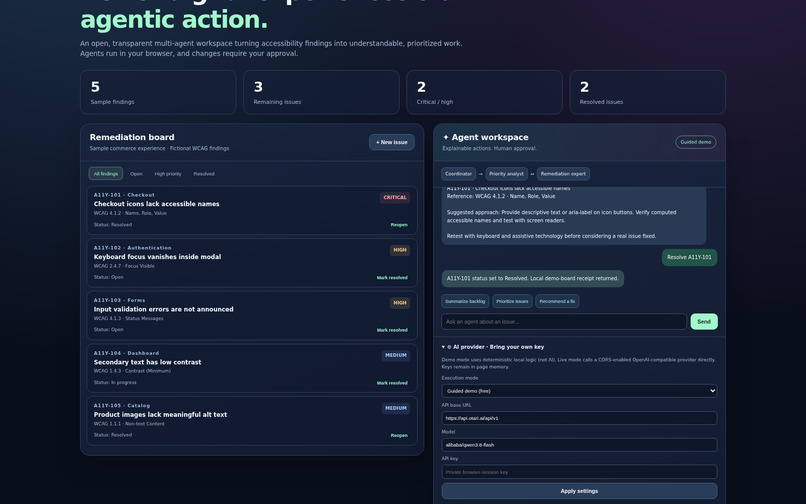
Users can explore a deterministic guided demonstration without an API key or configure an OpenAI-compatible inference provider for live AI agent orchestration.
How we built it
We developed AccessRelay using HTML5, CSS3, JavaScript ES Modules, and JSON.
The architecture follows the core ideas of the Open Agentic Web specification, including declarative agent definitions, browser-based execution, pluggable inference, and user-controlled permissions.
The system includes a public agent manifest, a three-agent network definition, a JavaScript runtime, JSON Schema-based action validation, browser-local storage, and an optional Bring Your Own Key (BYOK) interface.
The application is published through GitHub and deployed to Vercel.
Challenges we faced
One major challenge was designing an agent architecture that supports meaningful delegation without hiding important operations from users.
We also had to consider security boundaries between agent networks, credential handling, explicit consent for external requests, and the distinction between a successful local action and a verified real-world outcome.
Another important design challenge was making a technical multi-agent architecture approachable through a simple, accessible product interface.
Accomplishments
We created a responsive accessibility management experience with a publicly inspectable three-agent network, an interactive issue board, browser-side orchestration, schema-validated actions, human approval dialogs, and observable execution logs.
The prototype also demonstrates how an agent network can be published as portable JSON rather than tied exclusively to proprietary server infrastructure.
What we learned
Building an open agentic experience is not simply about adding AI chat to a website.
Interoperability requires portable agent definitions, clear permission boundaries, understandable execution behavior, and trustworthy user experiences.
We learned that effective human-agent collaboration depends on maintaining user oversight while reducing repetitive operational work.
What's next
Our next development priorities include generic MCP integration, model streaming, automated interoperability and conformance testing, and verified cross-origin collaboration with independently hosted agent networks.
We also plan to investigate integrations with real accessibility testing tools and product issue-management platforms.
Current prototype limitations: The included accessibility findings are fictional demonstration data. Guided demo mode uses deterministic logic rather than LLM inference. Live BYOK and external peer interoperability have not been fully validated, and the application does not yet implement generic MCP execution or model streaming.
Project links
Live application: https://accessrelay-open-agentic-web.vercel.app/
Open-source repository: https://github.com/samertall/tools/tree/main/open-agentic-web/accessrelay/
Published agent manifest: https://accessrelay-open-agentic-web.vercel.app/agent-manifest.json
Agent network definition: https://accessrelay-open-agentic-web.vercel.app/accessrelay.network.json
Built With
- accessibility
- agentic-ai
- ai-agents
- browser-runtime
- css3
- github
- html5
- javascript
- json
- json-schema
- llm
- multi-agent-systems
- open-source
- vercel
- wcag
- web-development
