The door was 2 inches too narrow. The owner had no idea.
My uncle has used a wheelchair his entire life. We tried to take him to a new restaurant downtown — great reviews, packed Friday night, exactly the kind of place anyone would want to go.
He couldn't get through the front door.
The owner wasn't negligent. He wasn't malicious. He had no practical way to know. That moment is why AccessMap exists.
The Problem
$$ \text{4,195 ADA lawsuits} \times \$50{,}000 \text{ avg settlement} = \$209{,}750{,}000 \text{ in 2023 alone} $$
ADA litigation has increased 320% over the past decade. The businesses getting sued aren't large corporations with compliance teams — they're restaurants, gyms, clinics, barbershops, and corner stores run by people who genuinely didn't know their space was non-compliant.
The problem isn't bad intent. It's an information gap:
| The Old Way | The Gap |
|---|---|
| $5,000 ADA consultant | Out of reach for small businesses |
| 3-week wait for a site visit | Too slow to act before a complaint |
| Generic PDF report | No actionable fix guidance |
| One location at a time | Doesn't scale to property portfolios |
7.5 million commercial spaces in America have never been properly checked. Not because owners don't care — because no practical tool existed to help them.
Until now.
The Solution
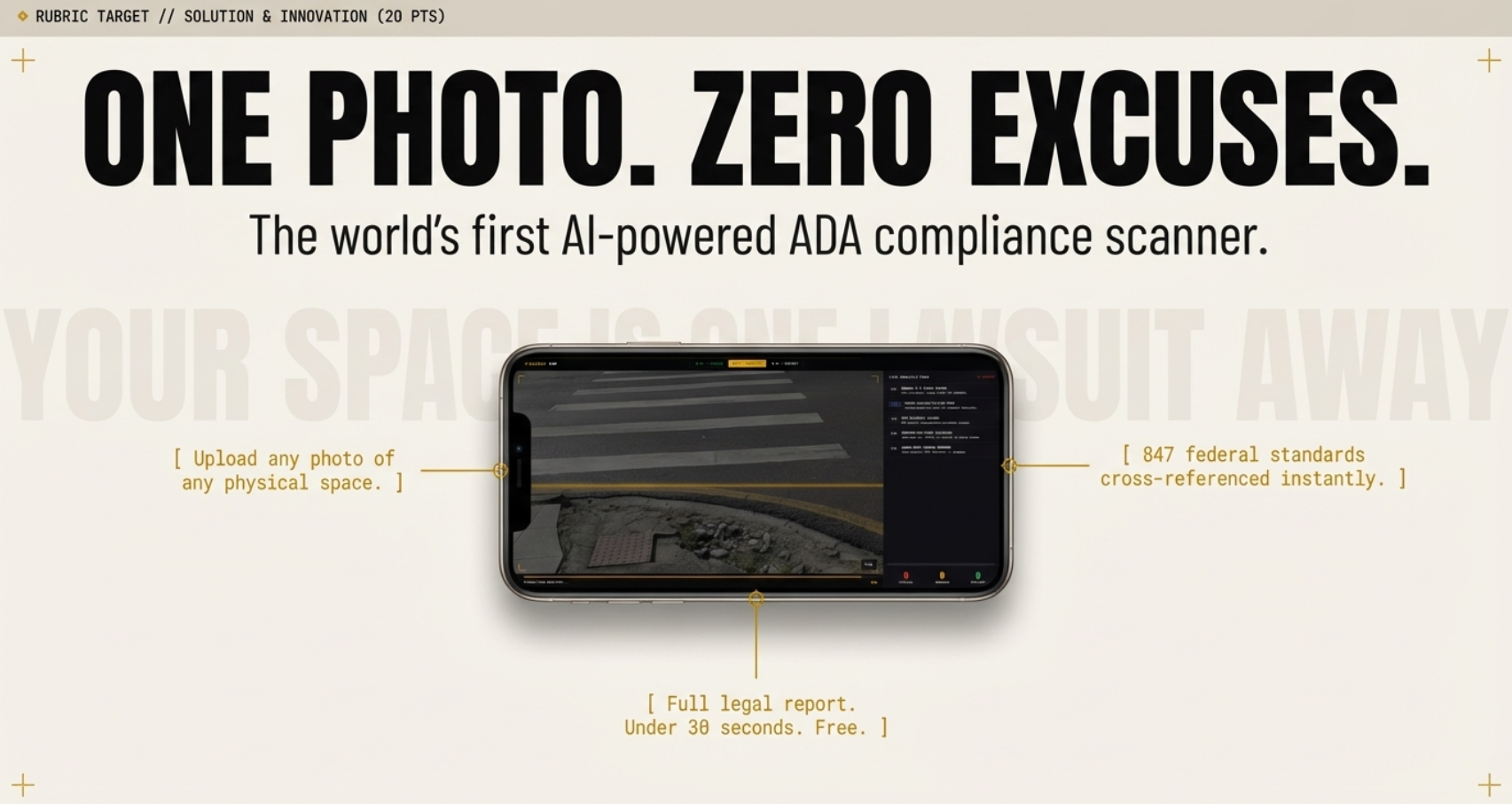
AccessMap is the first AI-powered visual ADA compliance scanner ever built.
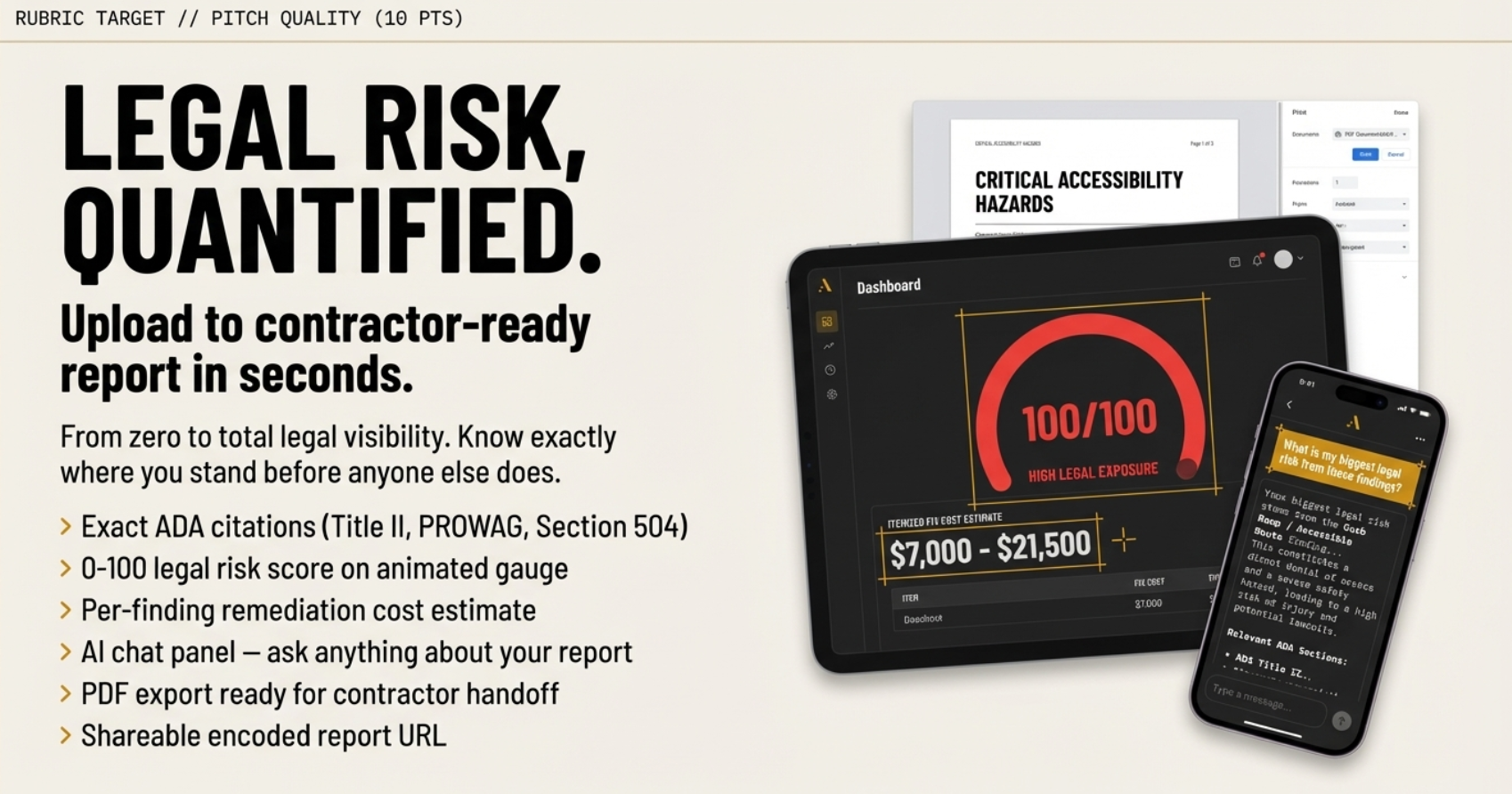
Upload a photo of any physical space. In under 30 seconds, Gemini 2.5 Flash Vision cross-references it against 847 federal ADA standards, flags every violation with exact legal citations, estimates remediation costs, scores your legal exposure from 0–100, and generates a step-by-step contractor fix guide.
No consultant. No site visit. No invoice. Just a photo.
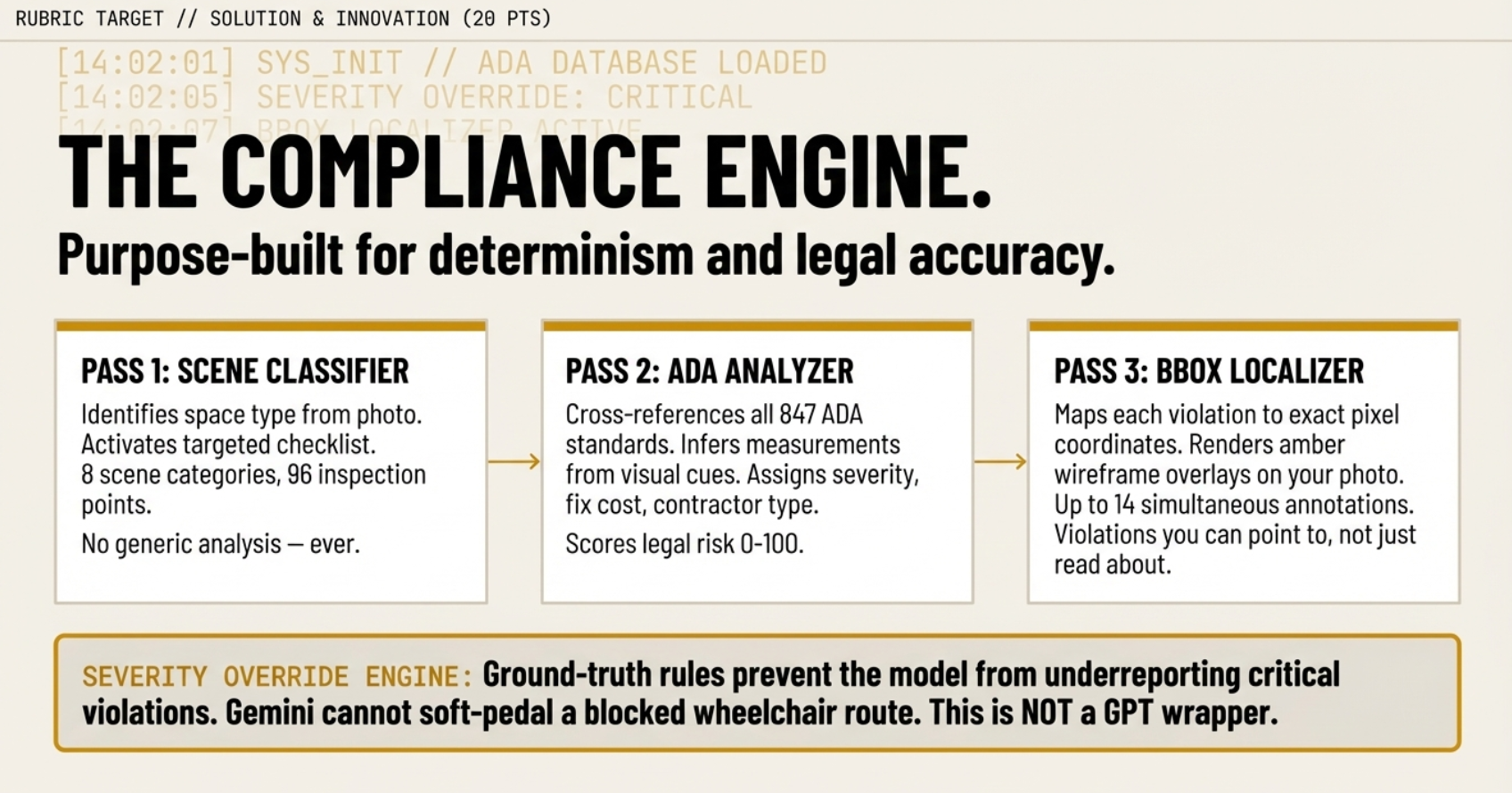
How It Works — 3-Pass Gemini Pipeline
Pass 1 — Scene Classification Gemini identifies the space type: parking lot, building entrance, restroom, ramp, sidewalk, elevator, retail counter, or corridor. This determines which checklist fires next.
Pass 2 — Deep ADA Analysis 847 federal standards are cross-referenced against the image. Each scene has its own dedicated checklist — not a generic prompt. Findings are classified by severity, assigned ADA section numbers, given fix cost estimates, and matched to contractor types.
Pass 3 — Bounding Box Localization Every violation gets a precise bounding box rendered directly on the uploaded photo. Up to 14 simultaneous annotations. See exactly what's wrong and where.
The Severity Engine
The output is protected by a deterministic override system that Gemini cannot soft-pedal:
isBlockingObstruction  →  CRITICAL, priority ≥ 9
isImpassableSurface    →  CRITICAL, priority ≥ 8
isAbsentRoute          →  CRITICAL, priority ≥ 8
isMissingGrabBar       →  CRITICAL, priority ≥ 8
isFadedMarking         →  WARNING cap, priority ≤ 7
The final risk score is always:
\[ \text{Risk Score} = \max(\text{Model Score},\ \text{Derived Score}) \]
The model can never low-ball a serious scene.
What You Get in 30 Seconds
- Violation cards — element, ADA standard, what's required, what was detected, fix cost, contractor type, timeline
- Legal risk gauge — 0–100 animated score calibrated to actual severity
- AI Fix Guide — per-finding remediation with materials, steps, and a compliance checklist (on demand)
- AI Chat Panel — ask anything: fines, DIY options, contractor briefs
- PDF export — printable report for contractor handoff
- Shareable link — encoded report URL for your team or insurance carrier
Traction
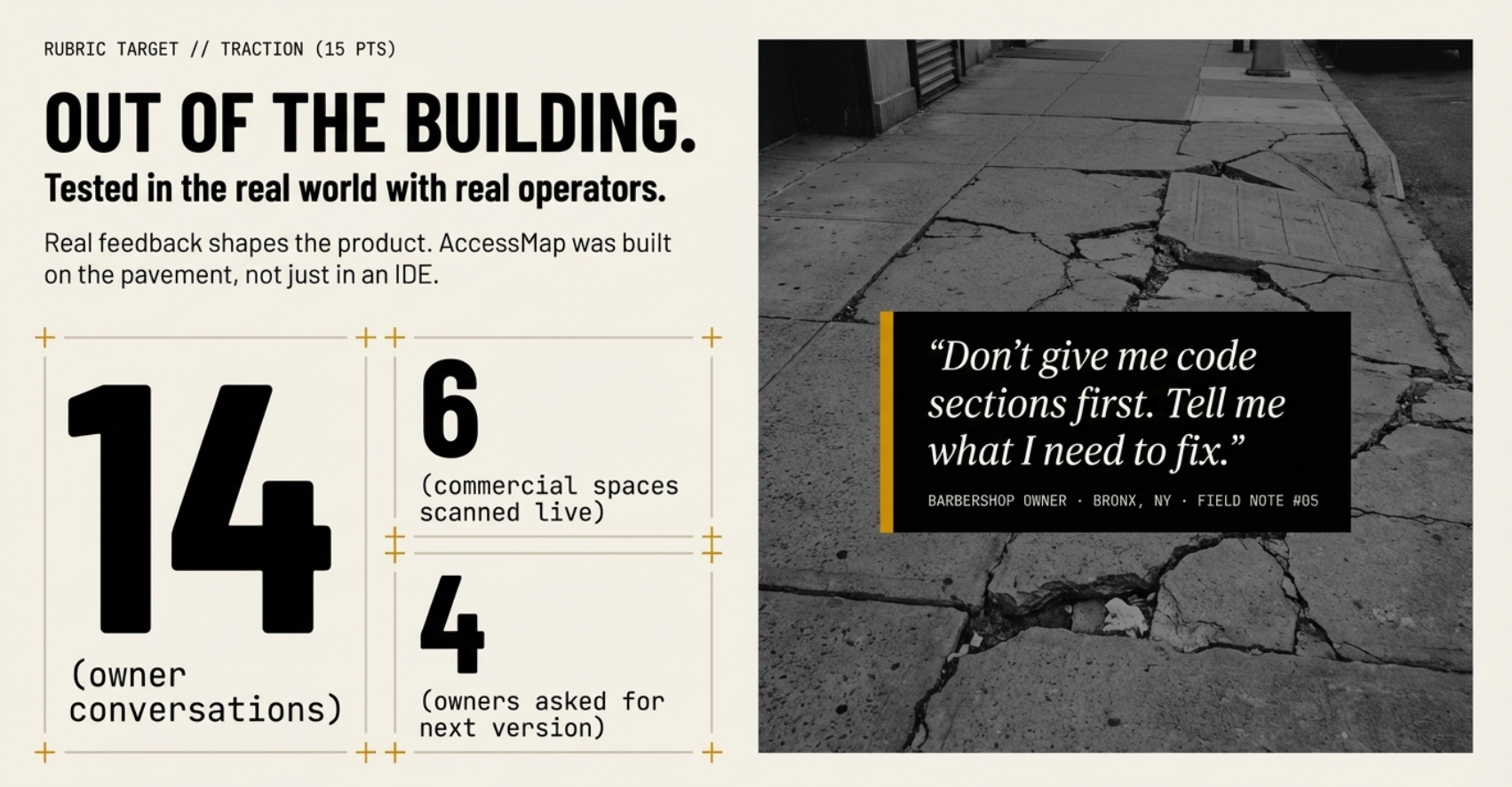
We didn't build this in a vacuum. We went outside first.
"I thought once the contractor signed off, we were good." — Deli owner, Queens
"Yeah, people mention that curb all the time." — Gym owner, Brooklyn (tested prototype on-site)
"If something can tell me where the obvious risk is, that's useful." — Property manager, Jersey City
"I'd use this first so we're not wasting audit time on obvious stuff." — Urgent care admin, Manhattan
| Metric | Count |
|---|---|
| Owner/operator conversations before building | 14 |
| Real commercial spaces reviewed with prototype | 6 |
| Owners who asked to see the next version | 4 |
| Scene types validated in the wild | 5+ |
Real business types tested: delis, gyms, urgent care clinics, property management offices, barbershops. Real phone photos — not polished demo images.
Market & Impact
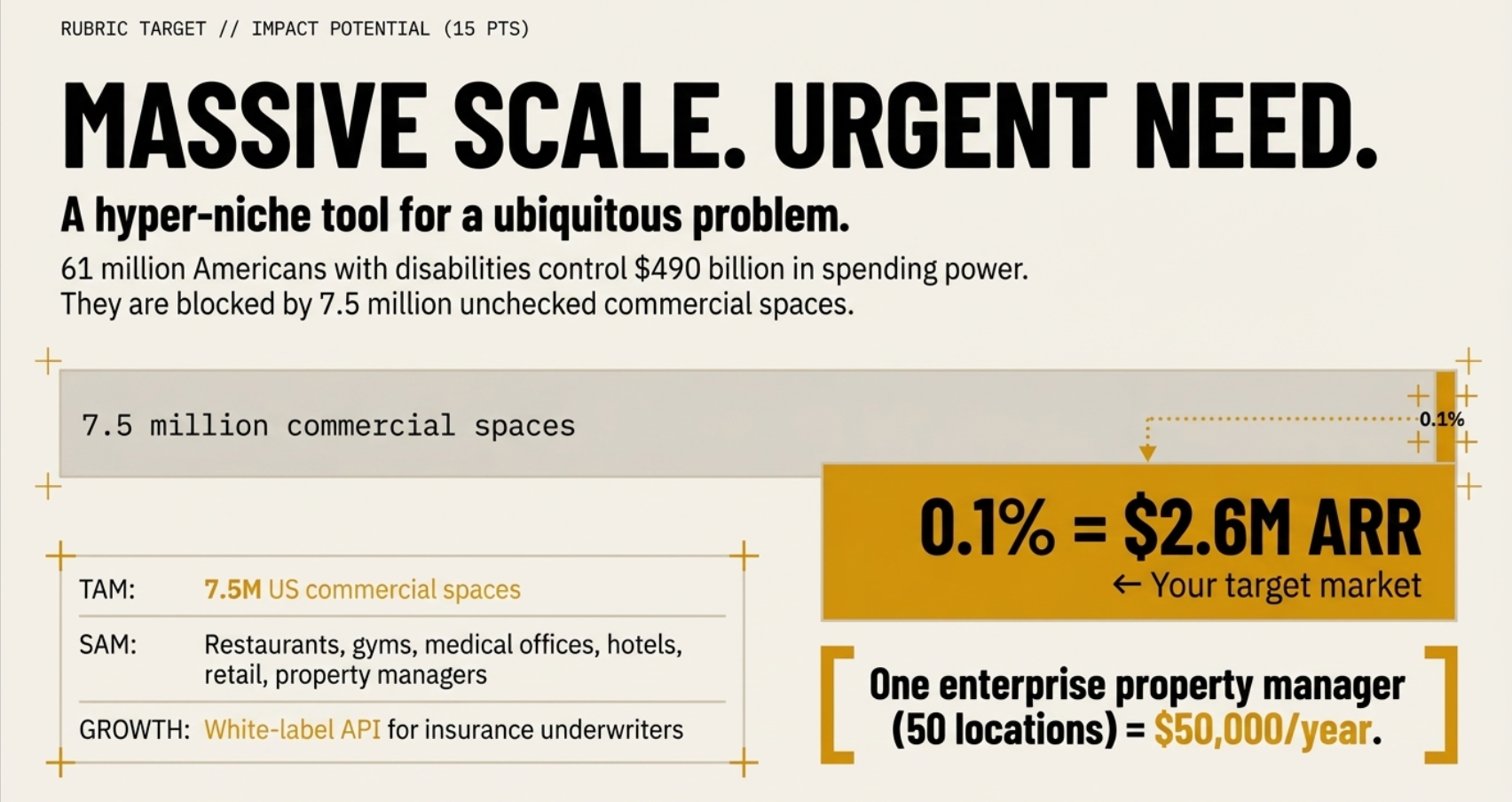
\[ 7{,}500{,}000 \text{ commercial spaces} \times \$29/\text{mo} = \$2.6\text{B TAR} \]
Even 0.1% penetration = \$2.6M ARR.
But the real number is this:
$$ 61{,}000{,}000 \text{ Americans live with a disability} $$
Every non-compliant entrance, every missing ramp, every too-narrow door is a barrier that tells 61 million people they don't belong in your space. People with disabilities represent $490 billion in annual spending power. The businesses that get compliant first don't just avoid lawsuits — they unlock an underserved market.
Target segments:
- Restaurants & food service (highest lawsuit exposure)
- Gyms & fitness studios
- Medical & dental offices
- Hotels & hospitality
- Retail stores
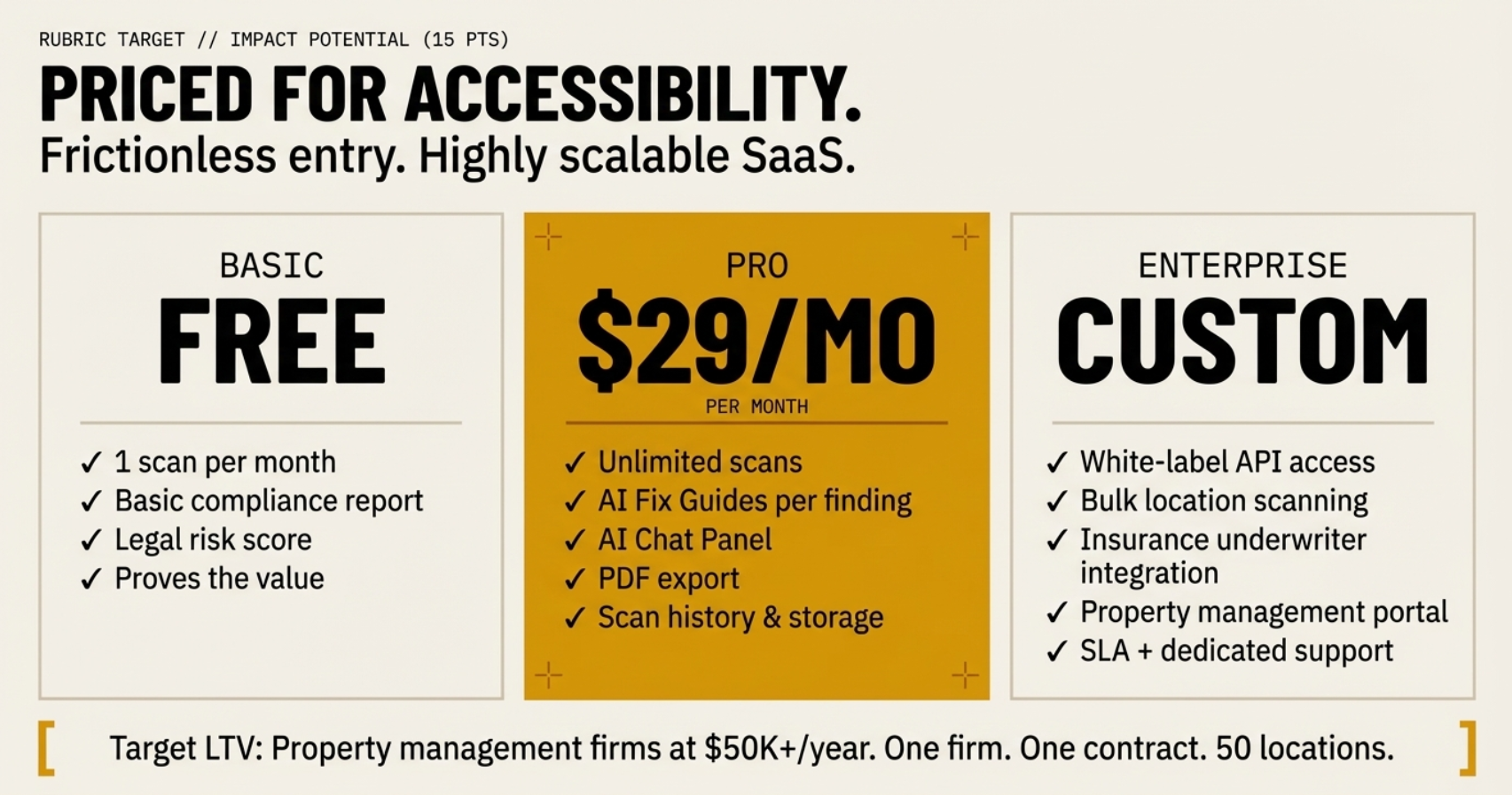
- Property management firms (highest LTV — 50+ locations = $50K/yr)
- Insurance underwriters (white-label API)
Business Model
| Tier | Price | Includes |
|---|---|---|
| Free | $0 | Unlimited scans, basic report, risk score |
| Pro | $29/mo | AI Fix Guides, AI Chat, PDF export, history |
| Enterprise | Custom | White-label API, bulk scan, insurance integration |
Built With
- Gemini 2.5 Flash — vision analysis, ADA reasoning, bounding box localization
- Node.js — zero-dependency server, standard library only
- Vanilla JS / HTML / CSS — no framework, no bloat
- Vercel — deployment
The entire backend is a single server.js file. No Express. No database.
No third-party dependencies. Fast, auditable, portable.
Try It
Drop any photo of a parking lot, entrance, ramp, restroom, or corridor. Real analysis. Real ADA citations. Under 30 seconds.
Built for INNOSpark '26 and HackHazards '26. Every restaurant. Every gym. Every hotel. Compliant. In 30 seconds.

Log in or sign up for Devpost to join the conversation.