-
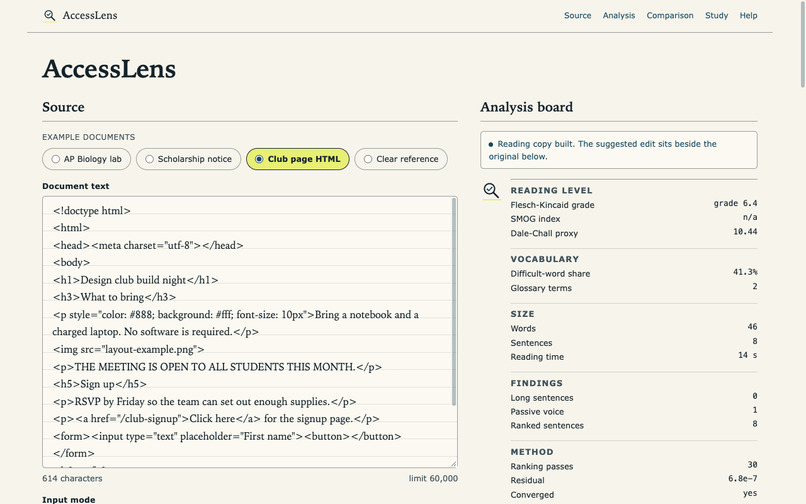
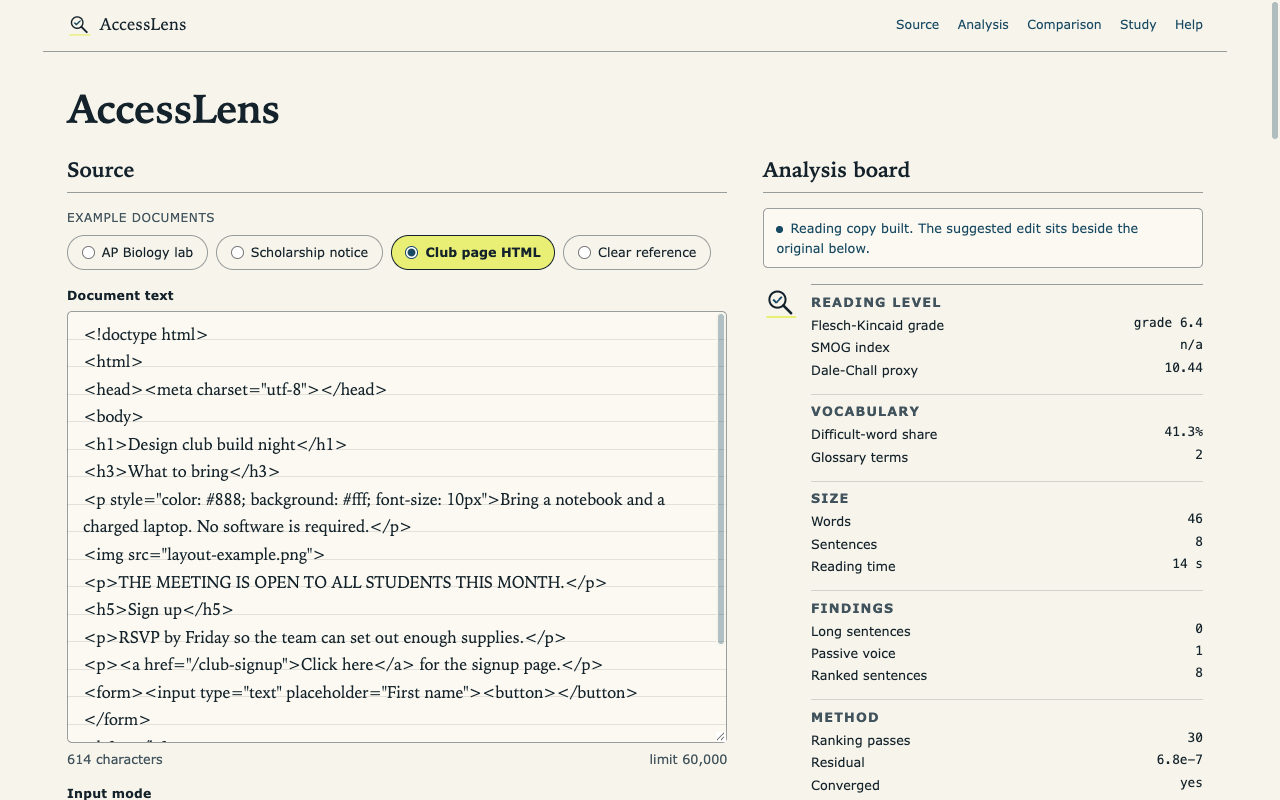
AccessLens desktop studio showing source-linked WCAG findings, TextRank key sentences, and glossary highlights.
-
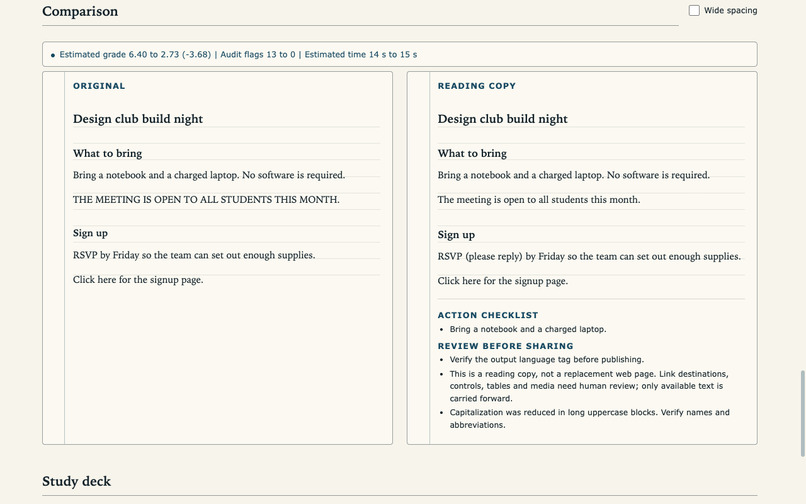
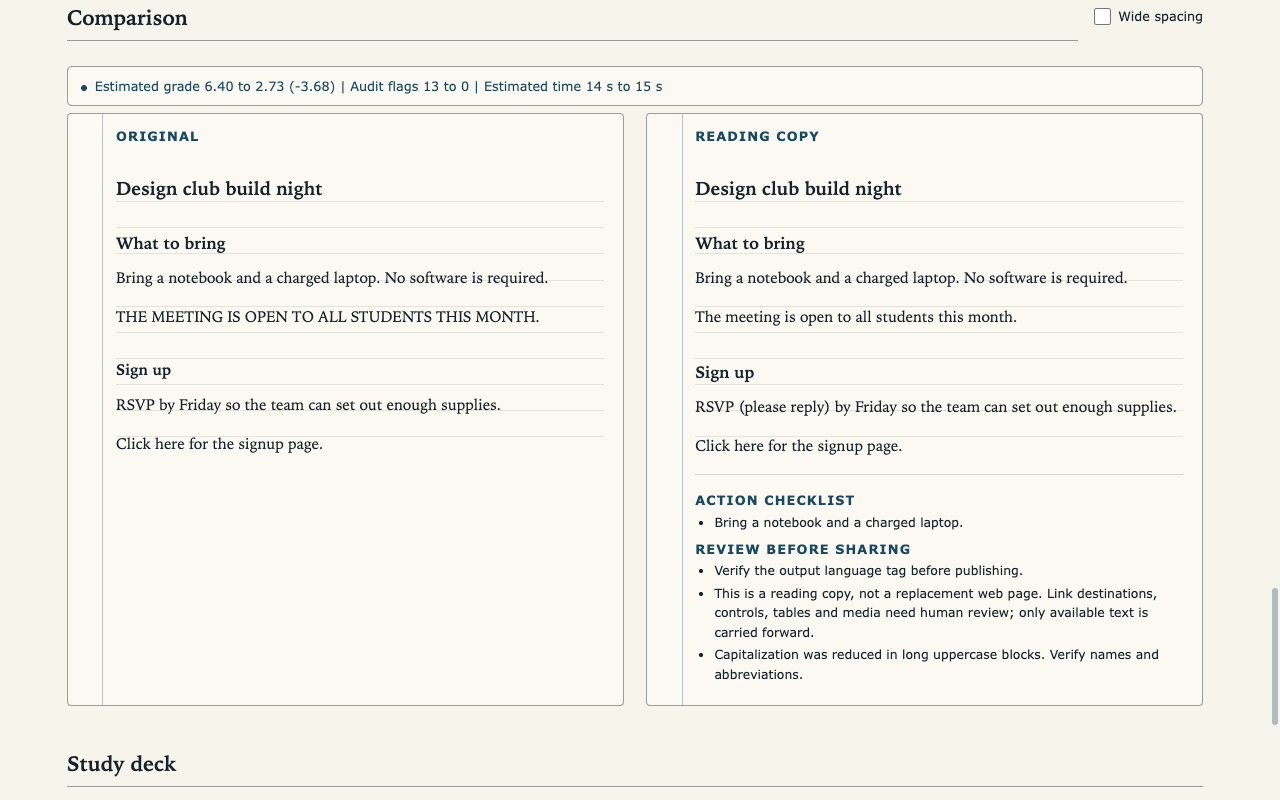
AccessLens reading-copy remediation view comparing before/after issue counts, Flesch-Kincaid grade, and SM-2 study cards.
Inspiration
A school handout or webpage can fail a reader for several reasons at once. Key instructions get buried inside dense paragraphs, technical terms go undefined, and exported HTML loses heading structure or contrast. Readability numbers alone never show which edits would actually help a student. AccessLens places the original source, every line-linked accessibility finding, a proposed reading copy, and an active-recall study deck in one local browser workspace.
What it does
- Graph-Based Key-Sentence Ranking and Glossary Extraction. Paste any handout or HTML snippet, or open one of four fictional school fixtures. AccessLens runs local TF-IDF sentence similarity with TextRank PageRank scoring to identify high-value sentences, marks unfamiliar vocabulary and passive constructions, and links every highlight back to its exact line and character span in the original source.
- Data-Only HTML Tokenizer and WCAG 2.2 Signal Audit. Tokenizes pasted HTML purely as inert data without ever loading or executing markup (49 hostile XSS inputs verified to produce zero executable markup). Audits heading hierarchy, color contrast, alt text, accessible names, and structural barriers, then generates a cleaned reading copy with explicit human-review callouts whenever forms, images, or embeds require manual verification.
- SM-2 Spaced-Repetition Study Deck and Auditable Exports. Builds cloze and definition recall cards directly from the source with SM-2 scheduling, Anki TSV export (hardened against directive injection), printable study sheets, formula-neutralized CSV, and a canonical SHA-256 JSON evaluation bundle.
How we built it
AccessLens is built with native ES-module JavaScript, HTML5, and CSS3 with zero runtime npm packages, zero uploads, and zero external network requests. TextRank builds an undirected sentence graph weighted by TF-IDF overlap, explicit tokenizer rules parse raw HTML safely without innerHTML execution, and Web Crypto computes a deterministic SHA-256 digest over canonical JSON evaluation snapshots.
Challenges we ran into
Keeping source highlights aligned to original character offsets even after HTML entity decoding and inline tag stripping was subtle. Equally important was surfacing the honest limits of automation. A Flesch-Kincaid grade is only a proxy, and passing automated HTML checks is never a legal accessibility certification. When an original document contains forms, figures, or embedded frames, the reading copy flags them for human review instead of fabricating replacements.
Accomplishments that we're proud of
- On the fictional Club page HTML fixture, the generated reading copy reduces automated findings from 13 to 0 and lowers estimated Flesch-Kincaid grade from 6.40 to 2.73.
- Across frozen synthetic evaluation fixtures, glossary term extraction achieved 88.2% precision, 93.8% recall, and 90.9% F1. The HTML audit detected 17 of 17 labeled findings across all 12 checks. TextRank matched 13 of 18 labeled key-sentence slots versus 8 of 18 for the lead-3 baseline.
- The final build passes 388 automated Node tests plus 33 headless Chrome checks at 1280x800 and 390x844 with zero console errors, zero page errors, and zero external requests, after closing 39 adversarial NLP, tokenizer, WCAG, and export edge cases.
What we learned
Lowering a readability number is not always the right edit. Expanding a domain abbreviation can raise an estimated grade score while making a lab handout far easier for a student to understand. Pairing before-and-after diffs with exact source spans makes that tradeoff transparent.
What's next for AccessLens
Test the reading-copy workflow with classroom teachers and assistive-technology users, expand the frozen evaluation suite with independently labeled documents, and improve structural preservation for tables and equations without ever executing pasted HTML.
Built With
- css3
- html5
- javascript
- natural-language-processing
- node.js
- textrank
- wcag
- web-crypto-api
