Inspiration
Accessibility is often treated as a final-stage checklist in web development, rather than a fundamental part of the engineering process. Developers may build visually appealing and technically sophisticated applications, yet unintentionally exclude users who rely on screen readers, keyboard navigation, assistive technologies, or alternative ways of interacting with digital interfaces.
Existing accessibility testing workflows can identify violations, but interpreting technical reports, understanding their real-world implications, and implementing appropriate fixes can be time-consuming. Developers are frequently left with a list of errors without sufficient context about why they matter, which users they affect, or how to resolve them without disrupting existing functionality.
We saw an opportunity to bridge this gap between accessibility testing and practical remediation.
That led to AccessLens AI: an intelligent accessibility engineering assistant designed around a simple philosophy — accessibility should not just be measurable; it should be actionable.
Our inspiration was to combine deterministic accessibility testing with the reasoning capabilities of NVIDIA Nemotron, delivered through Nebius Token Factory, to help developers understand accessibility barriers, make informed improvements, and validate the results within a unified workflow.
What it does
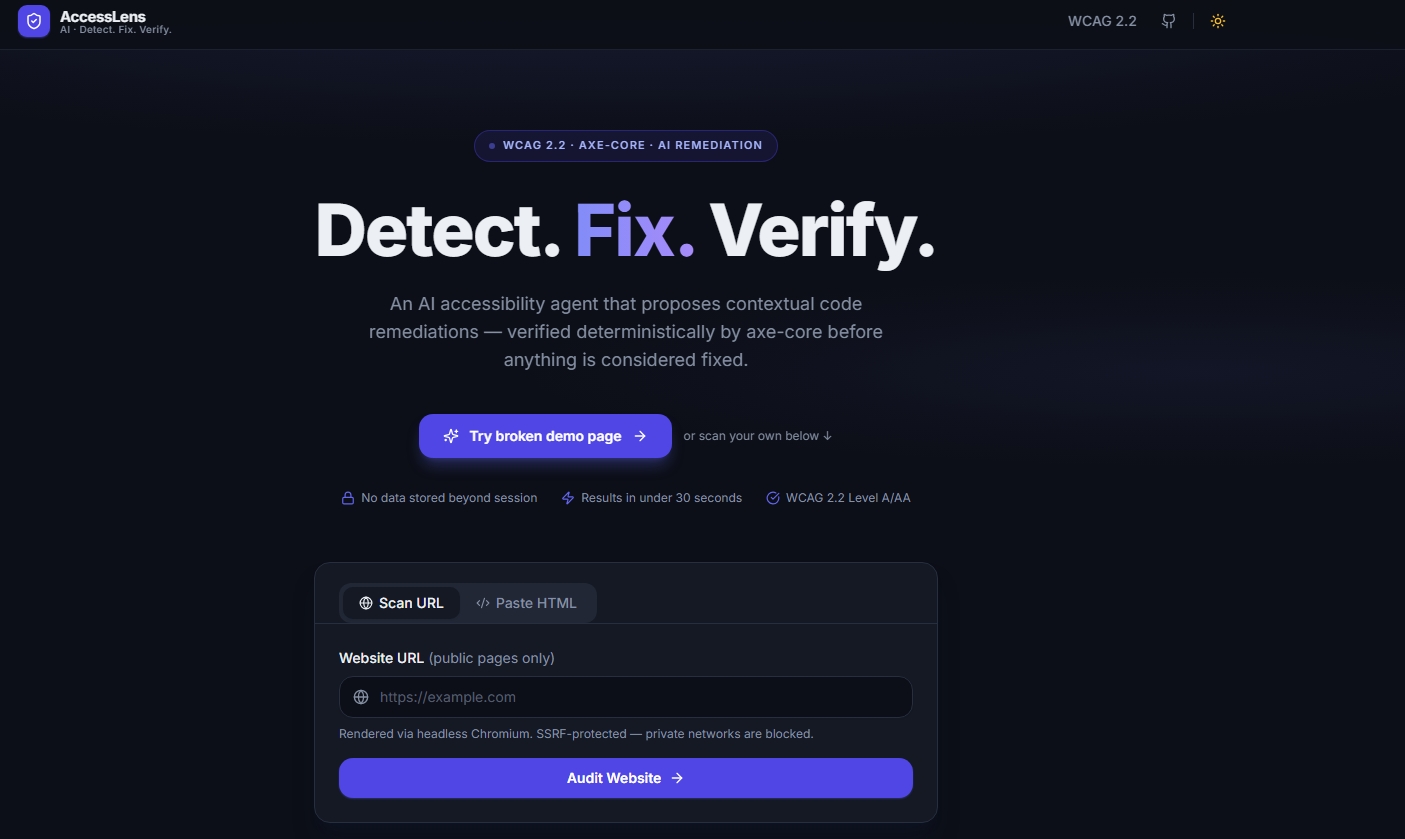
AccessLens AI is an AI-powered web accessibility auditing and remediation platform that helps developers identify, understand, prioritize, and address accessibility issues throughout the development process.
Instead of functioning as just another accessibility scanner, AccessLens AI focuses on transforming technical findings into actionable engineering decisions.
Core capabilities:
1. Intelligent Accessibility Auditing
Users can initiate an accessibility audit by providing a website URL or HTML input. The scanning engine analyzes the supplied content and identifies common accessibility violations, including:
- Missing or inadequate alternative text for images.
- Insufficient foreground and background color contrast.
- Improper heading hierarchy and document structure.
- Missing labels and accessible names in form elements.
- Keyboard accessibility and interaction-related issues.
- Semantic HTML and ARIA-related problems.
2. Issue Classification and Prioritization
Detected findings are organized to help developers understand the nature and potential severity of each problem. Instead of presenting an unstructured collection of errors, AccessLens AI aims to provide a more organized view of accessibility weaknesses and their remediation priorities.
3. Nemotron-Powered Accessibility Intelligence
Through NVIDIA Nemotron and Nebius Token Factory, AccessLens AI adds an AI reasoning layer to the auditing process.
The model receives relevant accessibility findings and contextual code information to generate:
- Human-readable explanations of technical violations.
- Insights into how an issue may affect users with disabilities.
- Context-aware remediation recommendations.
- Targeted code-fix suggestions that developers can review and adapt.
4. AI-Assisted Code Remediation
AccessLens AI goes beyond reporting problems by helping developers understand how to address them. It generates targeted suggestions based on the available code context, helping reduce the effort required to move from identifying a violation to implementing a potential solution.
Developers remain in control of reviewing and approving proposed changes.
5. Verification-Driven Workflow
A suggested fix should never be considered successful simply because an AI model generated it. AccessLens AI emphasizes verification by allowing developers to run accessibility checks again after applying changes and inspect whether the reported issues have been resolved.
Automated results are presented as evidence of improvement, while issues requiring human judgment are kept distinct from automatically verifiable findings.
The overall experience follows three principles:
DETECT → FIX → VERIFY
How we built it
AccessLens AI was designed using a modular architecture that separates accessibility detection, AI-powered reasoning, remediation suggestions, and verification.
Our approach combines conventional software engineering techniques with generative AI rather than relying on an LLM to independently determine whether a website is accessible.
1. Accessibility Analysis Layer
We use automated accessibility testing to inspect web content and identify detectable accessibility violations. The scanning layer produces structured findings that can be categorized and passed to subsequent stages of the workflow.
This deterministic approach provides an evidence-based foundation for the application.
2. AI Intelligence Layer — NVIDIA Nemotron
We integrated NVIDIA Nemotron through Nebius Token Factory to introduce contextual reasoning into the remediation workflow.
Instead of asking the model generic accessibility questions, we designed prompts around structured findings and relevant HTML context. This helps the model focus on the specific violation, explain its implications, and generate targeted recommendations.
Prompt engineering plays an important role in maintaining consistent responses and ensuring that generated suggestions remain relevant to the detected problem.
3. Nebius Token Factory Integration
Nebius Token Factory provides the inference API layer through which the application accesses Nemotron. This allows us to incorporate model capabilities without independently managing the underlying model-serving infrastructure.
The integration is handled through the backend, keeping credentials separate from the client-side application.
4. Remediation and Verification Pipeline
The remediation workflow connects AI-generated recommendations with the original accessibility findings. Developers can review proposed changes before applying them, followed by another automated scan to evaluate the outcome.
This separation between AI-generated recommendations and deterministic verification is an important architectural decision: the model assists with remediation, while automated checks provide measurable evidence of whether a particular violation has been addressed.
5. Product and User Experience
We focused on building a developer-oriented interface that makes complex accessibility information easier to navigate. The experience is organized around audit results, issue details, AI explanations, remediation recommendations, and verification.
Our goal was to make accessibility engineering feel like a continuous development workflow rather than a separate compliance exercise.
Challenges we ran into
Building AccessLens AI involved challenges beyond simply integrating an AI model into a web application.
Bridging deterministic testing and generative AI: Accessibility scanners produce structured technical findings, whereas language models work with contextual information. Designing a reliable connection between these two systems required careful handling of issue descriptions, relevant code context, and model responses.
Context-aware remediation: A generic code suggestion is not necessarily an appropriate fix. The same accessibility violation can require different solutions depending on the surrounding HTML structure, application behavior, and intended user interaction.
Reliability of AI-generated suggestions: Generative models can produce suggestions that appear technically convincing but may not fully address the underlying problem. We therefore treated AI output as a recommendation requiring review, rather than automatically accepting every generated change.
Distinguishing detection from compliance: Automated tools cannot identify every accessibility barrier or establish complete WCAG compliance. Some issues require manual testing, assistive technology evaluation, and human judgment. Designing the product around this distinction was essential to maintaining realistic expectations.
Integrating model inference into the application: Connecting Nemotron through Nebius Token Factory required us to consider backend integration, structured prompts, response handling, and the separation of application logic from model inference.
These challenges shaped an important principle behind AccessLens AI: useful AI engineering is not just about generating answers; it is about building a workflow in which those answers can be reviewed and validated.
Accomplishments that we're proud of
We are particularly proud of approaching accessibility as an engineering problem that deserves the same level of intelligence, automation, and continuous improvement as other parts of software development.
Our key accomplishments include:
- Designing a unified accessibility workflow that connects issue detection, AI-assisted remediation, and post-fix verification.
- Integrating NVIDIA Nemotron through Nebius Token Factory into a practical developer-focused application.
- Using contextual prompt engineering to transform structured accessibility findings into understandable explanations and targeted recommendations.
- Combining deterministic accessibility checks with generative AI instead of treating model-generated responses as unquestionable results.
- Designing a human-in-the-loop remediation approach that keeps developers responsible for reviewing and approving changes.
- Exploring how open-source AI models and accessible inference infrastructure can support a meaningful real-world developer tool.
Beyond the implementation itself, we are proud that AccessLens AI addresses a problem with a direct human impact: making digital experiences more inclusive for people who interact with technology in different ways.
What we learned
Building AccessLens AI gave us practical experience in designing an AI-powered engineering workflow rather than developing an application that simply wraps an LLM API.
We gained a deeper understanding of how to integrate NVIDIA Nemotron through Nebius Token Factory, structure prompts around technical context, handle model-generated recommendations, and combine AI reasoning with deterministic software validation.
We also learned several important lessons:
- AI and deterministic systems complement each other: LLMs can interpret, explain, and recommend, while testing frameworks provide repeatable checks and evidence.
- Context determines output quality: Providing relevant source code and structured findings is essential for generating useful technical recommendations.
- Human oversight matters: AI-generated code should be reviewed and tested before being trusted.
- Accessibility requires continuous attention: It is not a one-time checklist but an ongoing engineering responsibility.
- Infrastructure choices influence product development: Accessible model inference through platforms such as Nebius Token Factory allows developers to focus more on application logic and product capabilities.
Most importantly, we learned to evaluate an AI feature not just by whether it produces an answer, but by whether that answer helps a user accomplish a real task reliably.
What's next for AccessLens AI
We see AccessLens AI evolving from an accessibility auditing assistant into a more comprehensive accessibility engineering platform integrated into the software development lifecycle.
Our future roadmap includes:
1. Expanded Accessibility Coverage
Extending detection capabilities across more WCAG success criteria, improving support for complex interactive components, dynamic interfaces, and modern web applications.
2. Deeper Codebase Integration
Introducing integrations with popular code editors, development environments, and version-control platforms so developers can identify and address accessibility issues closer to where they write code.
3. Intelligent Remediation Workflows
Improving the contextual accuracy of AI-generated suggestions by incorporating more surrounding code, component relationships, and application behavior into the reasoning process.
4. Automated Pull Request Assistance
Exploring workflows that can generate reviewable accessibility improvement patches and pull-request suggestions, allowing teams to incorporate accessibility fixes into their existing collaboration processes.
5. Continuous Accessibility Monitoring
Moving beyond individual scans toward continuous monitoring that helps development teams identify newly introduced accessibility regressions as their applications evolve.
6. Better Reporting and Developer Insights
Building detailed reports, remediation tracking, and accessibility progress insights to help teams understand recurring issues, monitor improvements, and make more informed engineering decisions.
7. Stronger AI Evaluation and Verification
Developing more comprehensive evaluation workflows for generated fixes, with clearer separation between automatically verified improvements and issues that require manual accessibility testing.
Our long-term vision is to make accessibility an integral part of how software is designed, developed, tested, and maintained.
AccessLens AI is built on a simple belief: the future of web development should not only be more intelligent, but also more inclusive.
Built With
- accessibility-testing
- ai-agents
- artificial-intelligence
- assistive-technology
- automated-testing
- axe-core
- developer-tools
- express.js
- generative-ai
- html
- human-in-the-loop
- inclusive-design
- javascript
- llms
- nebius
- nebius-token-factory
- node.js
- nvidia-nemotron
- playwright
- prompt-engineering
- react
- rest-api
- typescript
- wcag
- web-accessibility


Log in or sign up for Devpost to join the conversation.