-
-
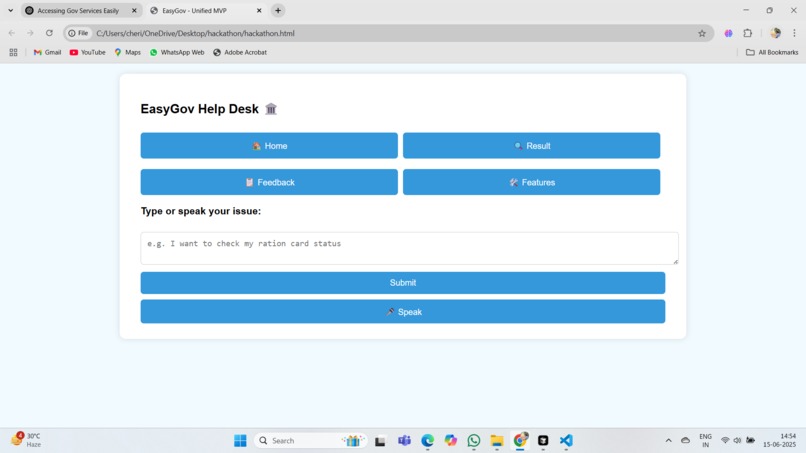
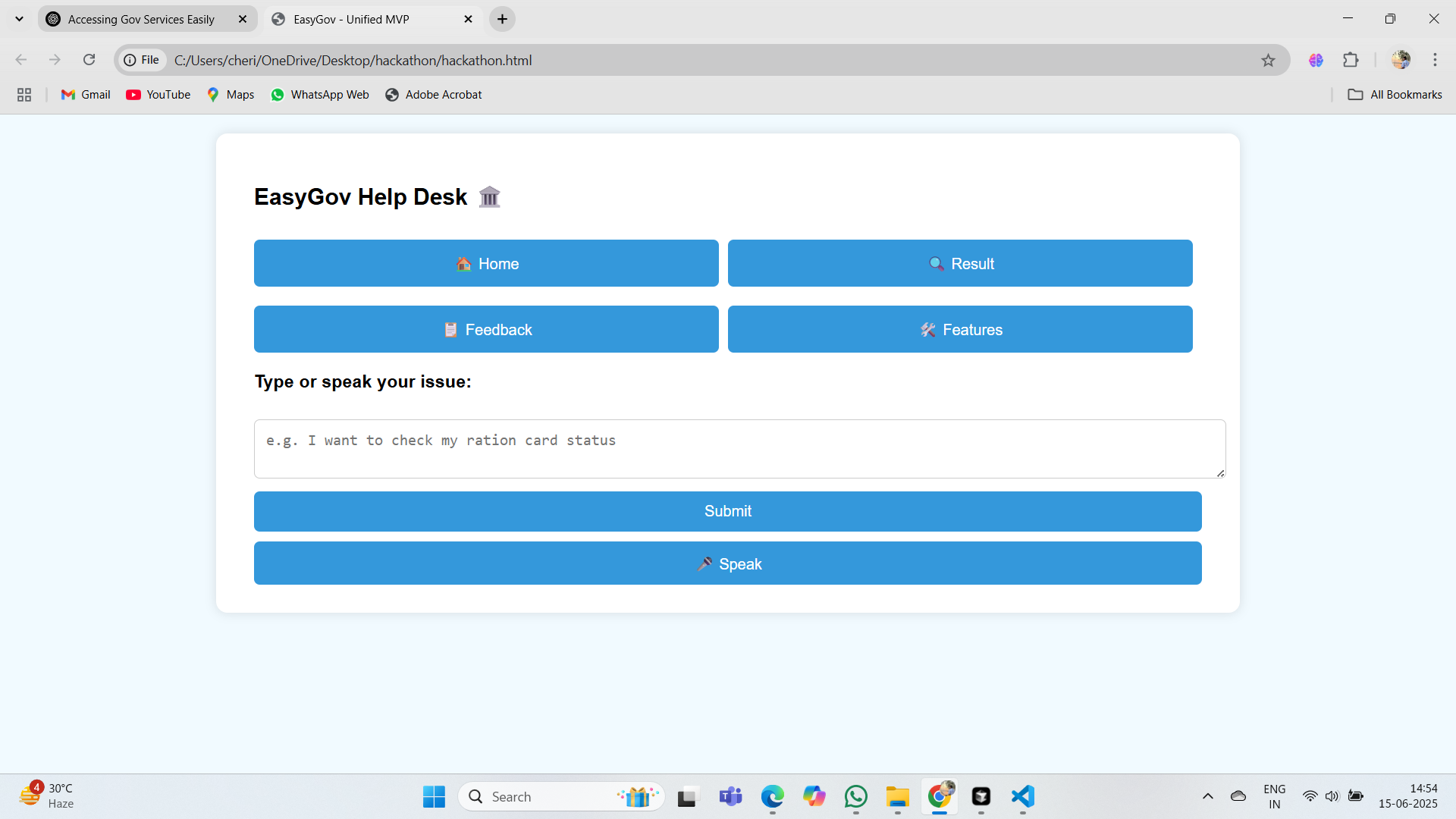
frontend
Inspiration
Many rural and elderly citizens face significant challenges when trying to access government services. Complex websites, language barriers, lack of digital literacy, and limited internet connectivity often prevent them from easily obtaining essential services like pensions, ration cards, and identity documents. We wanted to build a solution that simplifies this process, making government services more accessible and user-friendly for these underserved communities.
What it does
Our MVP is a unified platform that consolidates multiple government service portals into a single, simple interface. It offers:
- Easy-to-understand navigation with local language support
- Voice-assisted prompts for users unfamiliar with typing
- Simplified forms to apply for services like pensions, ration cards, and identity documents
- Status tracking of applications with notifications
- Support for offline assistance via local help centers or volunteers linked through the app
How we built it
We used a combination of modern web technologies:
- Frontend: React.js for a responsive and intuitive UI
- Backend: Node.js with Express to handle API requests and data processing
- Database: MongoDB to store user profiles, applications, and service statuses
- Integrated LLM-powered chatbot for guiding users through complex processes using natural language
- Localization libraries for multi-language support
- Hosted on cloud infrastructure with scalability in mind
Challenges we ran into
- Designing a simple UI that works for users with little digital experience
- Handling diverse regional languages and dialects
- Ensuring accessibility features for elderly users, such as large fonts and voice assistance
- Integrating multiple government APIs which have different data formats and update frequencies
- Managing data privacy and compliance with government regulations
Accomplishments that we're proud of
- Created a working prototype that reduces the number of steps required to apply for key services by over 50%
- Successfully integrated voice-assisted navigation to help users who cannot read or type easily
- Enabled real-time status tracking and notification system to keep users informed
- Developed a chatbot that answers common user queries, reducing the need for human assistance
- Positive feedback from pilot users in rural areas regarding usability and helpfulness
What we learned
- User-centered design is critical for creating accessible technology for vulnerable populations
- Voice and language support significantly enhance usability for elderly and rural users
- Interoperability challenges exist between various government data systems, requiring adaptable integration layers
- Regular testing with real users helps uncover hidden pain points that design assumptions might miss
- Data security and privacy must be prioritized, especially when handling sensitive personal information
What's next for Accessing Govt Services Hard for Rural/Elderly Citizens
- Expand language support to cover more regional dialects and scripts
- Develop an offline-first mobile app version for areas with poor internet connectivity
- Collaborate with local government bodies and NGOs for wider adoption and support networks
- Add biometric authentication to simplify secure logins for elderly users
- Incorporate AI-driven predictive assistance to proactively suggest relevant government services based on user profiles
- Conduct larger-scale pilot tests and gather user feedback for continuous improvement

Log in or sign up for Devpost to join the conversation.