-
-
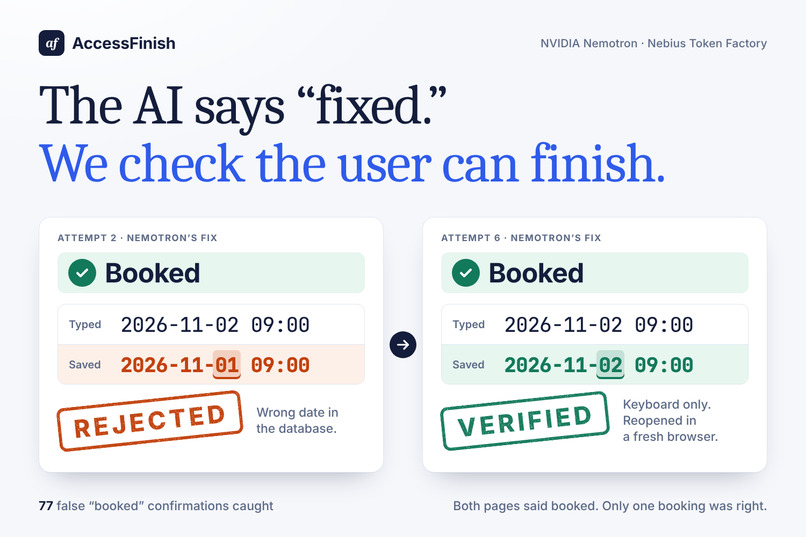
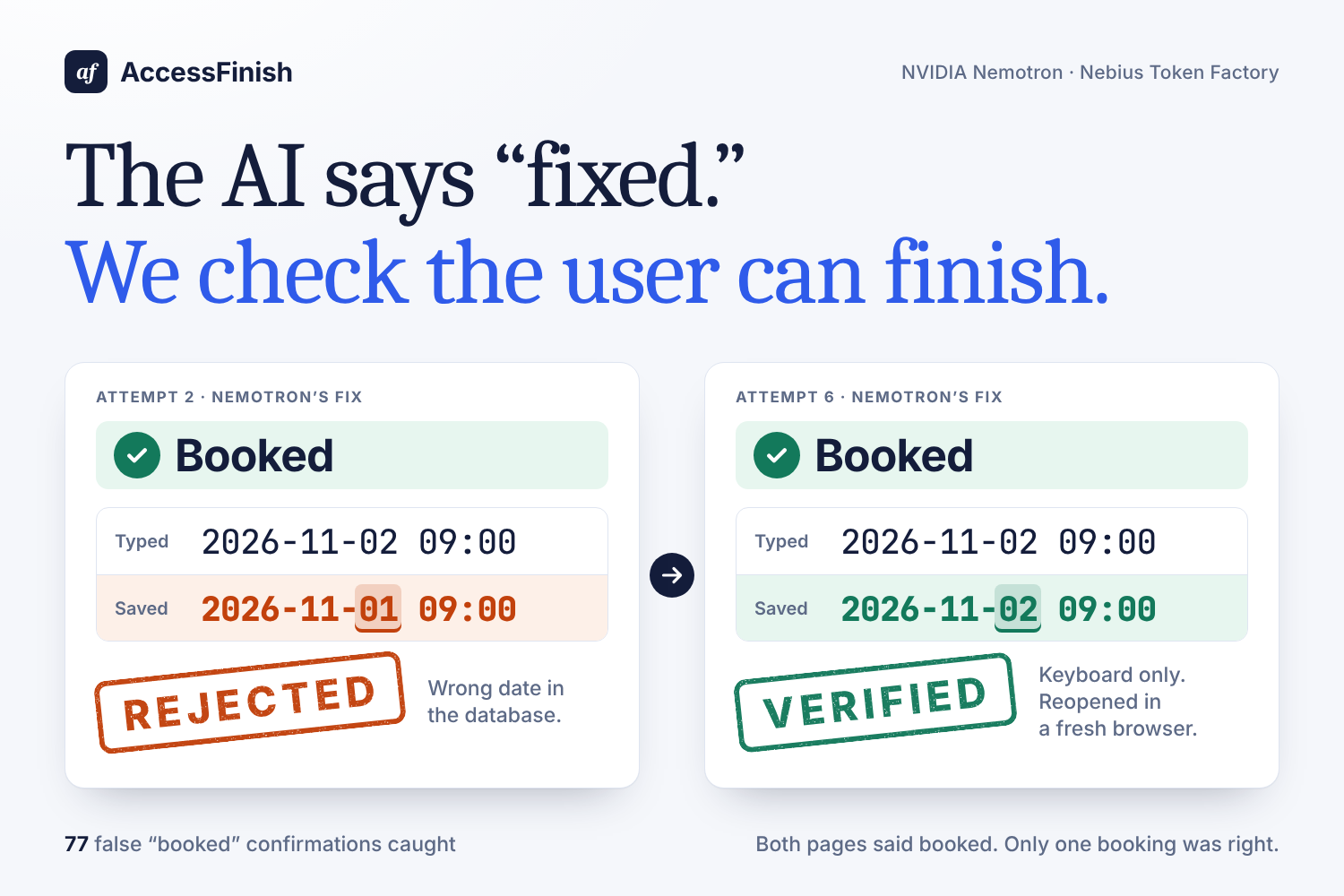
The AI says "fixed." We check the user can finish: both pages said booked, but only the fix proven end to end was accepted.
-
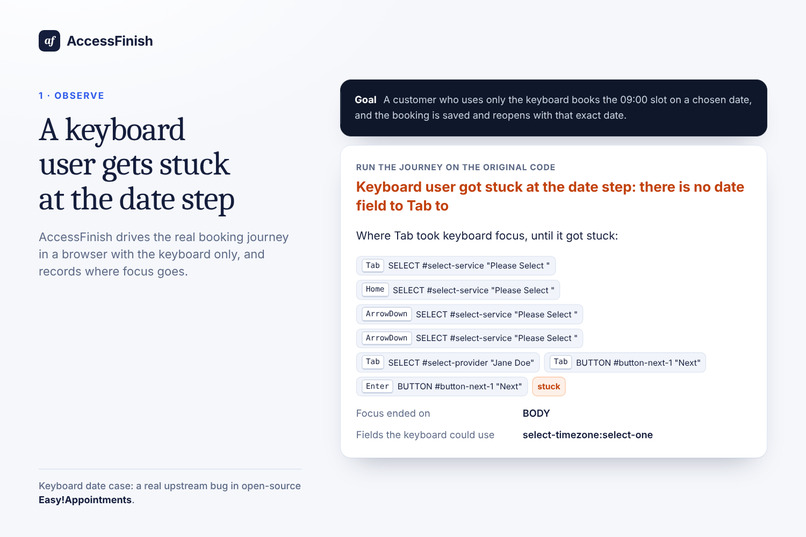
A real upstream bug in Easy!Appointments: a keyboard-only user Tabs through the booking and gets stuck. There is no date field to reach.
-
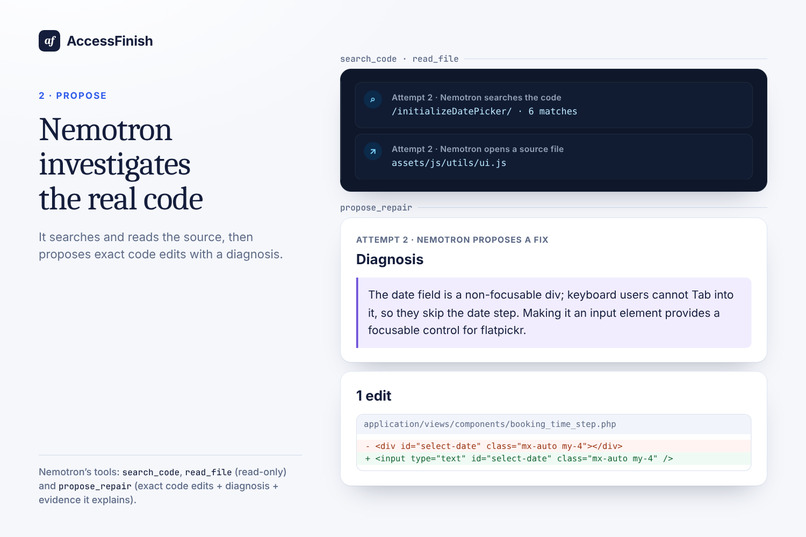
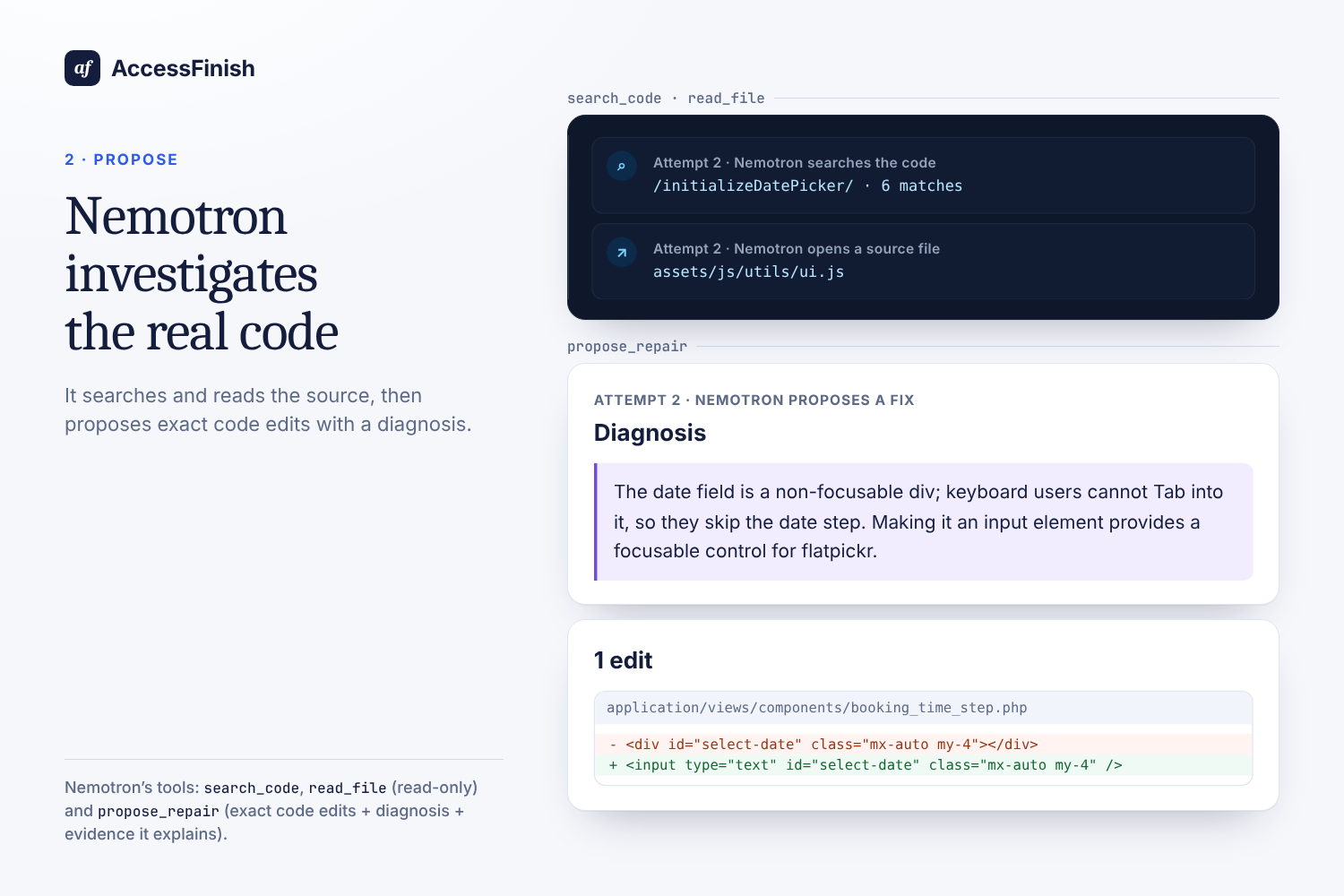
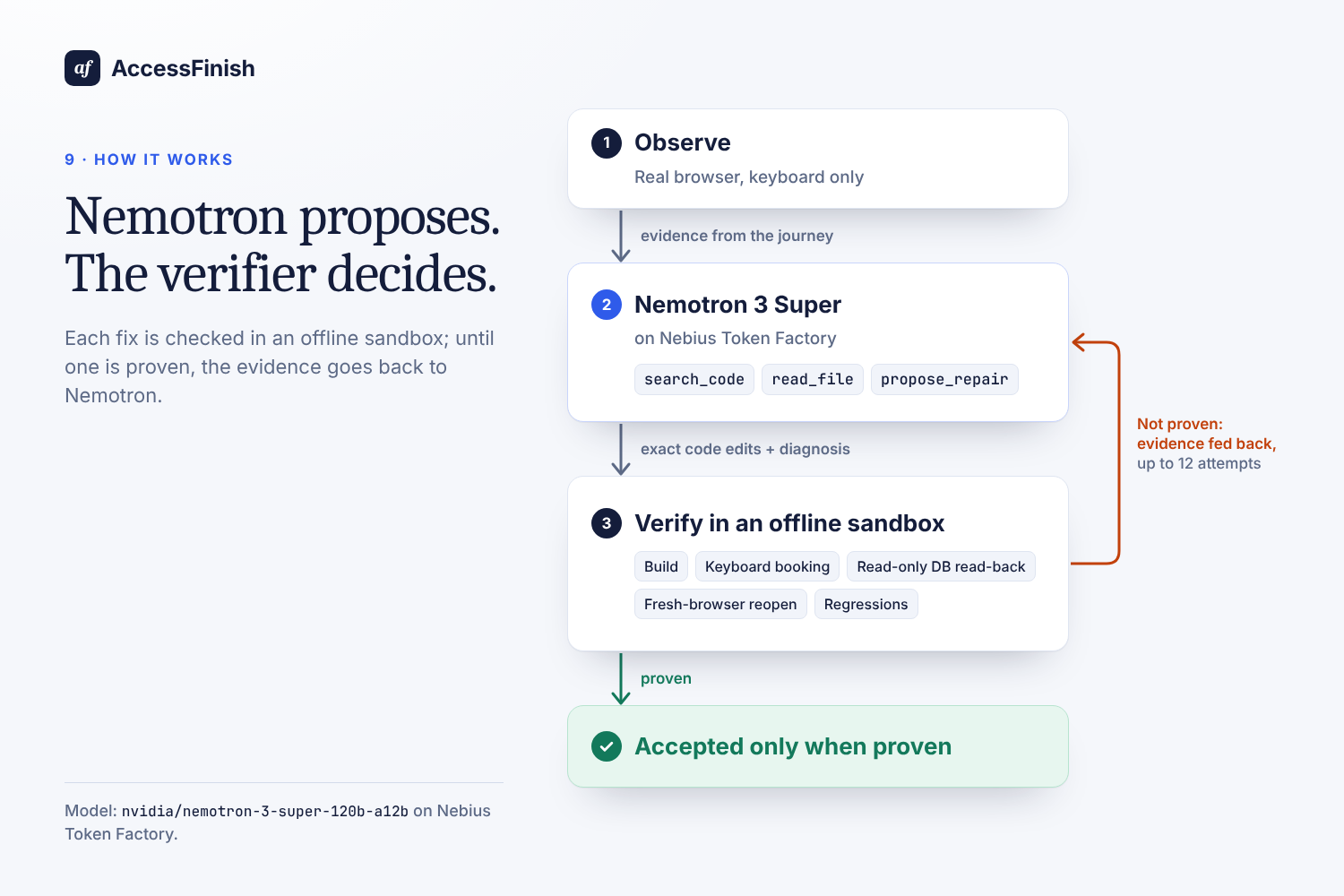
Nemotron 3 Super on Nebius Token Factory searches and reads the real source, then proposes exact code edits with its diagnosis.
-
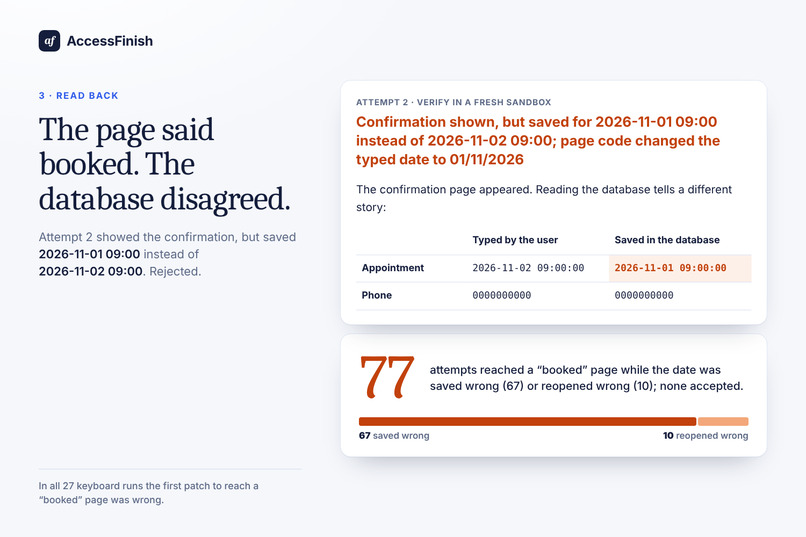
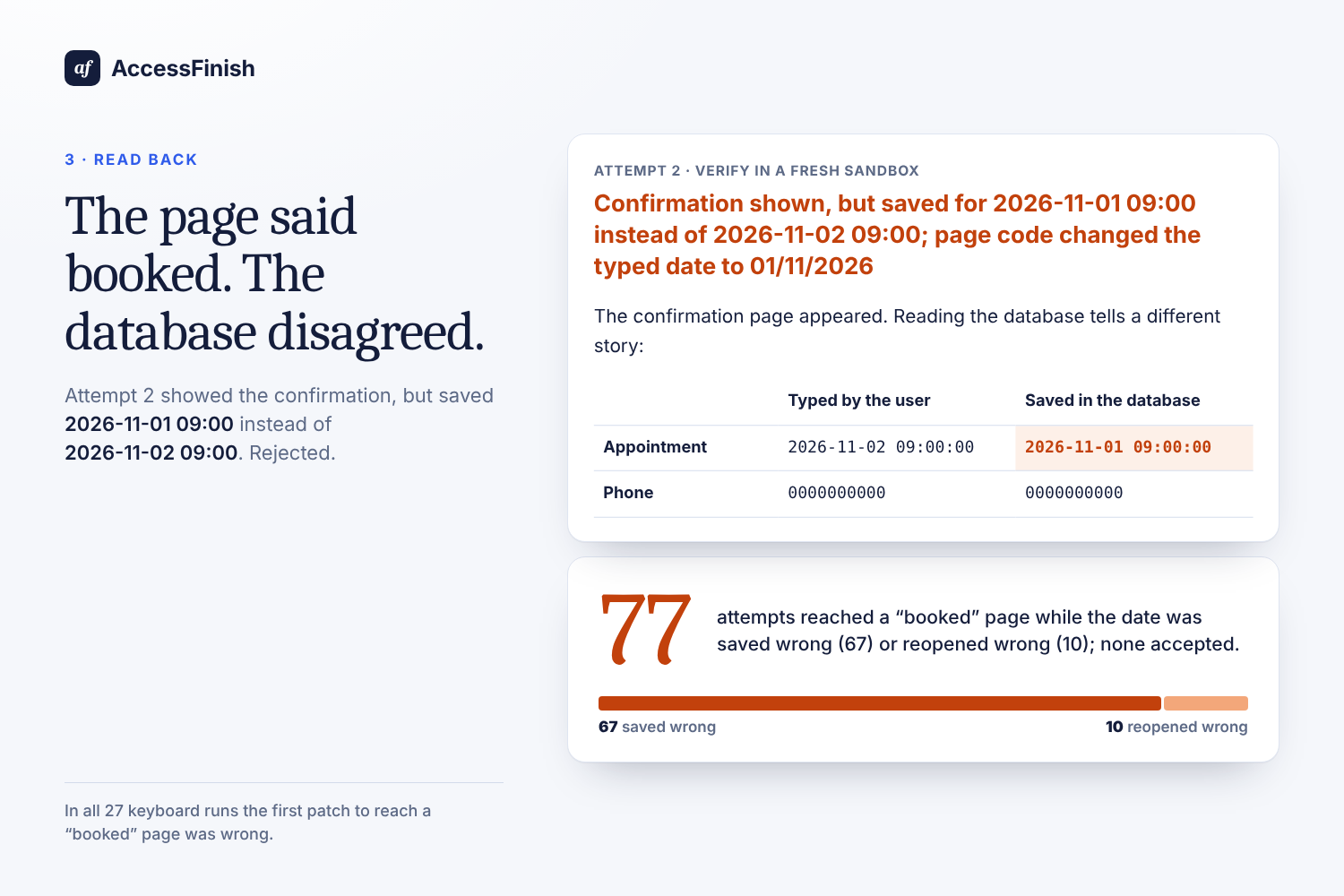
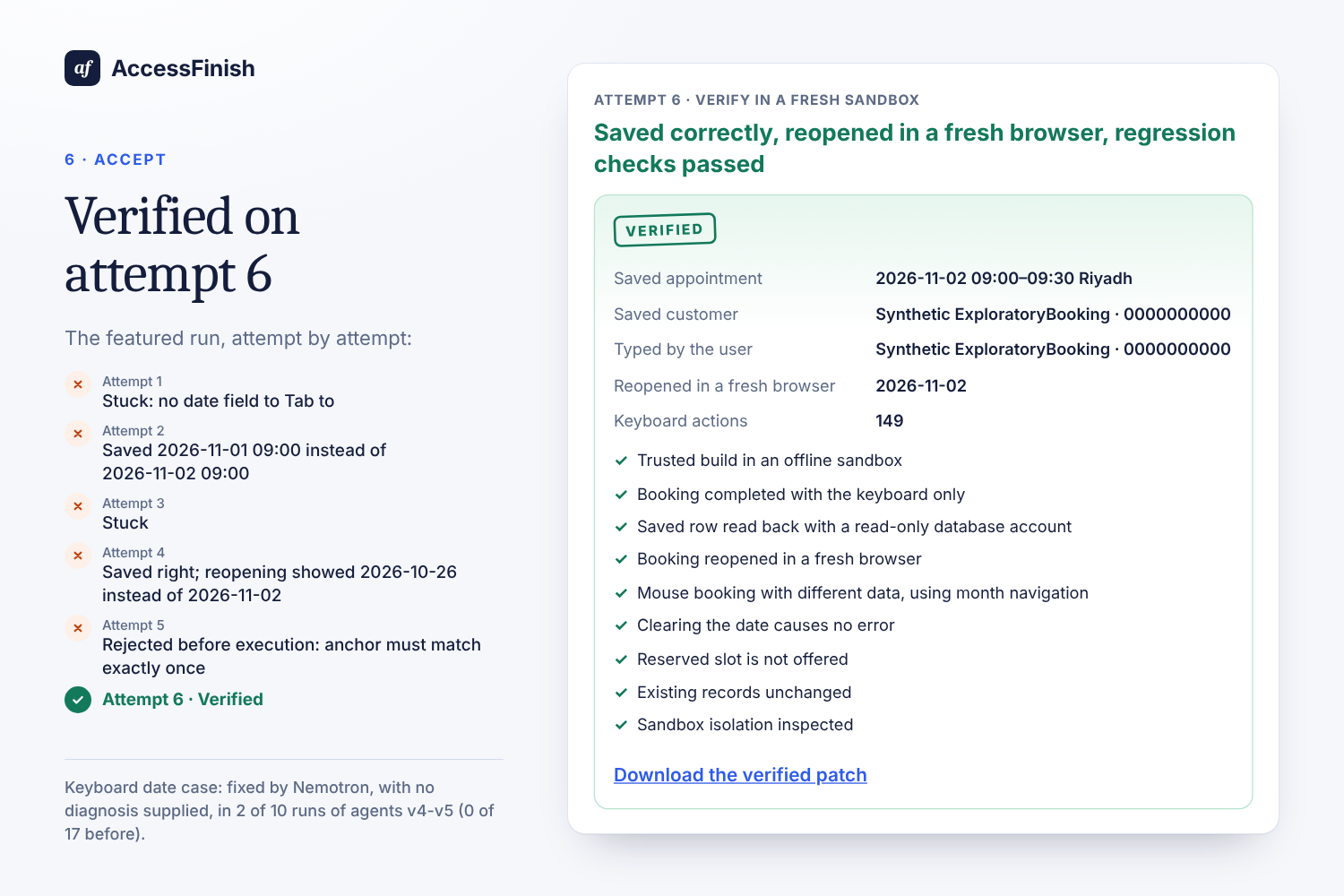
Attempt 2: the page said booked, but the database saved 1 Nov instead of 2 Nov. Rejected. 77 false "booked" pages caught, none accepted.
-
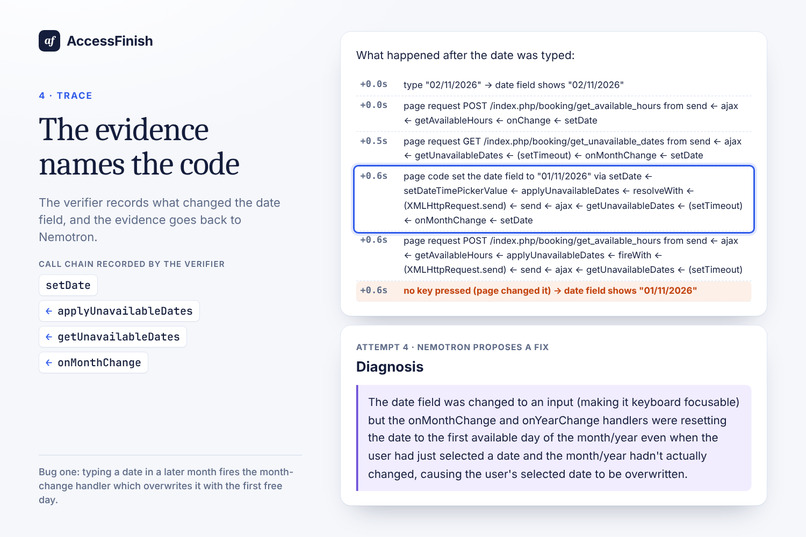
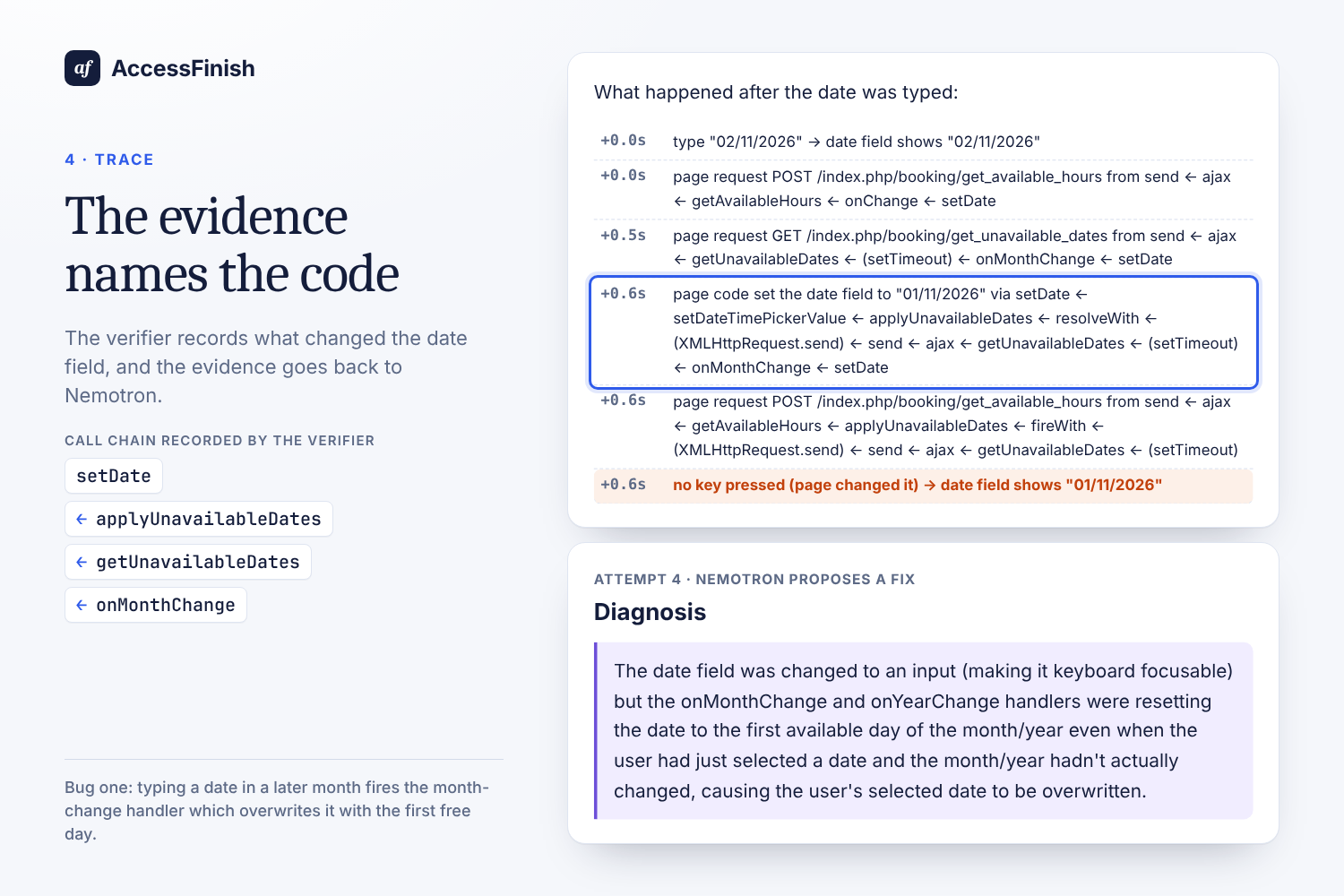
The verifier records which code overwrote the typed date: setDate ← applyUnavailableDates ← getUnavailableDates ← onMonthChange.
-
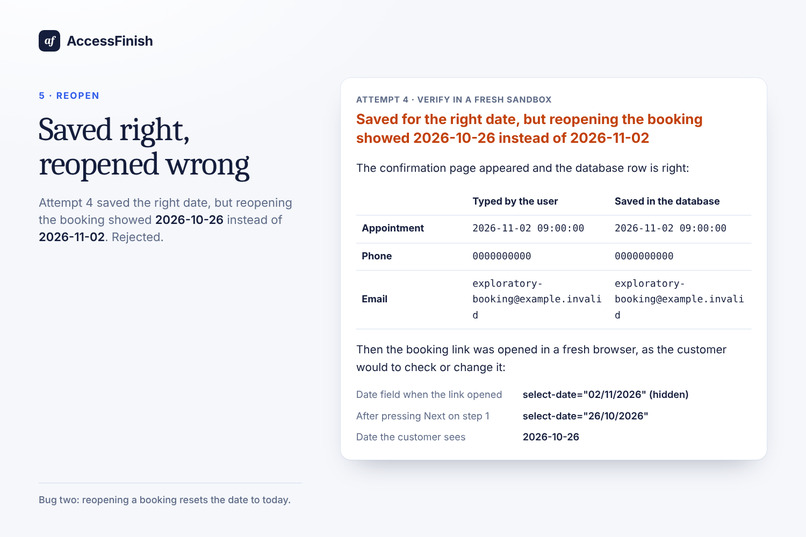
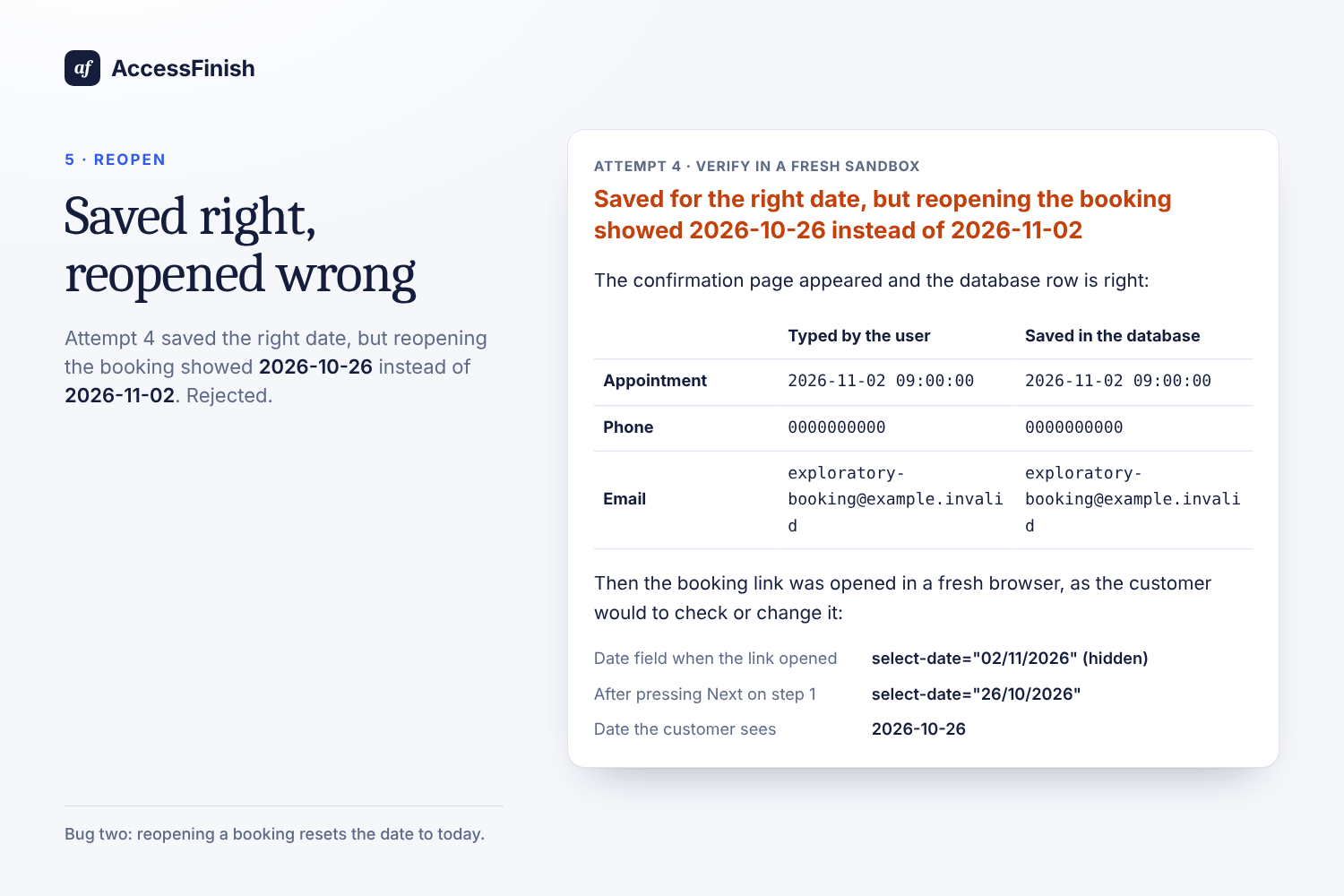
Attempt 4 saved the right date, but reopening the booking in a fresh browser showed 26 Oct instead of 2 Nov. A second bug. Rejected.
-
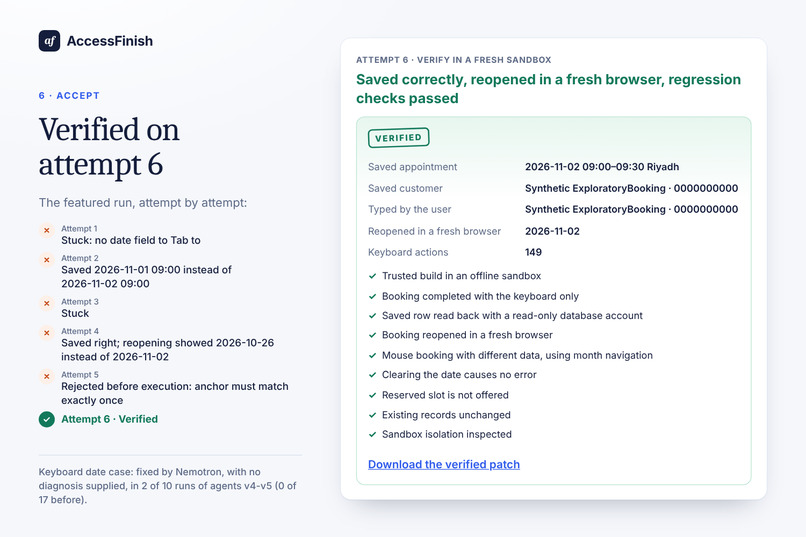
Verified on attempt 6: keyboard booking, database read-back, fresh-browser reopen and regression checks all pass. No diagnosis supplied.
-
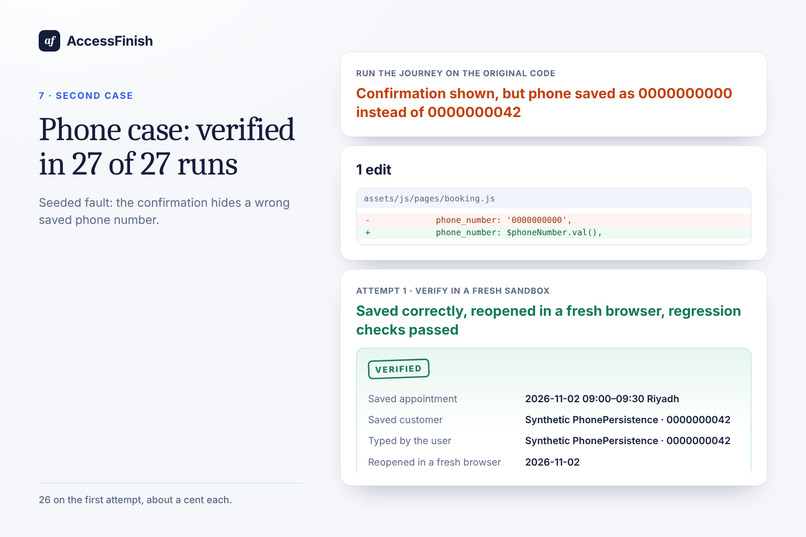
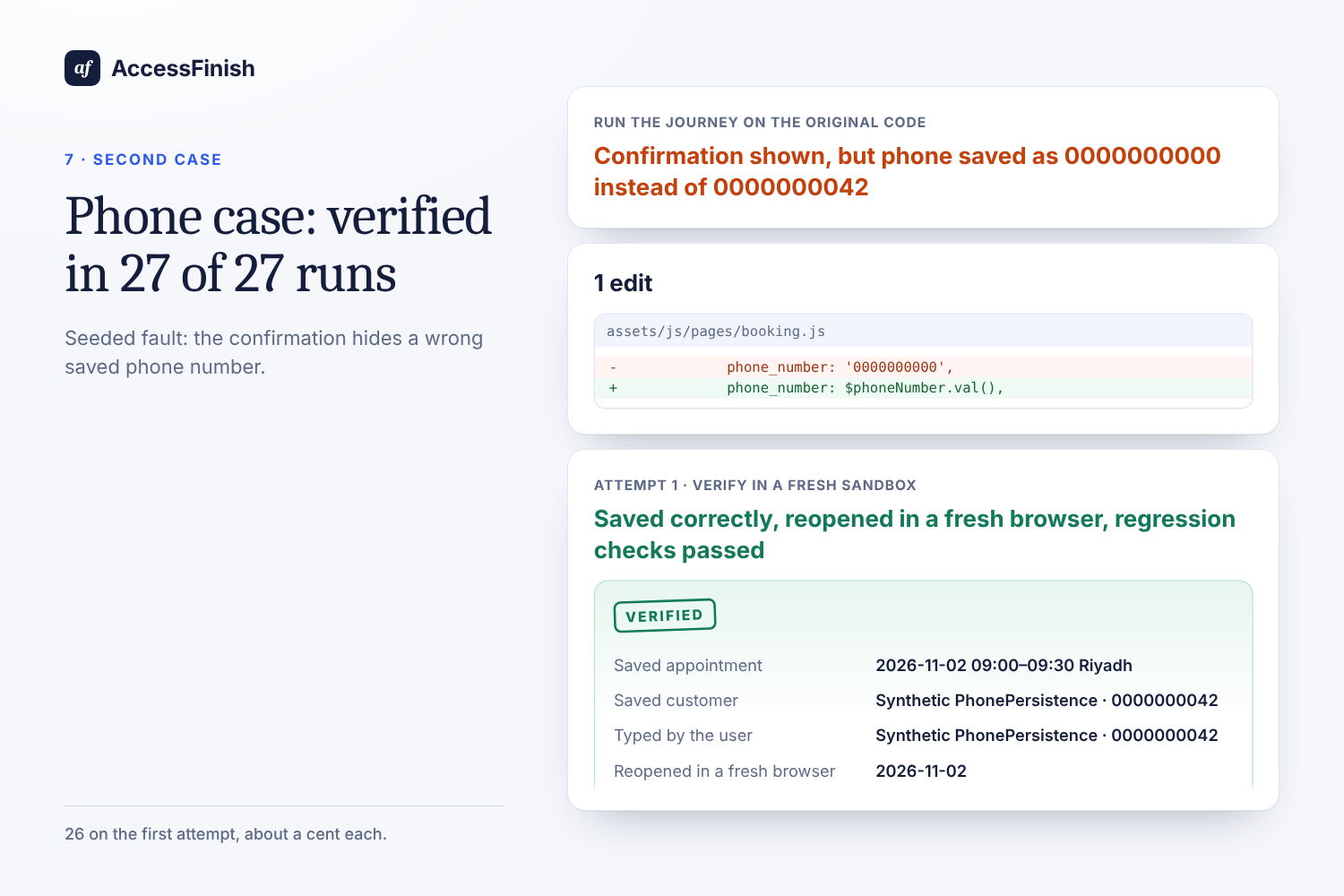
Seeded fault: the confirmation hid a wrong saved phone number. Nemotron fixed it in 27 of 27 live runs, 26 on the first attempt.
-
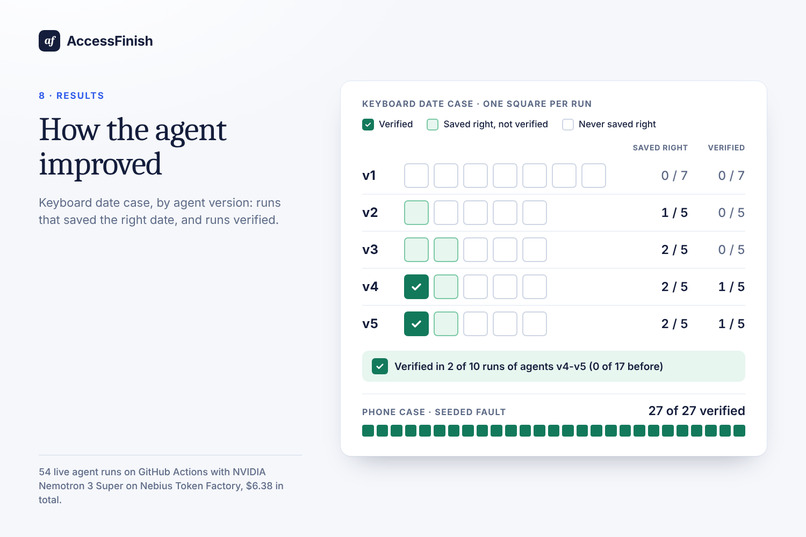
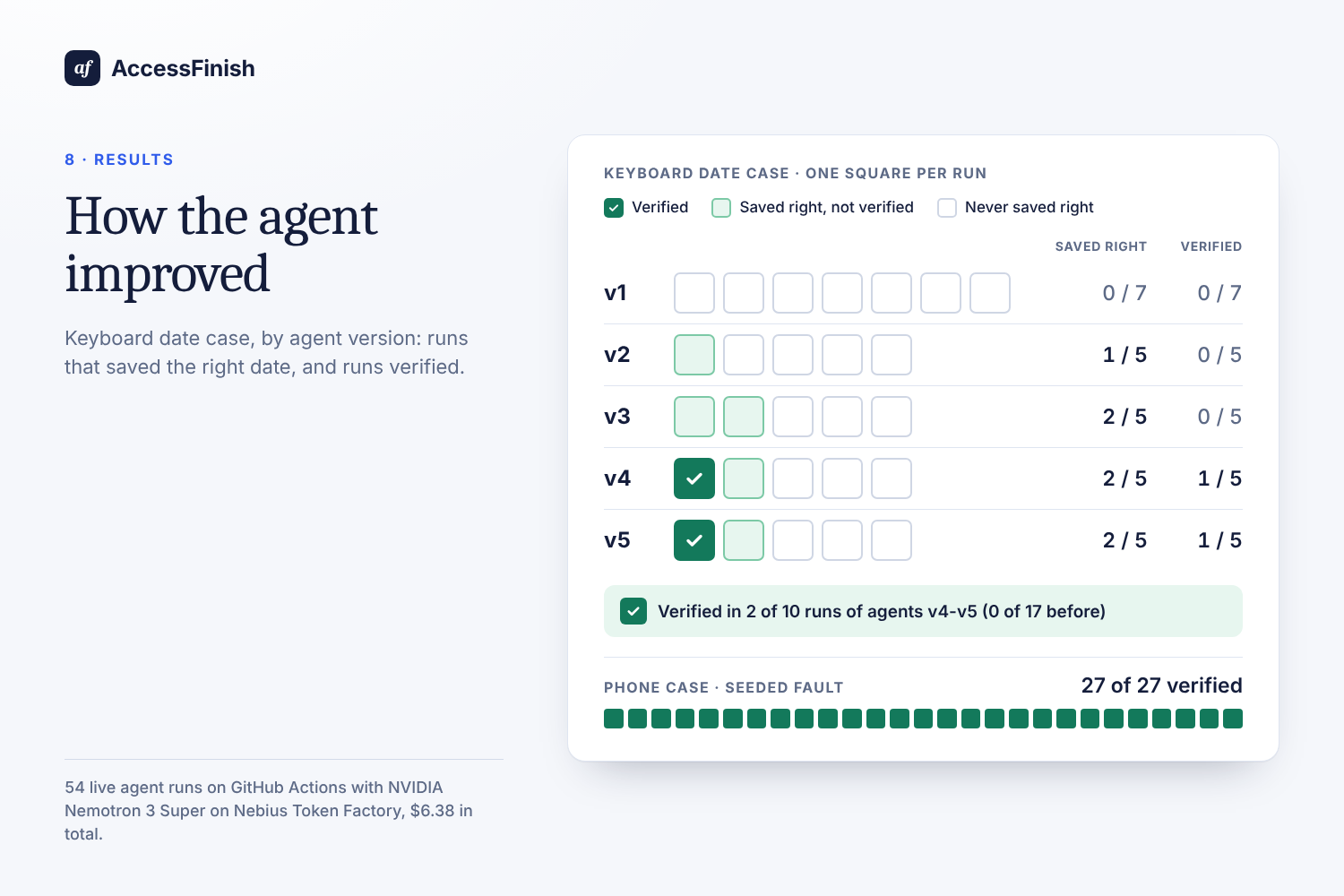
Keyboard bug by agent version: verified in 2 of 10 runs of v4–v5, 0 of 17 before. 54 live runs in total cost $6.38 on Token Factory.
-
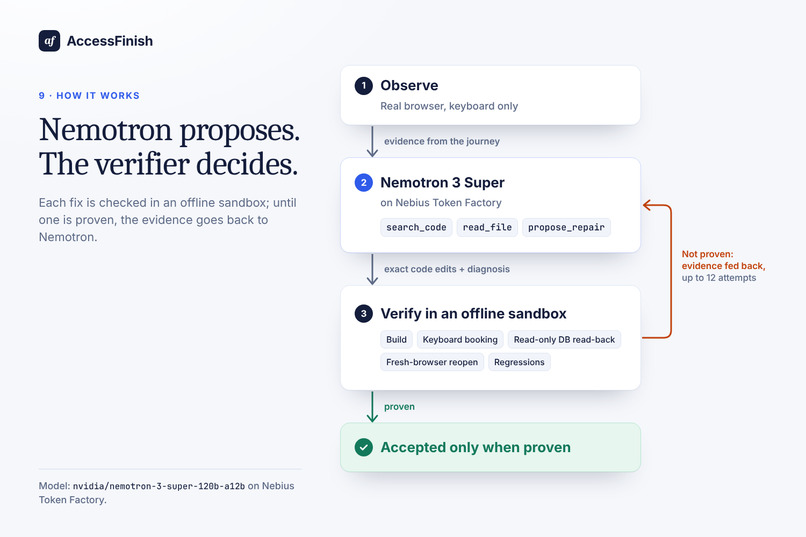
Nemotron proposes, the verifier decides: each fix is checked in an offline sandbox; if it fails, the evidence goes back. Up to 12 attempts.
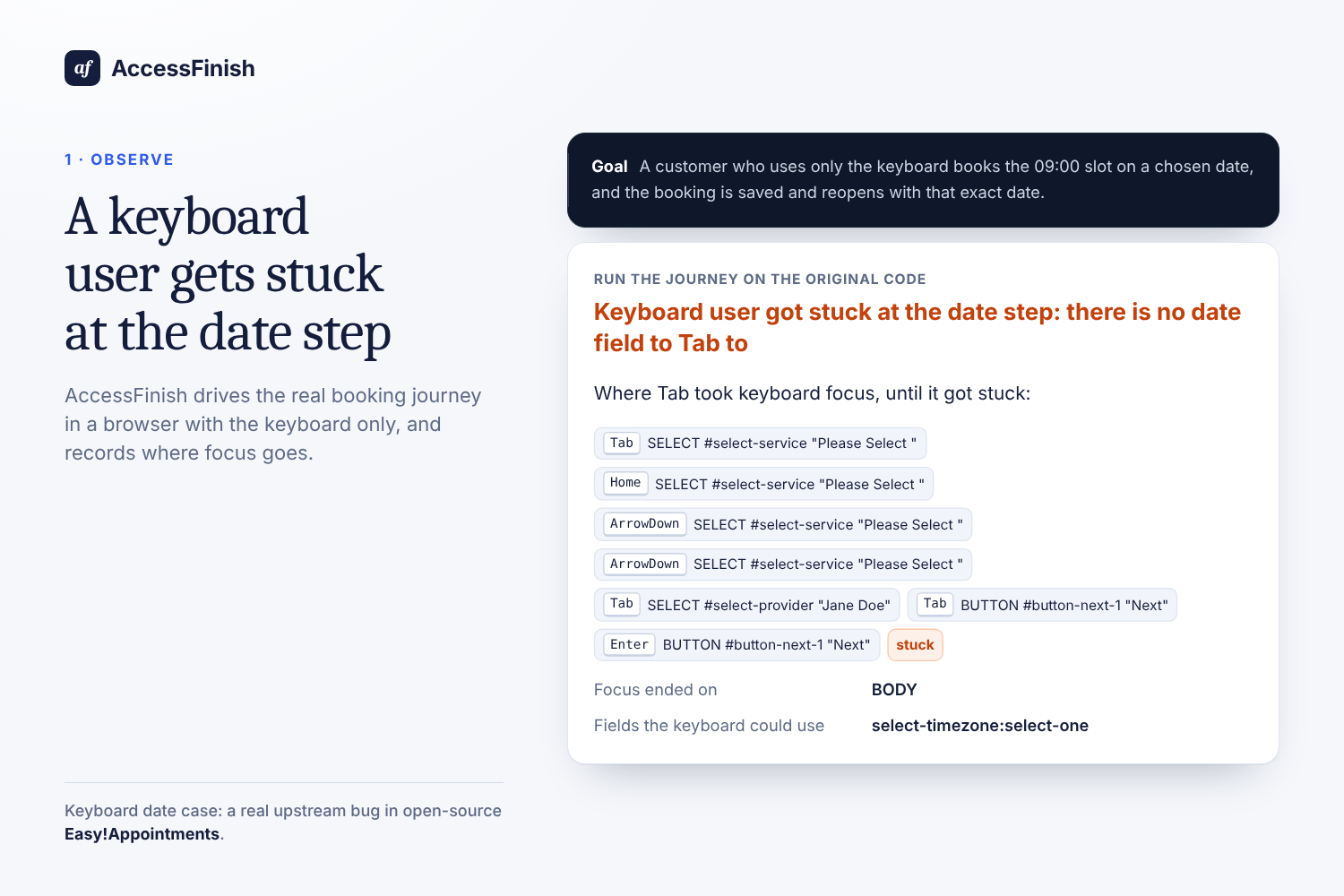
Access: can a keyboard user get through? Finish: is what they typed actually saved?
▶ Watch the 2-minute film · Replay the agent's runs · Every run with its raw evidence · Source on GitHub
Inspiration
Ask an AI to fix a broken form and it will tell you it's fixed. The page loads, maybe a confirmation appears. But a keyboard user still can't reach the date picker, or the booking is saved with the wrong phone number. For people who rely on a keyboard or assistive technology, "it renders" is not the same as "I can finish". We wanted an agent that only stops when the real outcome is right.
It matters at scale: about 1.3 billion people (16%) live with a significant disability (WHO), 95.9% of the top million home pages have detectable WCAG failures (WebAIM Million 2026), and since 28 June 2025 the European Accessibility Act requires in-scope services such as e-commerce to be accessible. Meanwhile coding agents write more and more UI fixes, judged by green builds and success pages — exactly the signals that can lie.
What it does
AccessFinish is a repair agent for broken user journeys. Given a goal like "a keyboard-only customer books the 09:00 slot and it's saved for that date", it:
- Observes the journey in a real browser using only the keyboard, recording where focus goes, where it gets stuck, and which page code changes what the user typed.
- Diagnoses and repairs with NVIDIA Nemotron 3 Super: the model gets the goal, the verifier's evidence and the source files — never the cause or the fix — investigates with read-only
search_codeandread_filetools, and proposes exact code edits plus the evidence its diagnosis accounts for. - Verifies for real in a fresh offline sandbox: build, keyboard booking, database read-back through a read-only account, reopen in a fresh browser, plus regression checks (mouse booking with different data through month navigation, clearing the date, reserved slots, untouched records, sandbox isolation).
- Feeds the evidence back when anything fails — a compile error with its code frame, a stuck key, a wrong saved value, the call chain that silently overwrote the date — with a ledger of every earlier attempt and which one got furthest, and tries again, up to twelve attempts.
The web page replays each run as a timeline: the stuck keyboard trail, Nemotron's searches, diagnosis and diff, each verifier verdict with its evidence, and the final proof with a downloadable patch. An evidence page lists all 54 live runs with their raw traces and the results of every agent version.
How we built it
- Model:
nvidia/nemotron-3-super-120b-a12bon Nebius Token Factory, with three tools:search_code(a regular expression over the app source),read_fileandpropose_repair. Edits must match the source exactly once; the harness tolerates whitespace slips likegit apply --ignore-whitespaceand records every adjustment next to the model's own text. Token usage, cost and Nemotron's reasoning are recorded for every request. - Causal provenance: the verifier hooks the date field's value setter before the app loads and attaches DevTools async stack traces, so evidence names the exact call chain that overwrote what the user typed.
- Verifier: Node.js orchestration of Docker containers for the app (PHP), MariaDB, a trusted Babel compiler, Playwright browsers and a read-only SQL reader. Candidate code runs with no network, no model key, read-only roots, dropped capabilities and resource limits.
- Target app: a pinned copy of open-source Easy!Appointments with synthetic data. Two journeys: a real upstream keyboard bug in the date picker, and a seeded fault where confirmation hides a wrong saved phone number.
- Page: plain HTML, CSS and JavaScript, no dependencies, keyboard and screen-reader accessible.
Results
All 54 runs were made live on fresh GitHub Actions runners with Nemotron 3 Super on Nebius Token Factory, $6.38 in total. After each batch we read the failed traces, improved the loop and bumped the agent version; from v2 on, results are never mixed across versions.
- Saved phone (seeded fault): verified in 27 of 27 runs, 26 on the first attempt (3 of them after the harness's recorded whitespace re-anchoring), about a cent each.
- Keyboard date (real upstream bug): fixed by Nemotron, with no diagnosis supplied, in 2 of 10 runs of agents v4–v5 (0 of 17 before). It is two bugs: typing a date in a later month fires the date picker's month-change handler, which overwrites the typed date with the first free day; and reopening a booking resets the date to today. In the first verified run Nemotron made the date reachable, was rejected for saving 1 Nov instead of 2 Nov, traced the reset through the recorded call chain
setDate ← applyUnavailableDates ← getUnavailableDates ← onMonthChange, saved the right date, then — after the harness noted that attempt had got furthest — fixed the reopen bug on top: verified on attempt 6, with four edits at the same code sites as our earlier guided fix but guard logic of its own. - Every false success was caught: across 27 keyboard runs, 77 attempts reached a "booked" page while the date was saved wrong (67) or reopened wrong (10). In all 27 runs the first patch that reached a "booked" page was wrong, so a confirmation-page check would have shipped a wrong patch every time. AccessFinish accepted none.
- Agent versions, keyboard runs that saved the right date: v1 0/7 → v2 1/5 → v3 2/5 → v4 2/5 → v5 2/5; verified: v4 1/5, v5 1/5.
- Verifier calibration: the original keyboard source stays blocked; a phone patch that hard-codes the test number is rejected when a second customer types a different one; the reference fixes verify; five archived single-shot proposals keep their accept/reject decision in every fresh-runner replay.
Challenges we ran into
Single-shot fixes weren't enough: in an earlier frozen test, five Nemotron attempts with an operator-supplied diagnosis gave 2/5 full passes on the keyboard case. With no diagnosis supplied, the first agent version never fixed it — Nemotron often blamed time zones (15 of 43 diagnoses). The breakthrough was evidence, not prompting: once the verifier recorded which code wrote the date field (the month-change handler's call chain), Nemotron's diagnoses named the real cause. The rest was harness engineering we measured run by run: whole-line mismatch reports, whitespace-tolerant anchors, tracking "saved correctly but reopened wrong" as progress, naming read-only code, returning the file's own lines and compiler code frames. Each change was reviewed adversarially and replayed against every recorded trace before a new live run.
Accomplishments that we're proud of
- Nemotron fixed a real upstream accessibility bug — two bugs, in fact — without being told the cause, verified end to end.
- A verifier that refused all 77 false successes, and that would have let a wrong patch ship in 27 of 27 keyboard runs had it trusted the confirmation page.
- Evidence a developer can act on: the keyboard focus trail, typed vs saved values, and the call chain of the page code that changed the date.
- Every run, including failures, is public with its raw evidence and the agent version that produced it.
What we learned
- Evidence beats prompting. The same model went from blaming time zones to naming the real cause once the verifier recorded the call chain that overwrote the typed date.
- A success page is a weak oracle. In all 27 keyboard runs the first patch that reached a "booked" page was wrong; only reading back the saved row and reopening the booking told the truth.
- Many wasted attempts were mechanical. 85 of 258 proposals were rejected before execution because an edit did not apply; returning the file's own lines with a failed edit, and tolerating whitespace, helped the model recover.
- Cheap inference makes honest iteration possible. All 54 live runs cost $6.38, so every agent version could be measured live instead of argued about.
What's next
More journey types (sign-up, checkout, settings), screen-reader-driven verification, and a GitHub app that opens a pull request with the verified patch and its proof attached.

Log in or sign up for Devpost to join the conversation.