-
-
2
-
1
Inspiration
When you're a student drowning in stress, dealing with a learning difference, or facing a sudden personal emergency, the absolute last thing you have energy for is reading twenty pages of bureaucratic portals and dead links.
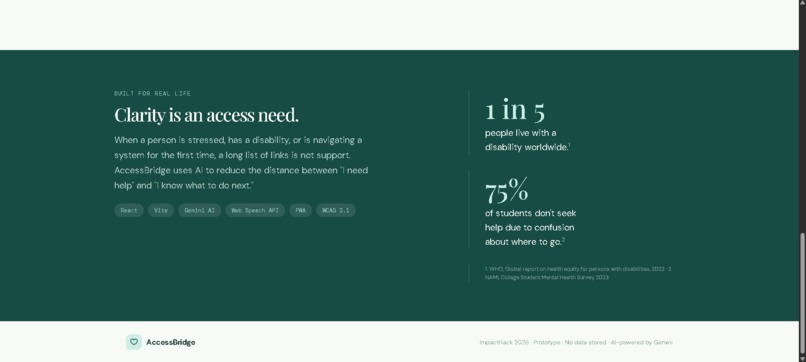
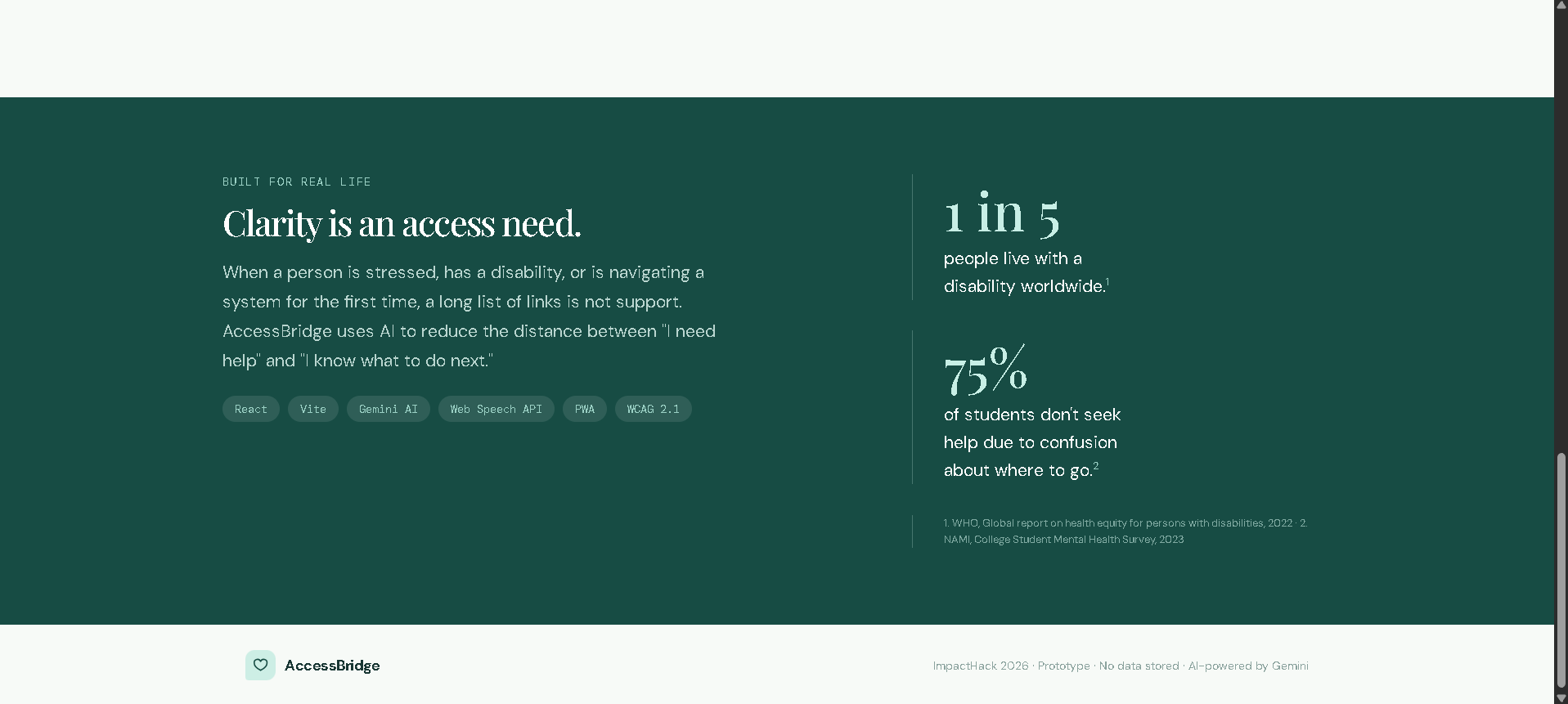
Research shows over 75% of students who struggle don't seek out institutional help simply because they don't know where to turn or feel embarrassed asking the "wrong" person. Most portals expect you to already know the exact clinical term or departmental name for what's wrong.
We wanted to build something that meets people where they actually are: letting them vent in plain English and turning that overwhelm into three clear, dignified steps to take today.
What it does
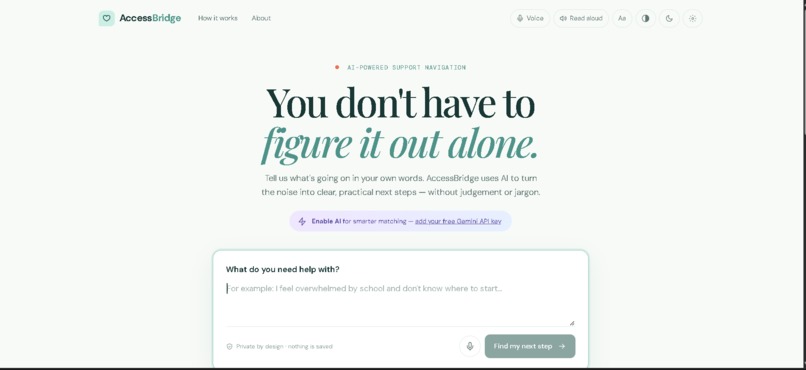
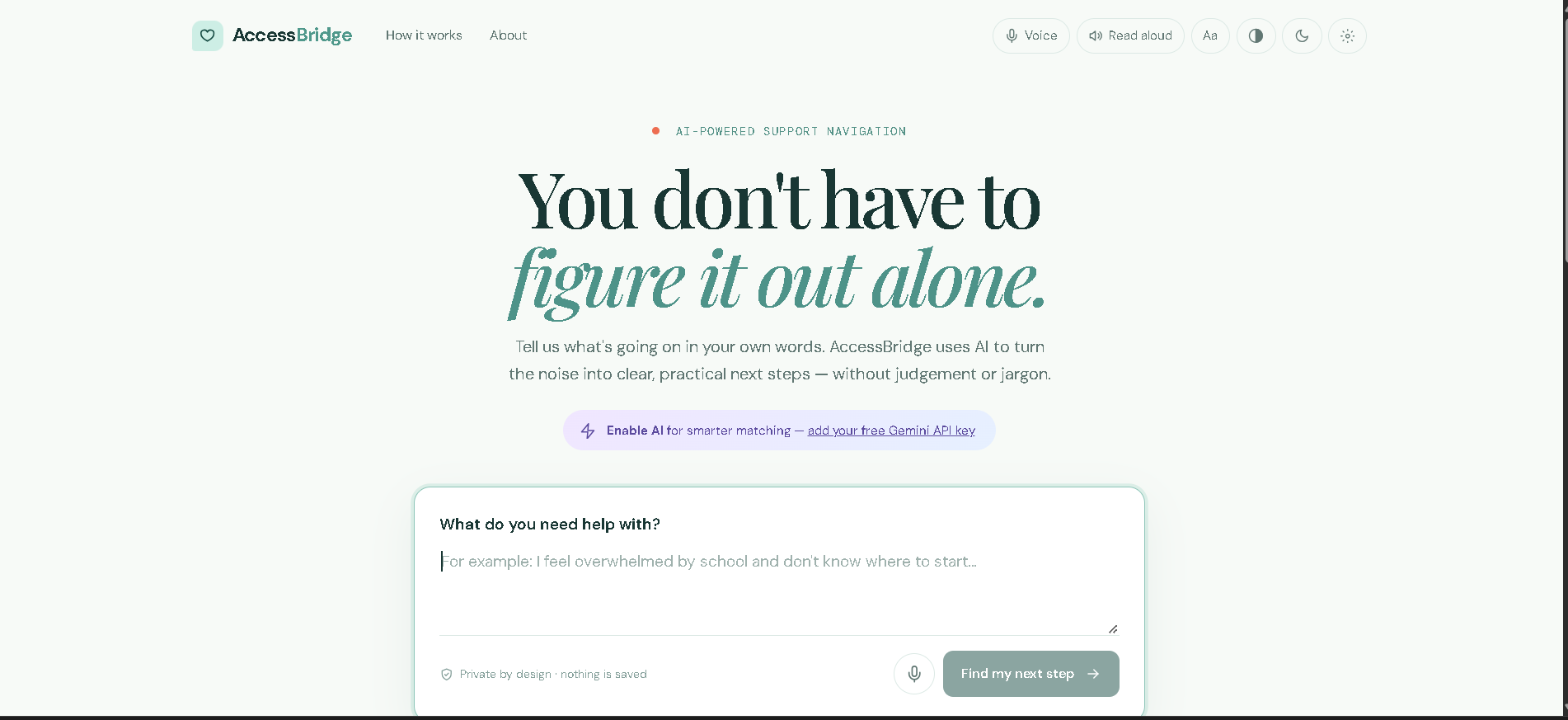
AccessBridge is an empathetic, privacy-first support triage app:
- Talk like a human: You type (or speak) whatever you are dealing with—whether it's "I can't focus on finals and don't have money for food" or "I think I'm getting bullied."
- Empathetic AI breakdown: Powered by Gemini, the app figures out the emotional tone, urgency level, and hidden practical hurdles (like needing a computer, privacy from parents, or immediate crisis support).
- Transparent matches: Instead of giving a mysterious black-box answer, it maps your situation against vetted local and national services with an explicit match percentage and a clear breakdown of why each resource surfaced.
- Immediate emergency triage: If someone mentions self-harm or unsafe situations, the interface instantly shifts to safety mode, surfacing direct crisis hotlines (Crisis Text Line, 988, Trevor Project) front and center.
- Built for real-life access: Includes voice input (speech-to-text), text-to-speech read aloud, dynamic text sizing, high-contrast mode, dark mode, offline support as an installable PWA, and zero logins or trackers.
How we built it
We built the core frontend using React 18 and Vite for fast performance and clean, accessible design.
- AI Engine: We hooked into Google Gemini (
gemini-2.0-flash) using custom structured JSON system instructions. It extracts emotional tone, detects crisis triggers, and scores resource relevance. - Deterministic fallback: If offline or if an API key isn't provided, our custom keyword and synonym NLP engine takes over smoothly so judges never hit a broken screen.
- Voice I/O: Leveraged the native Web Speech API for hands-free voice transcription and spoken feedback.
- Accessibility & PWA: Custom CSS variables power our WCAG-friendly High Contrast and Dark modes. A custom service worker and web manifest allow the app to be installed and loaded offline.
Challenges we ran into
- Making AI sound human without giving medical advice: Prompt engineering was tricky. We wanted Gemini to acknowledge feelings with warmth and empathy without pretending to be a licensed therapist or diagnosing medical conditions.
- Handling edge-case crises responsibly: Ensuring crisis detection was rock-solid and impossible to overlook, while keeping non-crisis advice practical rather than alarmist.
- True client-side privacy: Many services secretly log query history. We intentionally kept everything in memory and localStorage so sensitive struggles never leave the user's browser.
Accomplishments that we're proud of
- Dignified design: The user interface genuinely feels calming rather than sterile or clinical.
- Zero-barrier accessibility: Someone with visual impairment, motor difficulties, or reading fatigue can use voice controls, change text sizing, or switch to high contrast with a single click.
- Offline reliability: The app doesn't break if the network drops; our offline-first PWA caching and keyword fallback ensure help is always reachable.
What we learned
- Good accessibility isn't just about color contrast ratios—clarity of wording is an accessibility requirement in itself.
- AI is at its best when it removes cognitive load for someone in distress, acting as an empathetic interpreter rather than an authoritative gatekeeper.
What's next for AccessBridge
- Integrating verified campus-specific directory feeds (allowing colleges and high schools to plug in their own counsellors and local food pantries via a simple JSON config).
- Multi-lingual translation to support non-native speaking and immigrant families.
- SMS-based lightweight fallback for students without smartphone data plans.
Built With
- accessibility
- ai
- css3
- google-gemini
- html5
- javascript
- pwa
- react
- vite
- web-apis
- web-speech-api


Log in or sign up for Devpost to join the conversation.