-
AccessBridge
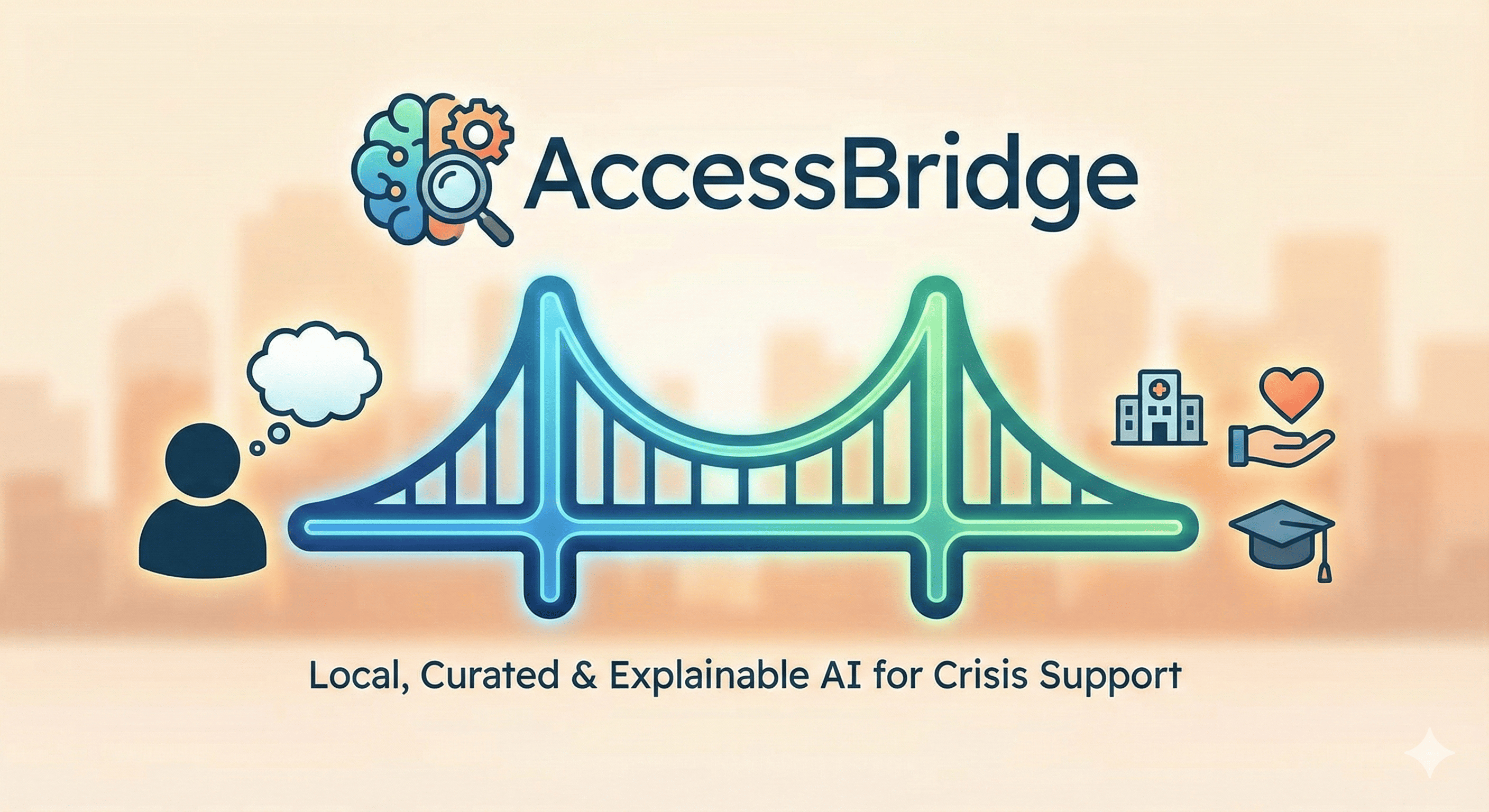
Inspiration AccessBridge grew from seeing how students and young families in crisis must blindly guess which schemes, NGOs, or campus offices might help and often give up after bouncing across portals and rumours. Emerging work on AI for public benefits navigation showed a gap for tools that support human helpers instead of trying to automate eligibility.
What it does AccessBridge is a one-city “crisis prep canvas” concept that turns one messy crisis story into a short, structured bundle of “worth exploring” supports across schemes, NGOs, and campus services. Users get a one-page prep sheet with their story, crisis tags, suggested supports, merged document checklist, and questions to ask, which they can share with counselors or NGO workers.
How we built it Conceptually, the MVP is a three-screen web experience: (1) crisis story plus AI-suggested, user-editable tags, (2) a situation bundle of 3–5 supports, and (3) a printable/shared prep sheet. The back end is envisioned as a lightweight classifier for tag suggestions plus deterministic mapping from tags into city-specific bundle templates, documents, and RiskHints maintained in a structured knowledge table.
Challenges we ran into The biggest conceptual challenge was drawing a hard line between “planning aid” and “eligibility engine”, especially given risks highlighted in public-benefits AI guidance. Another challenge was scoping the content to one city and a small set of crisis patterns while still feeling genuinely useful to real students and navigators.
Accomplishments that we're proud of The team shaped a coherent thin-slice concept that can realistically take a crisis story to a one-page action plan without overpromising automation or eligibility guarantees. The model of CrisisPatterns, SupportOptions, BundleTemplates, and RiskHints gives a clear path for co-curating content with local partners while keeping the logic auditable.
What we learned Research and prior pilots in this space reinforced that people prefer a small, opinionated set of options with clear first steps over long AI chat transcripts. It also became clear that responsible AI in public benefits means keeping humans in control, documenting boundaries, and exposing sources so helpers can verify or adapt recommendations.
What's next for AccessBridge Next steps are to validate the top crisis patterns and supports through interviews with students and counselors, then co-design the initial knowledge tables with one campus or NGO partner in a single city. After that, a simple clickable prototype can be built and user-tested with realistic crises to refine language, safeguards, and success metrics before expanding to new locations.


Log in or sign up for Devpost to join the conversation.