-
-
Access Orrery Light
-
Access Orrery Dark
-
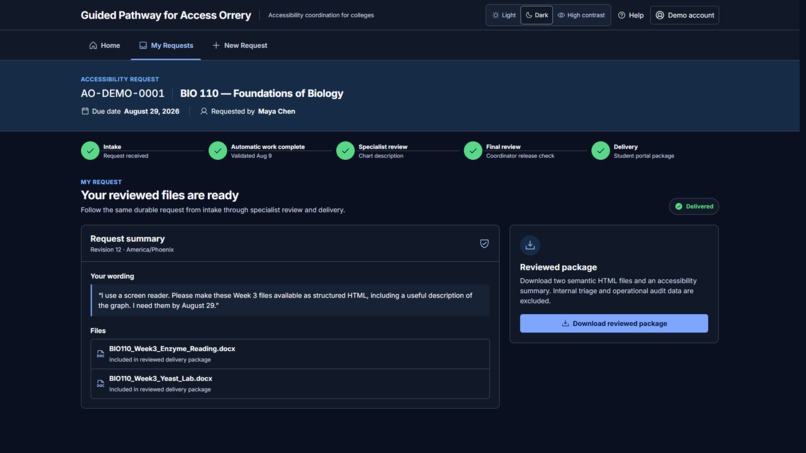
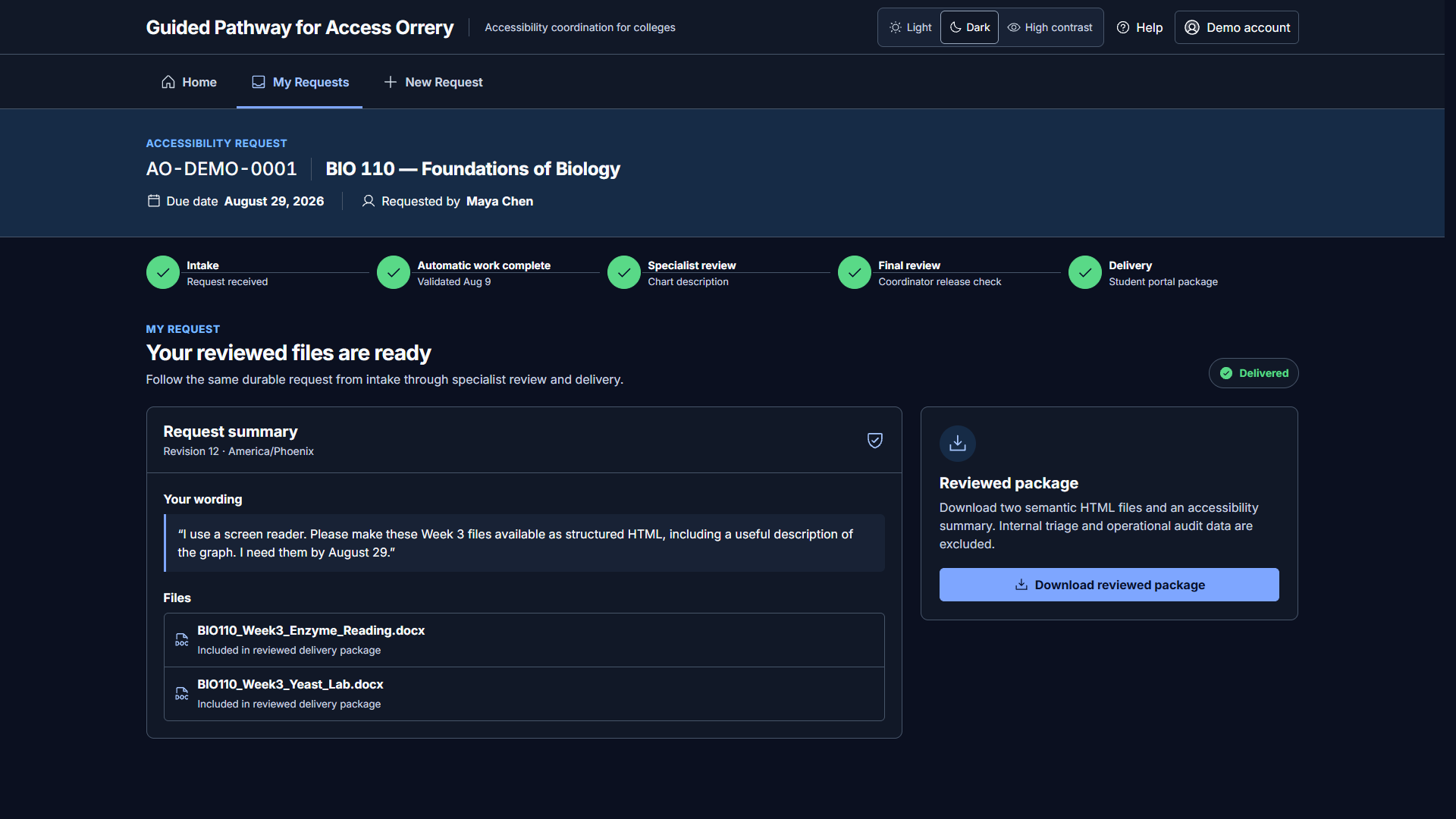
Dark Mode
-
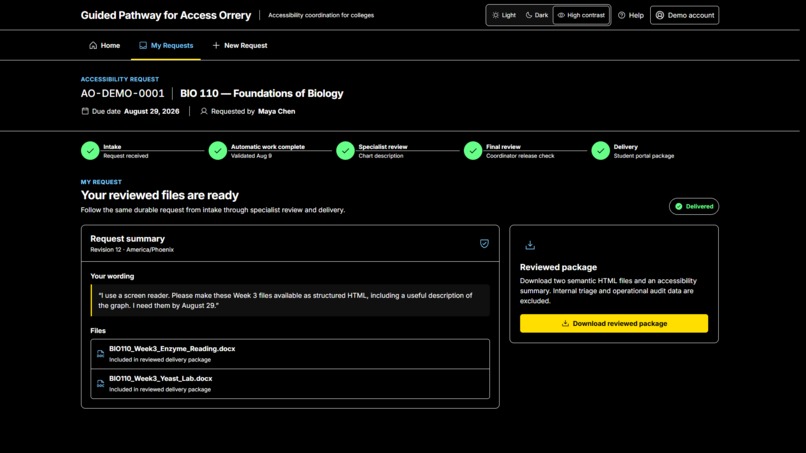
High Contrast Vision Mode
-
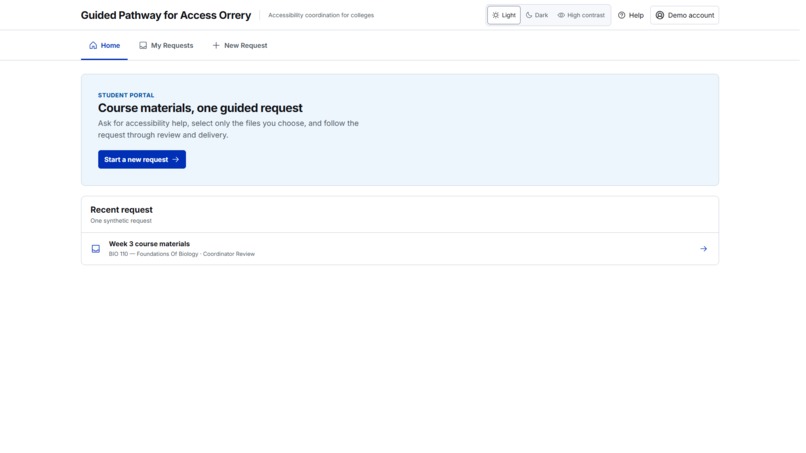
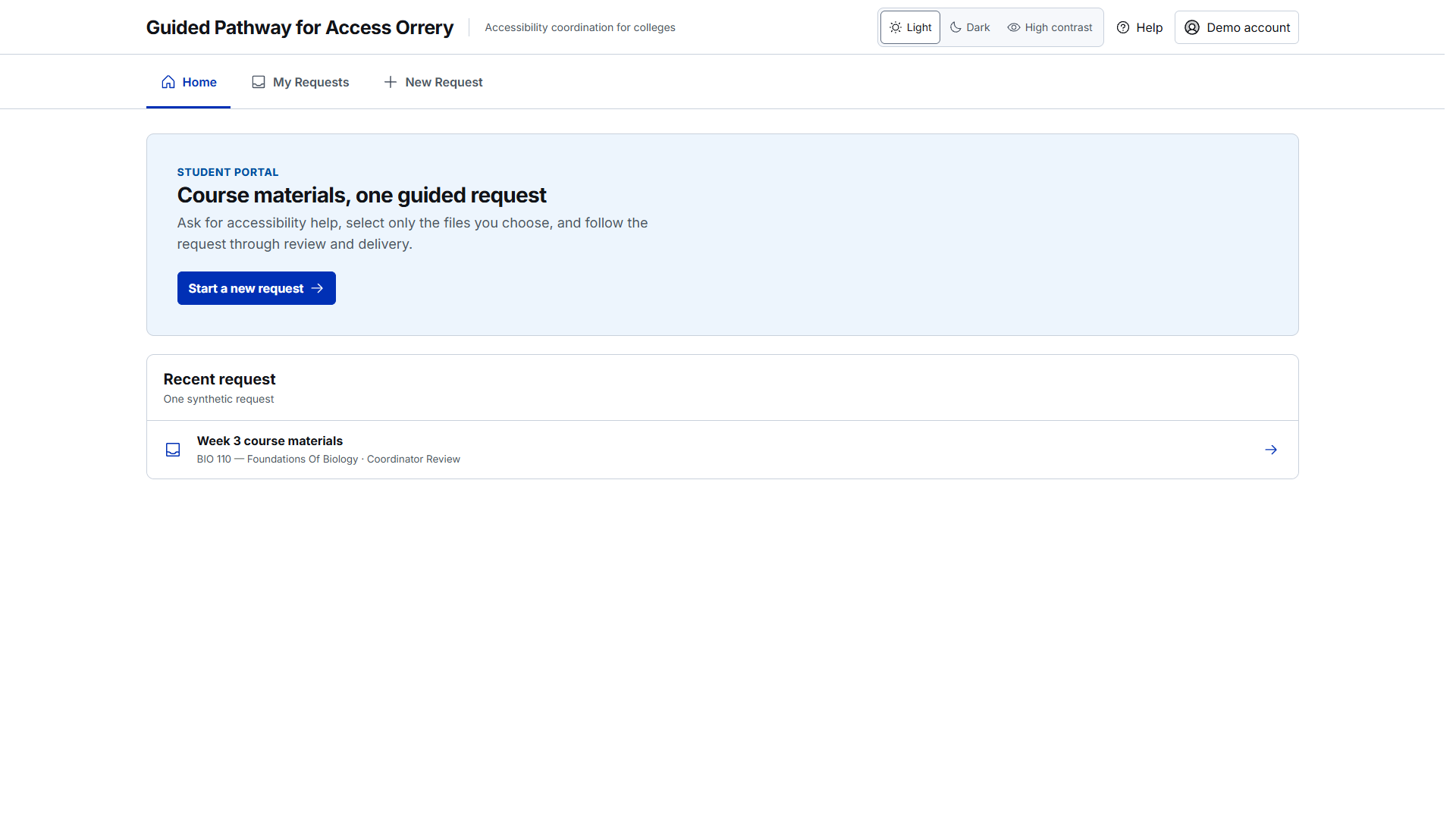
Student Front End
-
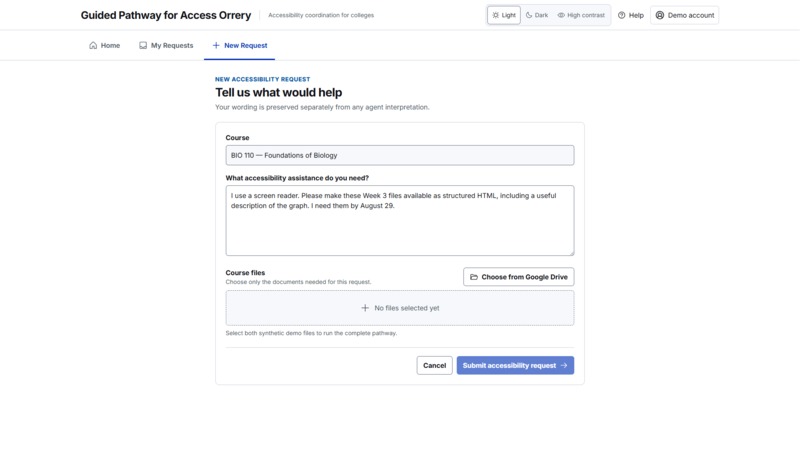
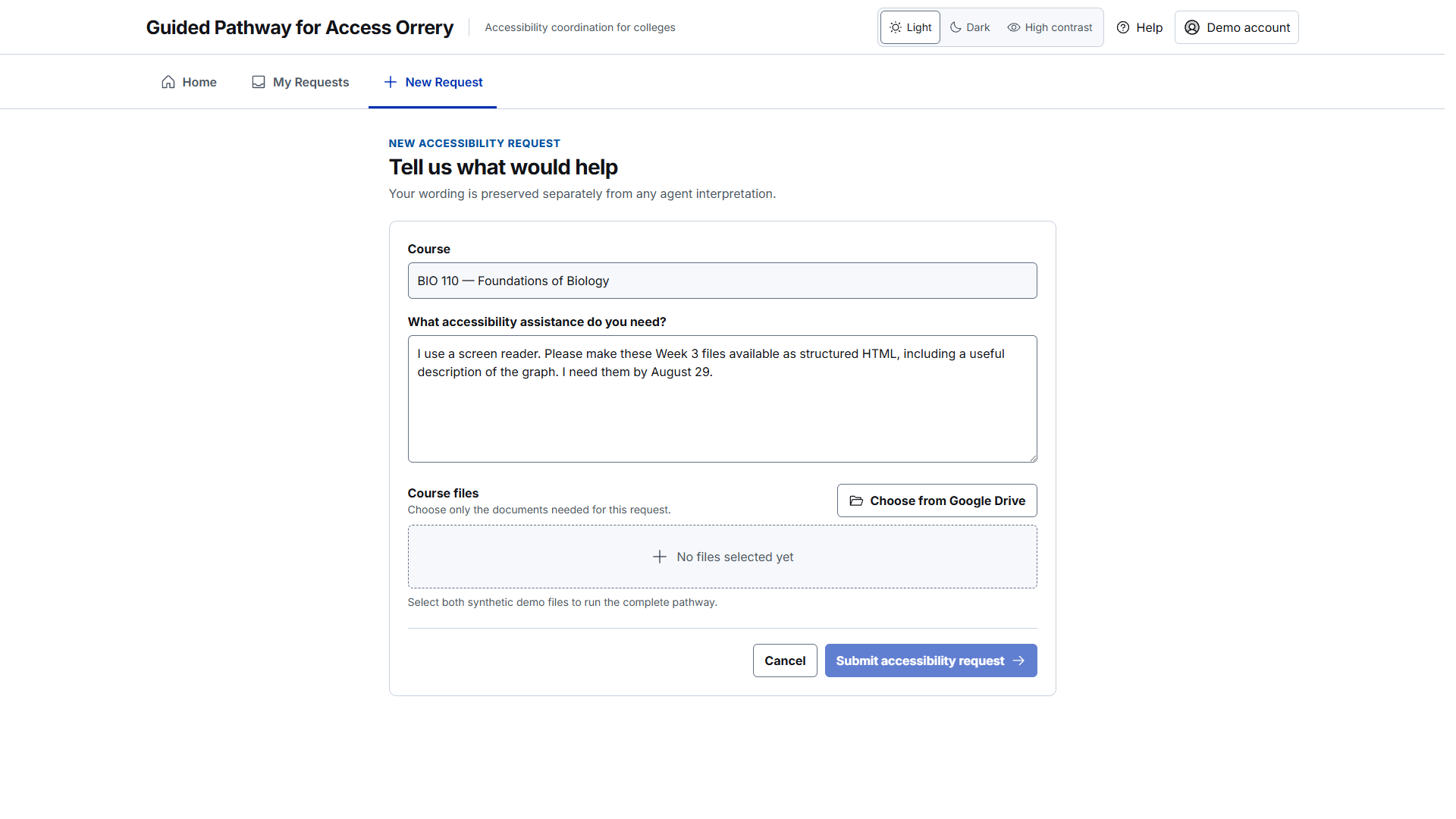
Student Request
-
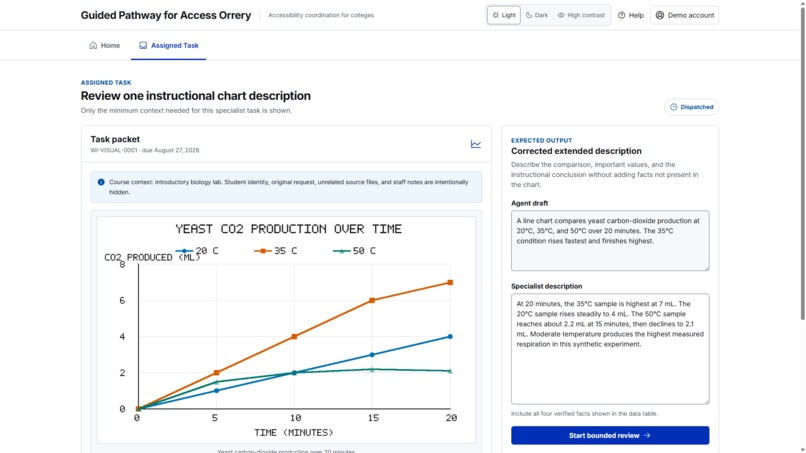
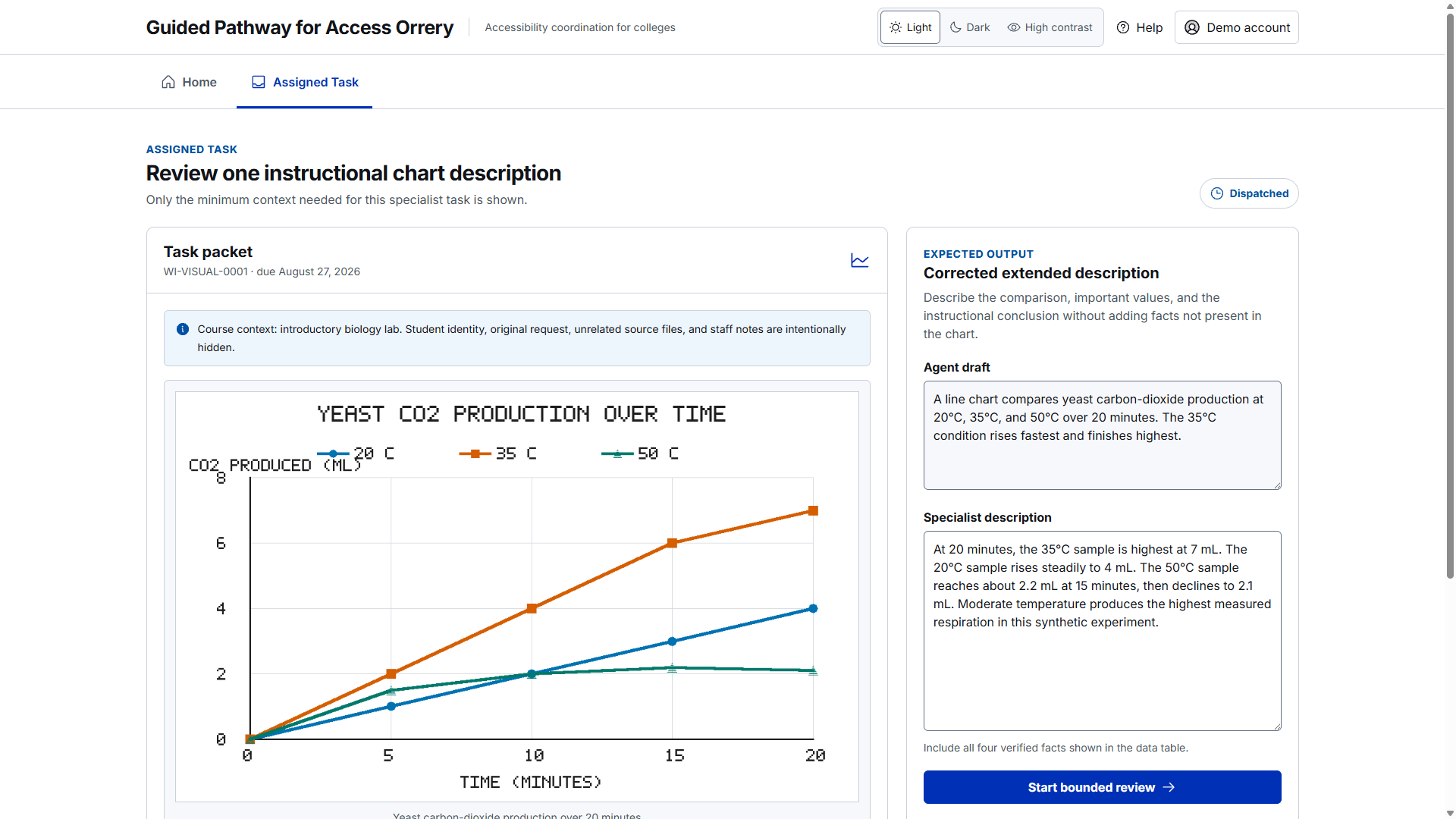
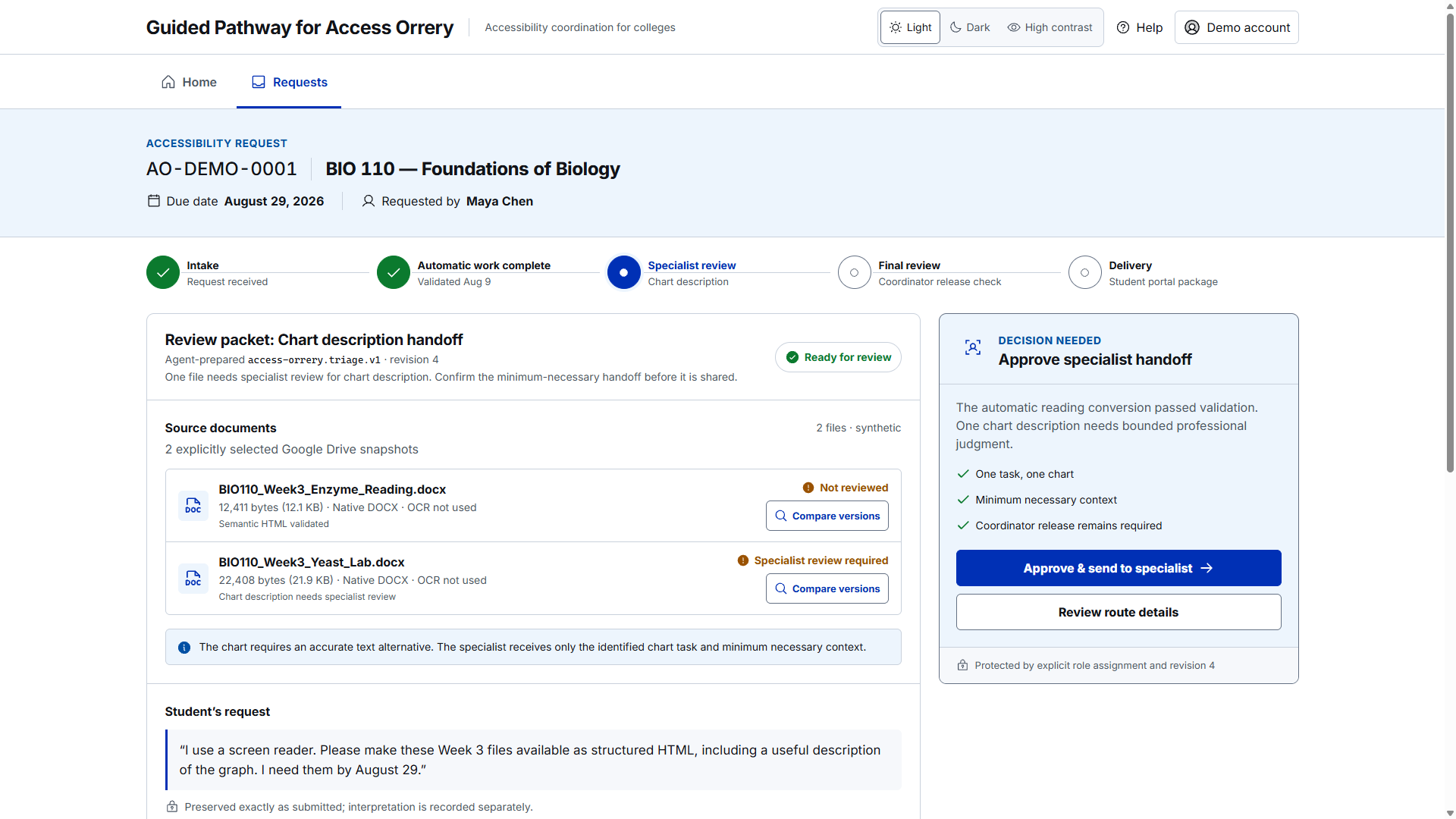
Specialist Workflow Example
-
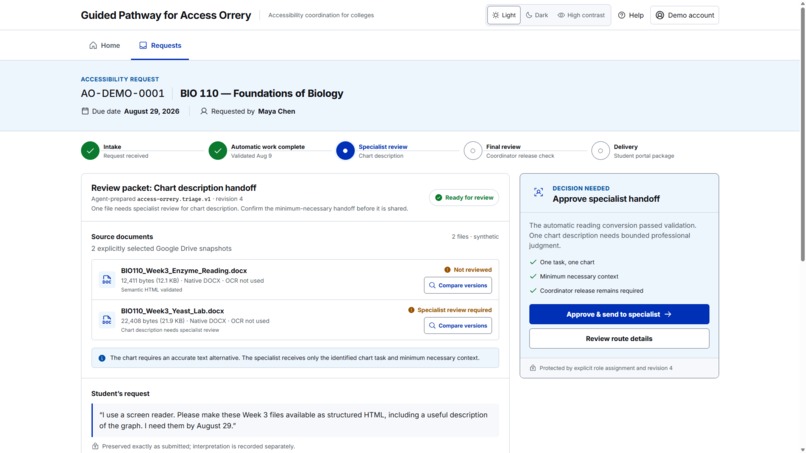
Coordinator
-
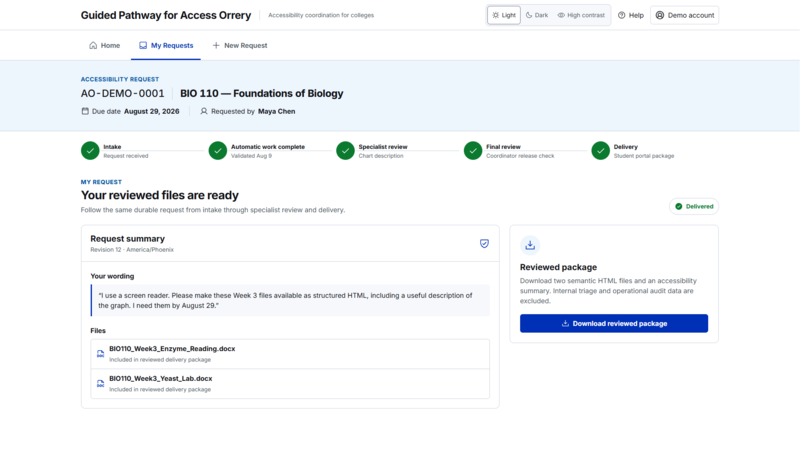
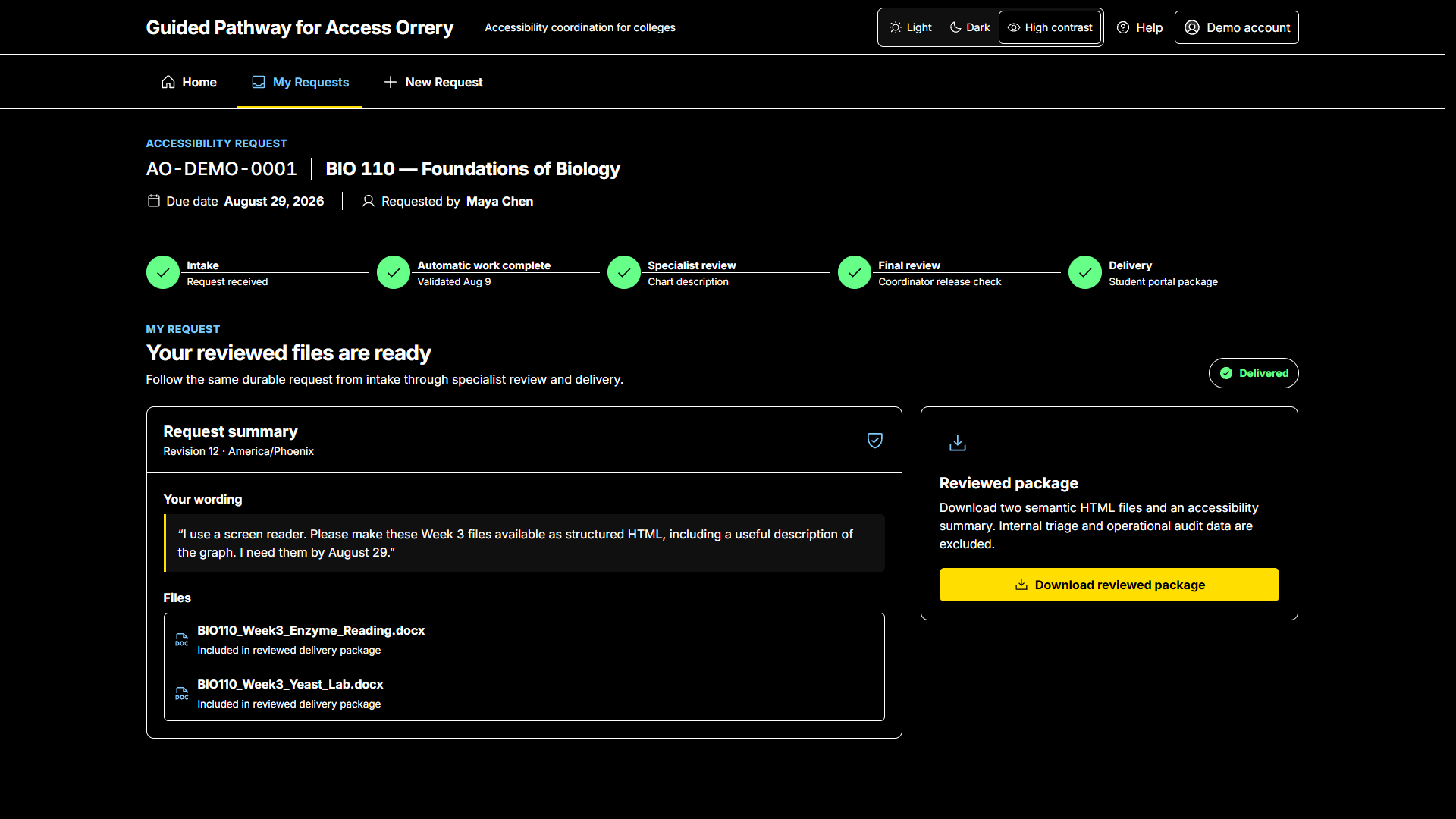
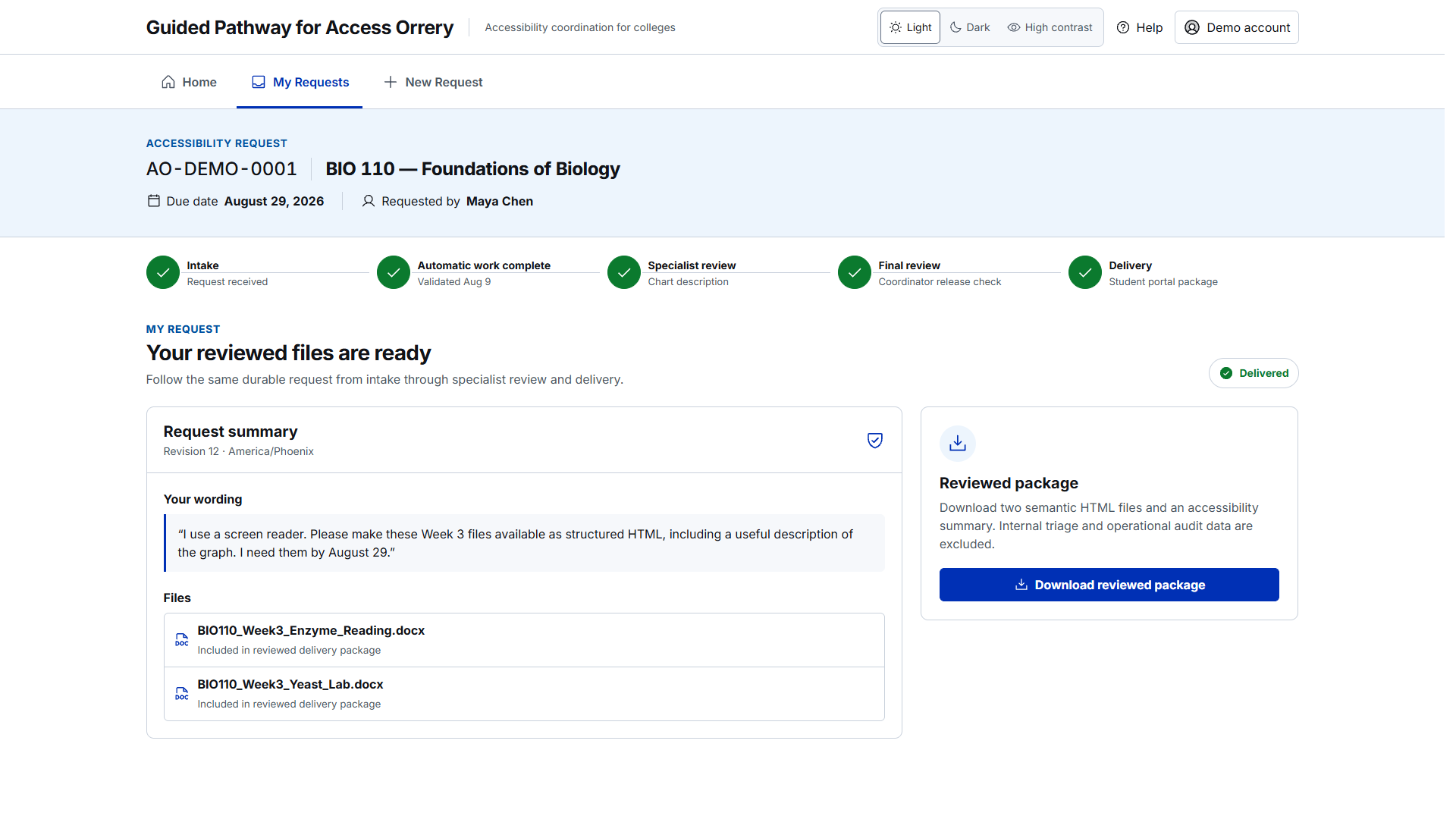
Student Receives Converted Files
Inspiration
Course materials should just work for everyone. When they don't, getting help shouldn't feel like navigating a departmental maze.
That was the spark behind Access Orrery. A student needing an accommodation shouldn't have to know the difference between format standards, figure out which campus specialist to track down, or chase their request across multiple email threads. They should simply be able to state what they need, attach their course files, and trust the system to handle the rest.
Higher education accessibility is a coordination challenge tailor-made for agentic AI. The goal isn't to automate away human accessibility experts—their professional judgment is essential. Instead, it’s about letting AI handle the heavy lifting: parsing documents, running routine conversions, identifying what genuinely requires human expertise, and keeping the entire request moving until accessible materials are delivered directly back to the student.
What It Does
Access Orrery turns an accessibility request into a single, durable, multi-role workflow.
Student Request: A student submits their course files through Google Drive Picker along with natural-language context on what would help.
Autonomous Triage & Conversion: Access Orrery converts supported native structure into validated semantic HTML. Concurrently, Gemini 3.5 Flash evaluates the content through Google ADK to identify instructional barriers. Text to speech and descriptive audio are planned as well as other formats and conversions.
Scoped Specialist Routing: When Gemini identifies a data-bearing instructional chart, the system extracts a bounded
visual_description_reviewtask and routes it to a visual accessibility specialist. The specialist receives only the relevant chart—never the student’s identity, broader profile, or unrelated course documents.Resumption & Synthesis: As soon as the specialist submits the semantic description, the parent workflow automatically resumes, re-synthesizes the document, and prepares the output for review.
Coordinator Gate & Delivery: The Accessibility Coordinator compares the original and modified documents side-by-side using an interactive visual reveal tool and confirms release. The student receives their finished package as an authenticated portal ZIP download.
In our live demonstration on Google Cloud, the system completed the entire Student → Coordinator → Specialist → Coordinator → Student lifecycle, transitioning through 15 state revisions to reach DELIVERED.
How We Built It
Access Orrery is built with a clear separation of concerns: probabilistic AI handles reasoning, while deterministic software enforces authority, security, and state.
Frontend: React and TypeScript with dedicated interfaces for students, coordinators, and specialists. Built from the ground up to support Light, Dark, custom High-Contrast themes, and native Windows forced colors.
Agentic Reasoning: Gemini 3.5 Flash orchestrated via Google ADK to triage incoming materials, evaluate semantic structure, and propose specialized routing.
Backend & Workflow State: Python and FastAPI backed by a persistent Firestore state machine, atomic mutations, and Cloud Tasks for asynchronous execution and reliable pause/resume cycles.
Cloud Infrastructure (Google Cloud):
Cloud Run: Hosts our public, Firebase-authenticated web frontend alongside a strictly private, IAM-protected backend worker.
Firestore & Cloud Storage: Manages durable workflow state, immutable artifact snapshots, and an append-only audit trail.
Secret Manager & Google Picker: Isolates API credentials and restricts Google Drive access strictly to student-selected files.
Cloud Build: Publishes reproducible, immutable container images for zero-drift deployments.
Challenges We Ran Into
The hardest part of building Access Orrery wasn't getting Gemini to analyze a document; it was building an agentic architecture robust enough to survive real-world operational constraints.
Durable Handoffs: Real-world accessibility can't be solved in a single prompt loop. It requires pausing execution for minutes, hours, or days while a human expert completes a task. Engineering an asynchronous state engine that halts cleanly, emits bounded tasks, and resumes without duplicate side effects or state drift required strict transaction modeling.
Zero-Trust Privacy Boundaries: FERPA compliance and student privacy are non-negotiable. We had to ensure a specialist writing alt text for an economics diagram never saw the student's name, accommodation records, or unrelated course materials. Every payload in the system is cryptographically bounded and role-isolated.
Live Cloud Hardening: Moving from local mocks to Google Cloud exposed subtle edge cases. During live integration, we diagnosed and resolved Firestore transaction iterator mismatches and ADK schema constraints (
additionalPropertiesenforcement). We fixed the persistence layer, updated the container image through Cloud Build, applied zero-drift Terraform plans, and proved that a blocked workflow could recover idempotently without data loss.
Accomplishments We're Proud Of
True End-to-End Live Cloud Execution: We didn't build a clickable prototype or a simulated demo. Access Orrery completed its full 3-role, 2-document synthetic workflow live on Google Cloud (
access-orrery-dev-260809), ending in an authenticated ZIP package (AO-EA11D701948792709599258E).Verifiable Correctness: The live run completed at revision 15 with 23 immutable audit events and passed all 28 automated post-run cloud verification checks cleanly. Our pre-flight suite passed 135 backend unit tests, 57 frontend tests, and over 1,000 policy and orchestration assertions.
Accessible by Design: Accessibility isn’t just the product’s function; it’s its foundation. The UI features semantic markup, complete keyboard navigation, WCAG-compliant contrast ratios, and tested screen-reader workflows rather than surface-level styling.
What We Learned
Agentic AI shines at orchestration, not replacement. In high-stakes institutional workflows, human expertise isn't a bottleneck to eliminate—it's the gold standard. The real value of an agent lies in surrounding human experts with frictionless logistics: doing the mundane parsing, routing the exact sub-task, and handling the assembly.
State machines make agents reliable. Intelligence without durable state is just a chatbot. Real enterprise agents require idempotent queues, deterministic validation gates, least-privilege IAM, and auditability.
Accessibility is a systemic coordination problem. Document conversion is only a fraction of the challenge. The real barrier is connecting students, faculty, coordinators, and specialists efficiently across disparate formats.
What's Next for Access Orrery
Our MVP proves the core orchestration model using structured documents and visual accessibility. Next, we want to expand Access Orrery into a universal campus operations platform:
Broader Remediation Tracks: Extending routing pipelines to support Braille/tactile graphics, text to audio and descriptive audio, complex STEM/MathML equation conversion, automated PDF remediation, OCR, and synchronized media captioning.
Interactive AI Intake Prescreening: Developing an empathetic, conversational intake agent. When a student simply states, "I can't access this reading," the agent can ask diagnostic questions to determine whether they need high-contrast reflow, screen-reader semantic HTML, or audio descriptions.
Faculty Collaboration Loops: Allowing professors to provide missing source materials, clarify ambiguous diagrams, or review synthesized outputs directly inside the bounded workflow.
The overarching thesis: The student shouldn't have to navigate campus bureaucracy. The bureaucracy should reorganize itself around the student's request.
Built With
- cloud-build
- cloud-storage
- cloud-tasks
- fastapi
- firebase-authentication
- firestore
- gemini-3.5-flash
- google-adk
- google-cloud-run
- google-drive-picker
- python
- react
- secret-manager
- terraform
- typescript

Log in or sign up for Devpost to join the conversation.