-
-
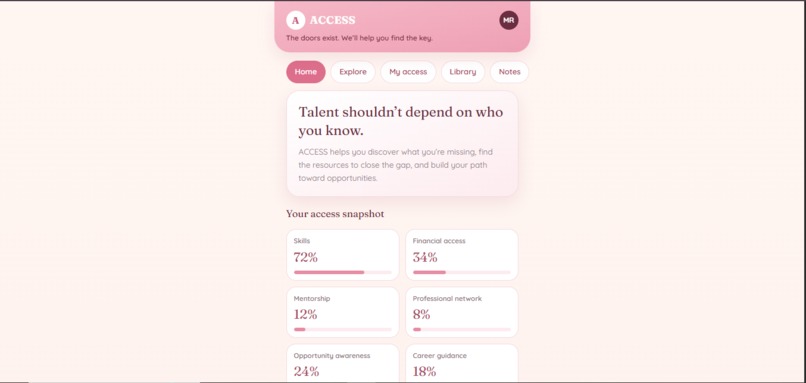
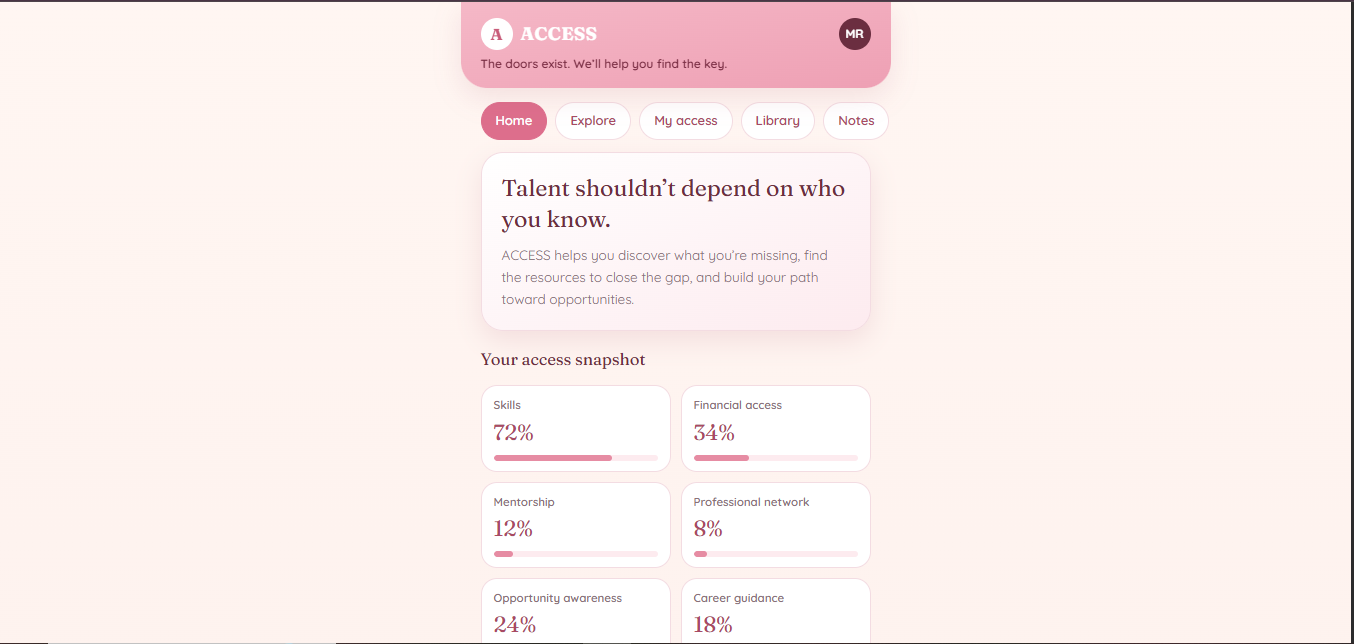
Home: your access snapshot shows exactly where the real gaps are ,skills, network, mentorship , before opportunities even show up.
-
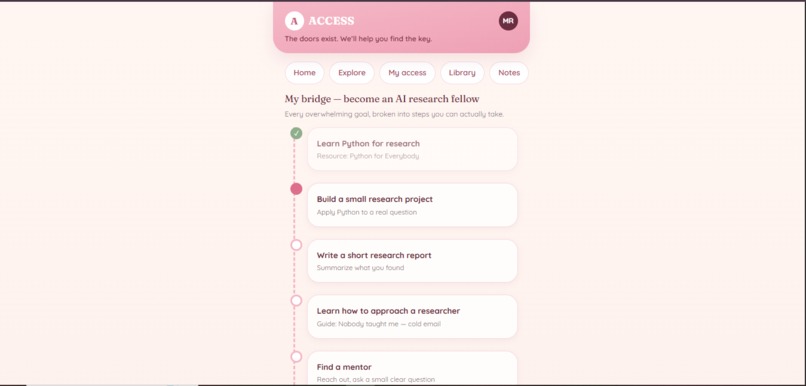
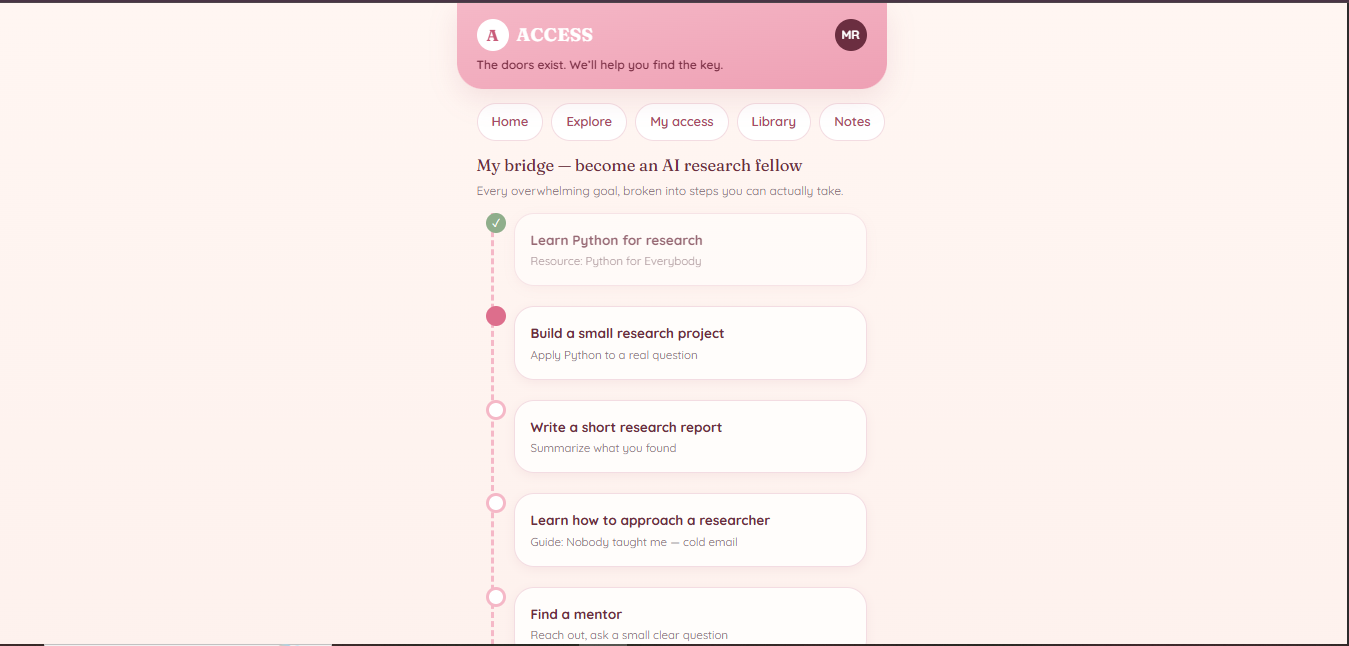
My Bridge: an overwhelming goal broken into small, ordered steps you can actually check off, one at a time.
-
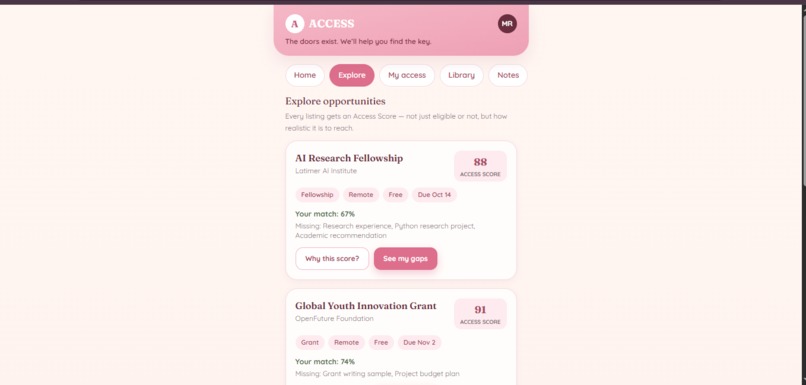
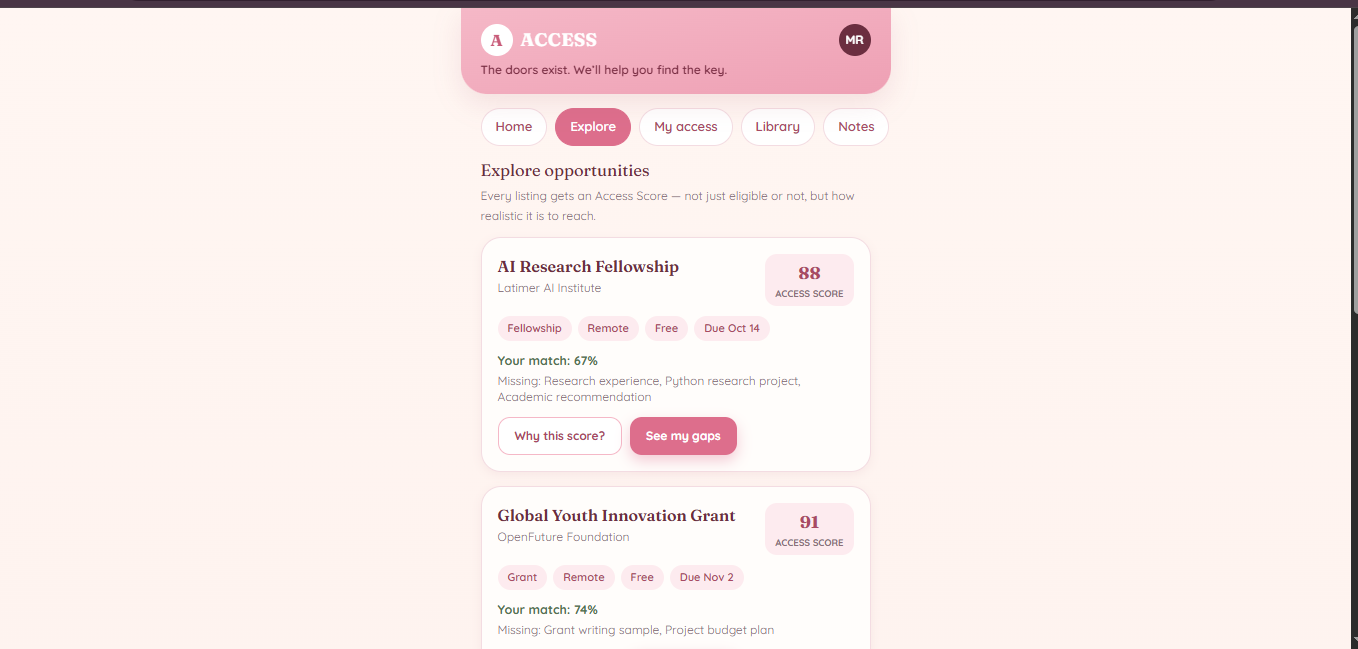
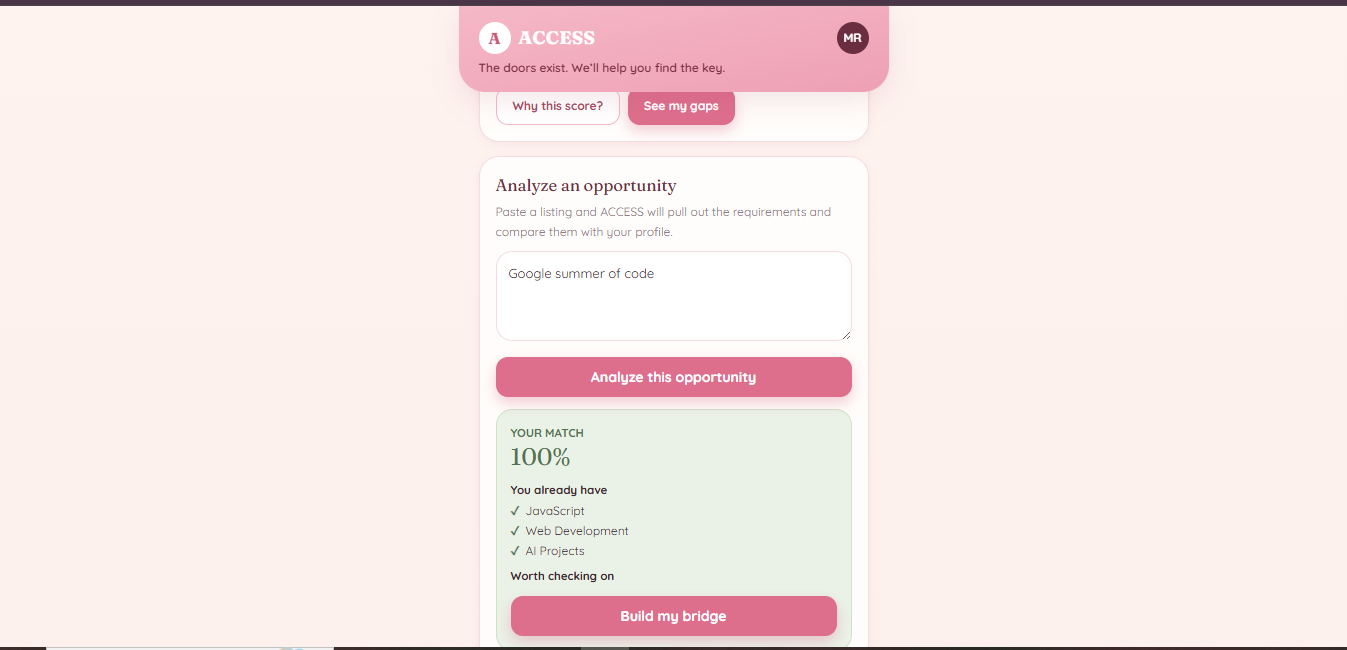
Explore: every opportunity gets an Access Score, plus your real match % and exactly what's missing
-
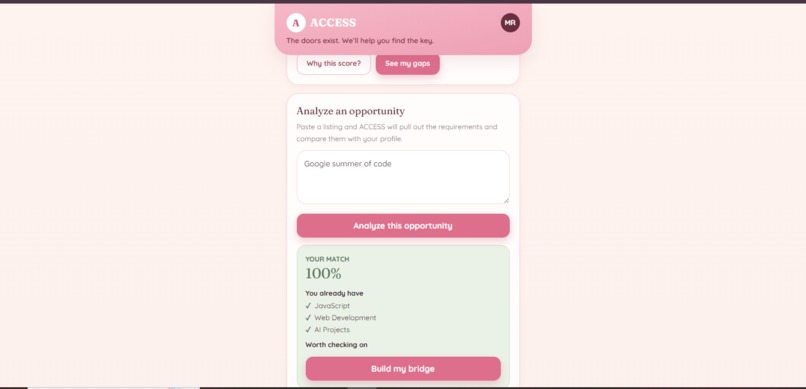
"Paste any opportunity and ACCESS extracts requirements, compares them to your profile, and shows your real match.
-
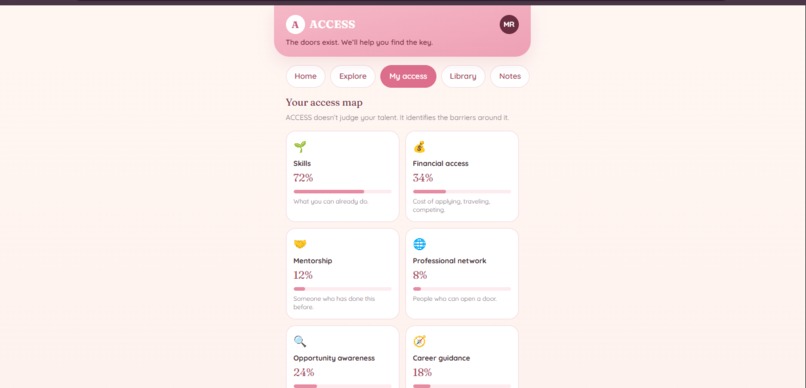
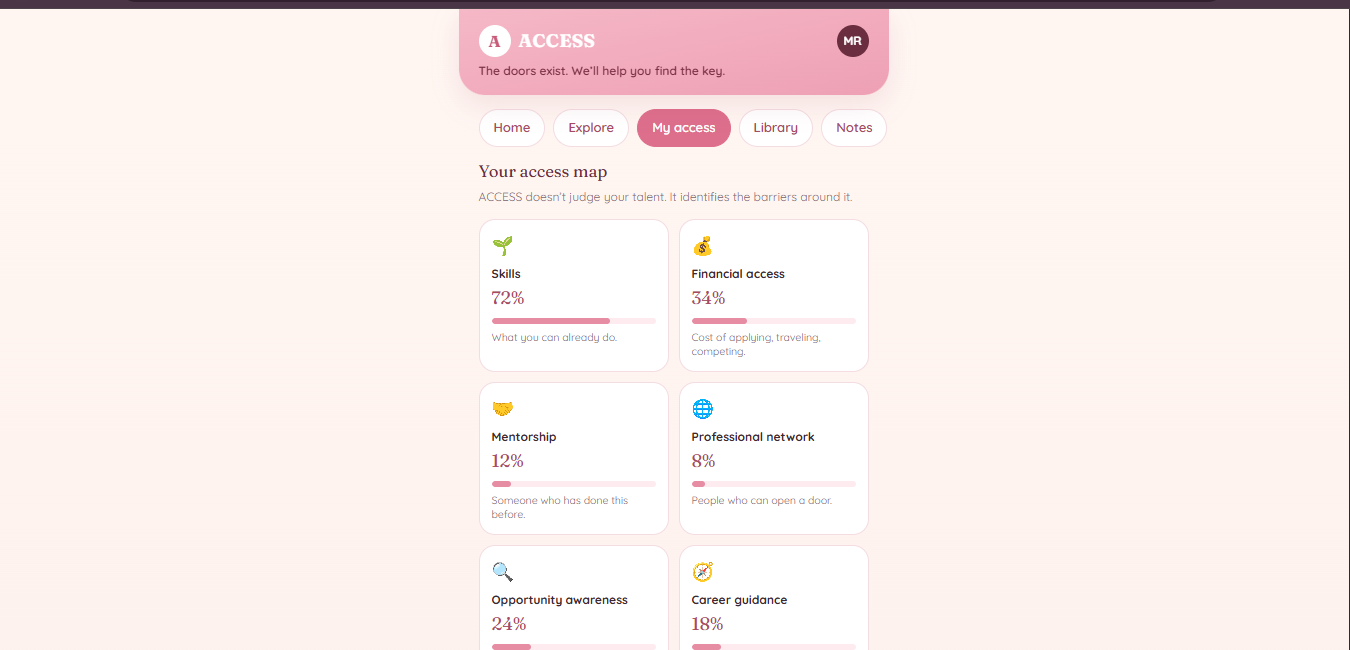
My Access: 8 dimensions mapped with icons and short explanations. ACCESS identifies barriers, not talent.
-
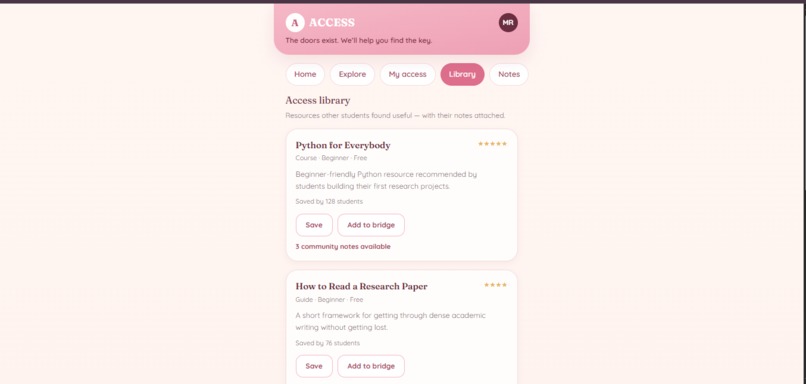
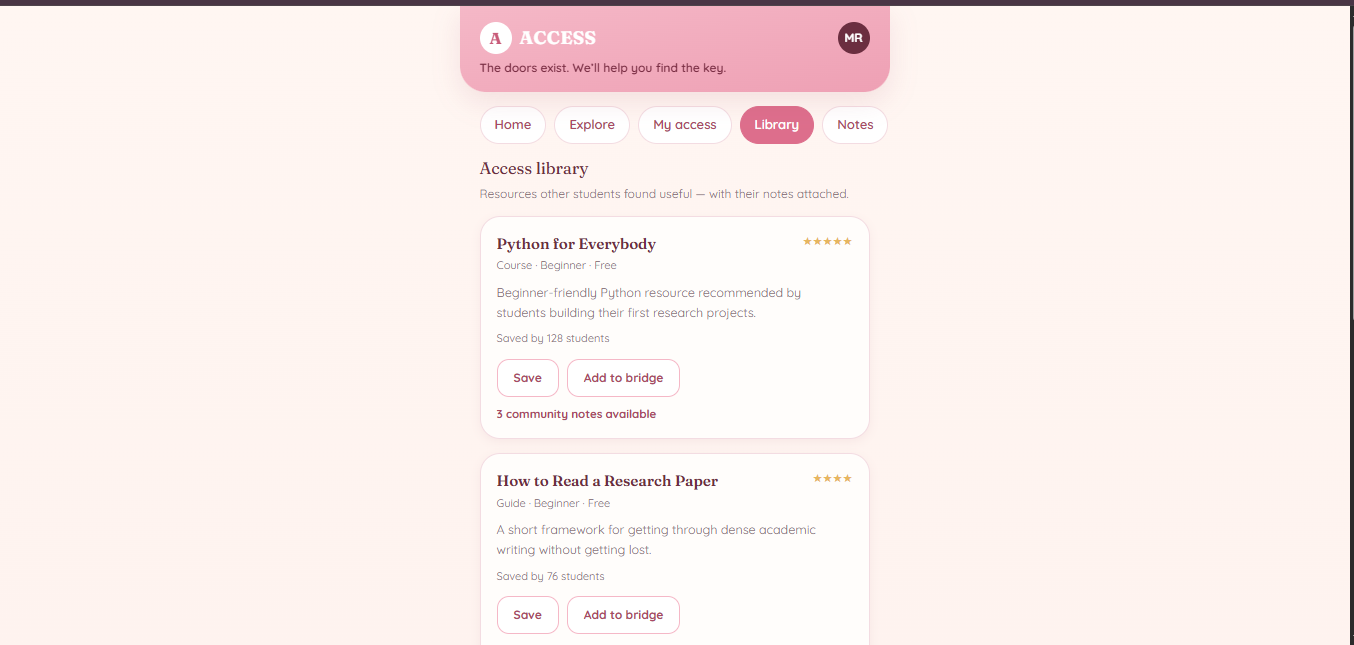
Access Library: community-recommended resources with ratings, save counts, and real student notes attached
-
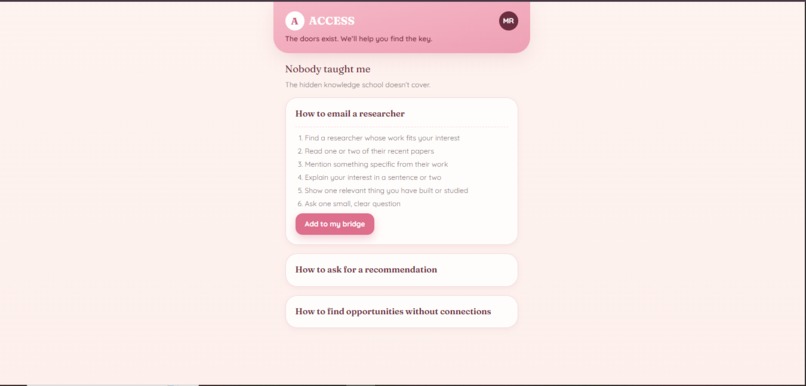
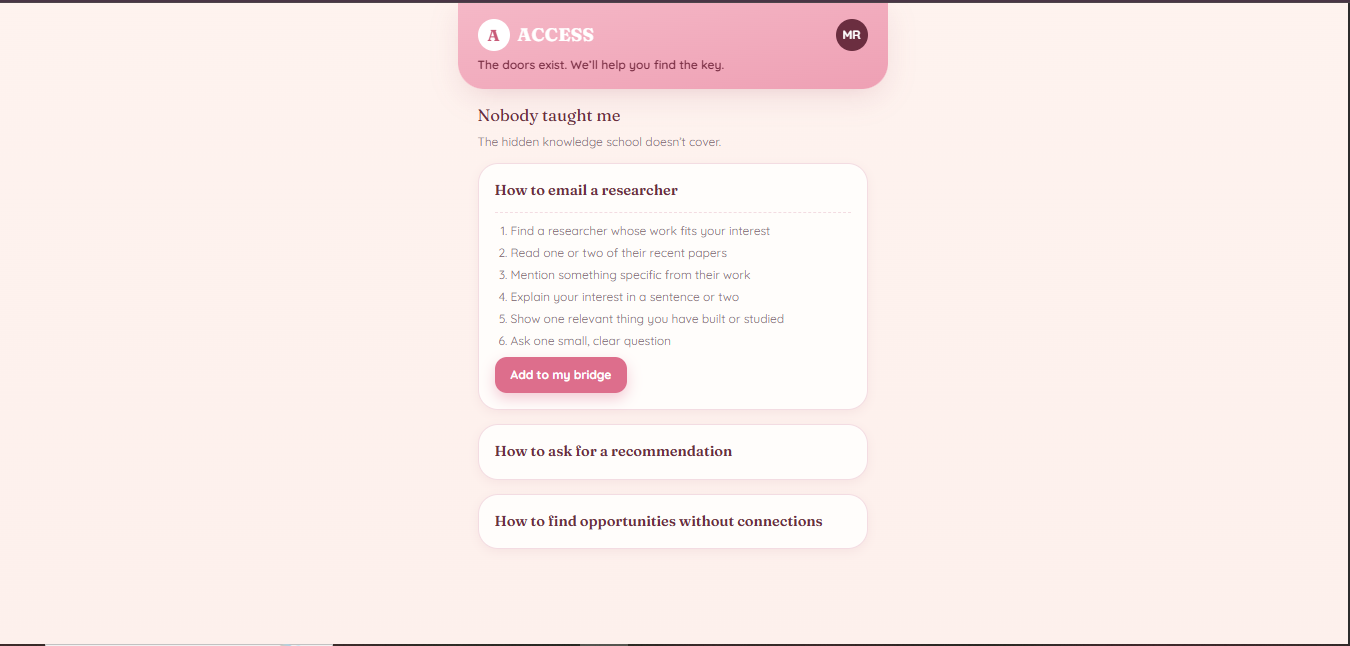
Nobody Taught Me: guides for the hidden knowledge school skips ,one tap adds a guide straight to your Bridge
-
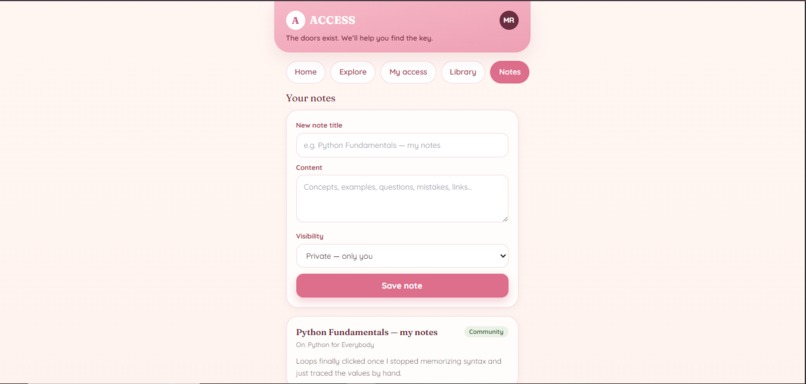
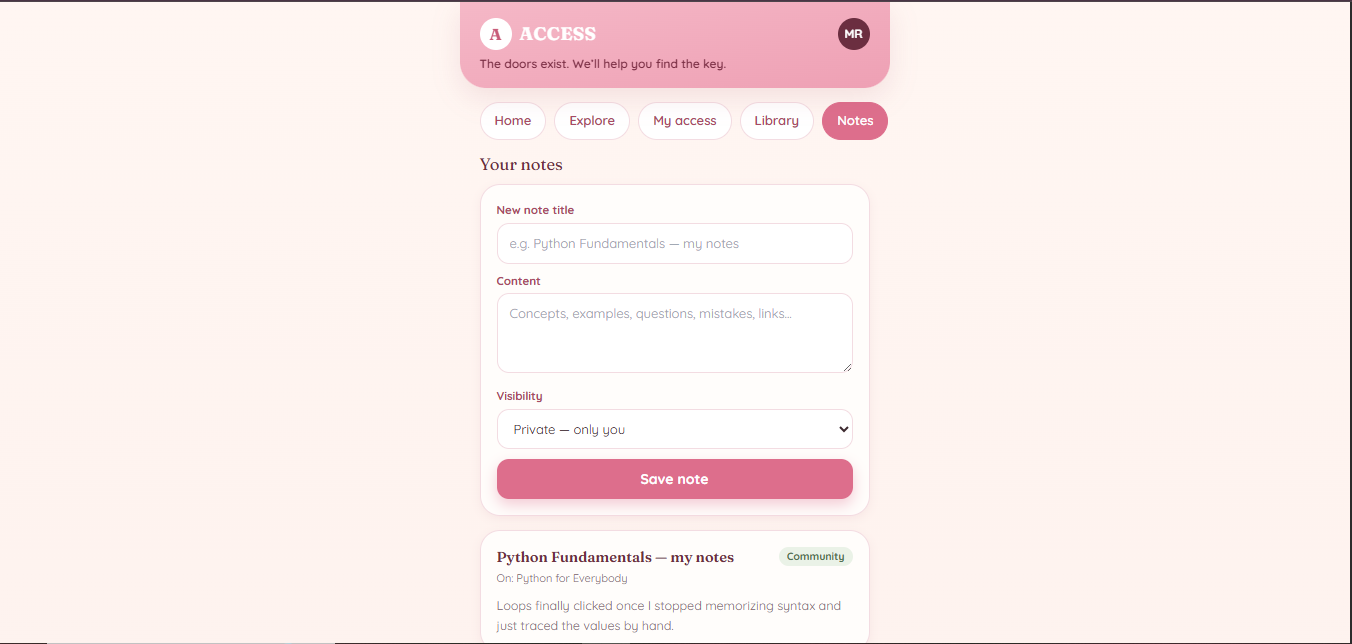
Notes: write your own study notes and choose private or community visibility before sharing.
-
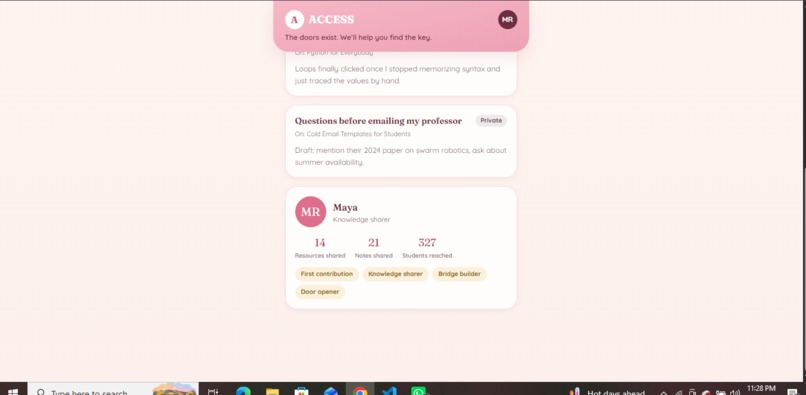
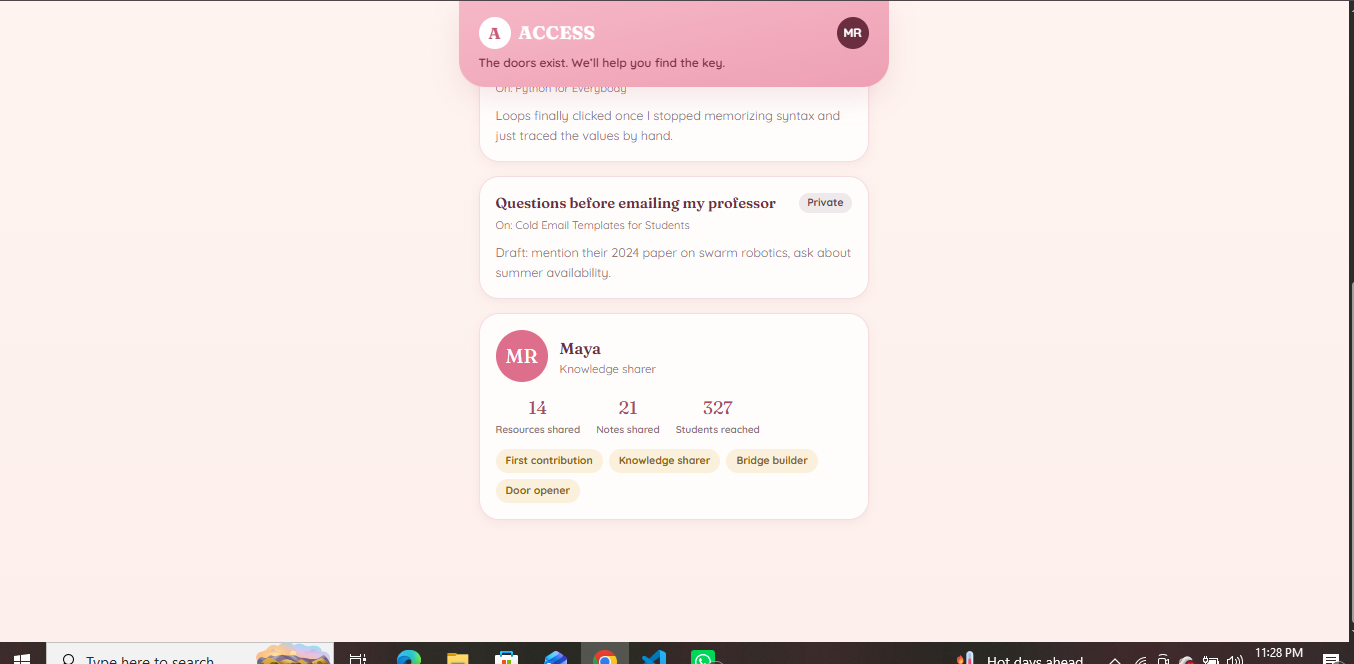
Community notes in action, plus a contributor profile ,resources shared, notes shared, badges earned
Inspiration
Two students can have identical talent and completely different outcomes — not because one worked harder, but because one had a mentor, a network, or simply knew an opportunity existed. We kept coming back to the same idea: the real barrier most students face isn't a lack of ability. It's a lack of access — to people, to information, to the unwritten rules of how applications and opportunities actually work. Nobody sits students down and teaches them how to cold-email a professor or ask for a recommendation. We wanted to build something that treats that hidden knowledge as seriously as it deserves.
What it does
ACCESS is a social-impact platform built around one loop: goal → gap → resource → notes → bridge → opportunity.
- Access Map — instead of just showing "eligible / not eligible," ACCESS breaks down a student's access across 8 dimensions (skills, mentorship, professional network, financial access, and more), so the real barrier is visible, not just the missing item on a checklist.
- Access Score — every opportunity gets scored on how reachable it actually is (free? remote? no application fee?), not just how prestigious it is.
- AI Opportunity Analyzer — paste in a listing, and ACCESS extracts the real requirements and shows exactly what you already have and what's missing.
- Library + Notes — a community-contributed resource library where every resource can carry other students' notes on how they actually used it — turning a link directory into a knowledge-sharing platform.
- My Bridge — turns an overwhelming goal into a concrete, ordered set of steps, ending in the moment we designed the whole demo around: Door Opened 🚪.
- Nobody Taught Me — short guides for the things school never covers: how to email a researcher, how to ask for a recommendation, how to find opportunities without connections.
How we built it
We built ACCESS on Next.js 14 (App Router) with TypeScript and Tailwind CSS, keeping the
component architecture intentionally simple for a hackathon timeline. The AI features run
through the OpenAI API (gpt-4o-mini) as small, single-purpose calls — extracting structured
data from a pasted opportunity, comparing it against a student's skills — deliberately not
as autonomous agents. The student stays in control at every step, and nothing AI-generated
publishes to the Library or Notes without explicit approval. For data, we designed a full
Supabase/Postgres schema (users, opportunities, resources, notes, bridges, trails) so the
product can scale to real accounts, but for the hackathon demo itself we run entirely on
browser-based storage — no backend required to try it, which mattered a lot given our timeline.
Challenges we ran into
The hardest part wasn't the code — it was resisting the urge to build fifty features. It would have been easy to turn ACCESS into a generic opportunity board with AI sprinkled on top. Keeping every feature tied back to one loop (goal → gap → bridge → opportunity) meant cutting things that were interesting but didn't serve that core story. We also had to be careful with the AI features: it would have been simple to wire up an autonomous agent that does everything for the student, but that would undercut the whole point of ACCESS — the student has to stay the one making decisions, not the AI.
Accomplishments that we're proud of
We're proud that ACCESS doesn't feel like "another opportunity platform." The Access Score, the Library-to-Notes connection, and the Bridge together create something we haven't seen elsewhere: a way to make invisible barriers visible and actionable, without ever telling a student they aren't qualified. We're also proud we kept the AI genuinely assistive — five small, transparent API calls, no black-box agent — while still making the "paste an opportunity, see your real gap" moment feel like magic.
What we learned
We learned how much design work goes into making inequality visible without making it feel discouraging — the framing of "here's what's missing" versus "you don't qualify" changes everything about how a tool like this lands emotionally. We also got a lot more comfortable scoping AI features narrowly: constraining ourselves to targeted, structured calls instead of an agent loop actually made the product easier to reason about and trust.
What's next for ACCESS
- Wire up real accounts and a live database so Notes, Bridges, and contributions persist across devices and students can actually build reputations as knowledge-sharers.
- Build out Knowledge Trails fully, so a whole learning path — not just a single resource — can be followed and remixed by other students.
- Expand the AI Opportunity Analyzer to pull real listings directly from program websites.
- Partner with universities and nonprofits to seed the Library with real, vetted resources before opening it up to broader community contribution.
Built With
- next.js
- node.js
- openai-api
- postgresql
- react
- supabase
- tailwind-css
- typescript

Log in or sign up for Devpost to join the conversation.