-
-
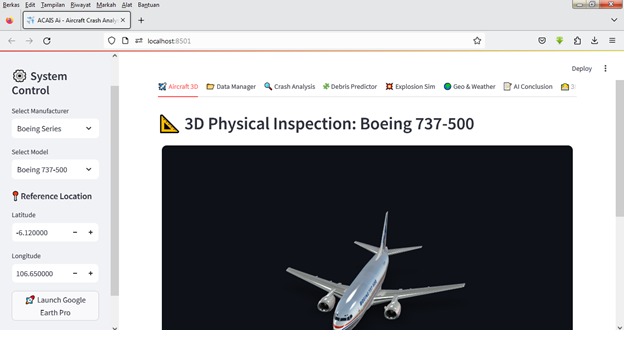
Software ACAIS V1.1 Ai
Inspiration
Aviation safety relies heavily on the rapid and accurate interpretation of Flight Data Recorder (FDR) and Cockpit Voice Recorder (CVR) data. Post-crash investigations, such as those conducted by the NTSB or KNKT, often take months of laborious manual data mapping to reconstruct the final moments of a flight. Our inspiration was to bridge the gap between raw, corrupted telemetry and actionable forensics. We wanted to build an automated, AI-driven command center that not only ingests messy black box data but instantly translates it into a physical, visual, and highly intuitive forensic reconstruction to assist investigators in identifying catastrophic failures like high-altitude stalls or aerodynamic breakups.
What it does
ACAIS Ai (Aircraft Crash Analysis & Investigation Simulation) is an all-in-one forensic dashboard. Once raw FDR data (Excel/CSV) is uploaded, the system performs a multi-stage analysis:
- Data Sanitization: Automatically hunts for and structures scattered telemetry data (Altitude, Airspeed, Pitch, Lat/Lon) despite corrupted headers or blank metadata rows.
- Live Physics Engine: Calculates critical aerodynamics. If the Angle of Attack (AoA) breaches normal flight envelopes, the system triggers a "Red Alert" UI.
- Visual Reconstruction: Synchronizes the telemetry with a 3D PyDeck flight path and dual-view video simulations of the crash scenarios.
- AI Executive Reporting: Processes the final physical variables into Google Gemini 1.5 Flash, generating a compliant, formal NTSB-style investigation summary in seconds.
How we built it
The application is built entirely in Python using Streamlit for a highly reactive, multi-tab user interface.
- Data Pipeline: We utilized pandas to construct a "Fuzzy Auto-Header Detector" algorithm capable of scanning through layers of messy metadata to standardize columns dynamically.
- Physics Computations: We integrated NumPy and native Python math to calculate terminal velocity, induced drag, and structural survivability. For instance, the total kinetic energy at impact is calculated in real-time using Ek = 1/2*m.v^2, and the critical structural impact load is derived using G = (V^2/2gd)
- Generative AI: We integrated the google-generativeai SDK. Instead of a generic chatbot, we utilized advanced Prompt Engineering to enforce a strict "Aviation Investigator" persona on the Gemini 1.5 Flash model. We inject real-time physical variables (like G-Force and Speed) directly into the prompt context so the AI can diagnose the probable cause mathematically
Challenges we ran into
The most significant technical challenge was building a fault-tolerant data ingestion pipeline. Real-world FDR data is incredibly messy—often containing blank rows, corrupted titles, or merged cells that cause standard dataframe parsers to crash. Developing an algorithm capable of dynamically identifying the true data headers up to 50 rows deep required extensive iteration. Additionally, synchronizing the reactive states across different UI tabs—ensuring that a detected stall in the data tab immediately triggers the CVR transcript simulator and switches the video output to the correct 3D scenario—demanded complex st.session_state management.
Accomplishments that we're proud of
We are incredibly proud of the automated transition from raw data to an AI-generated formal report. Engineering the system so that a user can upload a messy spreadsheet and instantly see a "Red Alert" dashboard with a blinking CVR transcript (e.g., "STALL! PULL UP!") is a major UI/UX triumph. Furthermore, successfully configuring Gemini 1.5 to read raw aerodynamic numbers and autonomously deduce complex aviation failures (like distinguishing a high-speed CFIT from an aerodynamic stall) proves the immense capability of generative AI in hard-science forensics.
What we learned
Developing ACAIS Ai deepened our expertise across multiple domains. We mastered advanced state management within Streamlit to create a cascading, multi-tab user interface. We learned how to translate complex aerodynamic principles into programmable Python logic. Most importantly, we honed our Prompt Engineering skills, learning how to tightly constrain a Large Language Model (LLM) so that it produces highly specialized, jargon-accurate technical documentation rather than conversational outputs.
What's next for ACAIS Ai (Aircraft Crash Analysis & Ivestigation Simulation)
The current iteration proves the concept of automated forensics. Next, we plan to implement live API integrations with ADS-B networks (like FlightRadar24) to allow real-time predictive failure analysis for aircraft currently in the air. We also aim to upgrade the 3D mapping with topographical collision algorithms to better predict the debris field radius and integrate native audio processing capabilities to transcribe and analyze real CVR audio files directly within the dashboard.
Built With
- gemini
- html/css/javascript
- openweathermap
- pandas
- python
- streamlit:


Log in or sign up for Devpost to join the conversation.