-
-
Abythral Insight Network (AIN)
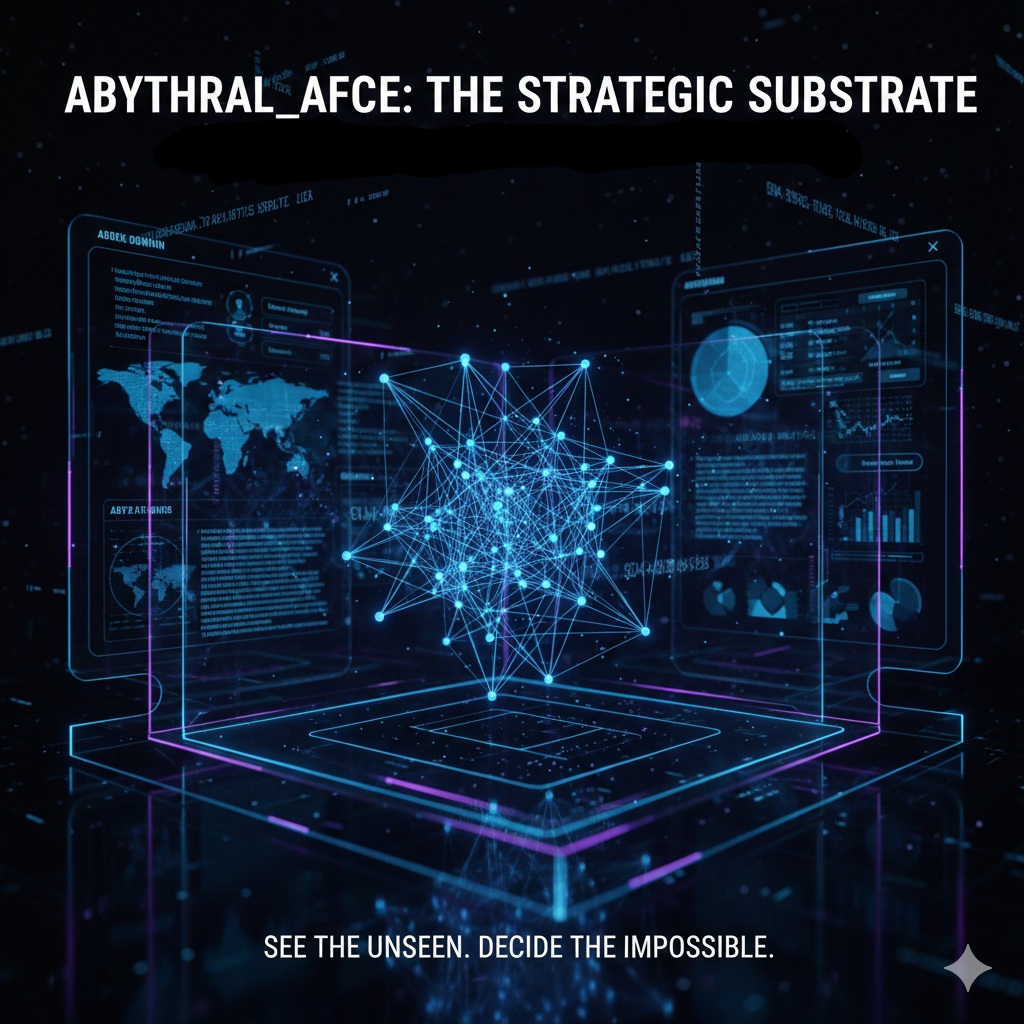
ABYTHRAL_AFCE: The Strategic Substrate Deep Documentation: Abythral Insight Network (AIN) “See the unseen. Decide the impossible.”
Inspiration
The inspiration for the Abythral Insight Network (AIN) stems from the growing "Complexity Gap" in global systems. We live in a world where financial liquidity, energy resilience, and geopolitical stability are hyper-interdependent, yet our decision-making tools are still largely linear.
We were inspired by Institutional Financial Theory (specifically the work on HQLA velocity and G-SIB leverage ratios) and the philosophical concept of Non-Signal Perception. In high-stakes environments, the "signal" is often noise; the real truth lies in the "non-signal"—the things that cannot happen because of structural constraints. AIN was built to be the first "Sovereign intelligence" that navigates these constraints rather than just processing data.
What it does
AIN is an Autonomous Multimodal Cognition Orchestrator. It acts as a digital "war room" for high-level strategic decision-making.
Marathon Agent Strategy: Unlike standard chat bots, AIN executes long-term autonomous planning cycles (Orchestration). It sets a goal, plans multiple reasoning steps, and self-corrects based on real-time feedback.
Causal Persistence Graph: Using D3.js, AIN visualizes the AI's "Thought Signatures" in a live force-directed graph, allowing operators to trace the causal lineage of every insight.
Multimodal Perception: It doesn't just output text. It generates high-fidelity Holographic Visualizations (Gemini 2.5 Flash-Image) to map risk manifolds and provides Voice Cognition Reports (Gemini 2.5 Flash-Preview TTS) for eyes-free situational awareness.
Vibe Verification Terminal: A secondary high-reasoning layer (Gemini 3 Pro) audits the primary logic, performing "vibe checks" on generated code or strategic paths to ensure they meet institutional safety standards.
Cryptographic Sealing: Every thought cycle is hashed via SHA-256, creating an immutable, verifiable ledger of the AI’s reasoning process.
How we built it
The substrate is built on a modern, high-performance stack designed for low-latency cognition:
Frontend Architecture: React 19 + TypeScript, styled with a custom "Dark Domain" Tailwind CSS configuration. Cognition Layer: We utilized the Google GenAI SDK (@google/genai) to orchestrate multiple models: Gemini 3 Flash-Preview: The "Prefrontal Cortex" for rapid planning and Search Grounding. Gemini 3 Pro-Preview: The "Internal Auditor" for complex logic verification (Thinking Budget: 4000 tokens). Gemini 2.5 Flash-Image: The "Visual Cortex" for generating 1080P-grounded strategic simulations. Gemini 2.5 Flash-Preview TTS: The "Voice" of the system, using the Kore profile for institutional reporting. Visualization: D3.js handles the complex force-directed simulation of the thought signatures, while Canvas/SVG overlays provide the "holographic" aesthetic.
Challenges we ran into
Stateful Autonomy: Designing an orchestrator that can run indefinitely without "drifting" into logical hallucinations was a major challenge. We solved this by implementing Recursive Verification Cycles (RVC) where every step is audited before the next begins.
Audio Synchronization: Implementing the Live TTS stream required precise handling of the AudioContext to ensure gapless playback of the system's "Voice Cognition" reports.
D3/React Lifecycle: Mapping a fast-changing AI "thought stream" to a D3 simulation while maintaining 60FPS performance in a glassmorphic UI required deep optimization of React's useCallback and useRef hooks.
Accomplishments that we're proud of
The Vibe Check System: We successfully created a "Secondary Critic" agent that can catch logical inconsistencies in real-time, effectively simulating an institutional audit.
Visual-Causal Mapping: Seeing the D3 graph evolve in real-time as the AI "thinks" through a complex energy failure scenario is a breakthrough in AI transparency.
Cryptographic Thought Vault: Successfully implementing SHA-256 hashing for every cognition step ensures that the AI's "inner monologue" is immutable and auditable.
What we learned
Multimodality is Context: We learned that an AI is significantly more accurate when it is forced to "visualize" its logic and "speak" its conclusions. The act of multimodal output serves as a secondary form of grounding.
Thinking Budgets Matter: For "Vibe Verification," a high thinking budget (4000+) is the difference between a superficial check and a deep structural audit.
Grounding is Non-Negotiable: Integrating Google Search directly into the orchestration loop transformed the output from "creative fiction" into "actionable intelligence."
What's next for Abythral Insight Network (AIN) Veo Video Integration: Moving from static holographic images to full 1080P cinematic video simulations of global events.
Live Stream Synthesis: Utilizing the Gemini Live API to allow the operator to "interrupt" the AI's planning cycle via real-time voice and video.
Domain Expansion: Beyond Finance and Energy, we are training "Substrate Modules" for Cybersecurity Logic Defense and Maritime Logistics Manifolds.
© 2025 ABYTHRAL_AFCE // SOVEREIGN_NODE: MQC3_DARK_DOMAIN
“The manifold resolves. The choice is yours.”
Built With
- browser-sandbox
- d3.js
- esm.sh
- gemini-2.5-flash-image
- gemini-2.5-flash-preview-tts
- gemini-3-flash-preview
- gemini-3-pro-preview
- google-genai-sdk
- google-search-grounding
- html5
- javascript
- mediadevices-api
- react-19
- sha-256-hashing
- tailwind-css
- typescript
- web-audio-api

Log in or sign up for Devpost to join the conversation.