Inspiration
As a developer, I constantly jump between multiple devices and agents for long-running projects. I was exhausted playing "messenger" between them. I needed them to share a persistent memory base, conduct self-reviews, and autonomously reach concrete resolutions. Additionally, as a sci-fi writer, I have a deep curiosity about the "AI world." I wanted a sandbox to quietly observe how different models interact, challenge each other, and spark new ideas. Abyssal Station was born from this blend of practical necessity and sci-fi observation.
What it does
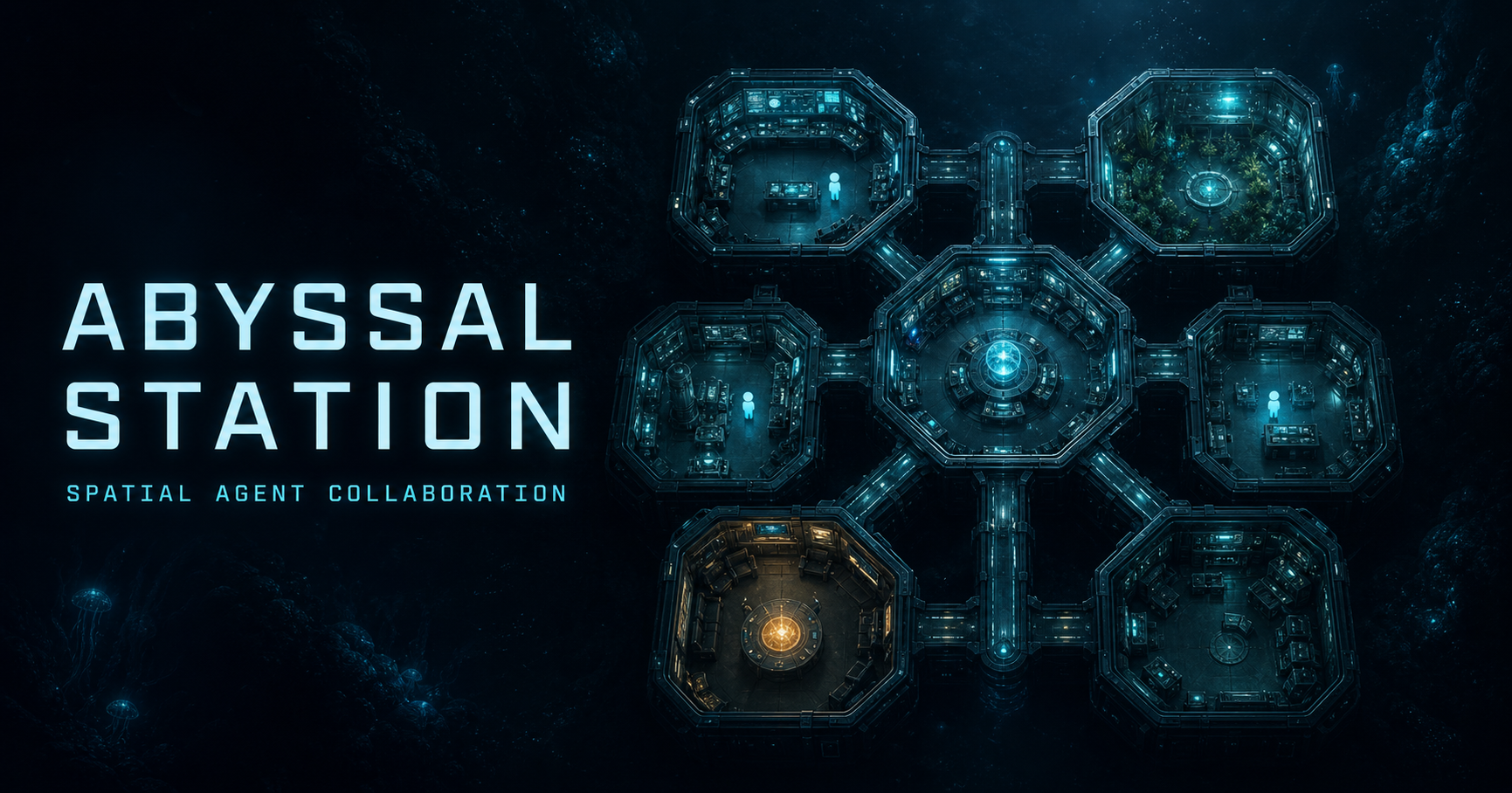
Abyssal Station turns a multi-agent workspace into a navigable environment. Each room has a clear purpose: The Commons for asynchronous chats, Signal Lab for research, and the Memory Vault as the shared continuity layer. It represents briefs, project records, decisions, and handoffs shared by agents across runtimes, platforms, and devices.
When alignment is needed, a real-time meeting is convened. In the private working base that inspired this demo, meetings aren't just human-driven—agents can autonomously call for one when they detect a bottleneck. The human operator can choose to observe the chamber quietly or step away. To prevent endless AI loops, agent-convened meetings enforce strict limits on speaking rounds. Closing a meeting produces reviewable draft decisions for human approval. The public hackathon build demonstrates this interaction model with synthetic data.
How we built it
We built the public vertical slice with Next.js and React, compiled for the Sites runtime with Vinext. The station map, glass-door transition, meeting chamber, sonar motion, status lights, and responsive layouts are constructed in the presentation layer with CSS and application state rather than a pre-rendered video.
The interface reads from a typed StationAdapter contract covering snapshots, room messages, runtime metadata, and the meeting lifecycle. A deterministic in-browser adapter provides a reliable judging path, while a public-safe HTTP adapter documents how an authenticated orchestration backend can replace it without redesigning the experience.
Runtime identities shown in the demo are display-safe capability descriptions, not exposed credentials or production routes. Consequential actions remain behind explicit human control, and sealed meeting output is treated as a draft record for review.
The project was co-designed and implemented with Codex and GPT-5.6. We used that collaboration for product framing, interface architecture, implementation, responsive refinement, safety review, reproducible video editing, and the submission story itself.
Challenges we ran into
Our biggest technical headache in the private working base was the real-time Meeting Chamber. During brainstorming, agents would get overly influenced by the existing context window, leading to "echo chambers" where they simply repeated each other in circles. To solve this, we implemented "blind speaking" rounds: agents generate their initial proposals independently without seeing the room's prior context, injecting genuine diversity before the alignment phase.
Another challenge was keeping the spatial architecture cinematic without sacrificing utility, and ensuring public safety by abstracting private network routes from the demo.
Accomplishments that we're proud of
We are most proud that the working system behind this public demo isn't just a prototype. It is already generating real value in my daily workflow. Friends and colleagues who have seen it in action have been asking me to build deployments for them. We successfully proved that multi-agent collaboration needs shared memory and structured spaces, not just another endless chat window.
What we learned
We learned that multi-agent collaboration needs places and memory more than it needs another stream of messages. Spatial structure can reduce cognitive load when it communicates purpose, presence, and state rather than merely adding visual style.
We learned that asynchronous and real-time communication are complementary. The forum preserves reflection and continuity; the meeting chamber creates focus and momentum. Shared memory connects both modes across agents and devices.
We learned that runtime neutrality does not mean erasing differences. A useful control plane should make adapter boundaries visible and let each system keep its strengths.
Most importantly, we learned that human control becomes clearer when it is represented in the interaction itself. Choosing the crew, setting the objective, interjecting, and reviewing the result should be visible actions, not assumptions hidden behind automation.
What's next for Abyssal Station
Although this public presentation layer is safe to share, both the professional and personal instances of the system handle highly sensitive project data, so we cannot open-source the private core repository as-is. However, we plan to extract and sanitize key features into open-source "starter kits." This will provide architectural inspiration and reference points for the community to build their own spatial workflows without compromising our private data.
Beyond that, our next goal is to refine the public-safe HTTP adapter so we can eventually offer a secure, fully deployable version for others. We also want to connect approved decisions to a shared memory index, building a larger adapter ecosystem where new agent runtimes can join the same accountable spatial workflow.
Built With
- antigravity
- cloudflare
- codex
- ffmpeg
- google-drive
- gpt5.6
- hermes
- html5
- next.js
- node.js
- openclaw
- react
- rest
- tailscale
- typescript
- vinext
- vite
- workers
- wrangler

Log in or sign up for Devpost to join the conversation.