-
-
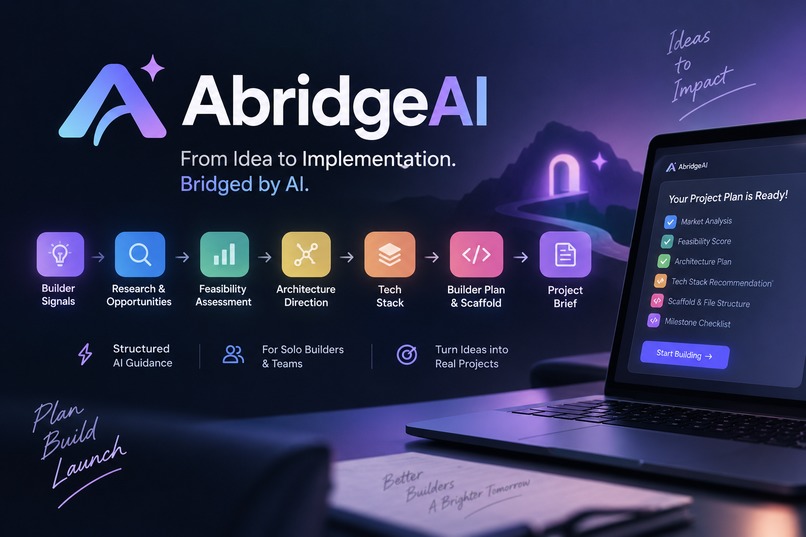
AbridgeAI turns a rough idea by typing a project idea in plain English into a build-ready plan in one run
Inspiration
Every side project starts the same way: a half-formed idea, a blank README,
and a weekend you'll never get back. I kept watching good ideas die at the
"now what?" step — before a single file was created. AbridgeAI came from
wanting a tool that does the thinking a project needs before the coding
starts: give it one sentence, and it hands you a feasibility verdict, an
architecture, a stack, a real starter scaffold, and a week-by-week plan —
instead of a blank screen.
What it does
AbridgeAI runs a seven-stage deterministic planning pipeline on your local backend:
- Builder Signals — reads your public GitHub profile for signal (optional)
- Research & Opportunities — market scan, risks, recommended direction
- Feasibility Assessment — a /100 score across five weighted axes
- Architecture Direction — module breakdown and data-flow spine
- Tech Stack — comfort-matched recommendation, or your own custom combo
- Builder Plan & Scaffold — a downloadable starter repo (
.zip) with a project-specificREADME.mdandPLAN.md - Project Brief — the full brief, viewable or exported as Markdown
Feasibility is scored as
$$\text{score} = \min\left(100,\ c + s + p + t + b\right)$$
over five axes — idea clarity, stack fit, scope, time realism, and builder fit. Above 70 it says GO; between 50 and 70 it says Proceed with caution; below that, Rethink / reshape — so the plan is honest before you commit.
If you add a custom stack like FastAPI + React + PostgreSQL + Docker,
the text gets parsed into structured components, the scaffold is auto-chosen
for the backend language, and the README renders each layer. Type C++ + Rust
together and both are recognized — the pipeline lists both and picks the best
matching starter base.
How we built it
The backend is Express + Node, the frontend is React + Vite, and all
planning logic lives server-side behind a typed stage registry
(stages.js) — the UI never rebuilds project logic, it just consumes
structured results over HTTP. Four stages are LLM-powered: Gemini goes
first; if it's missing, out of quota, or unparseable, Groq is tried
automatically; if both fail, a deterministic engine takes over so the app
never 500s. Badges in the UI tell you which path ran (Gemini · live,
Groq · live, LLM · cached, or fallback).
Even the deterministic fallback is idea-aware. Items are picked by hash-scored seeding — every candidate scores as
$$s_i = H(\text{seed} + \text{poolItem}_i)$$
with the best-seeded options chosen, so two similar ideas still diverge and a run never re-bills the same prompt twice (results are cached per input hash).
Challenges we ran into
The biggest was billing discipline: the Gemini free tier allows ~20
requests/day on this model, and one run already uses four — so a deployment
"worked yesterday" and shows fallback today for no code reason. Debugging
that led to the whole resilience story: a real provider chain (Gemini →
Groq → deterministic) instead of a single point of failure. We also had to
keep LLM output honest — models return malformed JSON, miss keys, or invent
content — so every stage sanitizes and clamps LLM results before anything
touches the UI.
Accomplishments that we're proud of
- The pipeline always produces a complete plan — demo-proof, even with no keys
- A real downloadable scaffold, not just text:
README.md,PLAN.md, a test, a fixture, and a core module that embeds the project's planned architecture - Deterministic fallbacks are idea-specific, not generic canned text
What we learned
- Resilient over ambitious: a fallback chain beats a single "perfect" model
- LLM output is a contract to validate, not a source of truth
- A typed stage registry made adding stages trivial — single source of truth
- Caching identical inputs prevents cost and guarantees stable re-runs
What's next for AbridgeAI
- More starter languages (C++/C#, web frameworks) and richer scaffolds
- A persisted project store + cloud run for multi-user use
- Cost-tiered provider routing (which stage uses which provider, by cost)
Built With
- ai
- developer-tools
- express.js
- gemini-ai
- groq-cloud
- hackathon
- llm
- node.js
- project-planning
- react
- scaffolding
- typescript
- vite
- web-app


Log in or sign up for Devpost to join the conversation.