ABRAZOS — Affective Bodies Reaching Across Zero-space
ABRAZOS is a telehaptic system exploring embodied affect, remote presence, and somatic communication across networked distances.
At its simplest: ABRAZOS lets people feel a hug from someone who isn’t physically there. It’s a way for bodies to share comfort and presence across distance—Boston to Barcelona, or across a campus network—through real-time haptics.
Inspiration
“Abrazos” means hugs in Spanish. I’ve been living across geographies and communities, and I kept coming back to a simple question:
What if we could transmit comfort—not as text or voice, but as sensation? Not a metaphorical “I’m here,” but a physically felt one.
ABRAZOS is my attempt to build a small, honest channel for care: a system where a gesture becomes touch.
What it does
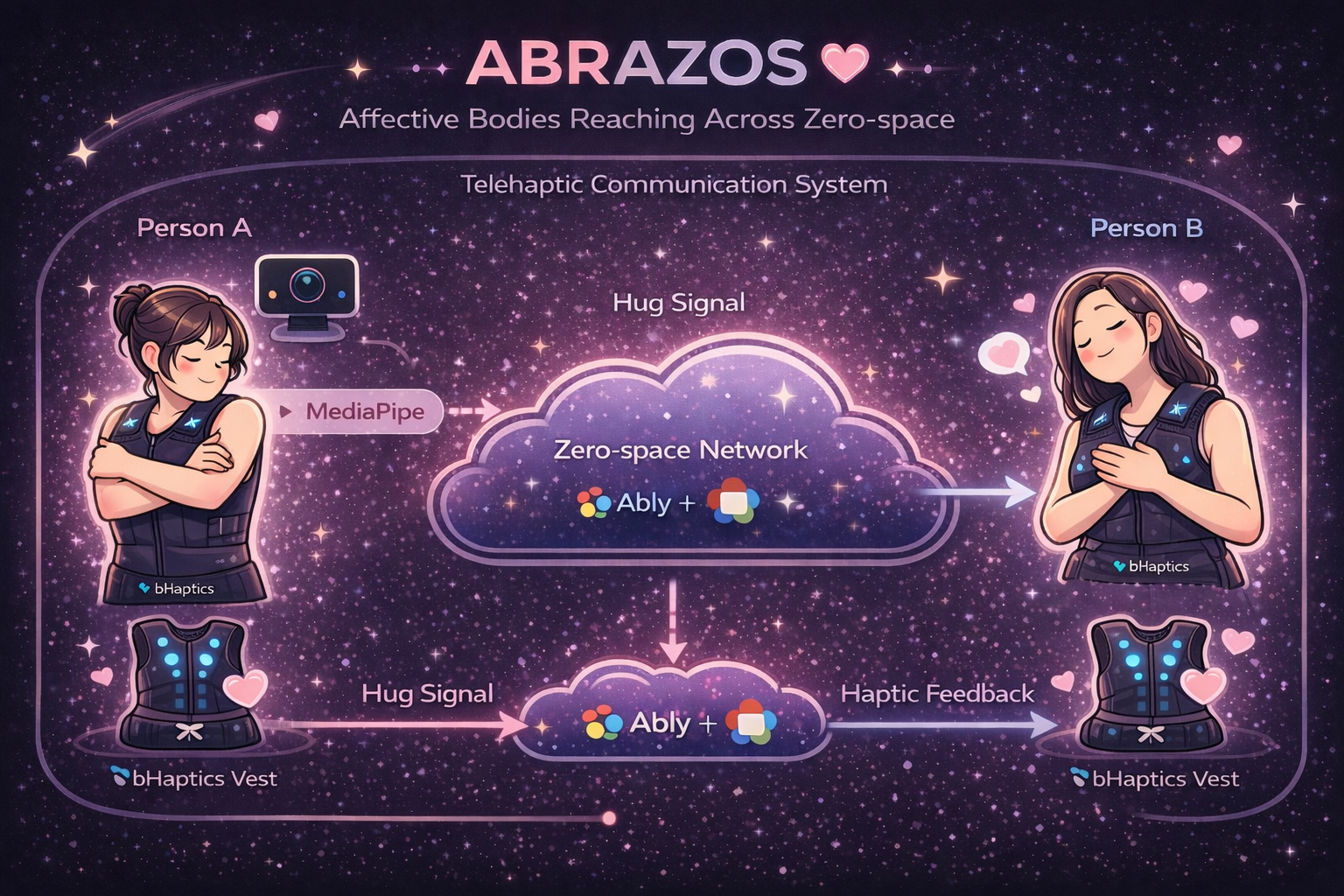
Two people wear bHaptics haptic vests.
One person performs a self-hug (or hug-like gesture).
The system uses MediaPipe pose detection to track the gesture and extract motion features.
Those features are translated into a haptic pattern (intensity + location mapping).
The pattern is sent over the network in real time.
The other person feels the hug as physical feedback on their body.
How we built it
ABRAZOS is a chain of perception → translation → transmission → sensation:
Pose Tracking (MediaPipe): Detects upper-body pose and identifies a hug/self-embrace configuration.
Signal Mapping: Converts the gesture into haptic “zones” on the vest (front/side emphasis) and intensity over time.
Networking: Streams the haptic event data to a paired receiver with low-latency messaging.
Haptics (bHaptics): Triggers real-time patterns on the receiving vest that mirror the sender’s gesture envelope.
The core system is working—MediaPipe is working, vest connection is up, and the pipeline is live. At this point, the main work is UI/UX: making pairing, calibration, and “hug language” intuitive enough that anyone can use it in seconds.
Challenges
Designing a hug detector that feels natural: People hug differently. The system needs to recognize intent without forcing rigid choreography.
Mapping emotion to sensation: A hug isn’t just “pressure” it has timing, rhythm, and warmth. Translating that into haptics is both technical and artistic.
Latency & stability: Even small network delays can break the illusion of presence. The goal is “felt immediacy.”
What we learned
Touch is a form of communication with its own grammar timing matters as much as intensity.
“Presence” isn’t only visual or audio; a small, well-timed tactile signal can feel deeply human.
The hardest part isn’t making haptics work it’s making the interaction feel obvious and safe.
What’s next
A friendly pairing + calibration flow.
A small library of “somatic messages” (comfort, reassurance, celebration).
Multi-gesture support (hand squeeze, shoulder tap, heartbeat-like pulses).
If there’s another vest on campus: instant long-distance hugs across MIT, and eventually Boston ↔ Barcelona.
Built With
- next.js
- webrtc


Log in or sign up for Devpost to join the conversation.