Blind Justice
Inspiration
Legal professionals handle some of the most sensitive information in the world, including contracts, NDAs, merger agreements, litigation files, and privileged client communications. However, most LegalTech and AI-powered document tools today rely on centralized storage and traditional vector databases, where raw text or reconstructable embeddings can be exposed to administrators, cloud providers, or inversion attacks.
We were inspired by a fundamental question:
Can AI assist legal reasoning without ever seeing the underlying data?
Blind Justice was built to challenge the assumption that intelligence requires visibility, and to prove that privacy-first, zero-trust AI systems are not only possible, but necessary for the legal domain.
What it does
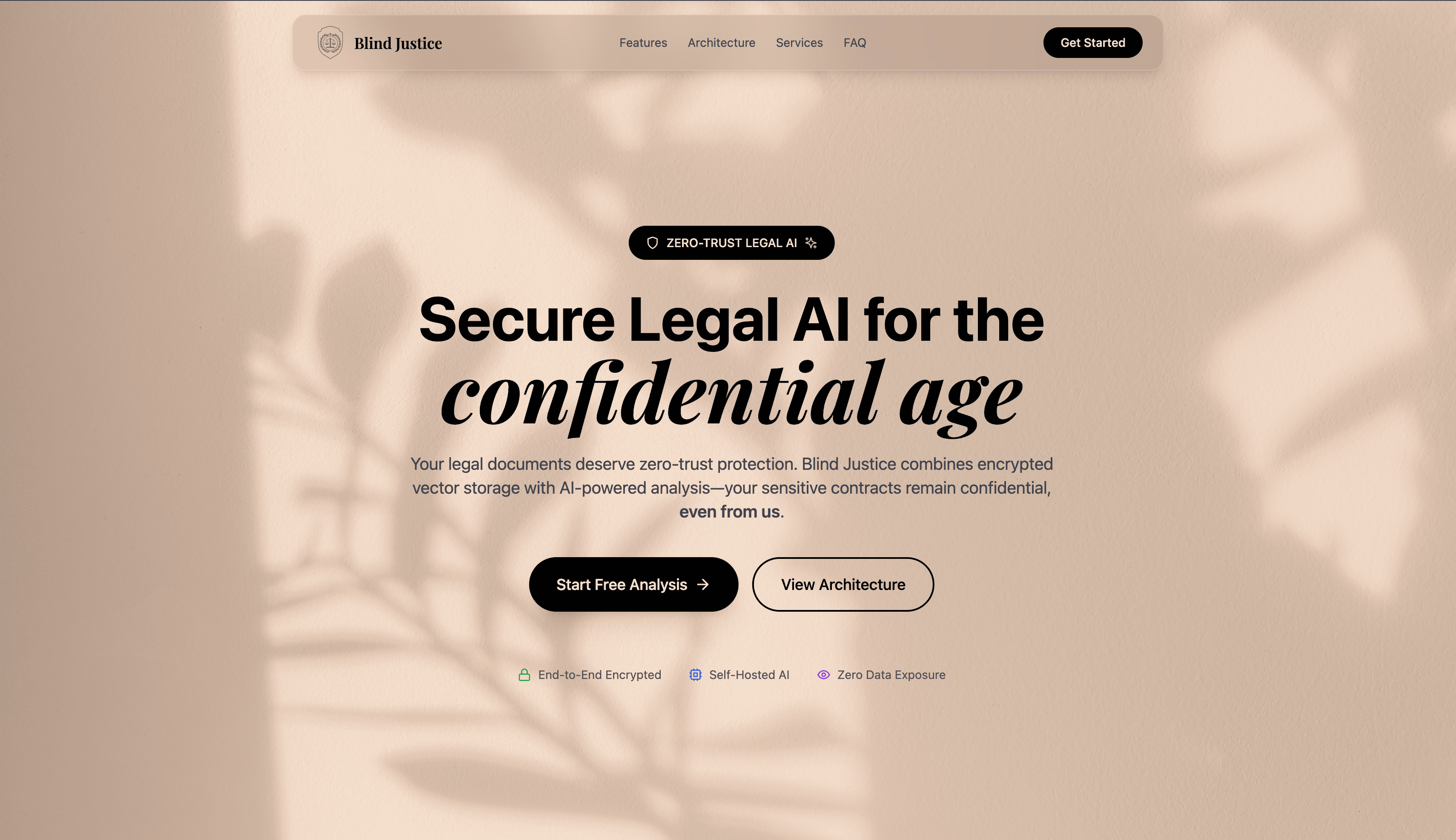
Blind Justice is a Zero-Trust Legal AI Data Room that enables law firms and legal teams to securely store, analyze, and query confidential legal documents using AI, without exposing raw data at any point in the system.
Key features include:
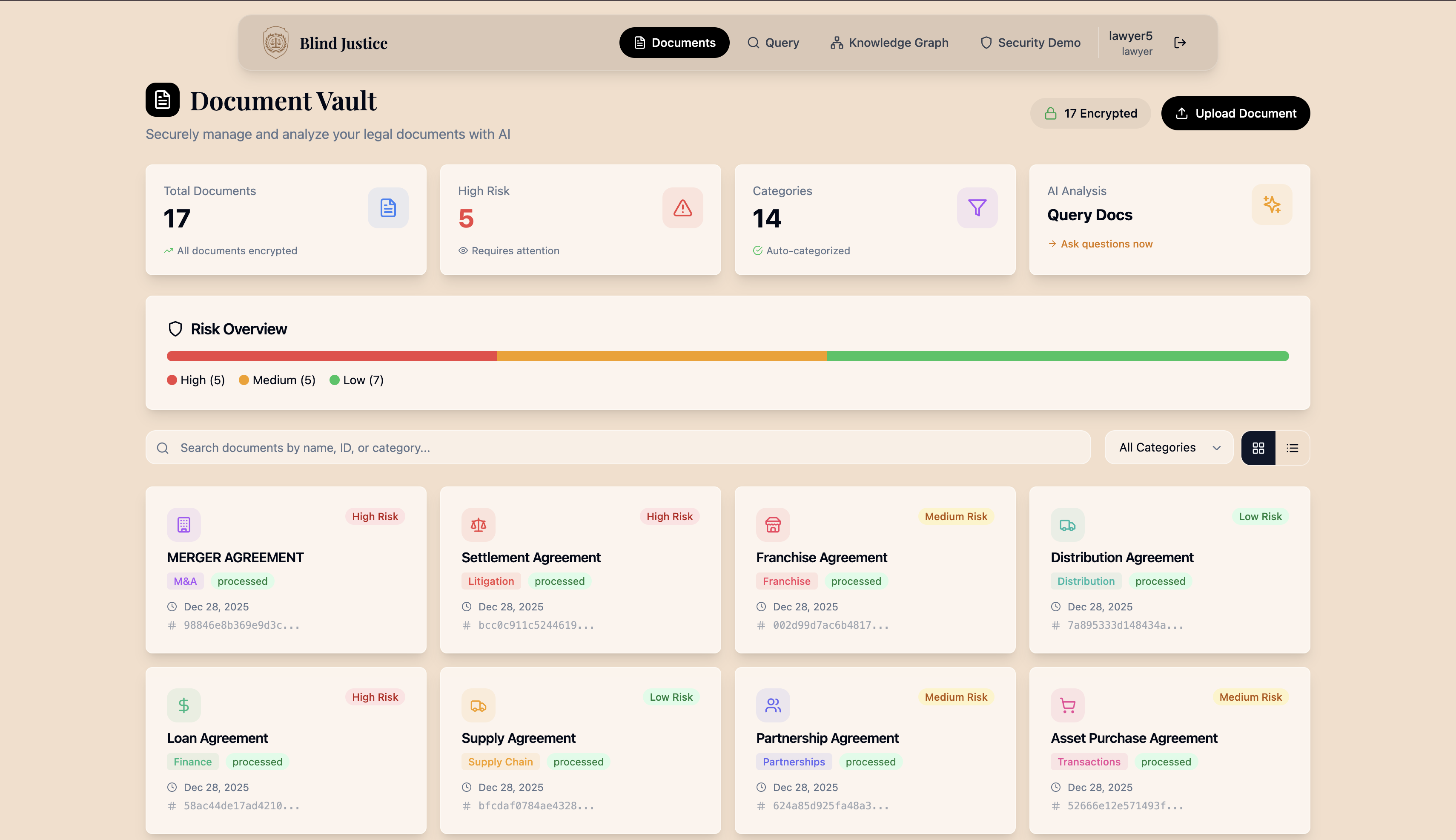
- Secure document vault for contracts, NDAs, and legal files
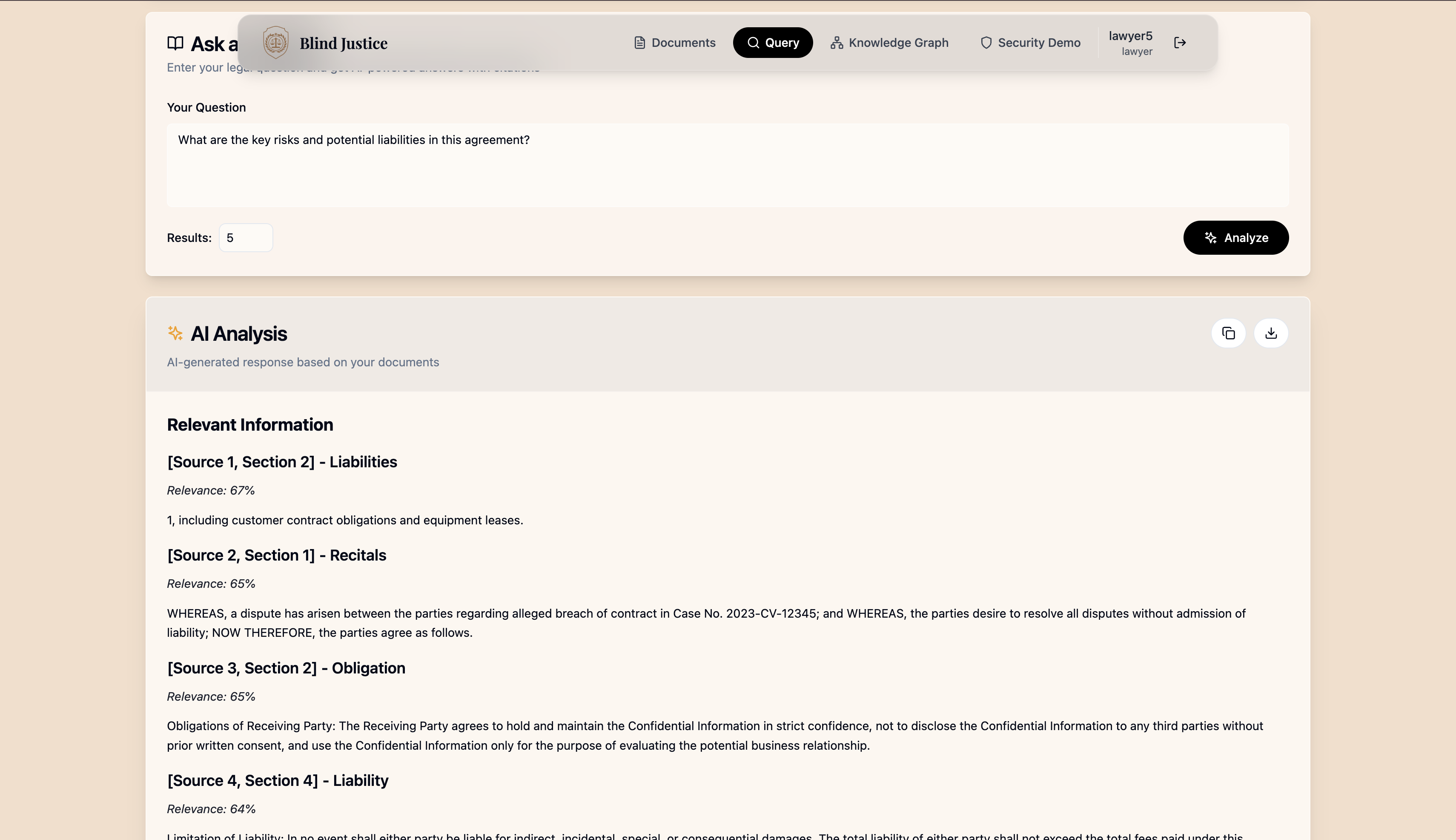
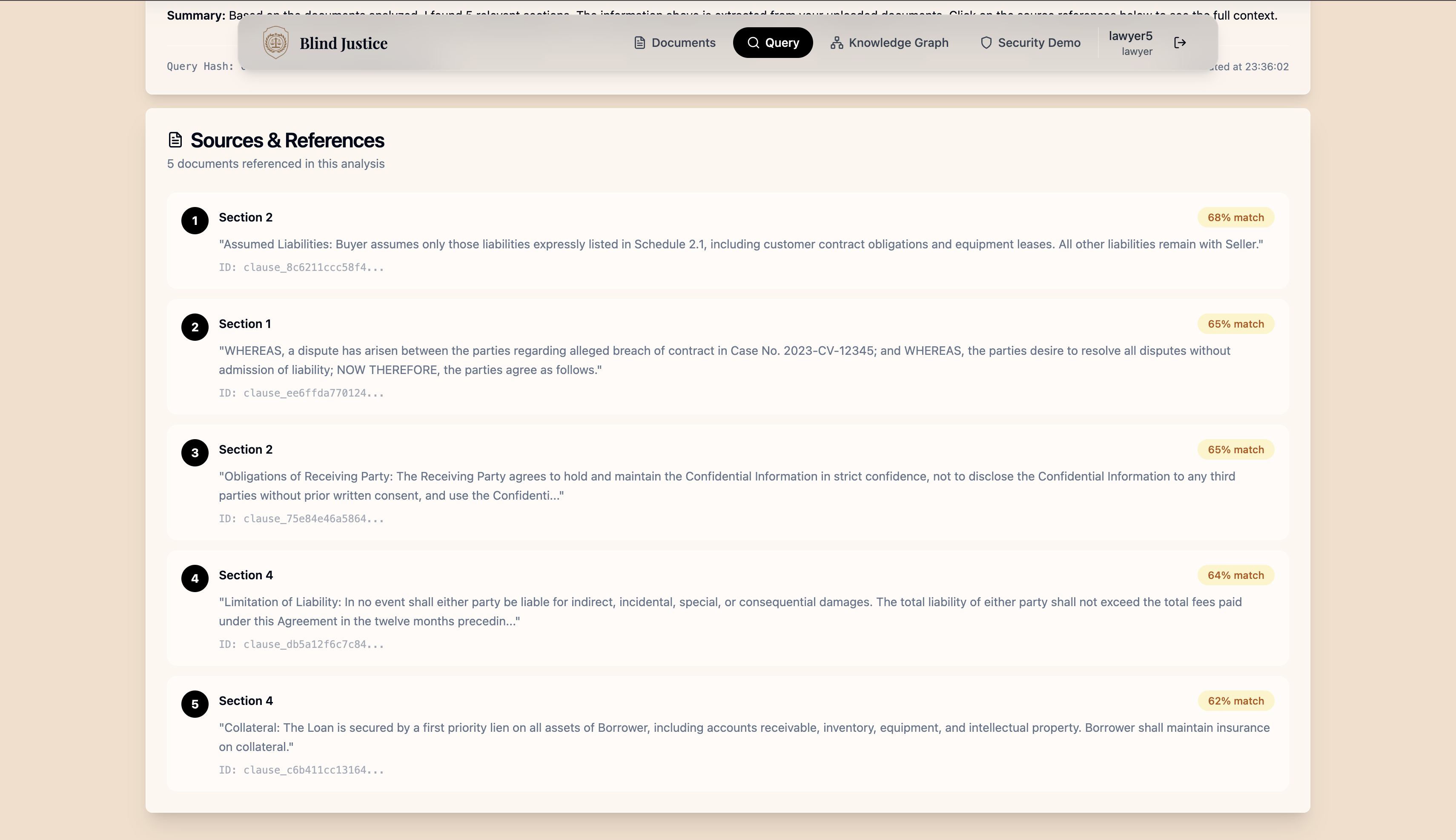
- Privacy-preserving AI-powered question answering
- End-to-end encryption where raw document text is never stored or visible
- Role-based access control for lawyers, reviewers, and administrators
- Admin-level blindness, ensuring even system operators cannot view sensitive data
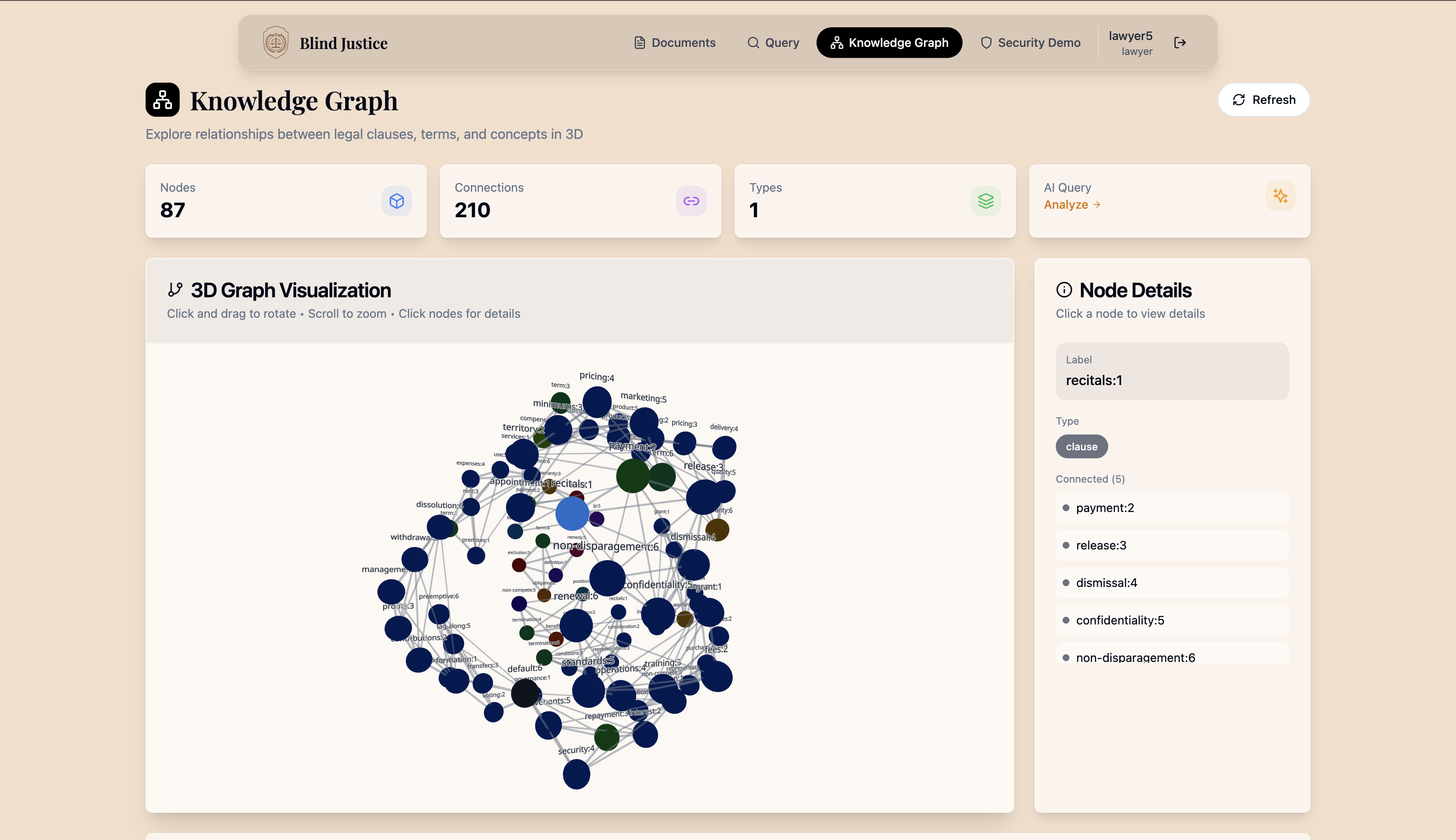
- Graph-based relationship mapping between clauses, entities, and legal concepts
- Immutable audit logs for compliance and traceability
The platform ensures that legal data remains blind to the infrastructure itself, living up to the name Blind Justice.
How we built it
Blind Justice follows a strict zero-trust architecture, designed to minimize trust assumptions at every layer.
Frontend
- Built with React + Vite for fast, modern, and responsive UX
- Secure authentication flows and role-aware dashboards
- Document vault, AI query interface, and graph-based visualizations
Backend
- FastAPI (Python) for authentication, authorization, and orchestration
- JWT-based authentication with fine-grained role-based access control
- Secure document ingestion and encrypted processing pipeline
Security & Storage Layer
- Raw documents are processed locally, chunked, embedded, encrypted using AES-256-GCM, and then stored
- Plaintext documents are never persisted
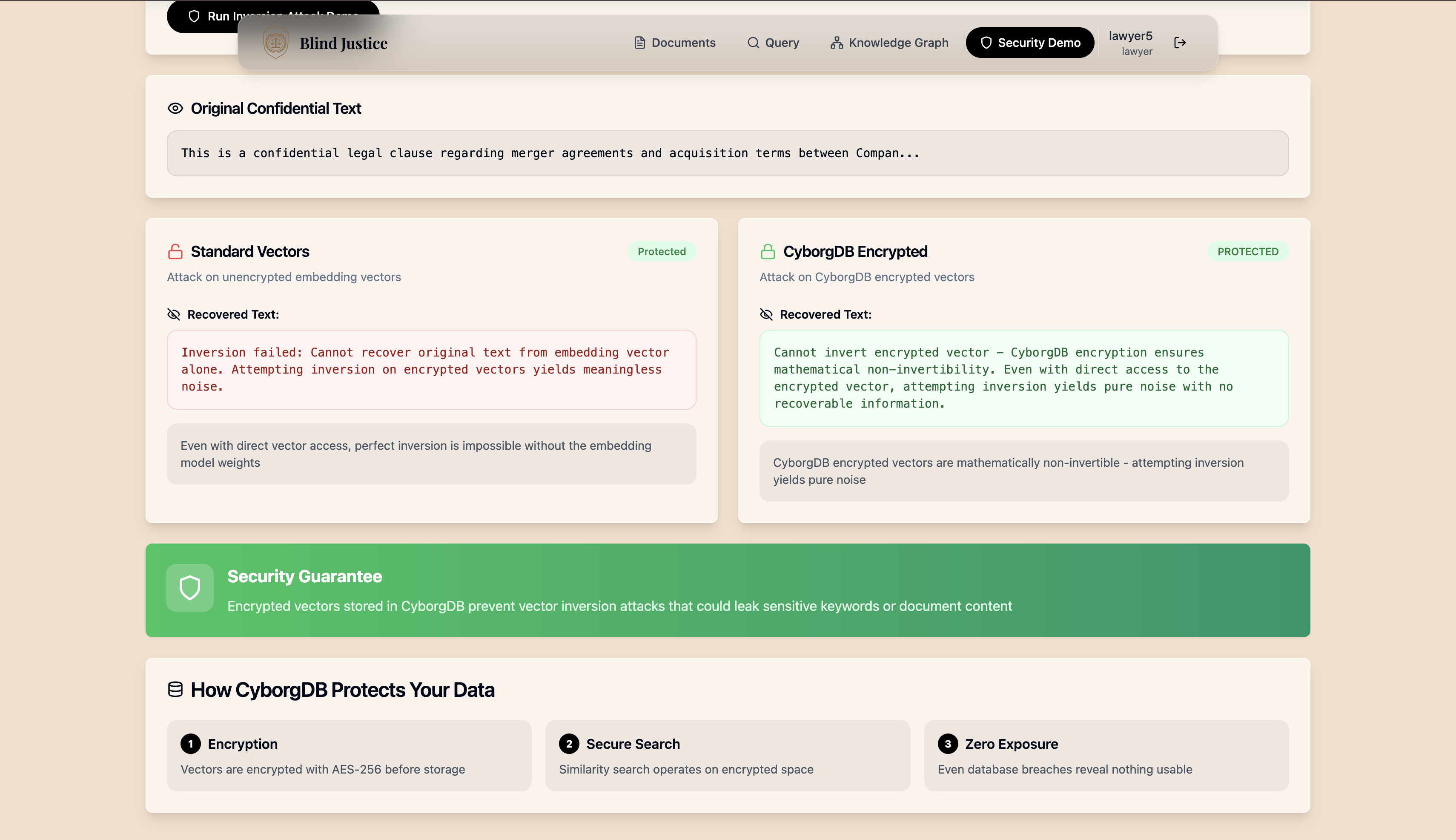
- Protection against vector inversion and embedding leakage attacks
- PostgreSQL for secure metadata storage and access control
- CyborgDB used as a secure, privacy-preserving data layer for storing and querying encrypted embeddings and representations
AI & Intelligence Layer
- Retrieval-Augmented Generation pipeline operating only on secured representations
- LLMs generate answers without direct access to raw legal text
- Graph layer models relationships between clauses, entities, and concepts without exposing document content
Audit & Compliance
- Immutable audit logs tracking document access, queries, and system actions
- Designed for compliance-heavy environments such as law firms and enterprises
Challenges we ran into
- Designing AI workflows where models never directly access raw text
- Preventing vector database inversion while retaining semantic search capabilities
- Balancing strong cryptography with low-latency query performance
- Enforcing zero-trust principles even for administrators and operators
- Structuring legal documents to support graph-based reasoning while preserving privacy
Each challenge required rethinking conventional AI and database design patterns.
Accomplishments that we're proud of
- Built a functional legal AI system where raw documents are never exposed
- Achieved true zero-trust access, including admin-level blindness
- Integrated CyborgDB to securely manage encrypted embeddings and queries
- Designed a RAG pipeline resistant to common data leakage vectors
- Delivered a production-grade architecture rather than a demo-only prototype
What we learned
- Security-first AI design fundamentally changes system architecture
- Traditional vector databases can be dangerous without cryptographic safeguards
- Zero-trust is not just encryption, but eliminating unnecessary trust assumptions
- Legal AI systems demand auditability, explainability, and strict access control
- Privacy-preserving AI is harder to build, but significantly more impactful
What's next for Blind Justice
- Clause-level risk detection and anomaly highlighting
- Multi-firm collaboration with cryptographic isolation
- Jurisdiction-aware legal reasoning and compliance checks
- Advanced graph analytics for precedent discovery and contract comparison
- Enterprise-ready deployment tooling for law firms and legal departments
Blind Justice is a step toward a future where AI enhances legal intelligence without compromising confidentiality, trust, or ethics.
Built With
- cyborgdb
- docker
- fastapi
- llm
- postgresql
- python
- rag
- react
- typescript

Log in or sign up for Devpost to join the conversation.