-
-
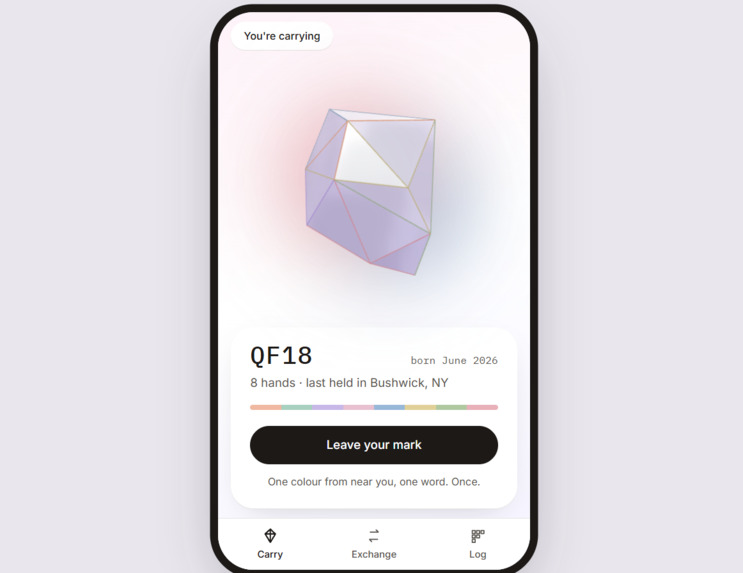
Screenshot of the app Home page.
Inspiration
Every prompt about slowing down gets answered the same way. Someone builds a thing with a timer on it. The brief even hands you the example: a note that arrives tomorrow. That is the convention, and we very nearly followed it.
However, read the brief's own sentence again. It says we are pushed toward less time, fewer people, fewer resources, fewer steps. Four things were taken. Almost everyone reaches for time, because time is the easy one to hand back; add a delay, add a countdown, call it slow.
So we asked what is genuinely left that cannot be optimized. Not artificially slowed, actually impossible to speed up. The answer turned out to be embarrassingly simple. You cannot be in two rooms at once. Physical presence is the last unforgeable thing in computing. You cannot buy it, automate it, scale it, or get a model to do it for you.
Ember is built on that single constraint and nothing else.
What it does
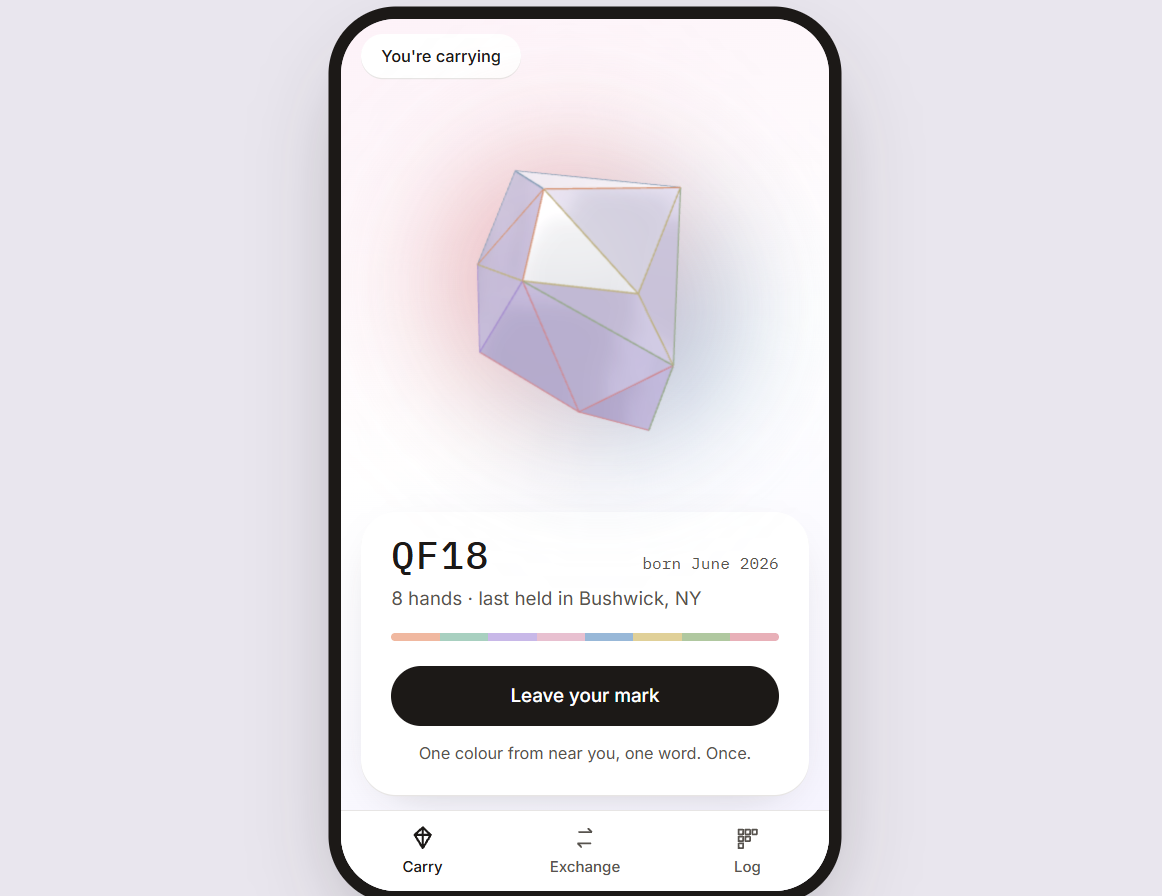
You carry one object. It has an ID, like XS60, and a shape made entirely out of the people who have held it.
While it is yours you leave exactly one mark on it. One color, taken with your camera from something physically near you, so the colour is evidence of a real room. One word. One shot, no undo, no edit, no second attempt.
Then you meet someone. A queue, a subway, a class, a date. You each show a code, you each scan the other's, and you swap. Your ember goes to them and theirs comes to you. You never get yours back. You never choose where it goes next. Four months later the one you started is in Barcelona with thirty-one marks in it from thirty-one strangers, and the one you were given never left NYC.
And then the part we did not plan for and ended up caring about most. When two people swap, the app checks whether that ember has passed through both of them before. If it has, it says so: You have both carried TR91. You held it in Downtown Brooklyn in April. They held it in Lisbon in September. Two people standing in front of each other find out they were already connected by an object neither of them controlled.
How we built it
React, TypeScript, Vite, Tailwind, and three.js through react-three-fiber. Deployed on Vercel.
There is no server. No database, no account, no login, nothing. This was the hardest architectural decision and it is the one we would defend hardest. The ember's entire state travels inside the QR code: packed into compact tuples, compressed with lz-string, and validated field by field on the way in, because anything scanned is untrusted and should be rejected rather than repaired. Your own history lives in localStorage. Privacy here is a thing we cannot violate, because there is nowhere for the data to go.
The crystal is generated, not modelled. A hash of the ember's ID seeds a PRNG, which places points using an R2 low-discrepancy sequence so that every prefix of the sequence is well distributed. That property matters more than it sounds: point number seven never depends on how many points there are in total, which means adding a hand adds exactly one vertex and disturbs nothing else, and the same ember renders identically on every device that has ever held it. A convex hull over those points, flat shaded, gives the facets. Each carrier owns the seams meeting at their vertex, lit in the colour they sampled, so a thirty-hand ember is veined with thirty different rooms.
The marks are deliberately the smallest creative act we could design. A colour is a hex value, so it cannot be obscene. A word can be filtered and read aloud by a screen reader. We wanted drawing. Drawing is unmoderatable at any real scale and it excludes everyone who cannot draw with a thumb, so we cut it, and the accessible choice turned out to be the better product.
Challenges we ran into
Finding an idea that was not already shipped. This took longer than the build. We checked and killed about a dozen directions on evidence: camera roll retrospectives (Google Photos Recap already does year-in-colour, top faces, selfie counts), failure and rejection logs (seven shipped apps, several of them counting to one thousand), collaborative storytelling, screenshot organizers, calendar retrospectives, peer mentoring. One competitor was already using the exact pitch line we had written down.
Making a gem that does not look like an NFT. A faceted crystal with a serial number and a list of past holders is, visually and structurally, indistinguishable from a token. The defence turned out to be almost entirely linguistic. The word "owner" does not appear anywhere in this product or in its source code, and we checked. No collection, no rarity, no value, no trading. You are a carrier. The thing passes through you.
The crossing cannot be as broad as the pitch. We would love to check whether any object has ever passed through both of you. Only the scanned ember travels in the code, and there is no server, so the app can only compare histories inside that one object. We could have added a backend and had the bigger feature. We kept the constraint instead, because an architecture that cannot leak is worth more than a feature, and an ember returning to hands that held it years ago is already the best moment in the product.
Accomplishments that we're proud of
Two people can genuinely swap an object, face to face, on two phones, with no network, no account, and no server anywhere in the loop. That is the whole thesis working.
The crossing. It is the only mechanic we designed that gets more valuable the longer the product exists rather than less. Every other app in this category decays. This one compounds.
Accessibility that is load bearing rather than bolted on. The camera is never required; deny it and the entire app still works. Every mark carries a word, so the object is readable aloud. Reduced motion is handled in the CSS and separately inside the 3D loop. Text never floats on the gradient, so contrast holds at roughly 16:1 for body and 7.6:1 for secondary.
And a privacy model that is structural. The app only ever shows where objects have been, never where people are. No coordinates exist anywhere; places are neighbourhood centroids and the city comes from your timezone, so we never ask for location at all.
What we learned
The most useful thing we learned was not about building. It was that anything which points a tool at data you already have is a bloodbath, because it is the cheapest thing in the world to build. Photos, calendar, screenshots, failures, firsts. Three apps each, most of them unrated. Mechanics that only work when another person turns up are nearly empty by comparison, because they are risky and they need people to show up. The empty shelf is empty for a reason, and the reason is a good one if you are willing to take the bet.
We also learned, the slow way, that constraints are not the price of the design. Dropping drawing in favor of a colour and a word felt like a loss for about an hour. It produced a better object, a moderatable product, and an accessible one.
What's next for Ember
A coarse place picker, so that someone in Jersey City is not recorded as New York. An optional relay carrying nothing but an ember ID and a city, so you learn that something you released has moved, without a single person becoming visible.
Public pages, one per ember, readable in a browser with no app and not one name on them. Someone posts a plate, a friend looks it up, the friend installs. That is the growth loop and it costs nothing.
Dropping: leaving an ember in a place for a stranger to find, so the game survives for people who are not socially dense, and so a nudge to move it never reads as you have failed to meet anybody.
And the feature we cut on purpose and will put back carefully: letting an ember nearby find someone willing to receive it. Never browsing people, never matching humans. The meeting serves the object. That distinction is the whole product, and the day we lose it we are just another proximity app.
Built With
- canvas
- jsqr
- leo-profanity
- localstorage
- lz-string
- mediadevices-api
- qrcode
- react
- react-three-fiber
- tailwindcss
- three.js
- typescript
- vercel
- vite
- webgl
