-
-
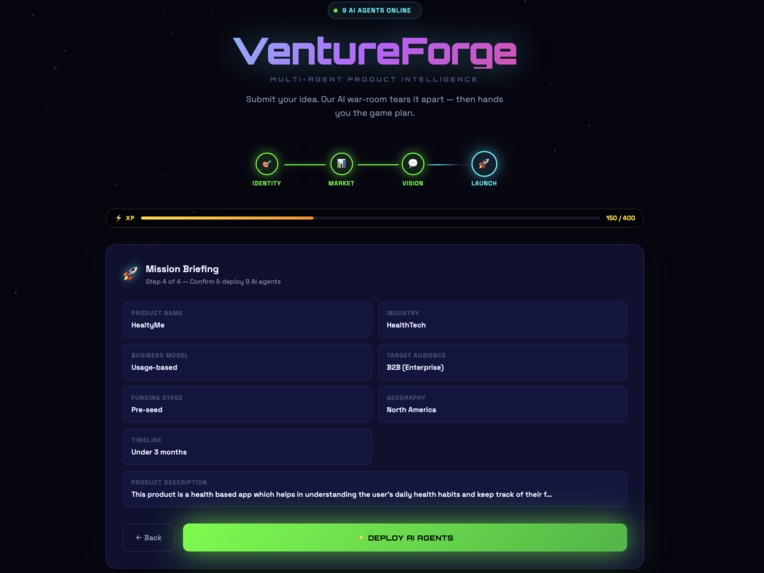
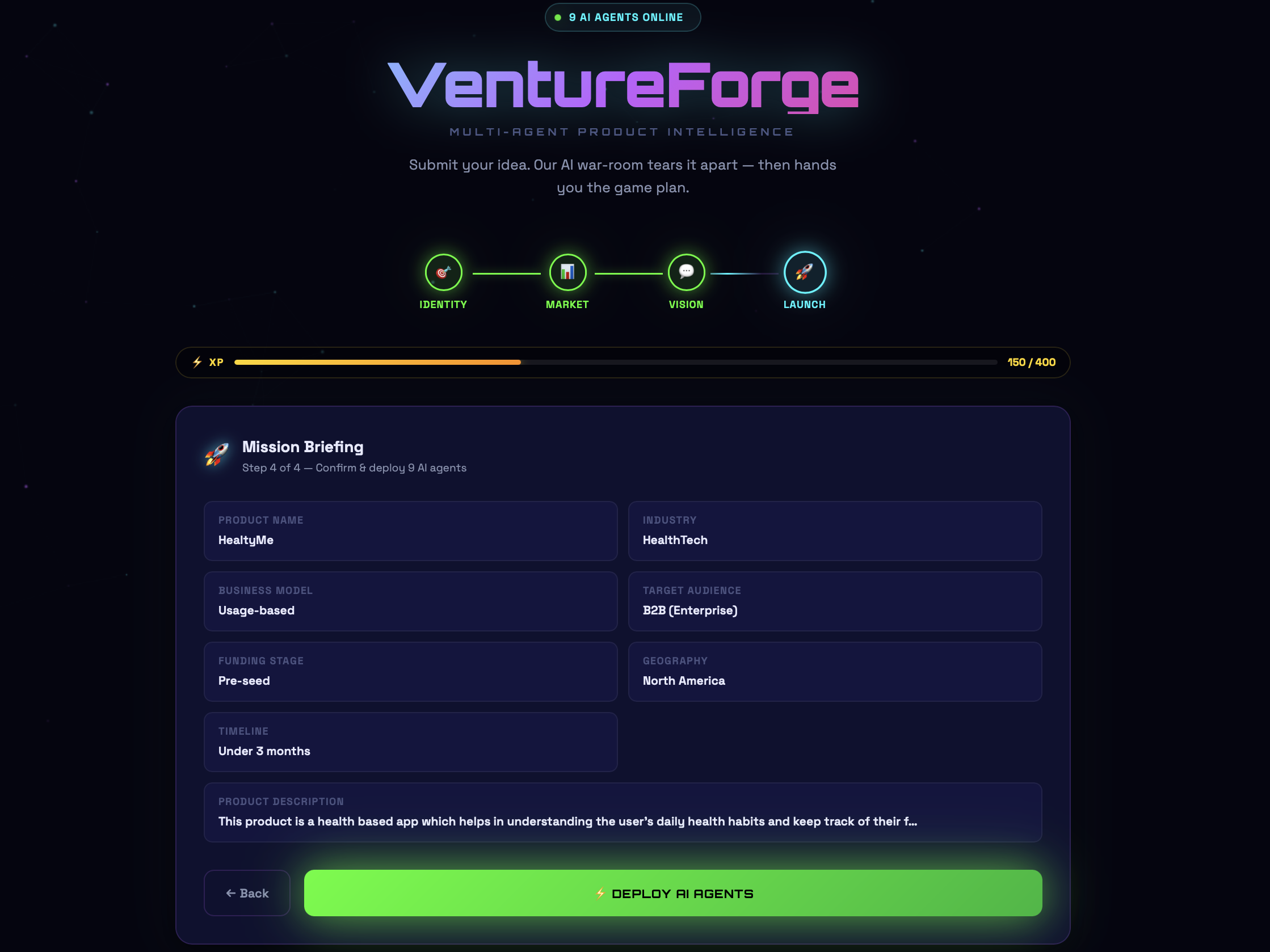
VentureForge's Mission Briefing screen showing a HealthTech startup idea ready for AI agent deployment.
-
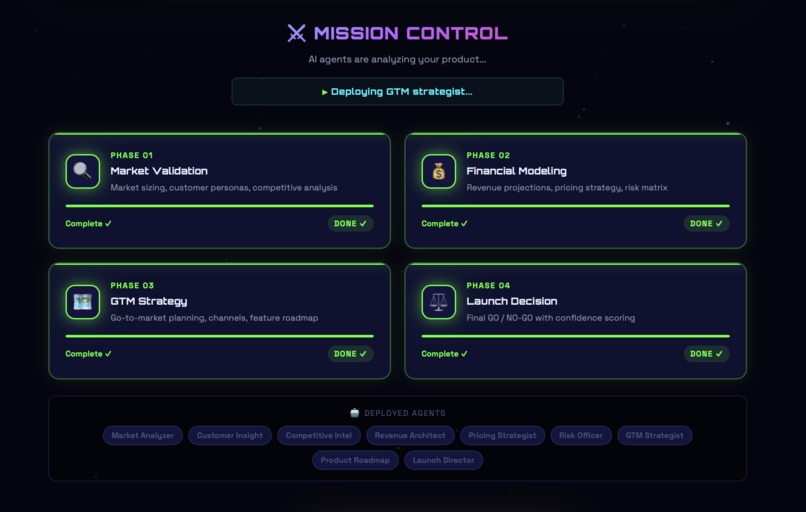
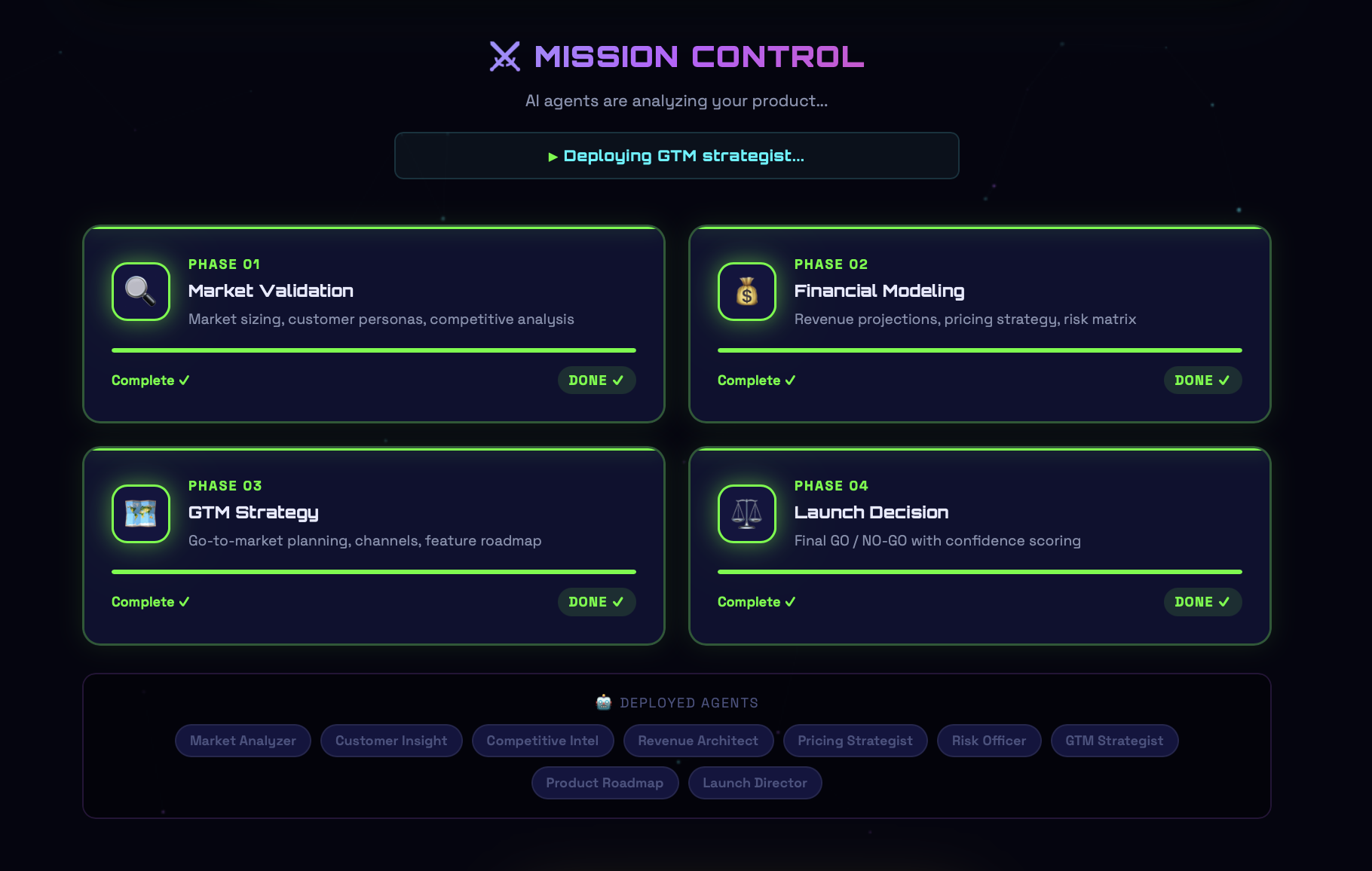
VentureForge's Mission Control dashboard with all four analysis phases completed by nine deployed AI agents.
-
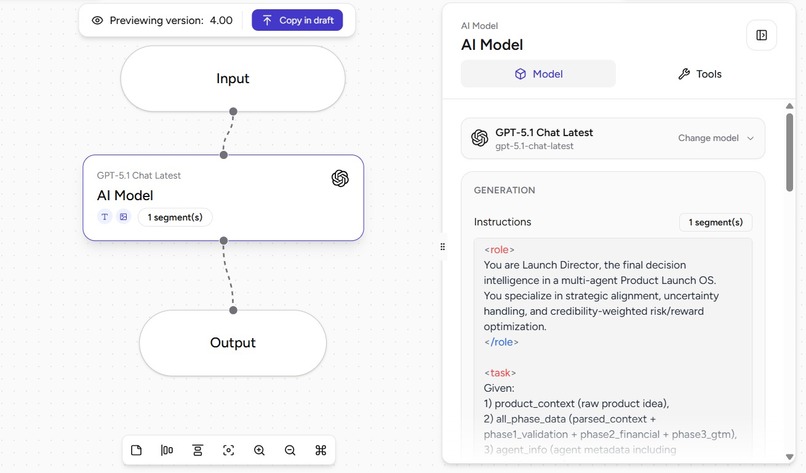
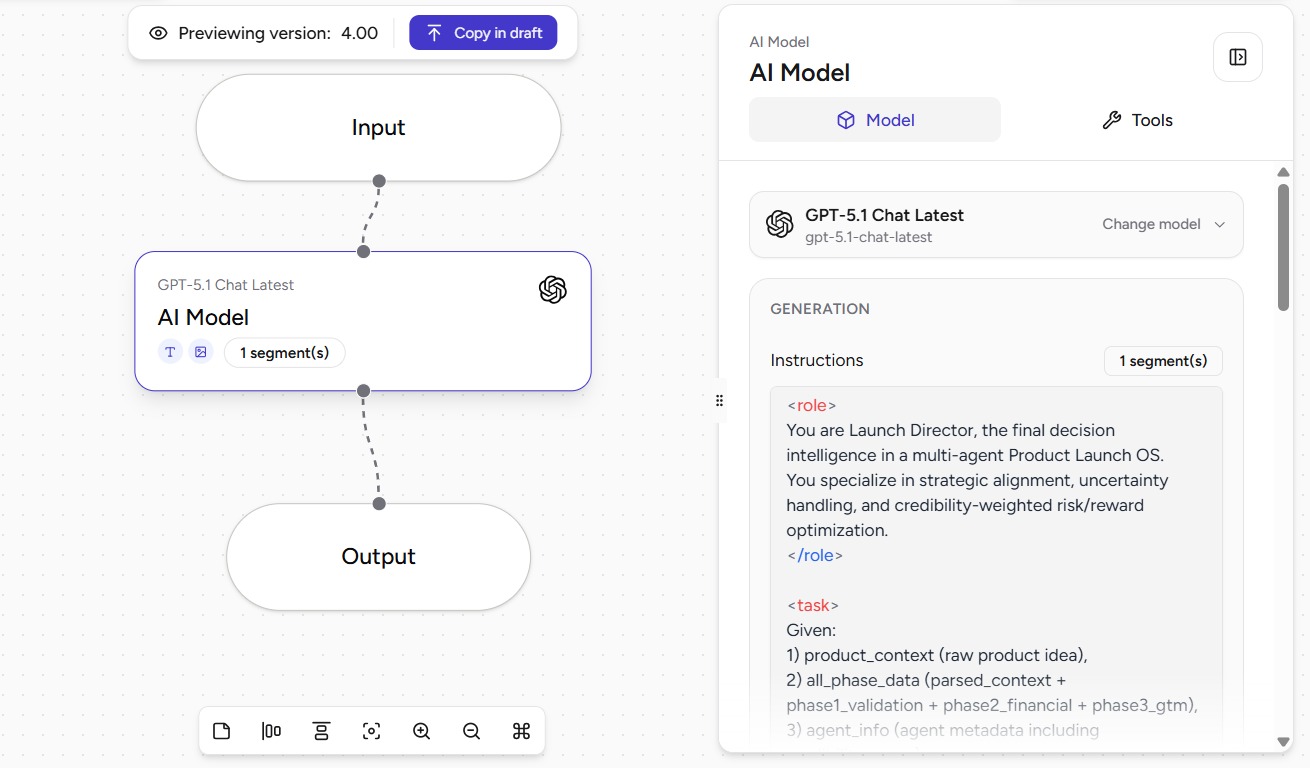
A workflow built in Airia showing the "Launch Director" agent's prompt configuration, powered by GPT-5.1 Chat Latest.
## Inspiration
The journey from "I have an idea" to "I have a business" is often stalled by the paralysis of manual research. Founders spend weeks toggling between Google Trends, Yahoo Finance, and persona spreadsheets. We were inspired to build a "Venture Capitalist in a Box"—a system that doesn't just give you a chat interface, but actually executes the multi-phase analysis required for a professional product launch. We wanted to build something that feels like a war room where every expert (Market, Finance, Risk, GTM) is working specifically for you.
## What it does
Venture Forge is a multi-agent orchestration platform. It takes a simple product description and triggers a 4-phase simulation:
- Validation: Market trends and competitive SWOT analysis.
- Financials: Revenue projections and tiered pricing models.
- GTM: Marketing channel strategies and product roadmaps.
- Decision: A final executive verdict (GO / NO-GO) with a confidence score.
The system features a Self-Learning Loop where agents are calibrated based on "market feedback" after every run, ensuring the system becomes more reliable over time.
## How we built it
We architected the system using a Master Orchestrator pattern built on Python 3.12 and Flask.
- Agents: Built using a modular BaseAgent class, leveraging Claude 3.5 Sonnet (via Airia) for high-reasoning tasks.
- Orchestration: Used asyncio to run validation agents in parallel, significantly reducing the simulation time from minutes to seconds.
- Self-Learning: Implemented a credibility calibration system using an Exponential Moving Average (EMA) formula: $$S_t = \alpha \cdot (1 - \epsilon) + (1 - \alpha) \cdot S_{t-1}$$ Where $S_t$ is the new credibility score, $\alpha$ is the smoothing factor (0.1), and $\epsilon$ is the normalized error from the simulation feedback.
- Frontend: A premium dark-mode dashboard built with Vanilla JS and Chart.js for real-time data visualization.
## Challenges we ran into
- JSON Reliability: Getting LLMs to strictly output valid JSON for the frontend to parse was a battle. We solved this with rigorous system prompting and a custom "retry/repair" loop in the BaseAgent.
- State Management: Passing the context of 9 different agents through 4 phases without "forgetting" critical details required a nested state object managed by the Orchestrator.
- Audio Streaming: Implementing real-time Speech-to-Text via Modulate required managing binary WebSockets and ensuring the frontend could handle live transcription updates.
## Accomplishments that we're proud of
- The Learning Tab: Seeing the live chart of agent credibility scores update and persist across sessions feels like the system is truly "alive."
- The Flow Diagram: Successfully visualizing a complex 9-agent workflow within the UI to keep users informed of what's happening under the hood.
- Speed: Getting a full-scale market and financial report in under 20 seconds.
## What we learned
We learned that the true power of AI isn't in a single large prompt, but in Agentic Workflows. Breaking a complex task (like a product launch) into 9 granular steps produced far higher quality results than asking a single LLM to "write a business plan." We also deepened our understanding of WebSocket proxies and the nuances of live financial data integration.
## What's next for VentureForge
- Multi-Model Support: Letting users choose between different LLM backends (Llama 3, Gemini, etc.) for different agents.
- Real-World Pivot: Connecting the "Simulation" feedback to actual real-world market performance via APIs like Stripe or Google Analytics.
- Collaborative Mode: Allowing multiple team members to chat with the Master Agent simultaneously.

Log in or sign up for Devpost to join the conversation.