-
-
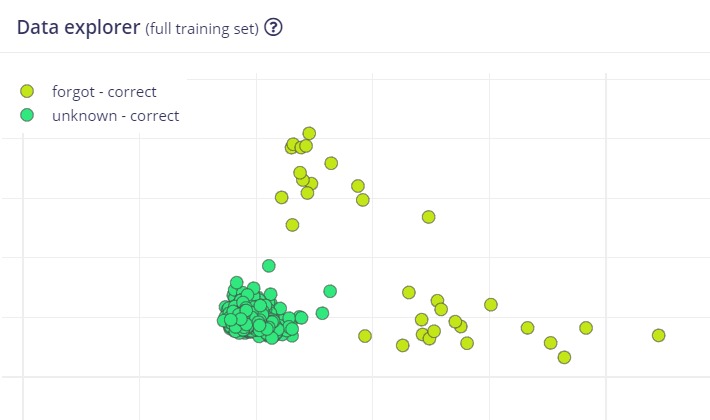
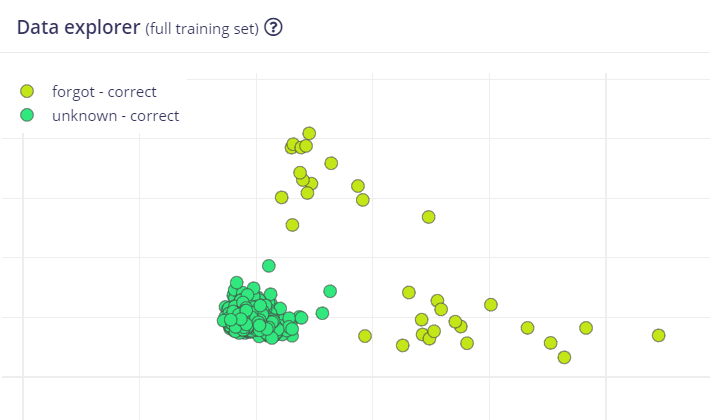
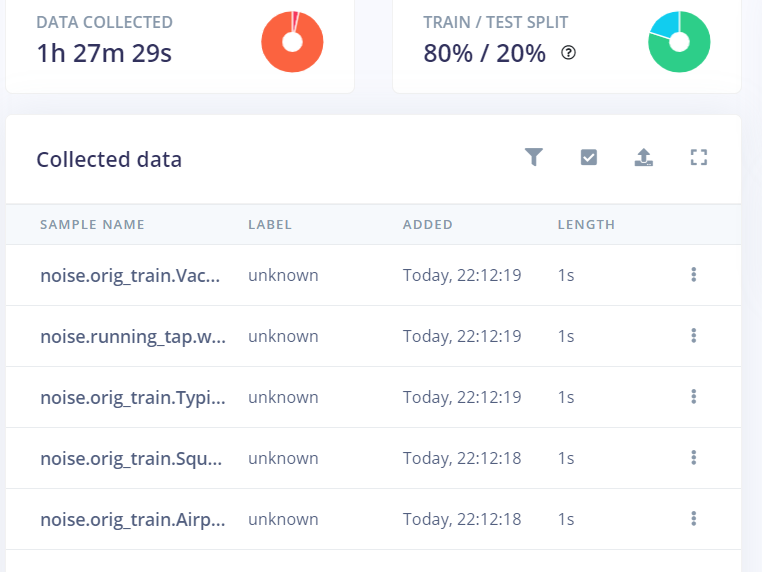
Dataset Distribution
-
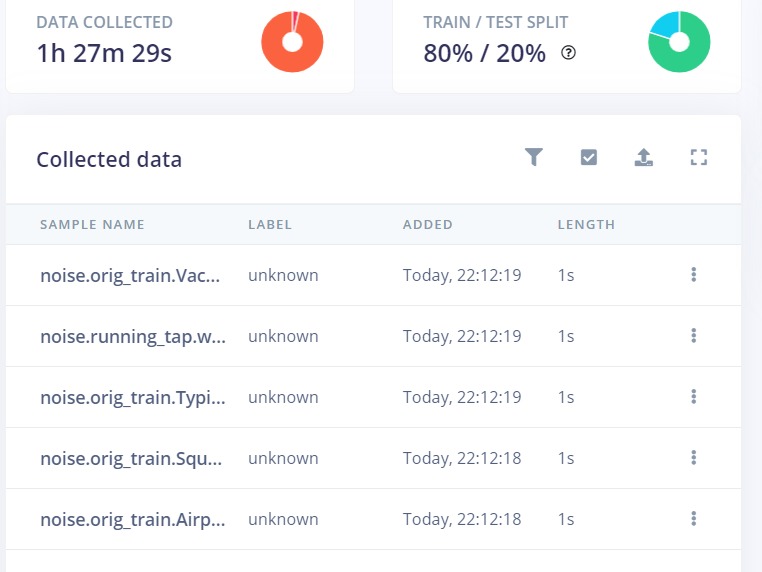
Total of 1hr 27 mins of sound data
-
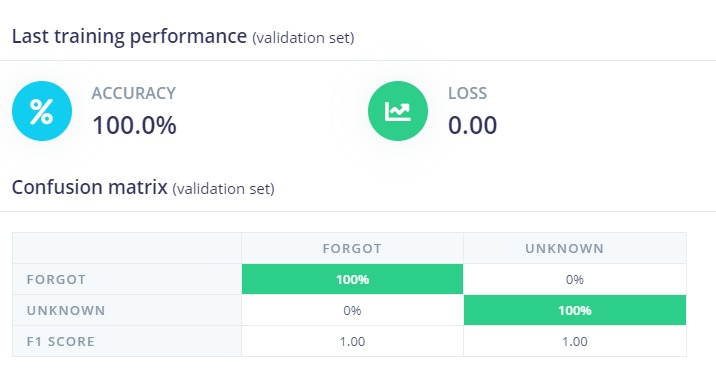
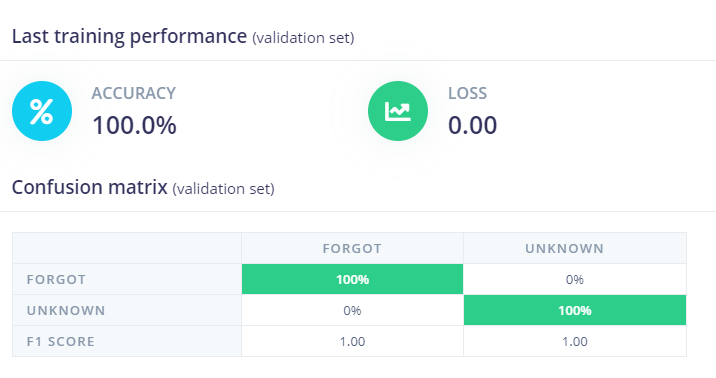
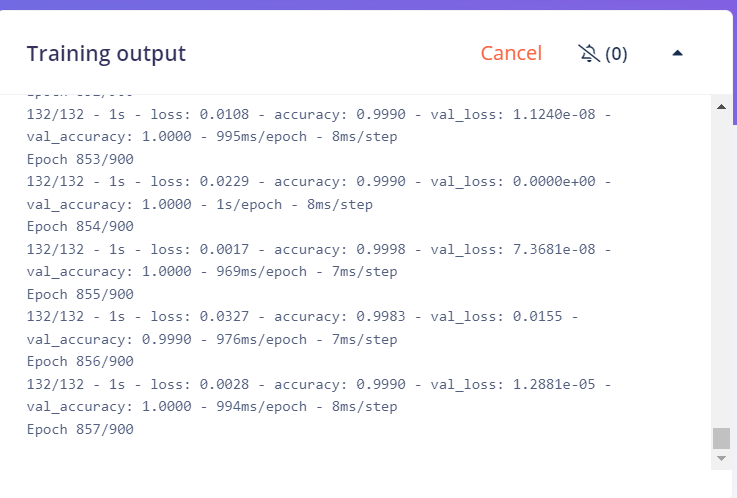
~100% Accuracy Reached
-
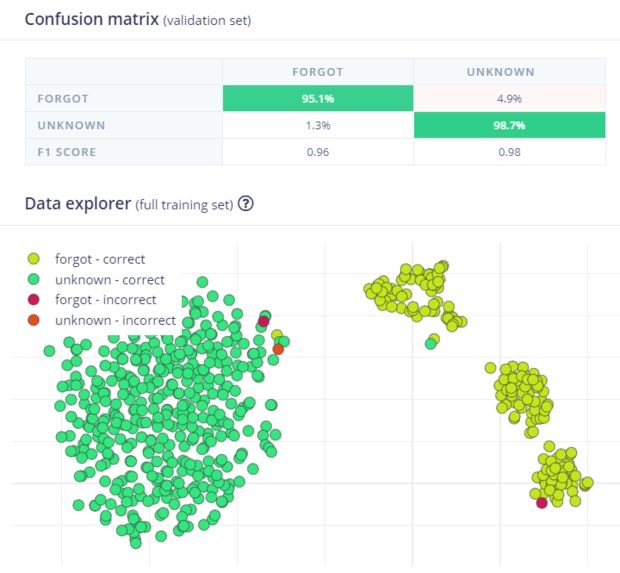
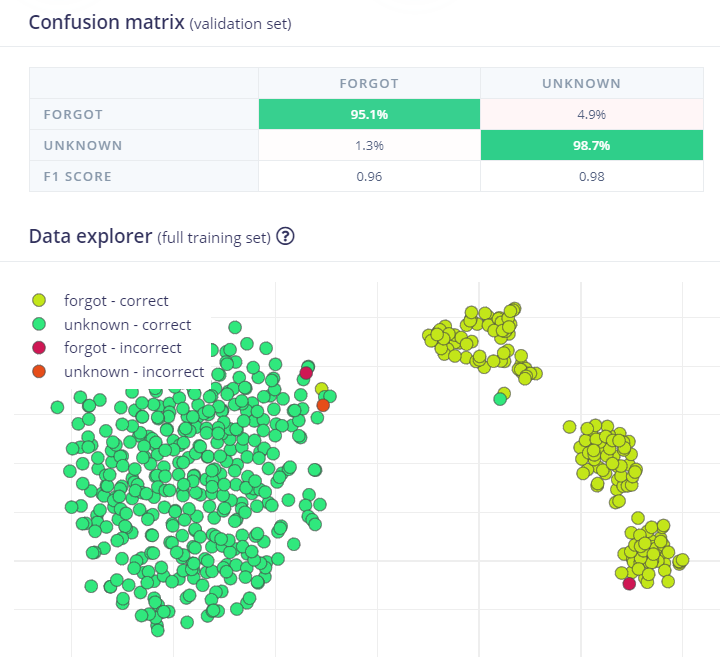
Confusion Matrix (Clear Separation Between Two Labels)
-
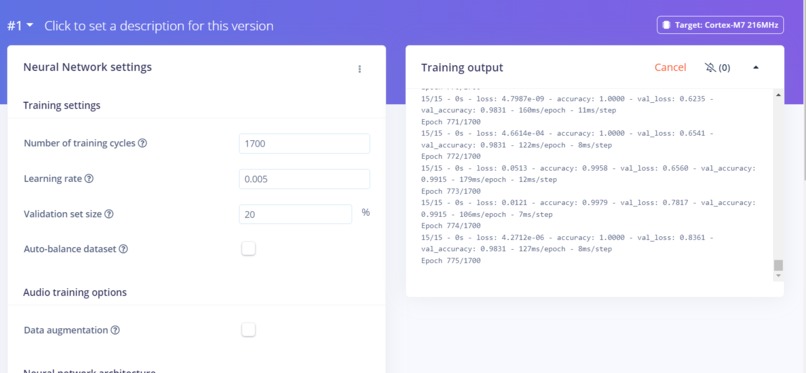
Training Accuracy
-
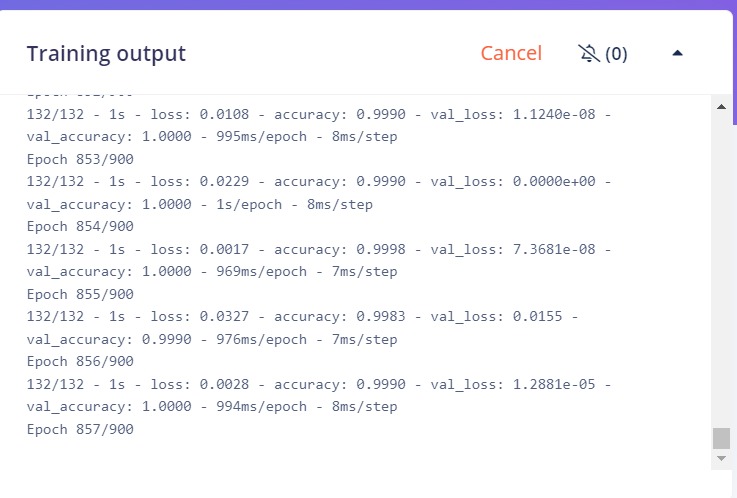
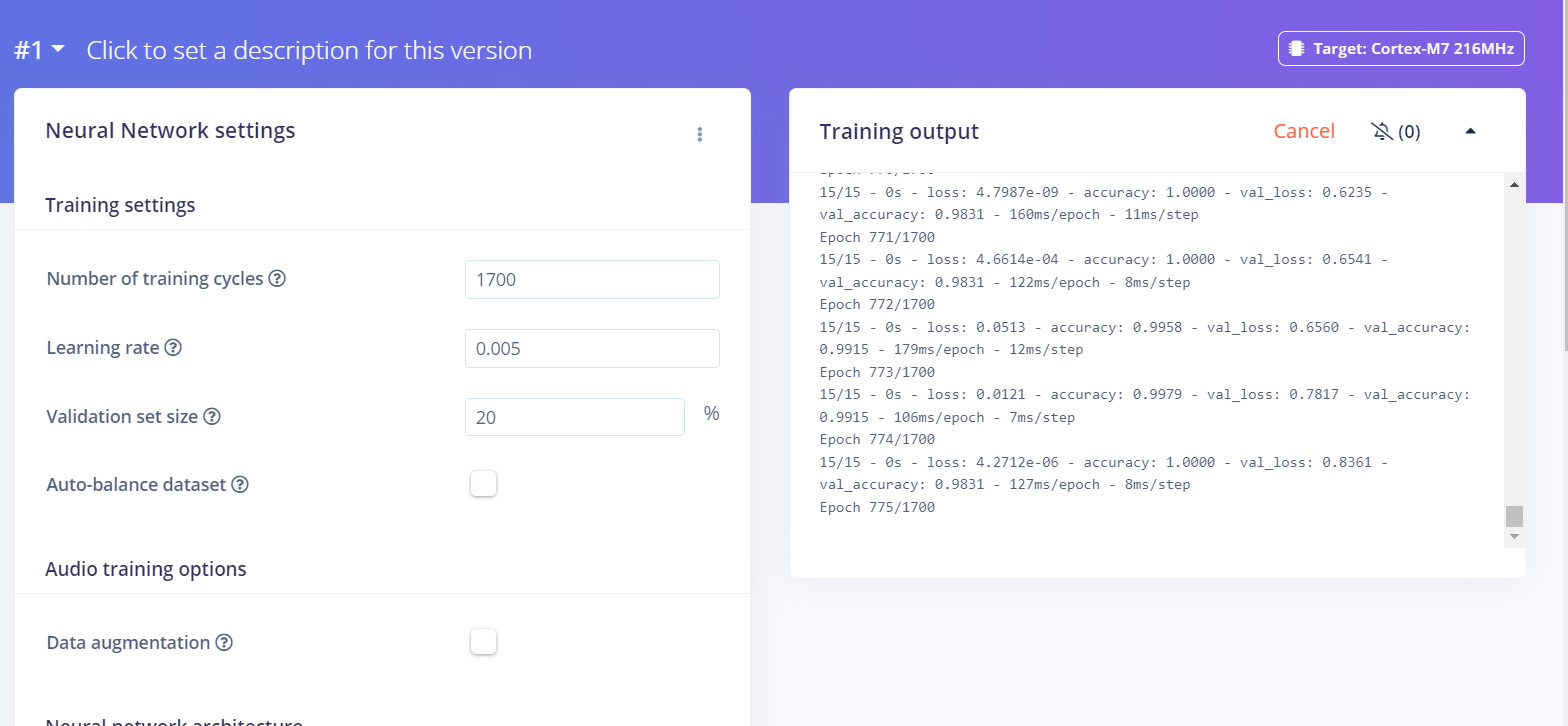
Training Output
-
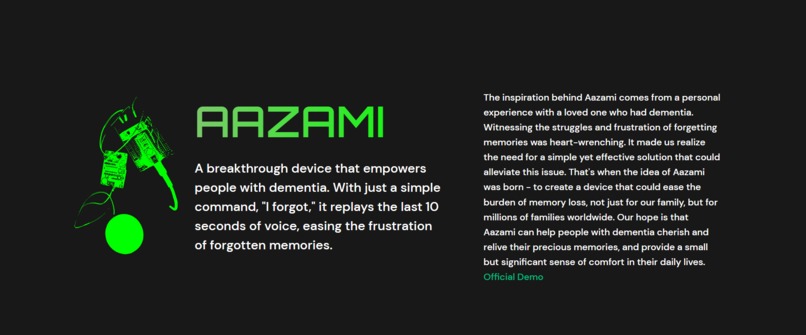
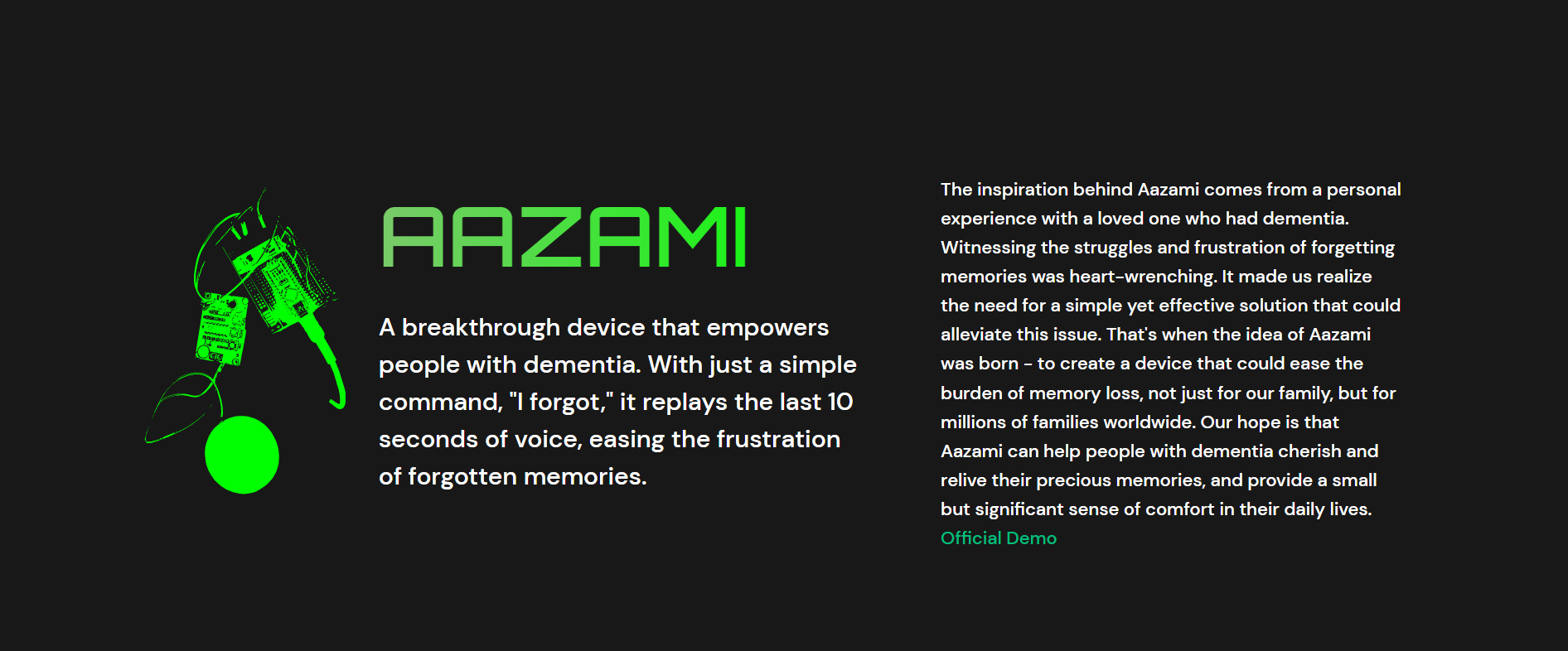
Photo of Official Aazami Website (Vue.js)
Inspiration
The inspiration behind Aazami comes from a personal experience with a loved one who had dementia. Witnessing the struggles and frustration of forgetting memories was heart-wrenching. It made us realize the need for a simple yet effective solution that could alleviate this issue. That's when the idea of Aazami was born - to create a device that could ease the burden of memory loss, not just for our family, but for millions of families worldwide. Our hope is that Aazami can help people with dementia cherish and relive their precious memories, and provide a small but significant sense of comfort in their daily lives.
What it does
Aazami's main function is to record the last 10 seconds of voice, which can be replayed by using a voice command, "I forgot." This innovative feature helps users to retrieve lost memories and ease the frustration caused by forgetfulness. Aazami is compact and easy to use, making it a convenient companion for people with dementia, their families, and caregivers. By providing an easy and reliable way to recall memories, Aazami aims to enhance the quality of life of people with dementia and their loved ones.
Aazami has the potential to significantly support patients with reorientation therapy, a common treatment for dementia. By providing users with a reliable tool to help recall recent memories, Aazami can reduce feelings of confusion and disorientation. With the ability to record and replay the last 10 seconds of voice, patients can use Aazami as a reminder tool to help them remember their daily routines or important details about their environment. In turn, this can help patients feel more confident and in control of their lives. With continued use, Aazami can also help patients engage in reorientation therapy, as they can use the device to actively recall information and strengthen their memory skills. Ultimately, Aazami has the potential to improve the quality of life for patients with dementia, helping them to feel more independent and empowered in their daily lives.
How we built it
To develop Aazami, we utilized a combination of hardware and software components including Arduino and Adafruit's Neopixel for the hardware, and Edge Impulse for machine learning. Our team started off by recording our own voices to create a dataset for "I forgot" voice detection, and refined it through trial and error to ensure the most appropriate dataset for our constraints.
We generated Arduino code and improved it to optimize the hardware performance, and also created an amplifier circuit to boost the sound of the device. Through these iterative processes, we combined all the components to create a functional and effective solution. Our website (aazami.netlify.app), developed using Vue.js, helped to promote our technology and increase its accessibility to those who need it most.
Challenges we ran into
While experimenting with Arduino and Edge Impulse, we faced an issue where the sound detection interval was set to 5 seconds. However, this was not sufficient for the user to say "I forgot" in perfect timing. To overcome this problem, we had to develop a separate algorithm that could detect sound at the ideal phase, enabling us to accurately capture the user's command and trigger the playback of the previous 10 seconds of voice.
Another significant challenge we encountered was that we were consistently receiving error messages, including "ERR: MFCC failed (-1002)," "ERR: Failed to run DSP process (-1002)," and "ERR: Failed to run classifier (-5)." These errors likely resulted from limitations in the memory size of the Arduino Nano BLE 33 we were using. To address this issue, we were required to manually adjust the size of our data sets, allowing us to process the data more efficiently and minimize the likelihood of encountering these errors in the future. Our initial dataset initially had an accuracy of 100% (as provided above), but we had some tradeoffs due to this error (~97% accuracy now).
Accomplishments that we're proud of
We take great pride in this project as we were able to identify a clear need for this technology and successfully implement it. By addressing the challenges faced by people with dementia and their caregivers, we believe that Aazami has the potential to enhance the quality of life for millions of people worldwide. Our team's dedication and hard work in creating this innovative solution has been a fulfilling and rewarding experience.
What we learned
Through this project, we gained valuable insights into the integration of ML in hardware. Although each member of our team brought unique expertise in either hardware or ML, working together to build a complete system was a new and exciting challenge. Creating our own ML dataset and identifying the necessary components for Aazami enabled us to apply ML in a real-world context, providing us with valuable experience and skills (i.e. Edge Impulse).
What's next for Aazami
Looking ahead, our next goal for Aazami is to expand our dataset to include voices of various ages and pitches. By incorporating a wider range of data, we can improve the accuracy of our model and provide an even more reliable solution for people with dementia. Additionally, we are eager to share this technology with individuals and groups who could benefit from it the most. Our team is committed to demonstrating the capabilities of Aazami to those in need, and we are continuously exploring ways to make it more accessible and user-friendly.


Log in or sign up for Devpost to join the conversation.