-
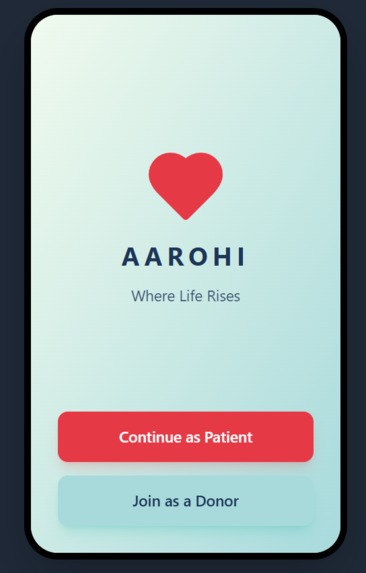
Welcome to Aarohi, where you can join as a donor or continue as a patient.
-
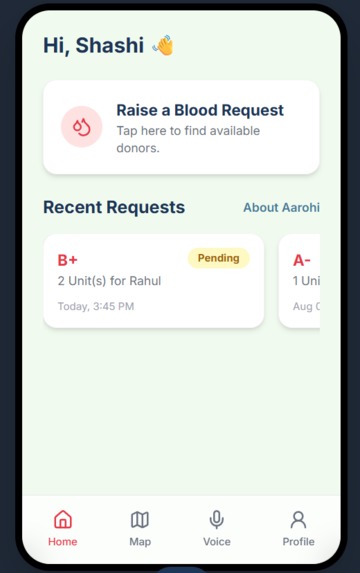
Your personalized dashboard to raise and track recent blood requests.
-
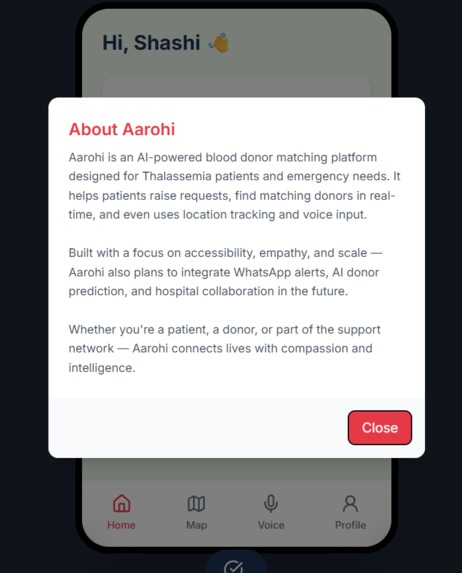
Discover Aarohi's mission as an AI-powered blood donor matching platform.
-
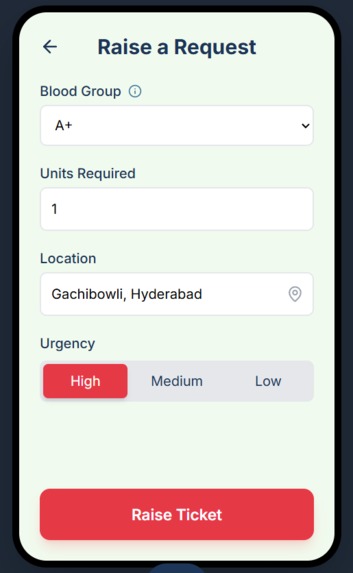
An intuitive form to quickly raise an urgent blood request.
-
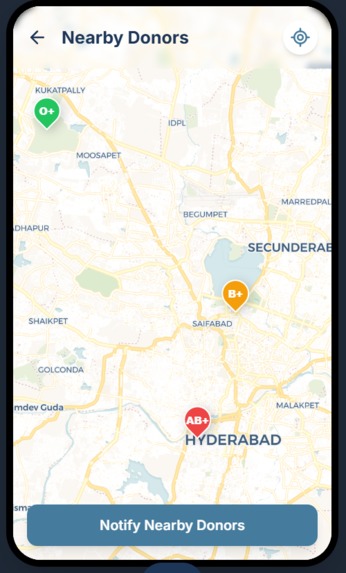
A real-time map to locate and notify nearby available donors.
-
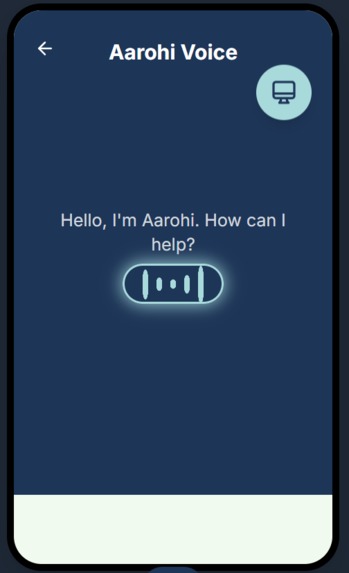
Meet Aarohi Voice, your integrated assistant for hands-free help.
-
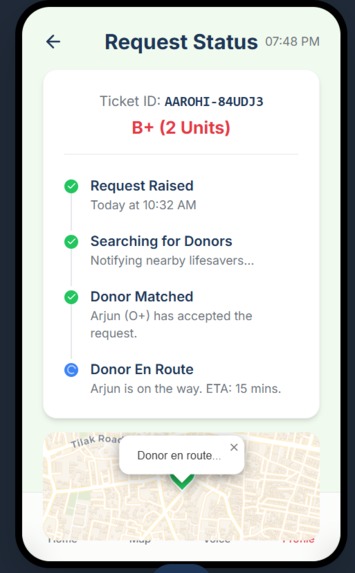
Live status tracking for your request, from matching to donor arrival.


Inspiration
Back in school, I once attended a medical camp where people voluntarily donated blood. I clearly remember seeing the posters, the urgency, and even some real-life emergencies where a specific blood type was needed, but no donor was available in time. I was too young to understand the weight of it then, but now, I realize how helpless it feels to know someone might not make it — not because of a lack of treatment, but due to the lack of timely coordination. That stuck with me.
Years later, when the opportunity came to build a meaningful solution, I saw this as my moment — not just to create an app, but to create a life-saving system that could one day prevent those tragedies.
What it does
Aarohi is a fully interactive, frontend-driven platform designed to simulate the ideal experience of a modern blood donor support system. Patients can:
- Raise emergency blood requests with details like blood group, units needed, and urgency level
- Track the request status through a live timeline
- View a live map showing the donor's movement toward the hospital, including a dynamic ETA
- Interact with a voice-powered AI assistant that accepts both spoken and typed queries
- Use a one-click Emergency Call for Blood button, which—when fully implemented—will automatically trigger WhatsApp messages, SMS, and voice calls to nearby donors
On the other side, donors can mark themselves available, receive incoming requests, see donation history, and view their unique QR-coded donor ID.
How we built it
We focused entirely on the frontend experience, crafting every screen with Tailwind CSS and vanilla JavaScript. We used Leaflet.js to simulate live donor movement on a map, setInterval logic for ETA updates, and JSONPlaceholder APIs to simulate dynamic donor data. The voice assistant interface was manually scripted to simulate natural AI interactions, and all data interactions are currently mocked to focus on demonstrating usability, emotion, and design intent.
Challenges we ran into
The hardest part was making everything feel real without an actual backend. We had to simulate not just data, but emotion: urgency, relief, responsiveness. Animating donor movement smoothly, building a voice assistant with conversational feedback, and keeping the UI emotionally soft yet functionally sharp—all of this took iteration and refinement.
We also had to balance complexity with simplicity, especially when showcasing backend-planned features (like Twilio calls or WhatsApp Cloud API alerts) within a purely frontend build.
Accomplishments that we're proud of
- Built a fully functional, mobile-responsive, voice-powered donor app with zero backend
- Created a smooth and realistic donor tracking map with ETA, timeline progression, and real-time feel
- Designed a chatbot/voice assistant experience that feels human, focused, and emotionally grounded
- Integrated a full simulation of future backend systems like emergency voice calls and AI-driven donor alerts — all in a single-page, working prototype
What we learned
We learned that frontend is more than design — it’s the surface through which real lives interact with real urgency. We realized that emotion, speed, and clarity matter just as much as code. And we understood how much of a difference a single well-designed button (like our Emergency Call feature) can make when built with empathy.
What's next for Aarohi – Where Life Rises
Aarohi's future goes far beyond this prototype. In Phase 2, we plan to implement:
- WhatsApp and SMS alert systems via Twilio or Gupshup
- AI-generated voice calls that automatically inform donors of urgent needs
- Donor availability prediction using machine learning (XGBoost, LSTM)
- Secure logins and role-based dashboards for hospitals, NGOs, and donors
- A real-time analytics dashboard for Blood Warriors and coordinators
- Offline mode and multilingual support for remote and rural users
- Integration with live blood bank APIs and hospital inventory systems
This is more than a hackathon project — it’s a system in motion, built to scale, and meant to serve.
Built With
- amazon-web-services
- descript
- elevenlabs-api
- exotel
- express.js
- firebase-auth
- firebase-realtime-database
- github
- google-cloud
- google-fonts
- google-maps
- html5
- jsonplaceholder-api
- leaflet.js
- lstm
- mongodb
- node.js
- openai-api
- python
- quickchart.io
- socket.io
- supabase
- tailwind-css
- twilio
- vanilla-javascript-(es6)
- vercel
- whatsapp-cloud-api
- xgboost

Log in or sign up for Devpost to join the conversation.