-
-
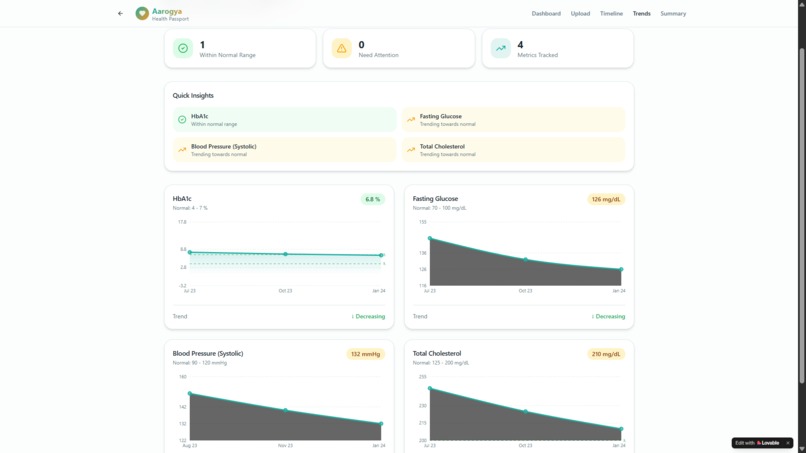
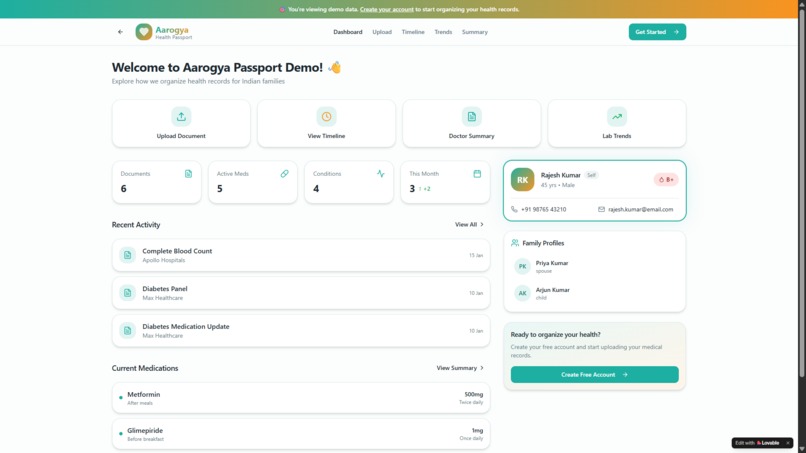
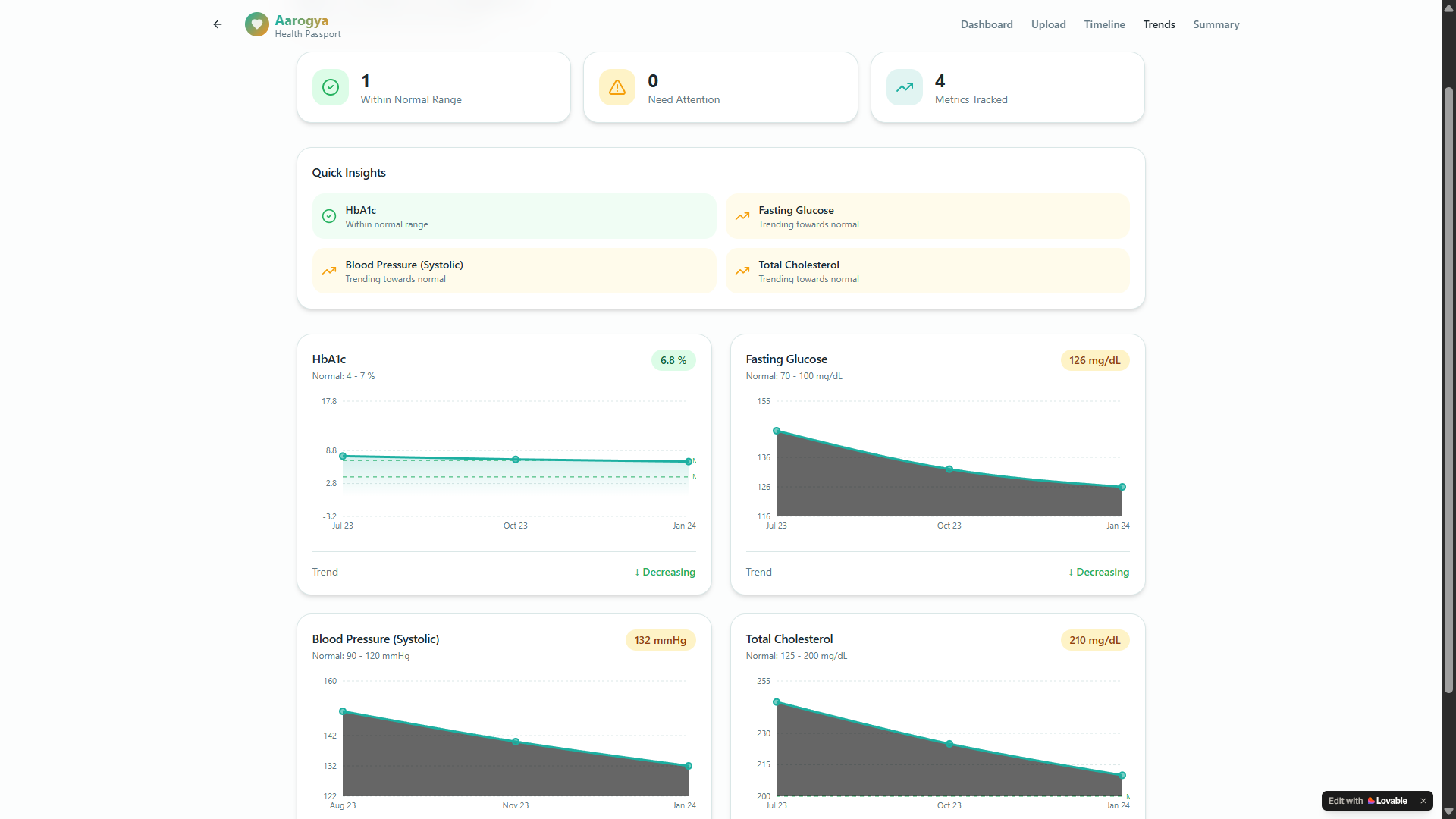
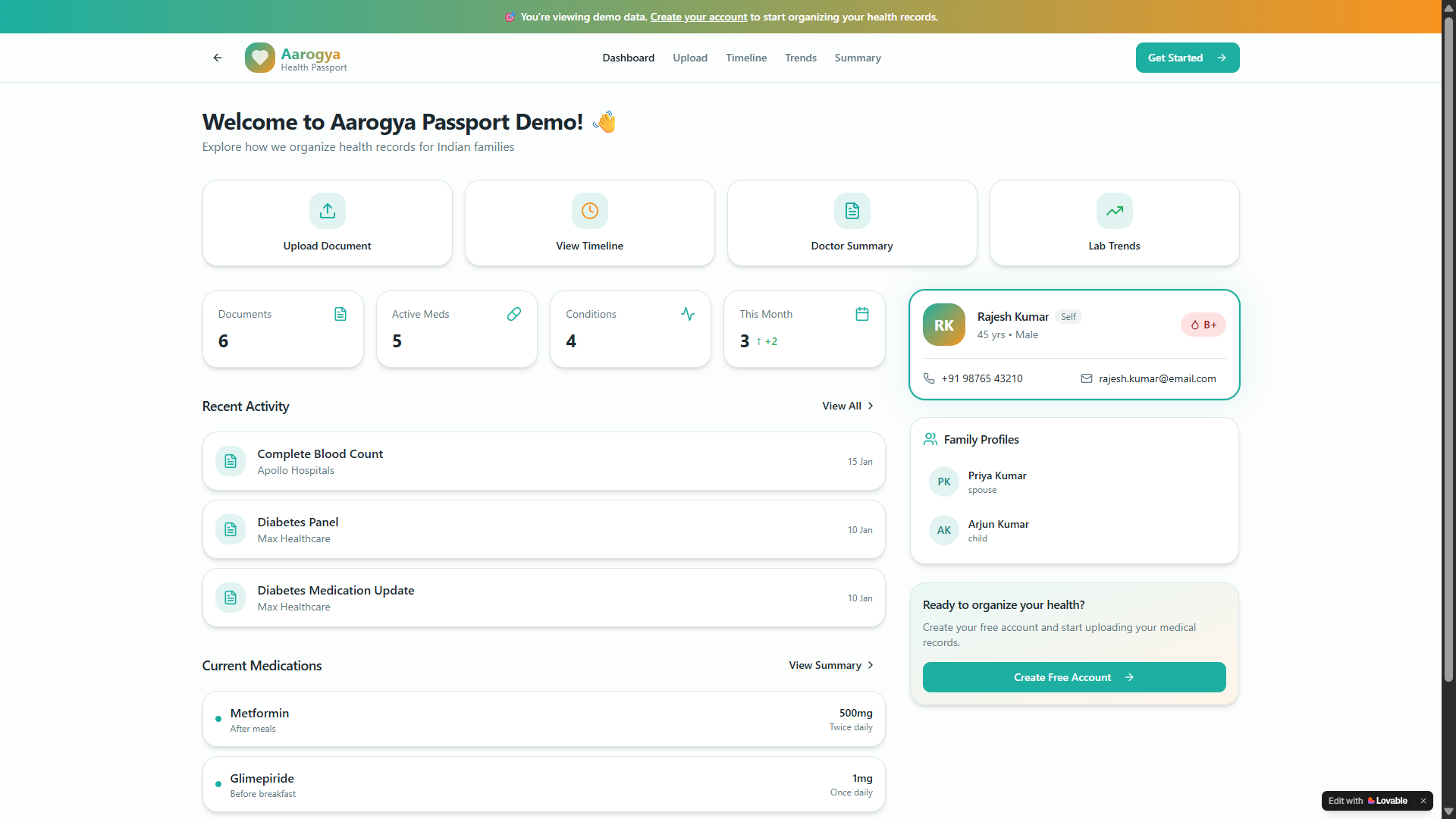
Patient health insights dashboard visualizing trends, medical history, and key health indicators.
-
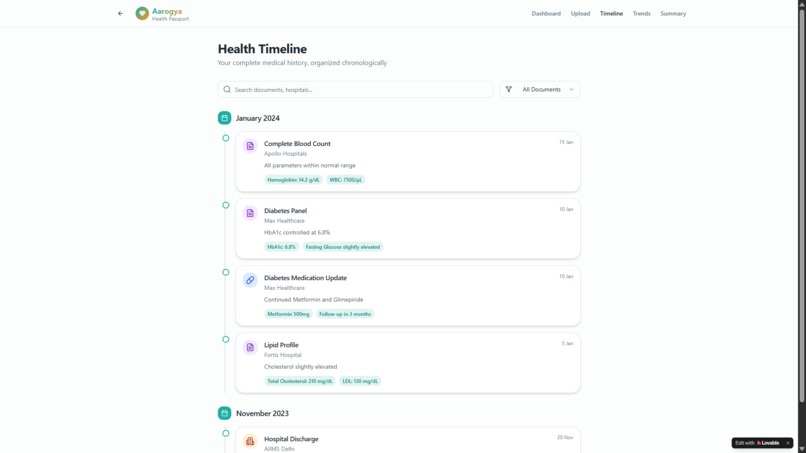
Document processing pipeline converting unstructured medical records into structured healthcare data.
-
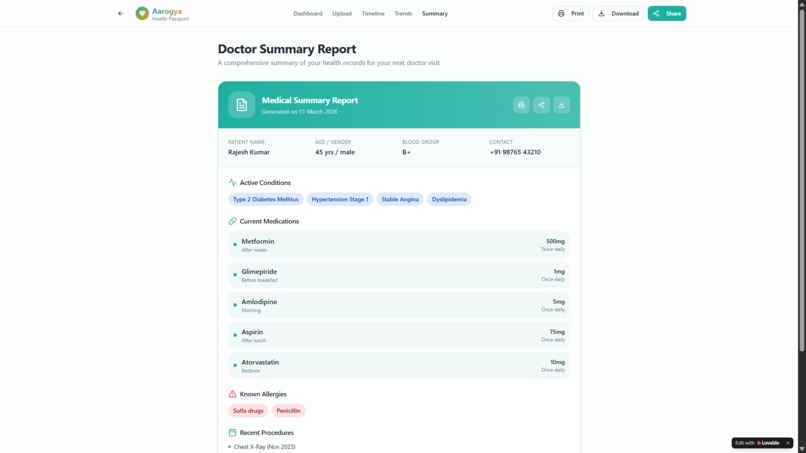
AI extracts structured clinical data from uploaded documents including medications, tests, and diagnoses.
-
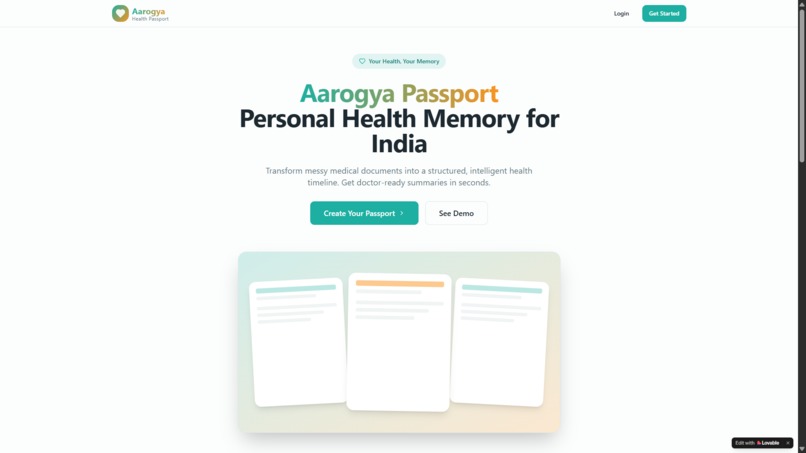
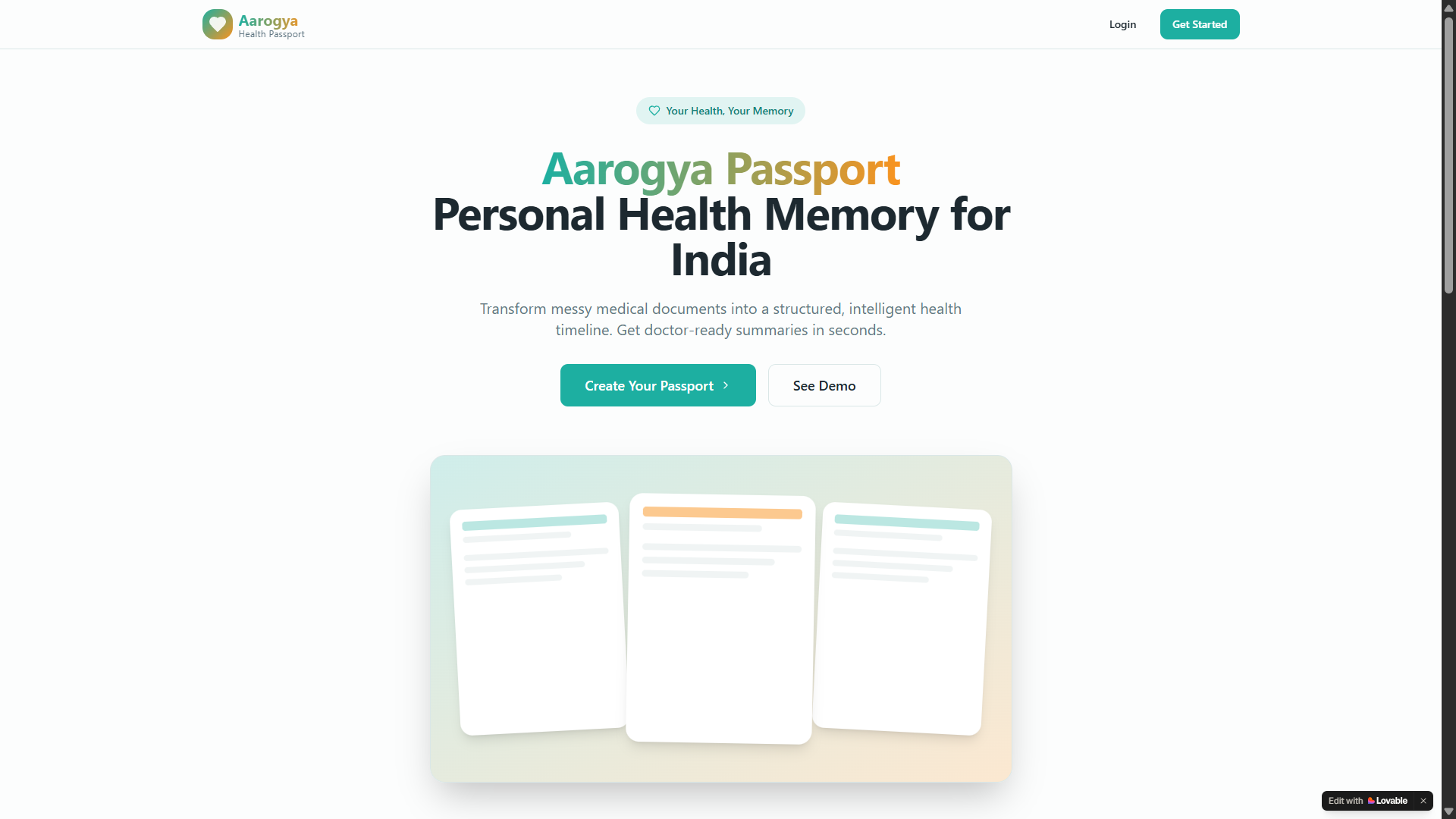
AI-powered health passport interface where patients upload medical records to build their unified medical history.
-
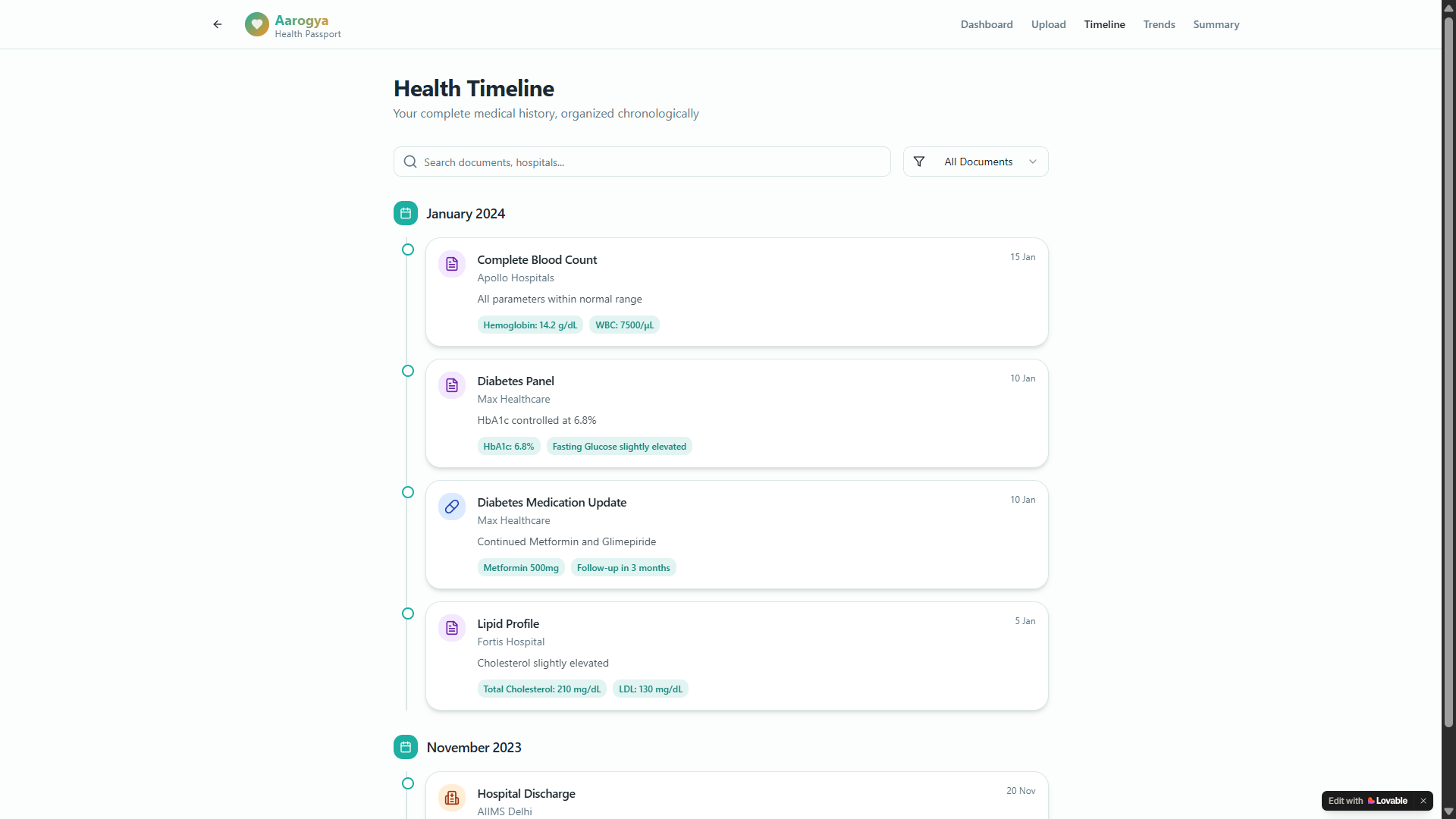
Automatically generated chronological health timeline showing diagnoses, prescriptions, and lab results across visits.
Inspiration
Healthcare systems operate in fragmented episodes. Every hospital visit often starts from zero because medical records are scattered across different hospitals, labs, and paper documents.
Patients repeatedly explain their history while doctors make decisions without full context.
This fragmentation leads to:
• repeated diagnostic tests • delayed treatment decisions • prescription risks due to missing history • inefficient consultations
For millions of patients, healthcare lacks continuity.
Aarogya Passport was created to solve this fundamental infrastructure gap by giving patients a portable AI-powered medical memory that organizes their entire health history into one unified timeline.
What it does
Aarogya Passport converts scattered healthcare documents into a structured patient health timeline using AI-powered document understanding.
Users can upload:
• prescriptions • lab reports • discharge summaries • scanned paper records • PDFs from hospitals
The system automatically:
Extracts medical information from documents
Identifies medications, diagnoses, and tests
Organizes them chronologically
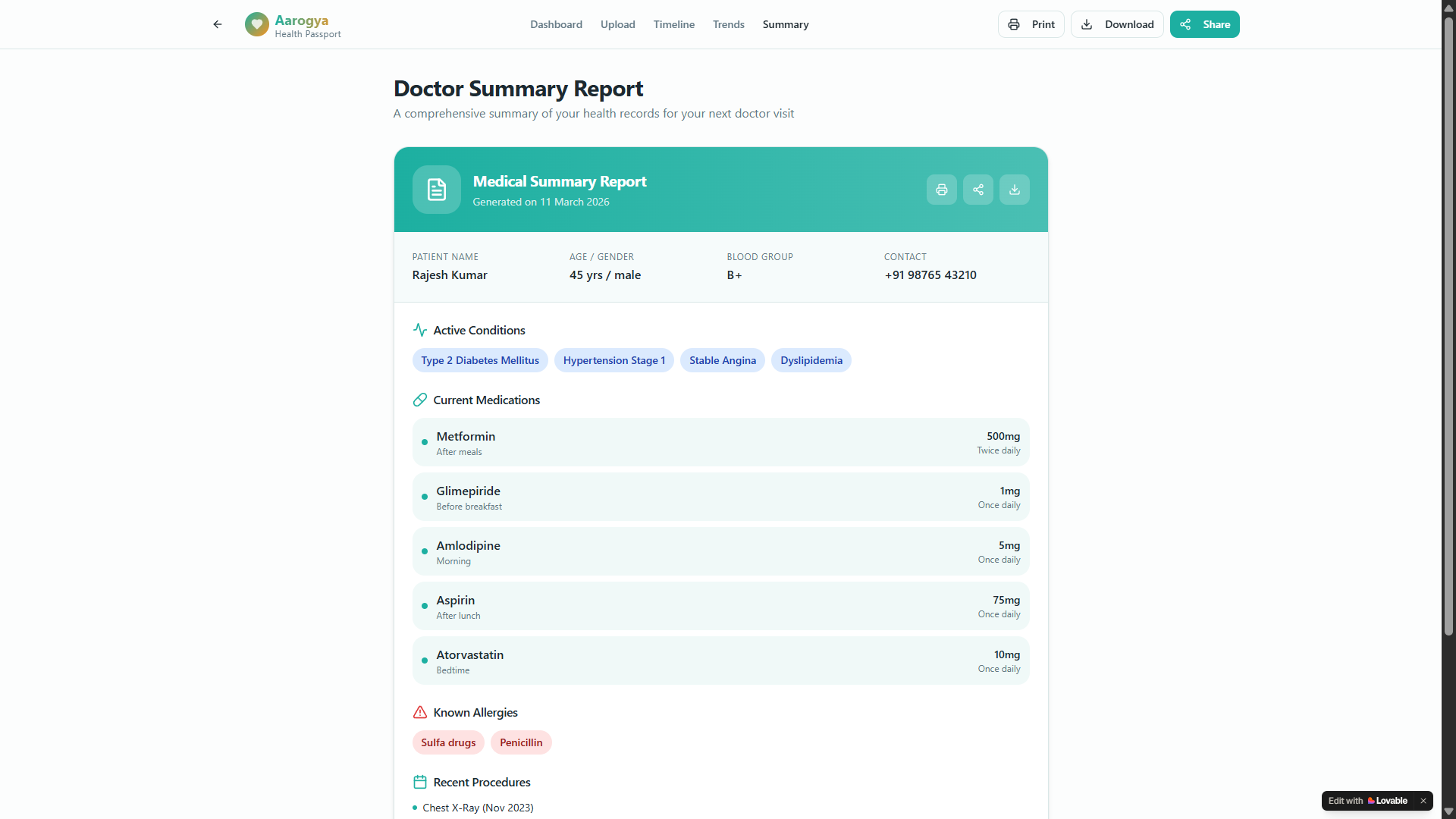
Generates doctor-ready summaries
Doctors can instantly view:
• complete patient history • medication timeline • previous diagnoses • relevant medical trends
This eliminates repeated history reconstruction and improves clinical decision-making.
How we built it
The system combines document AI with structured medical data processing.
Document Processing
Medical records are uploaded as PDFs or images.
AI-based parsing extracts:
• medications • diagnoses • lab test results • visit dates • hospital information
Clinical Entity Extraction
Natural language processing identifies key medical entities such as:
• diseases • drug names • dosage information • diagnostic procedures
Timeline Reconstruction
All extracted data is organized into a single chronological health timeline that shows the patient’s complete medical journey.
AI Summary Generation
The system generates concise summaries for doctors including:
• current medications • past diagnoses • recent lab results • key health indicators
This allows clinicians to understand patient history within seconds.
Challenges we ran into
Unstructured medical documents
Healthcare records vary widely in format. Some are typed reports, others are scanned prescriptions with inconsistent layouts.
Solution: Implemented flexible document parsing and entity extraction.
Medical terminology detection
Drug names, abbreviations, and diagnostic codes appear in many forms.
Solution: Built rule-based extraction combined with medical keyword recognition.
Timeline normalization
Different reports contain different date formats and structures.
Solution: Standardized extracted data into a unified chronological model.
Data clarity for doctors
Raw extracted data is difficult to interpret.
Solution: Added AI-generated summaries to highlight the most relevant information.
Accomplishments that we're proud of
• Built a working prototype that converts medical documents into structured patient history • Implemented AI-powered document understanding for healthcare records • Created a unified chronological medical timeline • Generated automated doctor-ready summaries • Designed a patient-owned healthcare data model
The system demonstrates how AI can reduce fragmentation in healthcare systems.
What we learned
Building Aarogya Passport highlighted how complex healthcare data interoperability is.
Key lessons included:
• medical data is highly unstructured • document parsing requires flexible extraction approaches • clear clinical summaries are more useful than raw data • patient-owned records can significantly improve continuity of care
We also learned that healthcare AI must prioritize clarity and reliability over complexity.
What's next for Aarogya Passport
Future development will focus on expanding real-world usability.
Planned improvements include:
Multilingual medical document support
Support for regional languages such as Hindi, Tamil, and Bengali.
Mobile patient app
Allow patients to capture and upload records directly from their phones.
Doctor collaboration tools
Enable secure sharing of timelines with healthcare providers.
Health analytics
Provide insights on long-term health trends and medication history.
Integration with hospital systems
Allow interoperability with electronic medical record platforms.
Built With
- ai
- data
- deployment
- document
- entity-framework
- extraction
- for
- frameworks
- generation
- javascript
- language
- learning
- machine
- medical
- natural
- node.js
- parsing
- processing
- prototype
- python
- react
- structured
- timeline
- tools
- web-based

Log in or sign up for Devpost to join the conversation.